How to Build a Negotiation Strategy Step by Step: The Ultimate Expert Guide

Negotiation sits at the core of every successful business interaction. Imagine a high-stakes merger negotiation where two multinational corporations vie to align interests worth billions of dollars. In 2018, during the landmark IBM-Red Hat acquisition, strategic negotiation enabled IBM to acquire Red Hat for $34 billion — a deal hailed for its value creation and minimal conflict. This example highlights how a well-designed negotiation strategy can dramatically alter outcomes in complex environments.
In today’s fast-paced global market, executives face unprecedented challenges: cross-cultural differences, digital transformation, and increasingly savvy counterparts. Developing a negotiation strategy is no longer optional; it is a strategic imperative that safeguards value, builds relationships, and creates competitive advantage. Without a structured approach, negotiators risk leaving money on the table or damaging long-term partnerships.
This comprehensive guide will take you beyond generic advice. You will learn the psychology and theory underpinning negotiation, master key frameworks like BATNA and Harvard Principled Negotiation, and follow a precise step-by-step process to craft your own winning strategy. We will analyze real-world case studies, expose common pitfalls, and provide advanced tactics and ready-to-use scripts. By the end, you will possess a rigorous, actionable blueprint to consistently negotiate high-value deals with confidence and precision.
· Table of Contents
· The Strategic Foundation: Core Theory, Psychology, and Research
· Key Frameworks and Models: BATNA, Harvard Principled Negotiation, MESO Comparison
· Step-by-Step Process: How to Build Your Negotiation Strategy
· Real-World Case Studies: IBM-Red Hat, Apple-Samsung Patent, Amazon Procurement
· Common Pitfalls and How to Avoid Them
· Advanced Tactics for Experienced Negotiators
· Scripts and Templates: Exact Dialogues and Email Templates
· Frequently Asked Questions
· Conclusion: Synthesizing Key Insights and Next Steps
· References
The Strategic Foundation — Core Theory, Psychology, and Research
Building a negotiation strategy requires more than intuition; it demands a deep understanding of the cognitive and behavioral principles that govern decision-making and interpersonal dynamics. The foundational research of Daniel Kahneman, especially his work on cognitive biases and prospect theory, reveals why negotiators often misjudge value and risk. For instance, Kahneman’s identification of loss aversion explains why parties may cling to suboptimal positions rather than exploring value-creating compromises.
Fisher and Ury’s seminal book, "Getting to Yes," introduced the Harvard Principled Negotiation approach, emphasizing separating people from the problem, focusing on interests rather than positions, generating options for mutual gain, and insisting on objective criteria. This method revolutionized negotiation by shifting from adversarial bargaining to collaborative problem-solving. It builds trust, reduces conflict, and increases the likelihood of integrative outcomes.
Robert Cialdini’s principles of influence—reciprocity, commitment, social proof, authority, liking, and scarcity—illuminate the psychological levers negotiators can ethically employ to shape counterparts’ perceptions and decisions. Shell’s “Bargaining for Advantage” synthesizes these insights into a practical framework highlighting preparation, relationship building, communication, and leverage.
Understanding these theories is critical because negotiation is fundamentally a human interaction shaped by perception, emotion, and cognitive shortcuts. A strategy grounded in this science anticipates common biases, leverages influence tactics, and constructs a roadmap that maximizes both value creation and value claiming.
Key Frameworks and Models
Negotiation frameworks provide structured pathways to analyze and approach negotiations systematically. Here we compare three of the most influential frameworks: BATNA, Harvard Principled Negotiation, and MESO (Multiple Equivalent Simultaneous Offers).
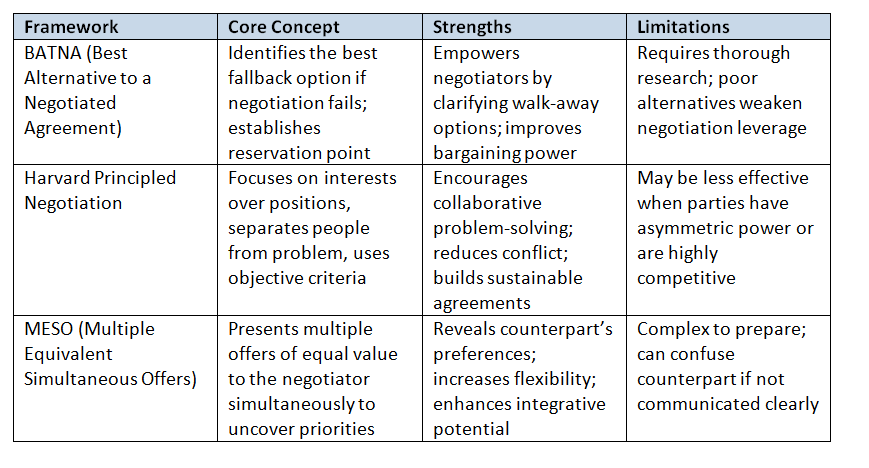
Each framework complements the others. BATNA anchors your negotiation power; Harvard Principled Negotiation guides the interaction style and process; MESO refines offer presentation to maximize mutual gain. Mastery of these tools equips negotiators to adapt dynamically.
Step-by-Step Process — How to Build Your Negotiation Strategy
A disciplined, repeatable process ensures thorough preparation and execution. Follow these steps:
Step 1: Define Your Objectives and Interests
Begin by articulating your primary goals and underlying interests. Distinguish between positions (what you say you want) and interests (why you want it). For example, in salary negotiations, the position might be a specific number, but the interest could be financial security, recognition, or career progression.
Actionable tip: Create an interests map listing your top 5 objectives ranked by importance.
Step 2: Research Your Counterpart and Context
Gather intelligence on the other party’s needs, constraints, history, and negotiation style. Use public data, previous interactions, and industry insights. Understanding BATNA and reservation points on both sides is crucial.
Actionable tip: Develop a counterpart profile including their probable BATNA, cultural factors, and negotiation tendencies.
Step 3: Determine Your BATNA and Reservation Point
Identify your best alternative if negotiations fail and establish the minimum acceptable outcome (reservation point). This step protects you from accepting unfavorable deals.
Actionable tip: Quantify your BATNA with concrete alternatives and prepare to communicate it subtly if needed.
Step 4: Identify Zones of Possible Agreement (ZOPA)
Based on your and the counterpart’s reservation points, estimate the ZOPA — the range within which an agreement is feasible. If no ZOPA exists, reconsider your BATNA or explore interests more deeply.
Actionable tip: Visualize the ZOPA on a negotiation value spectrum to set realistic expectations.
Step 5: Design Multiple Equivalent Offers (MESO)
Prepare several offers of equivalent value that package different trade-offs. This tactic helps uncover the counterpart’s priorities and creates opportunities for integrative bargaining.
Actionable tip: Use a scoring matrix to ensure offers are truly equivalent in value to you before presenting.
Step 6: Plan Your Opening and Concession Strategy
Decide your initial offer, anchoring high but realistically. Plan your concession pattern strategically to convey flexibility while protecting value.
Actionable tip: Script your opening statement and map concessions with triggers and limits.
Step 7: Anticipate Counteroffers and Prepare Responses
Simulate counterpart reactions and prepare responses for common objections, stalls, or aggressive tactics.
Actionable tip: Develop a decision tree outlining possible negotiation paths and corresponding responses.
Step 8: Establish Communication and Rapport Strategy
Plan how to build trust and manage the interpersonal dynamics, drawing on Cialdini’s principles of influence.
Actionable tip: Identify rapport-building techniques tailored to the counterpart’s personality and culture.
Step 9: Document and Review
Write down your strategy in a checklist format and review it with colleagues or mentors to identify blind spots.
Actionable tip: Use a negotiation playbook template to formalize your strategy and track progress.
Real-World Case Studies
Detailed examples illustrate how strategic negotiation frameworks and processes play out in practice.
Apple vs. Samsung Patent Negotiations (2011-2018)
These tech giants engaged in protracted litigation and negotiation over intellectual property. Apple’s negotiation strategy combined a robust BATNA (strength of patents and market position) with integrative tactics to eventually license critical technology. Their use of MESO—offering multiple licensing packages—helped unlock value without protracted litigation. The strategy balanced hard distributive bargaining with relationship management to preserve future collaboration potential.
IBM-Red Hat Acquisition (2018)
IBM’s $34 billion acquisition of Red Hat exemplifies principled negotiation at scale. IBM identified Red Hat’s interests (open-source leadership and independence) and addressed them through contractual safeguards. IBM’s BATNA was limited, as delaying acquisition could allow competitors to step in. By focusing on objective criteria like market valuation and cultural fit, IBM negotiated terms maximizing value for both, showcasing the power of preparation and integrative bargaining.
Amazon Procurement Negotiations
Amazon’s procurement teams employ data-driven BATNA calculations and leverage volume purchasing power to negotiate supplier contracts. They use MESO techniques by presenting suppliers with multiple contract options combining price, delivery schedules, and quality guarantees. Amazon’s strategic preparation and leverage application minimize costs while fostering supplier partnerships—demonstrating negotiation strategy’s role in operational efficiency.
Common Pitfalls and How to Avoid Them
· Overlooking BATNA: Accepting deals inferior to your alternatives. Fix: Rigorously research and quantify BATNA before negotiation.
· Anchoring Too Low or High: Setting unrealistic opening offers damaging credibility. Fix: Base anchors on market data and counterpart analysis.
· Ignoring Interests: Fixating on positions narrows options. Fix: Use interest-based questioning to uncover underlying needs.
· Poor Preparation: Failing to anticipate counteroffers or cultural nuances. Fix: Conduct comprehensive research and role-play negotiation scenarios.
· Emotional Reactivity: Letting anger or frustration cloud judgment. Fix: Practice emotional regulation techniques and maintain professional detachment.
· Lack of Flexibility: Rigid concession patterns block value creation. Fix: Develop MESO offers and contingency plans.
Advanced Tactics for Experienced Negotiators
· Anchoring with Calibration Questions: Use calibrated questions ("How can we work together to...") to shift negotiation dynamics.
· Use of Silence: Strategic silence after offers pressures counterparts to fill void, often revealing concessions.
· “Bracketing” Technique: Make opening offers that bracket the expected agreement zone to control value distribution.
· Timing Leverage: Exploit deadlines and time pressure judiciously to enhance bargaining power.
· Building Coalitions: Enlist allies or third parties to strengthen your position in multiparty negotiations.
· Psychological Framing: Frame proposals emphasizing gains rather than losses to counteract loss aversion biases.
Scripts and Templates — Exact Dialogue and Email Templates
Script for Initial Offer Presentation:
“Thank you for meeting today. Based on our mutual goals and the data we’ve reviewed, I propose the following package [present MESO offers]. I believe these options reflect fair value and address both our priorities. I’m eager to hear your thoughts.”
Response to Aggressive Counteroffer:
“I appreciate your perspective. To understand your priorities better, can you share what aspects of this offer are most critical to you? Perhaps we can explore alternatives that create value for both.”
Email Template for Follow-Up After Negotiation Meeting:
Subject: Follow-Up on Our Recent Discussion
Dear [Name],
Thank you for the productive discussion on [date]. As agreed, I am sharing the summary of our points and proposed next steps. Please find attached the detailed MESO offers for your review.
Looking forward to your feedback.
Best regards,
Frequently Asked Questions
Q1: What is the most critical element in building a negotiation strategy?
A1: Preparation is paramount. Understanding your BATNA, counterpart’s interests, and the ZOPA sets the foundation for all subsequent tactics and decisions.
Q2: How can I identify my BATNA if information about alternatives is limited?
A2: Use creative scenario planning and consult industry experts or mentors to estimate fallback options. Sometimes indirect data, such as competitor moves, provide valuable clues.
Q3: When should I use distributive vs. integrative negotiation tactics?
A3: Use distributive tactics when resources are fixed and parties’ interests directly oppose. Employ integrative tactics when interests can be expanded through trade-offs or collaboration.
Q4: How do cultural differences impact negotiation strategy?
A4: Cultural norms affect communication styles, decision-making, and trust-building. Tailor your approach by researching cultural protocols and adapting your rapport-building accordingly.
Q5: Can negotiation strategy be applied to everyday situations outside business?
A5: Absolutely. Principles like BATNA and interest-based negotiation enhance outcomes in personal negotiations like salary discussions, vendor contracts, or family agreements.
Conclusion
Negotiation is both an art and a science, demanding rigorous preparation, psychological insight, and tactical flexibility. By embracing a structured, theory-informed approach—anchored in frameworks like BATNA and Harvard Principled Negotiation—you unlock superior outcomes while preserving relationships. The step-by-step process outlined here equips you to design powerful negotiation strategies tailored to your unique context. Coupled with real-world lessons, advanced tactics, and ready-to-use scripts, this guide empowers you to negotiate with confidence and maximize value consistently.
Your next step is to apply this blueprint to your upcoming negotiation: start by mapping your BATNA and interests today. Consider documenting your strategy in a playbook, rehearsing with colleagues, and continuously refining based on feedback. Mastery comes from deliberate practice grounded in these proven principles. Begin now, and transform negotiation from a reactive task into your competitive advantage.
References
· Kahneman, D. (2011). Thinking, Fast and Slow. Farrar, Straus and Giroux.
· Fisher, R., Ury, W., & Patton, B. (2011). Getting to Yes: Negotiating Agreement Without Giving In. Penguin Books.
· Cialdini, R. B. (2007). Influence: The Psychology of Persuasion. Harper Business.
· Shell, G. R. (2006). Bargaining for Advantage: Negotiation Strategies for Reasonable People. Penguin Books.
· Mnookin, R. H. (2000). Bargaining with the Devil: When to Negotiate, When to Fight. Simon & Schuster.
· Harvard Business Review articles on negotiation strategy (various authors).