How to Counter Negotiation Tactics: A Complete Defensive Playbook

Negotiations can be battlefield-like arenas where subtle psychological maneuvers decide victory or defeat. Consider the 2012 patent licensing standoff between Apple and Samsung, where each side deployed aggressive anchoring and framing tactics, resulting in a multimillion-dollar jury verdict and years of litigation. Apple’s ability to anticipate and counter Samsung’s initial lowball offers and claims of non-infringement turned the tide in their favor, illustrating how defensive negotiation tactics can be as decisive as offensive ones.
Most negotiators fail because they underestimate the psychological underpinnings of tactics like anchoring, scarcity, and calibrated questioning. Behavioral economics research, including Daniel Kahneman’s insights on loss aversion and framing effects, reveals that many negotiators fall prey to cognitive biases without realizing it. Meanwhile, Chris Voss’s tactical empathy and labeling techniques show how to disrupt opponent strategies before they take root. The stakes are high: misreading or ignoring these dynamics can cost millions, stall deals indefinitely, or damage long-term relationships.
This guide arms you with a scientifically grounded, actionable playbook to not only recognize but dismantle common and advanced negotiation tactics. You will master frameworks such as the Fisher-Ury principled negotiation, Voss’s tactical empathy, and Cialdini’s influence principles from a defensive lens. We provide exact scripts, counter-response tables, and real-world case studies from elite negotiations to ensure you leave every table stronger. Whether you are a seasoned executive, lawyer, or procurement leader, this is your definitive resource for turning negotiation tactics against their user.
· Table of Contents
· The Psychology and Science Behind Countering Negotiation Tactics
· Key Frameworks and Models for Defensive Negotiation
· Step-by-Step Process to Identify and Neutralize Tactics
· Real-World Case Studies of Successful Countermeasures
· Recognition and Counter-Response Guide (with Table)
· Advanced Insights: Expert-Level Defensive Techniques
· Scripts and Templates for Common Defensive Scenarios
· Frequently Asked Questions on Countering Negotiation Tactics
· Conclusion and Call to Action
· References
The Psychology and Science Behind This Topic
Understanding how to counter negotiation tactics requires a deep dive into behavioral economics, social psychology, and cognitive science. At the core are cognitive biases that negotiators exploit—anchoring, loss aversion, reciprocity, and framing—concepts rigorously studied by Daniel Kahneman, Robert Cialdini, and others.
Anchoring, as Kahneman and Tversky demonstrated, causes negotiators to fixate on an initial number, skewing their valuation and concessions. This bias often manifests in opening offers or demands designed to reset the reference point. Loss aversion magnifies the pain of giving concessions, making offers framed as losses more impactful than equivalent gains. Cialdini’s principles—reciprocity, scarcity, authority, commitment, liking, and social proof—are the psychological levers negotiators pull to influence concessions and agreement speed.
Chris Voss’s "Never Split the Difference" introduced tactical empathy, mirroring, and labeling as methods to disrupt adversaries’ cognitive biases and emotional triggers. These techniques engage the opponent’s brain at a meta-cognitive level, defusing aggressive tactics and opening pathways for collaborative problem-solving. Meanwhile, game theory concepts like Nash equilibrium explain the strategic interdependence of moves, emphasizing how defensive counter-tactics can shift outcomes from zero-sum fights to positive-sum agreements.
In sum, the science reveals that successful defense is less about blunt resistance and more about anticipatory, calibrated responses that exploit the same psychological vulnerabilities used offensively. Recognizing these mechanisms transforms you from a reactive party into a proactive strategist.
Key Frameworks and Models
Three foundational frameworks guide the defensive negotiator’s mindset and approach:
1. Fisher and Ury’s Principled Negotiation (Getting to Yes) - Focuses on separating people from the problem, focusing on interests not positions, inventing options for mutual gain, and insisting on objective criteria. This framework helps counter positional hardball tactics by shifting to interest-based dialogue.
2. Chris Voss’s Tactical Empathy Model - Emphasizes understanding and verbalizing the opponent’s emotions (labeling), mirroring language, calibrated questions, and the accusation audit to preempt hostile moves. It counters intimidation and aggressive anchoring by humanizing and disarming.
3. Cialdini’s Influence Principles (Reciprocity, Scarcity, Commitment, Social Proof, Authority, Liking) - Helps identify and neutralize covert influence attempts by recognizing their triggers and preparing counter-responses.
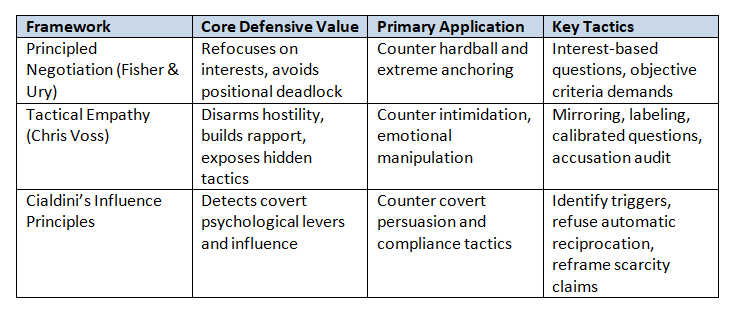
Each framework offers a complementary lens: principled negotiation elevates the conversation, tactical empathy manages emotional dynamics, and Cialdini’s principles protect against subconscious influence.
Step-by-Step Process or Analysis
Step 1: Preparation and Psychological Mapping
Analyze the negotiation context to anticipate what tactics the other party is likely to deploy. Use intelligence gathering and behavioral profiling to identify past patterns. Prepare your BATNA (Best Alternative to a Negotiated Agreement) robustly to reduce vulnerability to pressure tactics.
Step 2: Early Signal Recognition
From the outset, listen for classic tactic signatures — extreme anchoring, false deadlines (scarcity), loaded questions. Use active listening and note discrepancies. Early detection allows you to set the tone and limits.
Step 3: Apply Tactical Empathy and Labeling
When you detect emotional manipulation or aggression, apply Voss’s labeling technique: e.g., “It seems like you feel strongly about this point.” This verbalizes and defuses tension, making the counterpart aware their tactic is noticed.
Step 4: Reframe and Redirect Anchors
Use calibrated questions (“How did you arrive at that figure?”) and objective criteria (“Can we look at market benchmarks together?”) to neutralize unfair anchors and shift to collaborative problem-solving.
Step 5: Manage Reciprocity and Commitment Pressures
When faced with reciprocity pressures (“We made a concession, now you must”), pause and reframe: “I appreciate your concession. Let’s focus on the overall value rather than isolated moves.” Avoid automatic compliance by invoking fairness and mutual interests.
Step 6: Defuse Scarcity and Deadline Tactics
When opponents use fake or artificial deadlines, employ a calibrated question: “What happens if we take a little more time to ensure this works for both sides?” This challenges the urgency without direct confrontation.
Step 7: Close with Mutually Beneficial Offers
End with options that meet interests, not positions, using the principled negotiation model. Reinforce objective criteria and confirm mutual gains to prevent last-minute hardball reversals.
Real-World Case Studies
Apple vs Samsung Patent Negotiations (2010-2018)
Context: Apple used aggressive anchoring and threat of litigation to set the framework, Samsung responded with counter-anchors and dilution of claims.
What Happened: Apple’s legal and negotiation teams anticipated Samsung’s tactics, countering with calibrated questions about patent validity and economic impact. Tactical empathy was used to understand Samsung’s business imperatives, enabling Apple to negotiate a licensing deal that preserved market advantage.
Lesson: Combining principled negotiation with tactical empathy can convert a zero-sum fight into a positive-sum outcome.
NFL Contract Negotiations: Patrick Mahomes Extension (2020)
Context: Mahomes’ agent initially set a record-breaking anchor with a $500 million contract demand.
What Happened: The Kansas City Chiefs’ front office recognized the anchor as a strategic play to reset market value. They responded by breaking down the contract into performance-based elements and used calibrated questions (“How do you justify that figure in the context of team salary caps?”).
Lesson: Deconstructing complex anchors into measurable components helps neutralize inflated demands.
Diplomatic Standoff: US-North Korea Summit (2018)
Context: North Korea used scarcity and deadline tactics to pressure for concessions quickly.
What Happened: The US delegation employed tactical empathy by labeling North Korea’s goals and concerns, defused urgency by requesting more time for internal consultation, and insisted on objective criteria like verifiable denuclearization steps.
Lesson: Emotional intelligence and principled negotiation prevent coercive deadlines from derailing talks.
Recognition and Counter-Response Guide
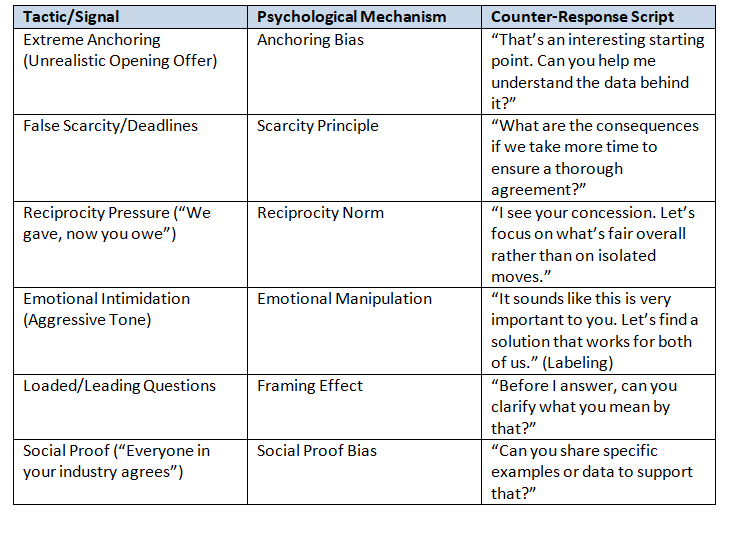
This table equips negotiators with immediate scripts to neutralize common tactics while maintaining control and rapport.
Advanced Insights
Elite negotiators integrate advanced concepts such as:
- The Accusation Audit: Preemptively naming opponent’s possible complaints to disarm them (e.g., “You might think we’re being inflexible…”).
- Nash Equilibrium Analysis: Anticipating opponent’s best responses to your counters to avoid escalation traps.
- Multi-issue Bundling: Grouping concessions to transform zero-sum conflicts into integrative solutions.
- Psychological Time Management: Using pacing and strategic silence to increase opponent’s cognitive load and reduce tactic effectiveness.
- Power Dynamics Mapping: Assessing each party’s BATNA and leverage shifts in real time to recalibrate your defense posture.
These tools require experience but yield outsized defensive advantages when deployed precisely.
Scripts and Templates
1. Defusing an Extreme Anchor
“Thank you for sharing your initial offer. To ensure we’re both aligned, could you walk me through how you arrived at that figure?”
2. Countering a Fake Deadline
“I appreciate the urgency. What would be the impact if we took an additional week to finalize details that benefit us both?”
3. Responding to Reciprocity Pressure
“I acknowledge your concession and want to ensure we make progress that’s fair and sustainable for both parties.”
4. Labeling Aggressive Behavior
“It seems like this issue is causing some frustration. Let’s work through it together.”
5. Redirecting Loaded Questions
“Before I respond, can you clarify what outcomes you’re hoping to achieve with that question?”
Frequently Asked Questions
Q1: How can I identify covert negotiation tactics before they take effect?
A1: Look for behavioral cues such as abrupt changes in tone, unusually high or low offers, and attempts to rush decisions. Use active listening and ask open-ended calibrated questions to reveal underlying intentions.
Q2: What is the best way to respond to emotional intimidation in negotiations?
A2: Employ tactical empathy by labeling the emotions you observe without judgment. This disarms hostility and opens dialogue while maintaining your composure.
Q3: Are there ethical concerns when using counter-tactics?
A3: Yes. Always aim for transparency and fairness. Counter-tactics should neutralize unfair manipulation, not exploit vulnerabilities unethically. Maintaining trust is essential for long-term relationships.
Q4: How do I prepare my BATNA to strengthen my defensive position?
A4: Research alternatives thoroughly and quantify their value. Knowing your options reduces pressure from opponent tactics and improves your confidence and leverage.
Q5: Can these defensive tactics be used in multi-party negotiations?
A5: Absolutely. Frameworks like principled negotiation and tactical empathy scale well in complex dynamics, but require careful calibration of messaging and coalition-building.
Conclusion
Mastering the art of countering negotiation tactics transforms you from a passive responder into a proactive strategist. By understanding the psychological mechanisms at play, leveraging proven frameworks, and deploying calibrated scripts, you can neutralize common and sophisticated moves that otherwise erode your position. Real-world cases affirm that defensive negotiation prowess drives superior outcomes and preserves vital relationships.
Begin integrating these tools today: prepare meticulously, listen actively, and respond deliberately. Your ability to anticipate, recognize, and dismantle tactics not only protects your interests but creates space for creative, mutually beneficial agreements. Elevate your negotiation game with this playbook and ensure you never lose ground to manipulation again.
References
- Fisher, R., Ury, W., & Patton, B. (2011). Getting to Yes: Negotiating Agreement Without Giving In. Penguin Books.
- Voss, C., & Raz, T. (2016). Never Split the Difference: Negotiating As If Your Life Depended On It. HarperBusiness.
- Kahneman, D. (2011). Thinking, Fast and Slow. Farrar, Straus and Giroux.
- Cialdini, R. B. (2009). Influence: Science and Practice. Pearson Education.
- Shell, R. (2006). Bargaining for Advantage: Negotiation Strategies for Reasonable People. Penguin Books.
- Grant, A. (2013). Give and Take: A Revolutionary Approach to Success. Viking.