How to Deal with Manipulation in Negotiation: The Definitive Guide for Professionals

In a high-profile merger negotiation between two global tech giants, discussions suddenly spiral into chaos. One party’s lead negotiator employs subtle psychological manipulation—misrepresenting facts, exploiting emotional triggers, and using aggressive deadline pressure. The other side feels cornered, confused, and on the brink of walking away from a billion-dollar deal. This scenario is not uncommon in high-stakes negotiations, where manipulation can quickly shift the balance of power, escalate conflict, and threaten to derail even the most promising agreements.
Understanding why these high-conflict negotiations unravel so quickly is crucial. Research in psychology and behavioral economics makes it clear that the first few minutes and emotional cues in any negotiation set the tone for success or failure. Most negotiators are unprepared for the emotional flood, cognitive biases, and covert tactics their counterparts may wield. Without mastering the psychological underpinnings and strategic countermeasures, negotiators risk falling prey to manipulation, losing leverage, and exiting the table empty-handed.
This comprehensive guide will empower you to recognize, respond to, and neutralize manipulation in negotiation. Drawing on cutting-edge frameworks like Chris Voss’s FBI tactical empathy, William Ury’s "Going to the Balcony," and the Thomas-Kilmann Conflict Mode Instrument, you will learn step-by-step processes, psychological techniques, and exact scripts proven in real-world crises—from hostage standoffs to boardroom battles. This article equips senior professionals and negotiators to remain calm, assertive, and influential—even under intense pressure.
· Table of Contents
· The Psychology Behind This Challenge
· Key Frameworks and Models: Comparing Tactical Approaches
· Step-by-Step Process to Counter Manipulation
· Real-World Case Studies of Manipulation in Negotiation
· Recognizing and Countering Manipulative Tactics
· Advanced Techniques for Expert Negotiators
· Scripts and Templates for Difficult Negotiation Scenarios
· Frequently Asked Questions
· Conclusion: Mastering Manipulation to Win Negotiations
· References
The Psychology Behind This Challenge
Negotiation manipulation taps deep into human neuropsychology, exploiting emotional and cognitive vulnerabilities. Understanding the brain’s responses during conflict is foundational to managing manipulation effectively.
One of the most critical mechanisms is the amygdala hijack, described by psychologist Daniel Goleman. When negotiators feel threatened—whether by aggressive tactics or perceived unfairness—the amygdala triggers a fight-flight-freeze response. This emotional flooding overwhelms the prefrontal cortex, impairing rational decision-making and increasing impulsivity. The counterpart’s goal often is to induce this state to gain leverage.
Daniel Kahneman’s dual-process theory—System 1 (fast, intuitive, emotional) and System 2 (slow, logical, analytical)—provides another lens. Manipulators aim to keep their targets in System 1 mode, provoking quick reactions and snap judgments, while they operate strategically in System 2. Skilled negotiators must consciously engage their System 2 to assess, pause, and respond deliberately.
Chris Voss’s FBI hostage negotiation principles emphasize tactical empathy: actively understanding and vocalizing the emotional state of the counterpart without agreeing with their position. This lowers defenses and reduces emotional escalations. Similarly, John Gottman’s research on emotional flooding underscores the importance of recognizing when emotions overwhelm cognitive capacity and using calming techniques to regain control.
Social identity theory also plays a role—manipulators often invoke group loyalties and in-group/out-group biases to pressure concessions or isolate the target. Recognizing these psychological levers helps negotiators maintain perspective and avoid reactive traps.
These psychological insights frame why manipulation is so effective and why managing your emotional state is the first critical step to countering it.
Key Frameworks and Models
Several frameworks have emerged as gold standards in understanding and navigating manipulation in negotiation. This section compares three seminal models.
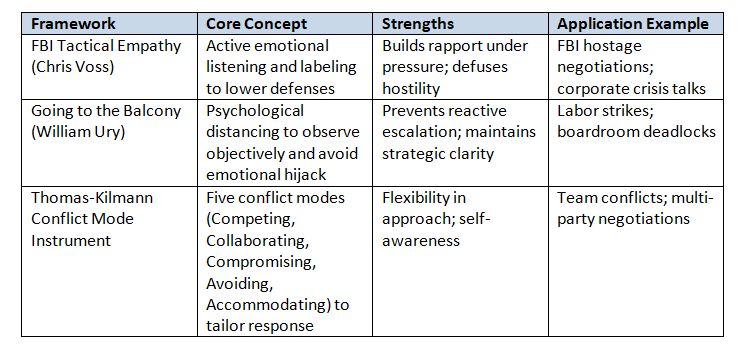
While Voss’s method excels in immediate emotional de-escalation, Ury's approach aids in managing internal reactions and maintaining presence. Thomas-Kilmann provides a diagnostic tool to select negotiation styles based on context and goals. Mastery involves integrating these frameworks fluidly.
Step-by-Step Process
This six-step process synthesizes psychological techniques and frameworks for systematically handling manipulation in negotiation.
Step 1: Prepare with Emotional Awareness and Scenario Planning
Before entering, identify your emotional triggers and set clear BATNA (Best Alternative to a Negotiated Agreement). Use Kahneman’s System 2 deliberate thinking to anticipate manipulative tactics your counterpart might use.
Step 2: Establish Tactical Empathy Immediately
Apply Voss’s labeling technique: listen actively and verbalize the counterpart’s emotions (“It seems like you’re feeling pressured about the timeline”). This lowers emotional barriers and signals understanding without conceding.
Step 3: Recognize Manipulation Tactics in Real Time
Use the manipulation tactics table (see later section) to identify lies, pressure, or diversion. Maintain psychological distance (“Going to the Balcony”) to avoid emotional hijack.
Step 4: Counter with Calm, Clear, and Assertive Communication
Respond with calibrated questions (“How am I supposed to meet that deadline under these conditions?”) and “no”-oriented phrases to regain control. Avoid reactive emotional responses.
Step 5: Use Anchoring and Reframing to Shift the Narrative
Re-anchor discussions around facts and interests rather than positions. Reframe negative statements into collaborative problem-solving (“Instead of rushing, let’s explore feasible timelines”).
Step 6: Close with Clear Agreements and Contingency Plans
Summarize agreements, confirm mutual understanding, and set mechanisms to monitor commitments. Prepare to walk away if manipulation persists.
Real-World Case Studies
Case Study 1: FBI Hostage Negotiation in 1972 Munich Olympics
During the hostage crisis, negotiators used tactical empathy and calibrated questions to defuse terrorists’ emotional intensity. Manipulative threats were recognized and neutralized by maintaining composure and focusing on humanizing all parties. The lesson: empathy under extreme pressure preserves rational dialogue.
Case Study 2: Boeing and Union Labor Dispute 2019
Union leaders used deadline pressure and misinformation to force concessions. Boeing’s negotiation team employed Ury’s "Balcony" technique to avoid emotional reactivity, combined with transparent communication and fact-based anchors to rebuild trust. Result: a sustainable agreement without strike.
Case Study 3: Diplomatic Standoff Over Trade Tariffs 2018
One country’s negotiators used social identity appeals and aggressive ultimatums. The opposing team applied Thomas-Kilmann’s collaborative mode, framing the conversation around mutual benefits and shared goals, ultimately breaking the deadlock. The key takeaway: flexibility in conflict modes can counter rigid manipulation.
Recognizing and Countering Tactics
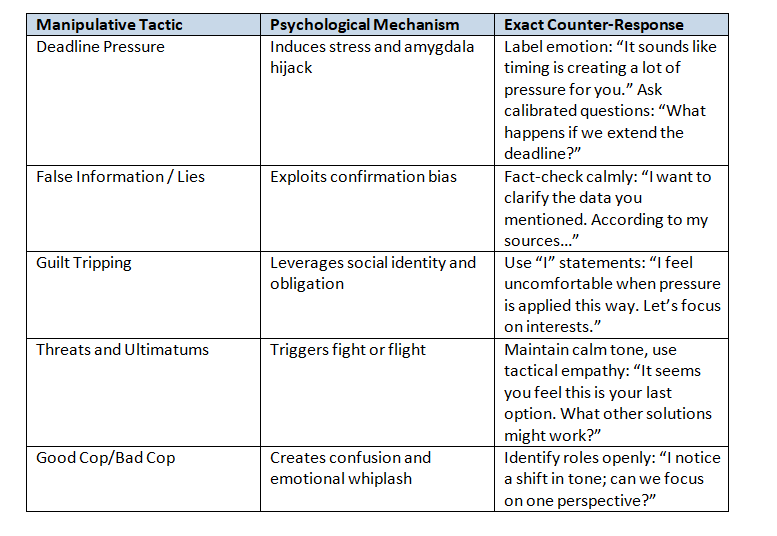
This matrix enables negotiators to diagnose tactics quickly and deploy precise psychological counters, preventing manipulation from gaining footholds.
Advanced Techniques
For expert negotiators, several sophisticated methods offer enhanced control:
- Micro-expression Reading (Paul Ekman): Detect subtle facial cues that betray concealed emotions or deceit, allowing preemptive responses.
- Presence Under Pressure (Amy Cuddy): Utilize power poses and breathing exercises pre-negotiation to boost confidence and reduce cortisol, improving decision-making.
- Moral Psychology Calibration (Jonathan Haidt): Frame arguments to align with the counterpart’s moral foundations (care, fairness, loyalty) to reduce resistance.
- Emotional Labeling with Strategic Ambiguity: Combine empathy with vague language to avoid committing prematurely while still validating emotions.
- Negotiation Jiu-Jitsu: Deflect attacks by redirecting aggression back toward problem-solving rather than personal conflict.
Integrating these techniques requires practice and self-awareness but yields significant advantages in high-conflict scenarios.
Scripts and Templates
Below are exact dialogue scripts for common manipulative scenarios.
Counterpart: “If you don’t sign today, this deal is off.”
You: “It sounds like timing is creating a lot of pressure for you. Can you help me understand what makes today the critical deadline?”
Counterpart: “After all we’ve done for you, this is how you repay us?”
You: “I appreciate our history, and I want to be fair. I feel uncomfortable when decisions are framed this way. Let’s focus on what works best for both sides.”
Counterpart: “Our research shows a 50% market increase, so your offer is too low.”
You: “Thanks for sharing that. I want to clarify the data because my sources indicate a different trend. Can we review the figures together?”
Counterpart: “If you don’t agree now, we’ll take legal action.”
You: “It seems you feel this is your last option. What other solutions might help us resolve this without escalating?”
Bad Cop: “You’re being unreasonable.”
Good Cop: “I think there’s room for discussion.”
You: “I notice a shift in tone between you both. To keep progress, can we focus on the key points we agree on?”
Frequently Asked Questions
Q1: How can I protect myself emotionally during manipulative negotiations?
A1: Develop self-awareness through mindfulness and breathing techniques to recognize emotional flooding early. Use “Going to the Balcony” to psychologically distance yourself and engage System 2 thinking. Preparation and scenario planning reduce vulnerability.
Q2: What if the manipulator refuses to engage in good faith?
A2: Maintain your BATNA and be prepared to walk away. Use calibrated questions to probe motives and create options, but do not concede to unethical pressure. Document interactions where appropriate.
Q3: How do I rebuild trust after manipulation damages the relationship?
A3: Acknowledge the breach openly, set transparent communication protocols, and use collaborative conflict modes (Thomas-Kilmann) to co-create agreements. Consistency over time restores credibility.
Q4: Can manipulation be unconscious on the counterpart’s part?
A4: Yes. Some tactics stem from stress or cultural negotiation styles rather than intent. Tactical empathy helps identify underlying emotions and opens pathways to understanding.
Q5: How do I train my team to handle manipulation?
A5: Use role-playing with real case studies, teach emotional regulation, and share key frameworks. Encourage debriefs post-negotiation to internalize lessons and update tactics.
Conclusion
Manipulation in negotiation is a pervasive and potent challenge that can derail critical deals, ruin relationships, and cause lasting damage. However, by understanding the psychological roots—amygdala hijack, System 1/System 2 dynamics, social identity pressures—and mastering proven frameworks like tactical empathy and emotional distancing, negotiators can not only survive but thrive in these high-conflict environments.
This guide has equipped you with a comprehensive toolkit: from step-by-step processes and real-world case studies to precise scripts and advanced psychological techniques. The difference between yielding to manipulation and steering conversations toward mutual gain lies in preparation, presence, and principled assertiveness. Embrace these insights and frameworks to regain control, build trust, and secure agreements even against the most challenging counterparts.
References
1. Kahneman, D. (2011). Thinking, Fast and Slow. Farrar, Straus and Giroux.
2. Voss, C. & Raz, T. (2016). Never Split the Difference: Negotiating As If Your Life Depended On It. HarperBusiness.
3. Ury, W. (1991). Getting Past No: Negotiating in Difficult Situations. Bantam.
4. Gottman, J. M. (1997). Why Marriages Succeed or Fail: And How You Can Make Yours Last. Simon & Schuster.
5. Cialdini, R. B. (2006). Influence: The Psychology of Persuasion. Harper Business.
6. Ekman, P. (2003). Emotions Revealed: Recognizing Faces and Feelings to Improve Communication and Emotional Life. Times Books.
7. Haidt, J. (2012). The Righteous Mind: Why Good People Are Divided by Politics and Religion. Pantheon Books.
8. Cuddy, A. (2015). Presence: Bringing Your Boldest Self to Your Biggest Challenges. Little, Brown and Company.