How to Defend Your Margin Against Procurement: The Definitive Guide for Suppliers and Buyers

In 2018, a leading electronics components supplier lost a critical multi-million-dollar contract with a global tech giant after a protracted procurement negotiation. The buyer’s procurement team wielded aggressive price pressure tactics, leveraging deep data analytics and a fractured supplier base to squeeze margins to unsustainable levels. Despite the supplier’s efforts, the final contract terms eroded profitability, forcing cutbacks and a costly restructuring. This situation, emblematic of countless supplier-buyer standoffs, reveals the high-stakes chess game played in procurement negotiations.
At its core, procurement is about managing risk, costs, and supplier relationships under intense commercial pressures. Buyers seek to optimize total cost of ownership (TCO), drive innovation, and ensure supply security — all while hitting ambitious KPIs tied to cost savings and supplier consolidation. Suppliers, conversely, must protect margins, sustain quality, and build long-term partnerships. Yet, asymmetries in information, power imbalances, and often adversarial mindsets lead to suboptimal outcomes on both sides. Most procurement battles fail because negotiators lack a strategic framework or underestimate psychological dynamics such as loss aversion and the threat of supplier replacement.
This guide unlocks the secrets to defending your margin against procurement pressure. You will learn how to decode the buyer’s incentives, apply powerful models like the Kraljic Matrix and BATNA analysis, and deploy step-by-step negotiation strategies. Real-world case studies from Toyota, Apple, and Amazon illustrate how top-tier organizations navigate margin conflict. You will also gain actionable scripts, counter-tactics, and advanced techniques to build value-based relationships and structure deals that protect your profitability without sacrificing partnership potential.
· Table of Contents
· The Strategic Landscape: How Procurement Really Works
· Key Frameworks and Models for Margin Defense
· Step-by-Step Margin Defense Strategy for Buyers and Suppliers
· Real-World Case Studies: Toyota, Apple, Walmart
· Tactics and Counter-Tactics Matrix
· Advanced Strategies for Long-Term Margin Protection
· Exact Scripts and Templates for Negotiation Scenarios
· Frequently Asked Questions on Procurement Margins
· Conclusion: Synthesizing Margin Defense and Next Steps
· References and Further Reading
The Strategic Landscape: How Procurement Really Works
Understanding how procurement functions at a strategic level is essential to defend your margin effectively. Procurement is not merely price haggling but a sophisticated discipline orchestrating spend management, supplier relationship management, and risk mitigation. Professional buyers operate with clear incentives, KPIs, and psychological drivers that shape their negotiation approach.
Professional buyers today are measured on cost savings (often annualized), supplier consolidation, compliance with procurement policies, and value creation. Their mandate is to reduce total cost of ownership (TCO), which includes purchase price, logistics, quality control, and lifecycle costs. This broader perspective demands suppliers to look beyond unit price and demonstrate value across the supplier lifecycle. Procurement teams segment suppliers using tools like the Kraljic Matrix — categorizing suppliers as strategic, bottleneck, leverage, or non-critical — to prioritize relationship management and negotiation tactics.
Should-cost analysis is a foundational method buyers use to estimate the fair cost structure of a product or service before negotiation. By reverse-engineering input costs, labor, overhead, and margins, buyers create a benchmark against which supplier quotes are measured. Understanding this process enables suppliers to anticipate buyer pressure points and prepare robust justifications for pricing.
Supplier segmentation through category management enables procurement to tailor strategies based on supplier risk and value. Strategic suppliers might see collaborative innovation and joint cost reduction programs, whereas leverage suppliers face aggressive price competition. The psychological dimension, informed by Daniel Kahneman's work on loss aversion, means buyers are often more motivated to avoid perceived losses (overpaying) than to achieve equivalent gains, driving hard negotiation stances.
In sum, procurement is a complex dance balancing economics, risk, psychology, and relationship dynamics. Suppliers who grasp these layers position themselves to defend margins without alienating buyers.
Key Frameworks and Models
Several frameworks distill the complexity of procurement negotiations into actionable insights. Below are three foundational models critical to margin defense.
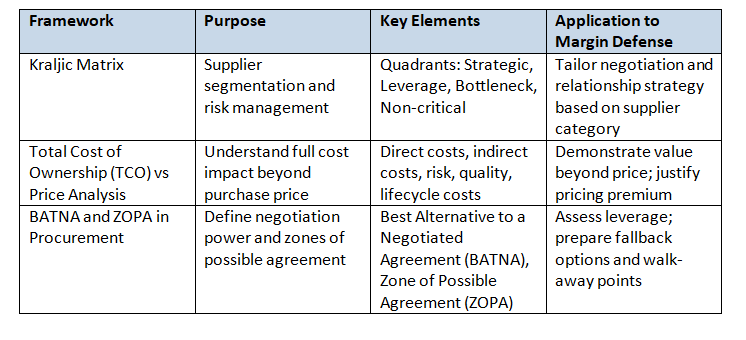
The Kraljic Matrix, introduced by Peter Kraljic in 1983, remains the gold standard for supplier portfolio management. Suppliers classified as strategic partners (high risk, high value) in the matrix can negotiate from a position of collaboration, emphasizing innovation and joint value creation. Conversely, leverage suppliers (low risk, high value) face intense price pressure, requiring suppliers to innovate cost structures or differentiate.
TCO analysis allows both sides to shift the conversation from price to value. For example, a supplier may propose higher upfront costs but demonstrate lower maintenance and downtime expenses, resulting in better TCO. Buyers using should-cost models will push back if supplier pricing exceeds their cost estimates, so transparent cost breakdowns and value engineering are critical.
BATNA (Best Alternative to a Negotiated Agreement) and ZOPA (Zone of Possible Agreement) frameworks help negotiators understand their bottom lines and where deal ranges overlap. A supplier with multiple buyer options has a strong BATNA and can resist steep margin erosion. Buyers with few alternative suppliers must moderate demands or risk supply disruption.
Step-by-Step Strategy
Effective margin defense requires a structured approach addressing both buyer and supplier perspectives. Below is a six-step strategy with specific tactics and language suggestions for each stage.
Step 1: Preparation and Intelligence Gathering
Suggested script for suppliers in preparation call:
“We’ve analyzed the full cost structure and benchmarked against peers to ensure our pricing reflects competitive value while maintaining quality and reliability.”
Step 2: Initial Engagement and Setting Expectations
Supplier script example:
“Our proposal focuses on long-term cost efficiency, factoring in reduced maintenance and improved uptime, which we believe align with your operational goals.”
Step 3: Negotiation and Price Discussion
Buyer script example:
“Based on our should-cost analysis, we see opportunities to optimize material inputs. Can you provide detailed cost drivers to validate your pricing?”
Step 4: Handling Pressure and Counter-Tactics
Supplier counter-script example:
“We understand price is critical, but compromising quality or service levels will increase your TCO. Let’s explore process improvements or packaging adjustments to meet budget.”
Step 5: Agreement Structuring
Sample supplier proposal language:
“To ensure stability for both parties, we suggest a three-year contract with annual price reviews linked to agreed indices.”
Step 6: Post-Negotiation Relationship Management
Buyer follow-up email template excerpt:
“Thank you for the collaborative negotiations. We look forward to working closely on continuous improvement projects to maximize value.”
Real-World Case Studies
Examining real corporate experiences offers invaluable insights.
Toyota’s Supplier Partnership Model
Toyota revolutionized supplier relations through its Toyota Production System (TPS) emphasizing lean manufacturing and mutual improvement. Rather than squeeze suppliers on price, Toyota invested in joint problem-solving and long-term collaboration, enabling suppliers to maintain healthy margins while driving cost reductions through efficiency. The lesson: strategic partnership can turn margin defense into shared value creation.
Apple’s Procurement Leverage
Apple’s procurement team wields immense buying power and employs sophisticated data analytics to benchmark supplier costs. Apple uses BATNA effectively, often threatening to switch suppliers or bring production in-house, forcing suppliers to accept thin margins. Yet Apple balances this with innovation incentives and strict quality standards, illustrating the power of combining hard negotiation with supplier enablement.
Walmart’s Supplier Squeeze Tactics
Walmart is renowned for exerting extreme price pressure on suppliers, leveraging its scale to demand relentless cost reductions. While this drives low prices for consumers, it results in margin compression and supplier consolidation. Suppliers must resist excessive margin erosion by differentiating offerings or co-investing in supply chain efficiencies. The key lesson: scale alone can create buyer power, but suppliers can counter with innovation and cost transparency.
Tactics and Counter-Tactics
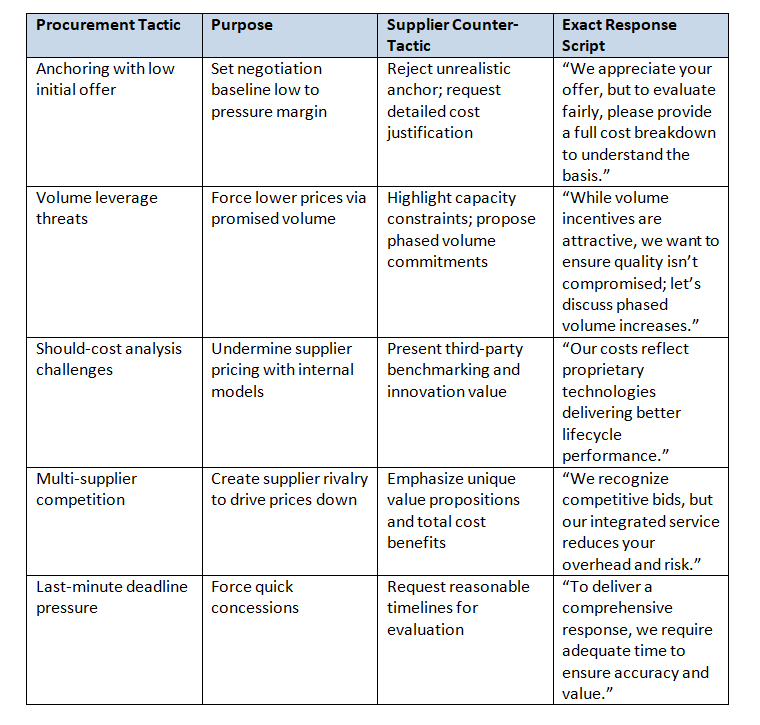
This table maps common procurement tactics to their objectives and offers specific supplier counter-response scripts.
Advanced Strategies
Beyond foundational tactics lie sophisticated approaches to defend margin sustainably.
Relationship leverage involves nurturing strategic partnerships where trust and transparency reduce adversarial pressure. Multi-year contracts with indexed price adjustments provide margin stability and shared risk management.
Value-based positioning shifts negotiation focus from price to outcomes—demonstrating how your solution reduces downtime, increases output, or improves compliance. Suppliers can use joint innovation roadmaps to co-develop products, creating switching costs for buyers.
Scenario planning, integrating transaction cost economics, helps quantify risks and costs of supplier replacement, strengthening negotiation leverage.
Data analytics and AI tools enable predictive insights into buyer behavior and pricing trends, allowing proactive margin defense.
Integrating category management with supplier innovation programs ensures continuous alignment of strategic objectives, reducing margin erosion drivers.
Scripts and Templates
Below are exact word-for-word negotiation scripts for typical procurement scenarios.
“Thank you for your proposal. To evaluate it thoroughly, could you please provide a detailed breakdown of the cost components? This will help us understand the underlying assumptions and explore areas for optimization collaboratively.”
“To ensure predictability and mutual growth, we propose a three-year agreement including annual price adjustments tied to the published raw material index. This approach protects both parties from market volatility.”
“We appreciate the opportunity to grow volume with you; however, to maintain quality and service levels, we suggest a phased volume ramp-up, allowing capacity and process adjustments.”
“To deliver an accurate and value-driven proposal, we kindly request an extension of the submission deadline by five business days. This will enable a more thorough analysis.”
“Our solution reduces your total cost of ownership by lowering maintenance requirements and improving uptime, which we believe provides superior long-term value compared to competitors.”
Frequently Asked Questions
Q1: How can suppliers effectively counter aggressive price pressure from procurement teams?
A1: Suppliers should focus on demonstrating total cost of ownership benefits, provide transparent cost break-downs, and propose collaborative value engineering opportunities. Using BATNA awareness and multi-year contracts with escalation clauses can also protect margins.
Q2: What role does the Kraljic Matrix play in margin defense?
A2: The Kraljic Matrix segments suppliers by risk and value, guiding negotiation strategy. Strategic suppliers can leverage partnership dynamics for margin protection, while leverage suppliers face more price pressure and must differentiate.
Q3: How do buyers calculate should-cost models?
A3: Buyers reverse-engineer product costs considering raw materials, labor, overhead, logistics, and profit margins. This benchmark informs negotiation ranges and highlights areas to challenge supplier pricing.
Q4: Can long-term contracts help suppliers defend margins?
A4: Yes, multi-year agreements with index-based price adjustments reduce volatility risk and create predictable revenue streams, enabling better margin management and joint investment in improvements.
Q5: What psychological factors influence procurement negotiations?
A5: Loss aversion motivates buyers to avoid overpaying, often causing tough stances. Recognizing these biases enables suppliers to frame proposals emphasizing risk mitigation and shared gains rather than just price.
Conclusion
Defending your margin against procurement pressure demands a deep understanding of procurement’s strategic and psychological underpinnings. By leveraging frameworks like the Kraljic Matrix, TCO analysis, and BATNA, suppliers and buyers can transform adversarial negotiations into collaborative value creation. Employing step-by-step strategies, backed by data and transparent communication, enables margin protection without sacrificing long-term partnership potential.
Armed with real-world insights, precise scripts, and advanced negotiation tactics, procurement professionals on both sides can foster sustainable contracts that balance cost, quality, and innovation. Whether you are a supplier facing relentless price pressure or a buyer seeking value beyond cost, mastering these techniques will elevate your negotiation outcomes and secure competitive advantage. Begin applying these principles today to turn margin defense into a strategic strength.
References
- Kraljic, P. (1983). Purchasing must become supply management. Harvard Business Review, 61(5), 109-117.
- Williamson, O.E. (1985). The Economic Institutions of Capitalism. Free Press.
- Kahneman, D. (2011). Thinking, Fast and Slow. Farrar, Straus and Giroux.
- Porter, M.E. (1979). How Competitive Forces Shape Strategy. Harvard Business Review.
- Monczka, R., Handfield, R., Giunipero, L., & Patterson, J. (2016). Purchasing and Supply Chain Management (6th ed.). Cengage Learning.
- Harvard Business Review Articles on Procurement and Supplier Negotiations (Various Authors, 2010–2023).