How to Defend Your Price Under Pressure: The Definitive Guide for Sales Professionals

Imagine you’re on a crucial sales call with a major prospect. The client loves your solution — the features, the support, even the ROI projections. But as you near closing, they drop the bomb: “Your price is too high compared to our budget. Can you offer a discount?” Suddenly, the deal you worked months to build teeters on the edge. Do you cave and risk eroding your margins or stand firm and risk losing the opportunity?
This scenario captures a universal challenge in sales and business: defending your price under pressure without damaging client relationships or leaving money on the table. Research consistently shows that unnecessary discounting shrinks profit margins by an average of 10-20% and conditions customers to expect lower prices next time. Moreover, buyer psychology around pricing is complex — influenced by cognitive biases, perceived value, and context rather than just sticker price.
This comprehensive guide will transform how you approach price objections. You will master the underlying psychology shaping buyer price perception, learn proven frameworks like the Value Ladder and BATNA adapted for pricing, follow a step-by-step negotiation process, and gain access to exact scripts and rebuttals to handle tough pushbacks. We will also analyze real-world examples from Apple, McKinsey, and Salesforce showing how price defense drives premium positioning and sustainable growth. By the end, you will have a professional-grade toolkit to confidently defend your price, protect margins, and close deals at premium rates.
· Table of Contents
· The Psychology of Price: Behavioral Economics Behind Buyer Perception
· Key Frameworks for Pricing Defense: Value Ladder, Price-Value Matrix, BATNA
· Step-by-Step Process to Defend Your Price in Negotiations
· Real-World Company Examples: Apple, McKinsey, Salesforce
· Objection Handling: Exact Word-for-Word Responses
· Advanced Tactics: Expert-Level Price Defense Techniques
· Scripts and Templates: Ready-to-Use Dialogue and Emails
· Frequently Asked Questions About Defending Price
· Conclusion and Compelling Call-to-Action
· References and Authoritative Sources
The Psychology of Price
Understanding how buyers perceive price is foundational to defending it effectively. Behavioral economics reveals that price perception is rarely rational or linear; it is shaped by cognitive biases, heuristics, and emotional responses.
One seminal concept is Kahneman and Tversky’s Prospect Theory (1979), which shows that people evaluate gains and losses asymmetrically — losses loom larger than gains. A price increase feels like a loss, triggering resistance, while a discount feels like a gain, fostering compliance. However, this also means that frequent discounting trains buyers to view regular pricing as a loss relative to an expected discount, eroding willingness to pay full price.
Anchoring is another powerful bias uncovered by Ariely in “Predictably Irrational” (2008). Initial prices (anchors) heavily influence buyer willingness to pay. For example, Apple’s premium pricing strategy establishes a high anchor, creating a perception of superior quality and exclusivity. Buyers compare all alternatives to this anchor, making lower-priced products seem inferior or commodity-like.
The price-quality heuristic also explains buyer assumptions that higher prices imply higher quality, even when objective differences are unclear. This is why luxury brands (Veblen goods) like Rolex or Tesla can command prices far above manufacturing costs, because the high price itself signals status and quality.
The decoy effect (Huber, Payne & Puto, 1982) manipulates choices by introducing a third, less attractive option to make the target product appear more reasonable or valuable. Strategic pricing can use this to guide buyers toward your preferred offering without discounting.
These psychological insights show that defending price is not just about facts or figures; it’s about managing perception and framing to align buyer value with your pricing.
Key Frameworks
Several structured frameworks help sales professionals and pricing managers systematically defend price. Here are three essential models:
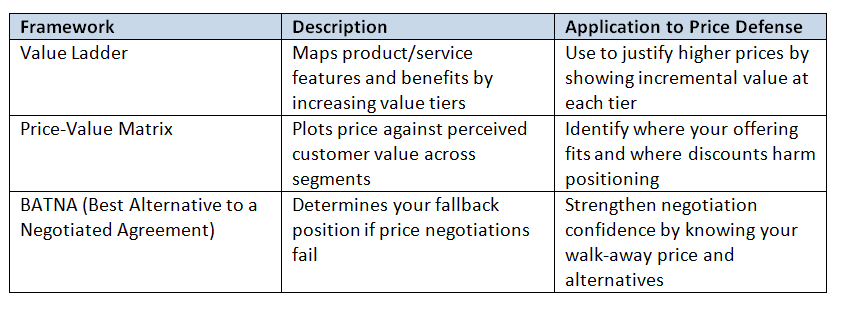
The Value Ladder helps you articulate how each pricing tier corresponds to concrete incremental benefits, reinforcing the rationale behind your price points. For example, Salesforce’s tiered CRM pricing clearly links advanced features to higher price levels.
The Price-Value Matrix aids in segmenting customers by their value sensitivity and willingness to pay, enabling targeted pricing strategies. McKinsey uses this to align consulting fees with client value creation, avoiding commodity discounting.
BATNA elevates your negotiation position by clarifying your alternatives. If the buyer demands an unsustainable discount, knowing you can walk away empowers you to hold firm or propose creative value exchanges instead.
Step-by-Step Process
Step 1: Prepare Thoroughly
Research the customer’s business, pain points, and budget constraints. Understand market benchmarks and your own cost structure. Define your BATNA clearly.
Step 2: Establish Value Before Price
Lead with value propositions, ROI calculations, and differentiation to build buyer belief that your offering justifies its price.
Step 3: Use Anchoring Strategically
Start with your full-price offer confidently to set the high anchor. Avoid premature discount signals.
Step 4: Listen and Empathize
When the buyer raises price objections, listen carefully and acknowledge their concerns without conceding.
Step 5: Reframe Price as Investment
Translate cost into business outcomes and opportunity cost of cheaper alternatives.
Step 6: Handle Objections with Scripts and Alternatives
Use prepared rebuttals and offer non-price concessions like extended terms, service upgrades, or payment plans instead of discounts.
Step 7: Close with Confidence or Walk Away
If the buyer accepts, reinforce the value and next steps. If not, be ready to walk away or schedule follow-ups.
Real-World Examples
Apple’s premium pricing on iPhones exemplifies anchoring and the price-quality heuristic. By refusing to discount significantly, Apple maintains brand exclusivity and healthy margins despite cheaper competitors.
McKinsey uses value-based pricing, tying consulting fees to client impact rather than hours billed. This approach lets them defend high prices by quantifying business outcomes delivered.
Salesforce employs tiered pricing aligned with features and customer segments. Their negotiation teams are trained to use BATNA and value framing to hold prices in complex enterprise deals, avoiding race-to-the-bottom discounting.
These companies show how strategic price defense is a competitive advantage driving profitability and brand strength.
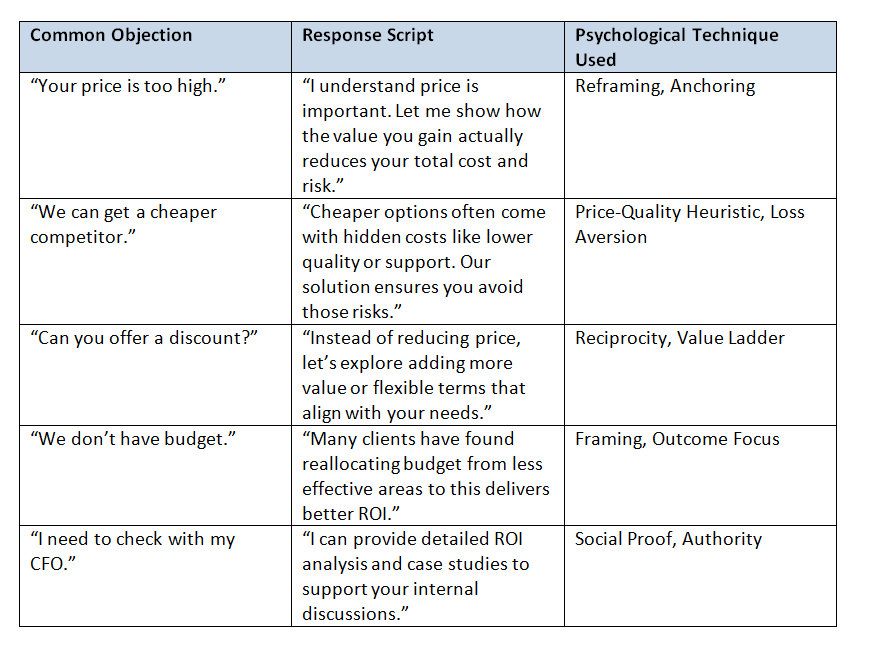
Objection Handling
Advanced Tactics
For expert sellers, advanced price defense includes:
- The Decoy Effect: Introduce a higher-priced option to make your target price look more reasonable.
- Price Partitioning: Break total price into components (software, support, customization) to reduce sticker shock.
- Time-Limited Offers: Use scarcity and urgency (Cialdini’s principles) without lowering price, e.g., “This pricing is guaranteed only for this quarter.”
- Non-Monetary Trade-Offs: Exchange additional services or exclusivity instead of discounting.
- Anchored Upselling: Present premium packages first, then standard ones look more affordable.
These tactics require nuanced timing and customer insight, but can dramatically improve price defense outcomes.
Scripts and Templates
Script 1: Initial Price Presentation
“Based on our discussion, the solution that best fits your needs is our [Product Name] at [Price]. This includes [Key Features], which will help you achieve [Specific Benefits]. Many of our clients, like [Reference], have seen [ROI Metric], which justifies this investment.”
Script 2: Price Objection Response
“I appreciate your concern about price. May I share how this investment translates into long-term savings and risk reduction? Additionally, we can explore enhancing your package with [Service] to maximize value without altering the price.”
Script 3: Discount Request Deflection
“While we don’t typically discount, I want to ensure you receive maximum value. Let’s consider options like extended payment terms or additional training sessions included at no extra cost.”
Email Template: Post-Meeting Price Reinforcement
Subject: Clarifying the Value of Our Proposal
Dear [Client Name],
Thank you for your time today. To recap, our solution at [Price] delivers [Summarized Benefits], backed by proven ROI and dedicated support. I’m confident this investment will drive measurable impact for your team.
Please let me know if you have any additional questions or would like to discuss next steps.
Best regards,
Frequently Asked Questions
Q1: How can I avoid discounting without losing the deal?
A1: Focus on demonstrating unique value, quantify ROI, and use alternative concessions like flexible terms instead of lowering price. Know your BATNA to negotiate confidently.
Q2: What if the customer insists on a discount?
A2: Politely explain why price reflects value, offer to bundle additional services or extend contract length, and be prepared to walk away if discount harms profitability.
Q3: How does anchoring affect price negotiations?
A3: The first price proposed sets an anchor that shapes buyer expectations. Present your full price confidently early to establish a high anchor and reference it throughout discussions.
Q4: Can psychological pricing tactics backfire?
A4: Yes, if perceived as manipulative or if value doesn’t match price. Always align pricing with authentic value and be transparent.
Q5: How do I handle internal pressure to discount?
A5: Educate leadership on margin impact of discounting, leverage data on lost revenue, and propose value-based pricing strategies to protect profitability.
Conclusion
Defending your price under pressure is both an art and a science that requires deep understanding of buyer psychology, rigorous preparation, and practiced negotiation skills. By mastering the frameworks, scripts, and advanced tactics outlined in this guide, you can confidently hold your pricing line while building strong customer relationships founded on value and trust.
The stakes are high: your margins, brand positioning, and long-term growth depend on resisting the discounting trap. Commit today to elevating your price defense approach and watch your deals close at premium prices with greater consistency.
Take the next step now — download our Price Defense Toolkit or schedule a personalized coaching session to start transforming your pricing conversations into profitable wins.
References
1. Kahneman, D., & Tversky, A. (1979). Prospect Theory: An Analysis of Decision under Risk. Econometrica.
2. Ariely, D. (2008). Predictably Irrational. HarperCollins.
3. Cialdini, R. B. (2009). Influence: The Psychology of Persuasion. Harper Business.
4. Huber, J., Payne, J. W., & Puto, C. (1982). Adding Asymmetrically Dominated Alternatives: Violations of Regularity and the Similarity Hypothesis. Journal of Consumer Research.
5. Nagle, T., Hogan, J., & Zale, J. (2016). The Strategy and Tactics of Pricing. Routledge.
6. McKinsey & Company. (2020). Value-Based Pricing in B2B. McKinsey Insights.