How to Define Your Negotiation Goals: A Strategic Blueprint for Business Success

In 2018, IBM negotiated a landmark multi-year cloud services contract reportedly worth over $1 billion with a major global financial institution. The secret behind IBM’s success was not just their technical prowess, but the crystal-clear definition of their negotiation goals long before the first meeting. They knew precisely what outcomes they wanted, what concessions they could afford, and where to push for value creation. This level of goal clarity gave them a significant advantage—turning a complex negotiation into a strategic win.
In today’s hypercompetitive and fast-evolving business environment, defining your negotiation goals is more critical than ever. With global supply chains under pressure, buyer power fluctuating, and digital disruption reshaping industries, organizations can no longer afford vague or wishful thinking about negotiation outcomes. Strategic goal-setting in negotiations underpins every move, from preparation and opening offers to concessions and closing. The ability to articulate and prioritize goals decisively determines whether you capture maximum value, build enduring partnerships, or walk away with losses.
This comprehensive guide will equip you to master the art and science of defining negotiation goals. You will understand the psychological and strategic fundamentals behind effective goal-setting, explore leading frameworks like BATNA, ZOPA, and MESO, and gain actionable step-by-step processes to craft your negotiation objectives. Real-world case studies from Apple, Amazon, and labor union negotiations will illustrate best practices and pitfalls. Advanced tactics, ready-to-use scripts, and a robust FAQ will ensure you leave with a practical, expert-level blueprint for negotiation success.
· Table of Contents
· The Strategic Foundation: Psychology and Theory Behind Negotiation Goals
· Key Frameworks and Models for Defining Negotiation Objectives
· Step-by-Step Process to Define Your Negotiation Goals
· Real-World Case Studies in Negotiation Goal-Setting
· Common Pitfalls and How to Avoid Them
· Advanced Tactics for Experienced Negotiators
· Scripts and Templates to Define and Communicate Your Goals
· Frequently Asked Questions on Defining Negotiation Goals
· Conclusion: Synthesizing Insights and Taking Action
· References
The Strategic Foundation: Psychology and Theory Behind Negotiation Goals
Defining negotiation goals is not merely listing what you want; it is a strategic exercise grounded in behavioral science and negotiation theory. At the heart of this lies the seminal work of Roger Fisher and William Ury, authors of "Getting to Yes," whose Harvard Principled Negotiation framework emphasizes separating people from the problem and focusing on interests rather than positions. Clear goal-setting aligns your negotiation interests and provides the foundation to explore options for mutual gain.
Daniel Kahneman’s research on cognitive biases and loss aversion underlines the importance of realistic goal expectations. His Prospect Theory demonstrates that negotiators are more motivated to avoid losses than equivalent gains, making it essential to define goals that balance ambition with feasibility. Unrealistic goals can trigger anchoring bias, tunnel vision, or escalation of commitment, sabotaging outcomes.
Robert Cialdini’s principles of influence—such as reciprocity and authority—also relate indirectly to goal clarity. When your negotiation goals are clear and credible, you enhance your perceived authority and ability to influence counterparts effectively. Shell’s "Bargaining for Advantage" further builds on this, emphasizing that goal clarity improves your ability to assess your Best Alternative to a Negotiated Agreement (BATNA) and Zone of Possible Agreement (ZOPA). Without understanding your BATNA and ZOPA, goal-setting lacks strategic grounding.
Psychological research also highlights the motivational power of setting SMART (Specific, Measurable, Achievable, Relevant, Time-bound) goals in negotiations. Locke and Latham’s Goal-Setting Theory confirms that specific and challenging goals lead to higher performance by focusing attention and mobilizing effort. This explains why top negotiators rigorously define their objectives before entering the room.
In sum, negotiation goal definition is a cognitive and strategic process informed by:
· Interest-based negotiation (Fisher & Ury)
· Cognitive biases and realistic expectation (Kahneman)
· Influence and authority dynamics (Cialdini)
· BATNA and ZOPA calibration (Shell)
· Goal-Setting Theory (Locke & Latham)
Mastering these foundations allows negotiators to build goals that are psychologically sound and strategically advantageous.
Key Frameworks and Models for Defining Negotiation Objectives
Over decades, negotiation scholars and practitioners have developed frameworks that help define and structure negotiation goals comprehensively. Understanding these models enables you to select or combine approaches tailored to your context.
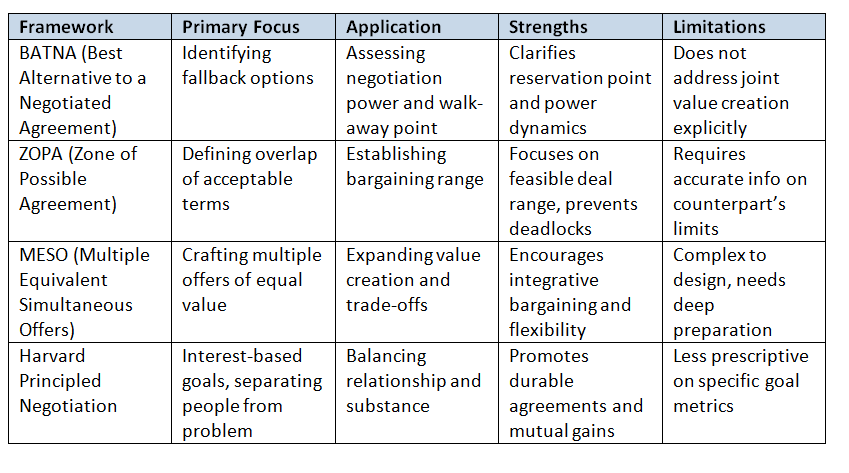
BATNA analysis compels you to define your fallback plan, which anchors your minimum acceptable outcome. For example, Amazon’s procurement teams rigorously assess supplier alternatives before goal-setting, ensuring they never accept terms worse than their BATNA.
ZOPA focuses on the overlapping region where both parties’ acceptable deals intersect. If your goals lie outside ZOPA, negotiation failure is likely. Apple’s patent cross-licensing deals with Samsung reflect methodical ZOPA identification to avoid costly litigation.
MESO advocates presenting multiple offers simultaneously, each equally valuable to you but with different trade-offs, to uncover counterpart preferences and maximize joint value. This was famously applied in IBM’s enterprise sales negotiations, allowing customized deal structures.
Harvard Principled Negotiation offers a holistic mindset emphasizing interests over positions, anchoring goals in mutual benefit, and improving long-term relationships.
Choosing and combining these models enables precise, realistic, and flexible goal-setting adapted to the negotiation context.
Step-by-Step Process to Define Your Negotiation Goals
Defining negotiation goals is a disciplined, multi-stage process. Below is a detailed walkthrough that synthesizes best practices from top negotiation experts.
Step 1: Conduct Comprehensive Stakeholder and Context Analysis
Begin by identifying all internal and external stakeholders affected by or involved in the negotiation. Gather relevant contextual data including market conditions, historical precedents, and counterpart profiles.
Ask:
· Who are the decision-makers on both sides?
· What are their interests, priorities, and constraints?
· Are there external deadlines or pressures?
Example: In labor union negotiations, understanding union leadership’s internal politics is critical before setting goals.
Step 2: Define Your Interests and Prioritize Them
Translate your position-based demands into underlying interests. Distinguish between core and peripheral interests and rank them.
Use Fisher & Ury’s approach:
· What do you really want to achieve (monetary, strategic, relational)?
· What can you trade off?
· Which interests are non-negotiable?
Example: Amazon’s procurement negotiators prioritize cost savings but are willing to trade payment terms flexibility.
Step 3: Assess Your BATNA and Your Counterpart’s BATNA
Evaluate your best alternatives if the negotiation fails. Similarly, estimate your counterpart’s BATNA.
Tools:
· Scenario analysis for fallback options
· Intelligence gathering on counterpart alternatives
Example: In M&A negotiations, a company’s BATNA might be an alternative acquisition target or continuing independently.
Your BATNA sets your reservation point, below which no deal should be accepted.
Step 4: Determine Your ZOPA and Reservation Points
Based on BATNA assessments, define the Zone of Possible Agreement.
Calculate:
· Your reservation value (worst acceptable deal)
· Your target value (desired optimal outcome)
· Counterpart’s estimated reservation and target values
Example: In Apple vs. Samsung patent negotiations, the ZOPA was narrowed precisely to avoid litigation.
Step 5: Develop Multiple Equivalent Offers (MESOs)
Design at least two to three offers that deliver equivalent value to you but vary in trade-offs, enabling you to test counterpart preferences.
Consider dimensions like:
· Price vs. volume
· Delivery schedules vs. payment terms
· Service levels vs. warranties
Example: IBM’s cloud contracts included MESOs balancing cost, customization, and support terms.
Step 6: Set SMART Goals and Document Them
Formulate goals that are:
· Specific: clear and detailed
· Measurable: quantifiable outcomes
· Achievable: realistic given constraints
· Relevant: aligned with broader strategy
· Time-bound: deadlines and milestones
Document these goals in a negotiation plan for reference and alignment within your team.
Step 7: Prepare Concession Strategy Aligned with Goals
Outline what concessions you can make and under what conditions, ensuring they do not undermine your reservation point.
Example: Amazon’s procurement team uses concession checklists and approval matrices.
Step 8: Communicate Goals Internally and Plan for Flexibility
Share your negotiation goals with your team and relevant stakeholders. Plan for contingencies and scenario adjustments.
This prevents misalignment and ensures coherent negotiation behavior.
Real-World Case Studies in Negotiation Goal-Setting
Analyzing real examples illuminates how defining negotiation goals drives outcomes.
Case Study 1: Apple vs. Samsung Patent Cross-Licensing Negotiations
Apple and Samsung were embroiled in patent disputes threatening billions in damages. Their negotiations succeeded because both parties carefully defined:
· BATNAs: Avoiding costly litigation
· ZOPA: Identifying overlapping licensing terms
· Interests: Protecting technology and market share
Apple’s team prioritized patent licensing fees balanced against avoiding business disruption, while Samsung focused on cross-licensing benefits. Their clear goals enabled an agreement that ended costly legal battles and allowed mutual innovation.
Case Study 2: Amazon’s Strategic Procurement Negotiations
Amazon’s procurement teams operate with rigorously defined negotiation goals aligned with company-wide cost leadership strategy. Before vendor talks, they:
· Analyze supplier BATNAs (alternative buyers)
· Set ambitious but realistic price targets
· Develop MESOs with varying volume discounts and payment terms
This goal clarity empowers Amazon negotiators to secure favorable terms that enhance margins and supply reliability.
Case Study 3: 2018 US Auto Workers Union Contract Negotiation
In labor negotiations between the United Auto Workers (UAW) and a major automaker, goal definition was essential. UAW prioritized:
· Wage increases and job security (core interests)
· Health benefits (secondary interest)
The automaker’s team focused on cost containment and operational flexibility. Both sides defined their BATNAs (strike vs. production slowdowns) and ZOPA precisely. The resulting contract balanced wage improvements with productivity gains, avoiding protracted strikes.
Common Pitfalls and How to Avoid Them
Poorly defined negotiation goals can doom outcomes. Recognizing pitfalls ensures corrective action.
· Pitfall: Vague or Overly Ambitious Goals
Consequence: Leads to unrealistic expectations and impasse.
Fix: Use SMART criteria and realistic BATNA analysis.
· Pitfall: Ignoring Counterpart’s Interests and BATNA
Consequence: Misjudging ZOPA, causing deal collapse.
Fix: Conduct thorough intelligence and empathy exercises.
· Pitfall: Failure to Prioritize Interests
Consequence: Wasting capital on low-value demands.
Fix: Rank interests clearly and allocate effort accordingly.
· Pitfall: Neglecting Concession Planning
Consequence: Making unstrategic concessions weakening your position.
Fix: Prepare concession matrices tied to goals.
· Pitfall: Lack of Internal Alignment
Consequence: Conflicting messages, undermining credibility.
Fix: Communicate goals across negotiation team and stakeholders.
Advanced Tactics for Experienced Negotiators
Seasoned negotiators deploy sophisticated techniques to refine goal definition.
· Dynamic BATNA Reassessment
Continuously update BATNA as new info emerges during negotiation to adjust goals.
· Scenario-Based Goal Simulation
Use decision trees and simulations to anticipate counterpart reactions and goal feasibility.
· Integrative Bargaining with MESO Expansion
Expand dimensions of negotiation beyond price to create value, adjusting goals accordingly.
· Anchoring Goals with Data-Driven Benchmarks
Leverage market data, precedent deals, and analytics to set credible, persuasive goals.
· Psychological Framing of Goals
Frame goals in ways that appeal to counterpart’s identity and values, enhancing acceptance.
Scripts and Templates to Define and Communicate Your Goals
Use these ready-made scripts and templates to articulate and share your negotiation goals effectively.
Script: Internal Team Kickoff Meeting
“Team, our primary negotiation goal is to secure a contract pricing at or below $X per unit, with delivery timelines no longer than Y weeks. Our BATNA is to onboard alternative suppliers, so any deal above $X or delays beyond Y weeks are unacceptable. We have three MESOs prepared that balance price, volume, and payment terms to maximize flexibility. Our concession limits and approval process are documented and must be adhered to. Questions or concerns?”
Email Template: Sharing Goals with Stakeholders
Subject: Negotiation Goals and Strategy Overview – [Project/Contract Name]
Dear Team,
Ahead of the upcoming negotiations with [Counterpart], please find our defined negotiation goals:
- Target price: $X per unit
- Reservation price: $Y (BATNA benchmark)
- Prioritized interests: cost, delivery, quality
- MESOs prepared: 3 variants balancing key dimensions
- Concession boundaries and approval workflows attached
Please review and provide feedback by [date]. Alignment is critical to success.
Best,
Opening Dialogue Script with Counterpart
“Thank you for meeting today. Before we dive in, I want to clarify our objectives. Our goal is to reach a partnership that delivers competitive pricing, reliable delivery schedules, and high-quality standards. We also value a collaborative approach that addresses your concerns. To achieve this, we’ve prepared multiple proposals to explore mutually beneficial options.”
Frequently Asked Questions on Defining Negotiation Goals
Q1: How do I determine if my negotiation goals are realistic?
Assess your BATNA and gather market intelligence to benchmark goals. Use SMART criteria to ensure clarity and feasibility. Discuss goals with trusted advisors or mentors for validation.
Q2: What if my counterpart’s goals are completely different?
Research their interests and constraints to find overlapping areas (ZOPA). Use MESOs to present varied offers. If no overlap exists, consider improving your BATNA or postponing negotiations.
Q3: How detailed should my negotiation goals be?
Goals should be sufficiently detailed to guide decision-making but flexible to adapt during talks. Include quantitative targets, prioritized interests, and concession parameters.
Q4: Can negotiation goals change during the process?
Yes. Dynamic reassessment based on new information or changing circumstances is vital. Update your goals and communicate changes to your team promptly.
Q5: How do I align negotiation goals with overall business strategy?
Ensure goals reflect broader organizational objectives like market positioning, financial targets, and relationship management. Involve senior leadership in goal validation.
Conclusion: Synthesizing Insights and Taking Action
Defining your negotiation goals is the cornerstone of successful bargaining. This process requires a strategic blend of psychological insight, rigorous analysis, and practical frameworks. By grounding your goals in clear interests, realistic BATNAs, and well-calibrated ZOPAs, you create a roadmap that guides every phase of negotiation.
Leading organizations like IBM, Apple, and Amazon demonstrate that precise goal-setting translates directly into superior outcomes—whether avoiding costly litigation, securing favorable contracts, or forging enduring partnerships. Avoid common pitfalls by prioritizing interests, planning concessions, and aligning internal stakeholders.
For experienced negotiators, advanced tactics like dynamic BATNA updates and MESO expansion further elevate goal effectiveness. Use the provided scripts and templates to communicate goals with clarity and authority.
Now is the time to elevate your negotiation preparation. Start by conducting a detailed stakeholder analysis and defining your interests today. Apply the step-by-step process outlined here to craft SMART, actionable negotiation goals that will empower you to negotiate with confidence and win strategically.
Take the first step: assemble your negotiation team, gather all relevant data, and begin drafting your negotiation goals. Your next negotiation’s success depends on it.
References
· Fisher, R., Ury, W., & Patton, B. (2011). Getting to Yes: Negotiating Agreement Without Giving In. Penguin Books.
· Kahneman, D. (2011). Thinking, Fast and Slow. Farrar, Straus and Giroux.
· Cialdini, R. B. (2007). Influence: The Psychology of Persuasion. Harper Business.
· Shell, G. R. (2006). Bargaining for Advantage: Negotiation Strategies for Reasonable People. Penguin Books.
· Latham, G. P., & Locke, E. A. (2007). New Developments in and Directions for Goal-Setting Research. European Psychologist, 12(4), 290–300.
· Harvard Business Review Press. (2014). Negotiation Mastery: Unlocking Value in the Real World. Harvard Business Review Press.