How to Handle Difficult Negotiations: A Complete Playbook

Negotiations can escalate quickly, especially when stakes are high and emotions run deep. Imagine a critical merger negotiation where one party abruptly accuses the other of bad faith, derailing hours of progress. Or picture a labor dispute where entrenched positions trigger hostile outbursts, and the deal seems poised to collapse. These scenarios are common in executive boardrooms, diplomatic talks, and high-stakes sales — where the wrong move in the first five minutes can ignite a downward spiral.
The psychology underpinning these clashes is complex. Most negotiators underestimate how rapidly the amygdala hijacks rational thought, leading to emotional flooding and impulsive reactions. They also overlook the power of tactical empathy — the ability to understand and verbalize the counterpart’s unspoken emotions — which Chris Voss’s FBI hostage negotiation techniques have shown to be a game changer. Without mastering these psychological triggers and strategic frameworks, negotiators risk deadlock or manipulation.
This definitive guide arms you with everything you need to master difficult negotiations. You will learn the neuroscience of conflict, proven frameworks such as William Ury’s “Going to the Balcony” and the Thomas-Kilmann Conflict Mode Instrument, and a detailed six-step process integrating behavioral science. Real-world case studies will illustrate what works and what doesn’t under pressure. You’ll discover how to recognize and neutralize manipulative tactics, deploy advanced psychological strategies, and use exact, tested scripts to regain control and close deals. Whether you’re a senior manager, lawyer, or sales leader, this playbook is your ultimate resource to transform conflict into collaboration.
· Table of Contents
· The Psychology Behind This Challenge
· Key Frameworks and Models
· Step-by-Step Process for Difficult Negotiations
· Real-World Case Studies
· Recognizing and Countering Tactics
· Advanced Techniques
· Scripts and Templates
· Frequently Asked Questions
· Conclusion
· References
The Psychology Behind This Challenge
Difficult negotiations trigger primal survival instincts before rational analysis engages. At the neurological level, the amygdala — the brain’s emotional alarm center — can hijack the prefrontal cortex responsible for thoughtful decision-making. Known as an “amygdala hijack,” this response floods the body with stress hormones like cortisol and adrenaline, shrinking cognitive bandwidth and fueling fight-flight-freeze reactions.
Daniel Kahneman’s seminal work on cognitive psychology distinguishes between System 1 and System 2 thinking. System 1 is fast, intuitive, and emotional; System 2 is slow, deliberate, and logical. Difficult negotiations often provoke System 1 dominance, especially under time pressure or perceived threats, leading to impulsive concessions or rigid refusals. Effective negotiators must consciously engage System 2 to analyze underlying interests and manage emotions.
Chris Voss, former FBI lead hostage negotiator, developed the concept of tactical empathy — deliberately identifying and articulating the other party’s emotions and perspectives to build rapport and trust. This technique counters emotional flooding described by John Gottman, who found that recognizing and soothing emotional arousal de-escalates conflict.
Social identity theory also explains stubbornness in negotiation. Individuals defend group membership (e.g., company, union, political faction) vigorously, interpreting concessions as threats to identity and status. Recognizing these dynamics enables negotiators to reframe discussions away from identity threats toward shared goals.
Understanding the interplay of emotional hijacking, cognitive biases, and social identity is critical to mastering difficult negotiations. Without this foundation, tactical moves risk backfiring by triggering deeper resistance.
Key Frameworks and Models
Negotiation mastery depends on applying structured frameworks that blend psychology and strategy. Below are three indispensable models widely used by experts:
1. Chris Voss’s FBI Negotiation Method: Emphasizes tactical empathy, calibrated questions, mirroring, and labeling to build rapport and influence.
2. William Ury’s “Going to the Balcony”: Encourages negotiators to mentally step back to manage emotions, maintain perspective, and focus on interests not positions.
3. Thomas-Kilmann Conflict Mode Instrument (TKI): Categorizes negotiation styles into five modes — competing, collaborating, compromising, avoiding, accommodating — helping negotiators adapt to context and counterpart style.
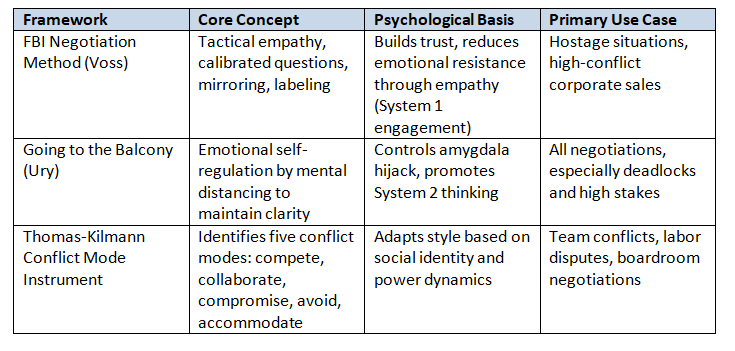
Each framework complements the others. Voss’s methods build connection, Ury’s approach preserves emotional control, and TKI informs strategic style choices. Mastery requires integrating all three according to each situation’s psychological landscape.
Step-by-Step Process for Difficult Negotiations
Mastering difficult negotiations requires a disciplined, repeatable process blending emotional intelligence with tactical action. Below is a six-step roadmap incorporating psychological insights and proven techniques.
Step 1: Prepare Thoroughly — Know Interests and Emotional Triggers
Preparation extends beyond facts and figures. Identify your core interests, your counterpart’s likely interests, and emotional hot buttons for both. Use Kahneman’s System 2 to anticipate irrational triggers. Prepare a BATNA (Best Alternative to a Negotiated Agreement) to reduce desperation.
Step 2: Establish Rapport and Use Tactical Empathy
Early moments set the tone. Use Chris Voss’s mirroring (repeating last few words) and labeling (“It seems like you’re concerned about…”) to validate emotions without agreeing. This reduces amygdala-triggered defensiveness and opens dialogue.
Step 3: Go to the Balcony — Manage Your Emotional State
If the counterpart escalates or uses manipulation, mentally “go to the balcony” per Ury’s model. Pause, observe your feelings, and consciously engage System 2 thinking. Use deep breathing or brief silence to regain control.
Step 4: Probe with Calibrated Questions
Ask open-ended, non-threatening questions to uncover interests and motivations. Examples include “How can we solve this in a way that works for both of us?” Avoid yes/no questions that trigger defensive System 1 responses.
Step 5: Identify and Counter Manipulative Tactics
Watch for tactics such as stonewalling, threats, or good cop/bad cop. Use labeling to name the tactic (“It seems like you’re trying to pressure me to decide quickly.”) and calmly reset boundaries (“Let’s focus on the facts and options available.”).
Step 6: Close with Collaborative Solutions and Confirmed Agreements
Summarize agreements aloud to ensure clarity. Use “I” statements (“I want to make sure we both benefit from this.”) to reduce social identity threats. End on a positive note, preserving relationships for future negotiations.
This process is iterative; negotiators often cycle back through steps as dynamics evolve. Mastery requires practice and emotional resilience.
Real-World Case Studies
Studying high-profile negotiations offers rich lessons on managing difficulty under pressure.
Case 1: FBI Hostage Negotiation in the 1993 Waco Siege
During the Waco standoff, FBI negotiators used tactical empathy and labeling to build rapport with David Koresh’s followers, seeking peaceful resolution. Despite eventual tragedy, early phases demonstrated the power of calm, empathic communication to reduce hostility.
Lesson: Patience and emotional validation can prevent escalation even with highly volatile counterparts.
Case 2: 2019 General Motors and United Auto Workers Labor Dispute
The 40-day strike was marked by entrenched positions and public posturing. GM negotiators used “going to the balcony” techniques to avoid reactive concessions, while union leaders leveraged social identity to rally membership. The eventual agreement balanced economic and identity-based interests.
Lesson: Recognizing social identity threats and maintaining emotional control are key in labor negotiations.
Case 3: 2018 US-North Korea Diplomatic Talks
High-stakes diplomatic negotiations faced frequent deadlocks and public brinkmanship. US negotiators applied calibrated questioning and reframed aggressive statements using tactical empathy to keep channels open.
Lesson: Advanced tactical empathy and reframing enable progress in polarized diplomatic environments.
Recognizing and Countering Tactics
Difficult negotiations often feature manipulative or defensive tactics. The table below maps common tactics, their psychological basis, and precise counter-responses.
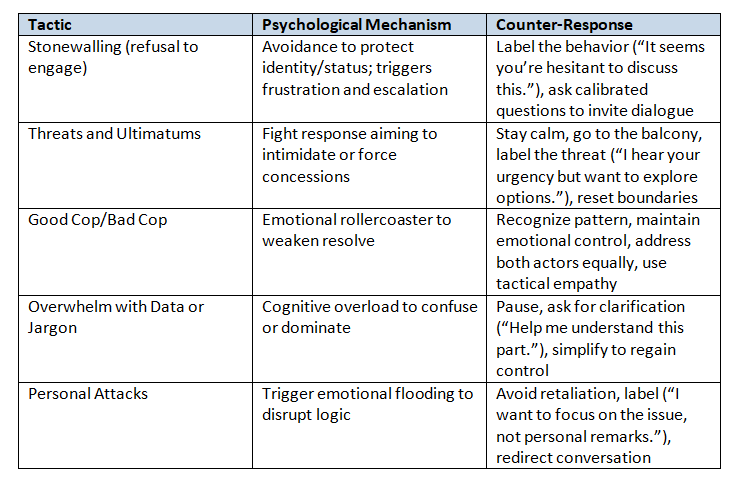
Mastering these counter-responses requires emotional regulation and presence under pressure, as Amy Cuddy’s research highlights.
Advanced Techniques
Once foundational skills are mastered, negotiators can deploy expert techniques:
- The “Accusation Audit” (Voss): Preemptively naming your counterpart’s objections reduces resistance (“You probably think I’m being inflexible.”)
- “Mirroring plus Silence”: After mirroring, pause silently to compel the other party to fill the gap, revealing more information.
- “Anchoring with Precise Numbers”: Using exact figures (e.g., $17,437 vs $17,000) leverages cognitive biases to increase perceived accuracy.
- “Third Side Perspective” (William Ury): Introducing a neutral third-party viewpoint to reduce identity conflict and create shared solutions.
- Micro-expression Reading (Paul Ekman): Detect brief emotional reveals to adjust tactics in real-time.
These sophisticated methods require situational awareness and calibrated application.
Scripts and Templates
Below are example dialogues for common difficult scenarios.
Scenario 1: Dealing with a Hostile Counterpart
“You seem frustrated by the current terms. It sounds like you’re worried this won’t meet your needs. Help me understand what’s most important to you right now.”
Scenario 2: Handling an Ultimatum
“I hear you’re set on this deadline. I want to respect your urgency, but let’s explore how we can meet your goals realistically.”
Scenario 3: Responding to Stonewalling
“I notice we haven’t been able to address this part yet. What concerns might be holding us back?”
Scenario 4: Deflecting Personal Attacks
“I want us to focus on solving the issue together. Can we set aside personal remarks and talk about the facts?”
Scenario 5: Closing an Agreement
“To summarize, we’ve agreed on X, Y, and Z. Does that capture your understanding? I want to ensure we both walk away satisfied.”
Frequently Asked Questions
Q1: How do I keep calm when the other side is aggressive?
A1: Use Ury’s “Going to the Balcony” technique — mentally detach, take deep breaths, and consciously engage your rational System 2 brain. Label the aggression calmly to de-escalate.
Q2: What if the counterpart refuses to negotiate or communicate?
A2: Identify avoidance tactics like stonewalling, then use calibrated open questions to invite dialogue. Avoid confrontation and maintain patience.
Q3: How do I recognize when I’m being manipulated?
A3: Watch for common tactics such as good cop/bad cop or overwhelming data. Use labeling to expose the tactic and reset boundaries assertively.
Q4: Can I use these techniques remotely, e.g., video calls?
A4: Yes. Tactical empathy and calibrated questions work well remotely, but be extra attentive to tone, pauses, and micro-expressions via video cues.
Q5: How do I build trust quickly with a new counterpart?
A5: Start by demonstrating tactical empathy, mirroring speech patterns, and proactively disclosing your interests transparently to create psychological safety.
Conclusion
Difficult negotiations are battlegrounds of emotion, identity, and strategy. Without deep understanding of the psychological undercurrents — from amygdala hijacks to social identity threats — even the most prepared negotiators risk costly failure. This playbook equips you with the neuroscience insights, proven frameworks, and exact scripts that top experts rely on to maintain control, build rapport, and achieve breakthrough agreements.
By mastering the six-step process, recognizing manipulative tactics, and deploying advanced techniques like tactical empathy and the accusation audit, you transform conflict into collaboration. Every negotiation is an opportunity to deepen influence and preserve relationships. Start applying these strategies today, and turn your toughest negotiations into your greatest victories.
References
- Kahneman, D. (2011). Thinking, Fast and Slow. Farrar, Straus and Giroux.
- Voss, C., & Raz, T. (2016). Never Split the Difference: Negotiating As If Your Life Depended On It. HarperBusiness.
- Ury, W. (1991). Getting Past No: Negotiating in Difficult Situations. Bantam Books.
- Gottman, J., & Silver, N. (1999). The Seven Principles for Making Marriage Work. Crown Publishers.
- Cialdini, R. B. (2006). Influence: The Psychology of Persuasion. Harper Business.
- Ekman, P. (2003). Emotions Revealed: Recognizing Faces and Feelings to Improve Communication and Emotional Life. Times Books.