How to Handle Price Pressure in Sales: The Definitive Guide to Protecting Your Margins and Closing Deals

Imagine a senior sales executive at a leading SaaS company facing a tough enterprise negotiation. The client demands a 20% discount, threatening to walk if the price isn’t lowered. Many salespeople, fearing lost revenue, cave—cutting margins and reinforcing a damaging cycle of price pressure. Yet, data from McKinsey reveals that companies who master price negotiation techniques and maintain pricing discipline can increase operating profits by up to 25%. The stakes could not be higher.
Price pressure is one of the most persistent challenges in sales. Buyers’ perception of value is often clouded by price anchors, comparison shopping, and social proof biases. Price conversations trigger deep psychological reactions—loss aversion, scarcity concerns, and perceived fairness—all of which influence decision-making beyond pure economics. Failing to address these dynamics not only erodes profits but also devalues your brand and makes future deals harder.
This comprehensive guide arms sales professionals and business leaders with the advanced behavioral economics insights, proven frameworks, and exact scripts needed to skillfully navigate price pressure. You will learn the science behind price perception, frameworks to structure your response, a detailed step-by-step process to protect margins, real-world examples from Apple to McKinsey, and expert-level tactics that go beyond the basics. Whether you’re a seasoned AE or a pricing manager, this pillar page will transform how you handle price pressure and close deals at premium prices.
· Table of Contents
· The Psychology and Science Behind Price Pressure
· Key Frameworks and Models for Price Negotiation
· Step-by-Step Process to Handle Price Pressure
· Real-World Case Studies: How Top Companies Do It
· Common Mistakes and How to Avoid Them
· Advanced Tactics for Expert Negotiators
· Scripts and Templates for Price Pressure Conversations
· Frequently Asked Questions about Price Pressure in Sales
· Conclusion: Synthesizing Insights and Next Steps
· References and Further Reading
The Psychology and Science Behind This Topic
Understanding price pressure requires a deep dive into behavioral economics and cognitive psychology. Traditional economic theory assumes rational buyers who weigh cost versus benefit objectively. In reality, as Nobel laureate Daniel Kahneman and Amos Tversky demonstrated with prospect theory, buyers do not perceive gains and losses symmetrically. Loss aversion means that a perceived price increase feels worse than the equivalent price decrease feels good, making price hikes psychologically painful.
The price-quality heuristic plays a crucial role—consumers often use price as a proxy for quality, especially in complex B2B solutions where technical differentiation is opaque. Lowering price can inadvertently signal lower value or inferior quality, eroding brand equity.
The decoy effect, where introducing a third option makes a target offering appear more attractive, is a subtle yet powerful tool to counter price pressure. Reference pricing—showing higher competitor prices or past prices—frames your offer as reasonable or even a bargain.
Finally, Robert Cialdini’s principles of influence—reciprocity, scarcity, authority, consistency, liking, and social proof—intersect with pricing psychology. For instance, creating scarcity (“limited slots”) can reduce price sensitivity, while reciprocity (“we’ve included an added service”) can justify higher prices.
Mastering these psychological levers is foundational. Negotiations are not just about numbers but managing perceptions, emotions, and cognitive biases to protect your margins and close deals on your terms.
Key Frameworks and Models
Several frameworks help sales professionals structure their approach to price pressure and negotiation:
1. **Value-Based Selling Framework** — Focuses on quantifying and communicating the economic and strategic value delivered to the client, shifting focus from price to ROI.
2. **The Four Quadrants of Price Negotiation** (Price, Value, Terms, Relationship) — Helps diagnose what levers to pull and when.
3. **Win-Win Negotiation Model (Fisher & Ury)** — Emphasizes separating people from the problem, focusing on interests, generating options, and using objective criteria.
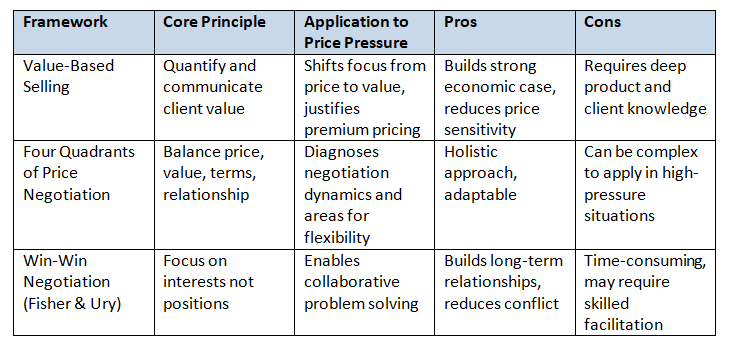
Each framework offers unique benefits; integrating them strategically enhances your ability to manage price pressure effectively.
Step-by-Step Process
Step 1: Prepare by Researching Client Value and Alternatives
Before the conversation, analyze the client’s pain points, quantify the economic impact of your solution, and research competitor pricing and terms. Preparation arms you with objective benchmarks and strengthens your position.
Step 2: Set Anchors Early with Premium Pricing and Value Messaging
Introduce your price early as a premium anchor supported by ROI-focused messaging. Use reference pricing to frame your offer as competitive relative to alternatives.
Step 3: Actively Listen and Validate Buyer Concerns
When clients push back, listen carefully to understand their underlying concerns. Validating emotions builds rapport and opens the door for collaborative problem solving.
Step 4: Reframe the Conversation Around Value and Outcomes
Use the value-based selling framework to shift focus from price as a cost to price as an investment with measurable business outcomes.
Step 5: Use Decoy and Scarcity Techniques to Strengthen Your Position
Offer tiered packages where the premium offering is the obvious best choice (decoy effect). Highlight limited availability or timing constraints to reduce price sensitivity.
Step 6: Negotiate Terms, Not Just Price
If discounting is unavoidable, negotiate on contract length, payment terms, or bundled services to preserve overall margin and value.
Step 7: Close Confidently with a Win-Win Mindset
Reiterate mutual benefits, confirm next steps, and maintain confidence in your pricing to reinforce perceived fairness and value.
Real-World Case Studies
Apple consistently refuses to discount its iPhones despite intense competition. By leveraging the price-quality heuristic and controlling the narrative around innovation and status, Apple maintains premium pricing and strong margins. Their marketing creates scarcity and social proof, making buyers less price-sensitive.
McKinsey applies value-based pricing by quantifying the financial impact of their consulting projects. They negotiate fees not on hours worked but on the value delivered, aligning incentives with clients and resisting discount pressure.
Amazon’s procurement teams use reference pricing and anchoring internally to push suppliers for better prices, but also strategically bundle contracts and focus on total cost of ownership, not just unit price. This comprehensive approach balances cost savings with supplier relationships.
Salesforce employs complex enterprise contracts combining tiered pricing, volume discounts, and long-term commitments. They train sales teams in behavioral negotiation tactics to handle price objections, emphasizing value realization and partnership.
These examples demonstrate how leading companies combine psychology, economics, and disciplined frameworks to master price pressure.
Common Mistakes and How to Avoid Them
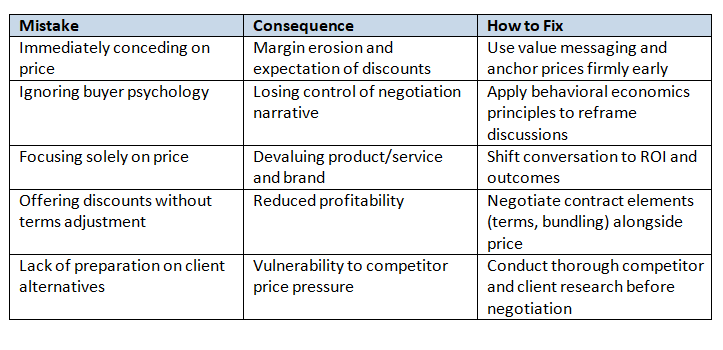
Avoiding these pitfalls is essential for preserving margin and maintaining pricing integrity.
Advanced Tactics
Top negotiators use techniques beyond basic negotiation skills:
- **Reverse Anchoring:** Introduce an even higher "premium" option early to make your actual offer seem more reasonable.
- **Time-Limited Offers:** Create urgency to reduce prolonged price haggling.
- **Reciprocity Framing:** Offer a small concession framed as a gift to trigger reciprocal behavior.
- **Bundling and Unbundling:** Repackage offerings to shift price perceptions and increase perceived value.
- **Emotional Labeling:** Explicitly name buyer emotions during negotiation to build empathy and trust.
- **Multi-Channel Follow-Up:** Use emails, calls, and social proof testimonials post-negotiation to reinforce value.
These tactics require finesse but can decisively defuse price pressure and close premium deals.
Scripts and Templates
Script 1: Handling Direct Price Objection
Client: "This price is too high compared to your competitor."
You: "I understand price is a key factor. Can I share how our solution delivers unique value that results in measurable ROI, which competitors don’t provide? For example, our clients typically see a 15% efficiency gain within six months, translating to significant cost savings."
Script 2: Responding to Discount Requests
Client: "Can you offer a discount?"
You: "I appreciate your interest in maximizing value. Instead of discounting the price, could we explore adjusting contract terms or adding complementary services that enhance your ROI while keeping the investment aligned?"
Script 3: Using Scarcity
You: "Because of high demand and our commitment to quality service, we have limited slots available for onboarding this quarter. Committing now ensures you benefit without delay and locks in current pricing."
Email Template: Post-Negotiation Value Reinforcement
Subject: Recap and Next Steps on Our Partnership
Dear [Client Name],
Thank you for the productive discussion earlier. As we reviewed, our solution’s ROI potential and tailored support will help you achieve [specific client goal]. We are excited to partner with you and committed to delivering exceptional value.
Please let me know if you need any further details as you consider next steps.
Best regards,
Frequently Asked Questions
Q1: How can I justify my price when competitors offer lower rates?
A1: Focus on the unique value your product or service delivers, quantifying ROI. Use reference pricing to frame your offer relative to market alternatives and emphasize quality, support, and outcomes over sticker price.
Q2: What if the client insists on a discount as a condition to move forward?
A2: Explore negotiating contract terms, volume commitments, or added services instead of cutting price. If discounting is unavoidable, structure it as a conditional concession tied to clear mutual benefits.
Q3: How do psychological biases affect price negotiations?
A3: Biases such as loss aversion, anchoring, and the price-quality heuristic shape how buyers perceive price and value. Understanding these helps you frame offers and responses that align with buyer psychology.
Q4: When is it appropriate to walk away from a deal due to price pressure?
A4: If the buyer’s demands erode your margins below sustainable levels or devalue your offering long-term, walking away preserves profitability and brand integrity.
Q5: How can I train my sales team to handle price pressure better?
A5: Implement training on behavioral economics, provide scripts and frameworks, conduct role-plays, and review real case studies to build skill and confidence in price negotiation.
Conclusion
Price pressure is an inevitable part of sales, but it need not dictate your margins or brand value. By mastering the underlying psychology, applying proven frameworks, and using precise, value-focused communication, sales professionals can turn price objections into opportunities to reinforce value and close premium deals. The blend of behavioral economics insights and real-world case examples in this guide provides a blueprint to elevate your pricing conversations and protect profitability.
Take the first step today—implement the step-by-step process and scripts outlined here, train your teams on these advanced tactics, and transform how your organization handles price pressure. Your margins, reputation, and long-term growth depend on it.
References
1. Kahneman, D., & Tversky, A. (1979). Prospect Theory: An Analysis of Decision under Risk. Econometrica.
2. Ariely, D. (2008). Predictably Irrational: The Hidden Forces That Shape Our Decisions. HarperCollins.
3. Cialdini, R. B. (2007). Influence: The Psychology of Persuasion. Harper Business.
4. Fisher, R., Ury, W., & Patton, B. (1991). Getting to Yes: Negotiating Agreement Without Giving In. Penguin Books.
5. McKinsey & Company. (2016). The Power of Pricing. McKinsey Quarterly.
6. Nagle, T., Hogan, J., & Zale, J. (2016). The Strategy and Tactics of Pricing: A Guide to Growing More Profitably. Routledge.