How to Handle Procurement in B2B Negotiations

In today’s hyper-competitive B2B marketplace, procurement professionals find themselves at the epicenter of value creation and cost control. Imagine a global manufacturing firm negotiating a multi-million dollar contract with a tier-1 supplier for critical components. The stakes are high: margins are tight, delivery timelines are non-negotiable, and supplier relationships directly impact production continuity. How procurement teams navigate this complex negotiation landscape can define organizational success or failure.
Handling procurement in B2B negotiations is more than just haggling over price—it requires strategic insight, deep understanding of negotiation psychology, and mastery of frameworks like BATNA (Best Alternative to a Negotiated Agreement) and ZOPA (Zone of Possible Agreement). As supply chains grow more complex and procurement processes more scrutinized, the ability to lead negotiations confidently and effectively is a must-have skill for procurement leaders.
This comprehensive guide will equip you with actionable strategies, negotiation tactics, real-world scripts, and measurable metrics to optimize your procurement negotiations. Whether you are a procurement manager, category buyer, or CPO, you will learn how to structure negotiations, engage stakeholders, leverage psychological principles, and measure success in a way that drives sustainable business value.
· Table of Contents
· Understanding the Role of Procurement in B2B Negotiations
· Preparing Thoroughly: Research, BATNA, and ZOPA Analysis
· Strategic Negotiation Frameworks and Psychological Principles
· Effective Communication and Scripted Dialogues in Procurement Talks
· Managing Multi-Stakeholder Negotiations and Internal Alignment
· Metrics and KPIs to Measure Procurement Negotiation Success
· Frequently Asked Questions
· Conclusion
· References
Understanding the Role of Procurement in B2B Negotiations
Procurement in B2B negotiations serves as the critical link between the buying organization and suppliers, responsible for securing goods and services that meet quality, cost, and delivery requirements. Unlike consumer purchasing, B2B procurement typically involves longer sales cycles, complex contracts, and multiple decision-makers on both sides.
Procurement professionals must balance cost reduction with supplier relationship management. A purely price-focused approach can jeopardize supplier commitment and operational continuity. Therefore, procurement negotiators often act as strategic partners, aiming to create win-win agreements that foster collaboration and innovation.
Real-world Example: At Siemens AG, procurement teams follow a “Total Cost of Ownership” (TCO) approach rather than focusing solely on unit price. This means negotiating terms that factor in lifecycle costs such as maintenance, supply chain risk, and sustainability initiatives — demonstrating the expanded role of procurement beyond simple price negotiation.
· Key functions of procurement in B2B negotiations:
· Supplier selection and evaluation
· Contract terms and conditions negotiation
· Risk mitigation and compliance assurance
· Cost and value optimization
· Relationship and performance management
Preparing Thoroughly: Research, BATNA, and ZOPA Analysis
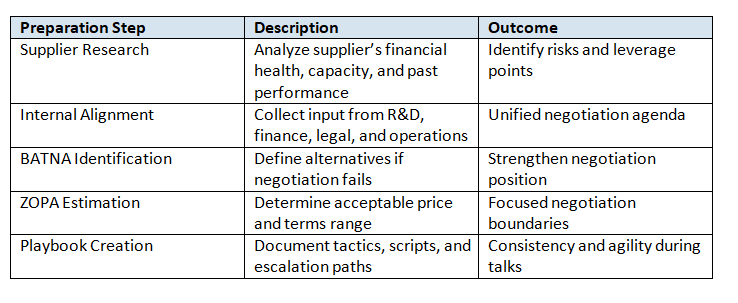
Preparation is the cornerstone of successful procurement negotiations. Effective preparation involves comprehensive supplier research, internal alignment, and identification of negotiation boundaries using frameworks like BATNA and ZOPA.
To prepare effectively:
· Conduct detailed supplier financial and operational analysis to assess stability and capacity.
· Map out internal stakeholder priorities, including budget constraints and technical requirements.
· Identify your BATNA by evaluating alternative suppliers or in-house solutions.
· Estimate the ZOPA by analyzing supplier cost structures, market benchmarks, and competitor pricing.
· Develop a negotiation playbook with clear objectives, fallback positions, and concession strategies.
Strategic Negotiation Frameworks and Psychological Principles
Mastering procurement negotiations requires integrating established frameworks with psychological principles that influence decision-making.
· The Harvard Principled Negotiation Model (People, Interests, Options, Criteria)
· The 7 Elements of Negotiation (Interests, Options, Alternatives, Legitimacy, Communication, Relationship, Commitment)
· The Negotiation Funnel — progressively narrowing issues from broad to specific
Real-world Example: GE Aviation’s procurement team employs interest-based negotiation to co-develop cost-saving innovations with suppliers, aligning both parties’ interests beyond price.
· Strategic tactics integrating these principles:
· Open with data-backed anchoring offers
· Use calibrated questions (e.g., “How can we work together to reduce lead times?”) to reveal interests
· Make small concessions linked to reciprocal supplier commitments
· Establish objective criteria (industry benchmarks, compliance standards) to justify terms
Effective Communication and Scripted Dialogues in Procurement Talks
Clear, purposeful communication is a decisive factor in procurement negotiations. Preparing scripted dialogues and question frameworks helps procurement professionals maintain control and guide discussions toward desired outcomes.
Key communication best practices include:
· Active listening to understand supplier constraints and motivations
· Using open-ended questions to explore options and concerns
· Maintaining professional tone and managing emotional triggers
· Confirming understanding through reflective summaries
Sample Script Example for Price Negotiation:
This script uses anchoring, acknowledges supplier value, and opens the door for creative problem solving.
· Communication frameworks to adopt:
· SPIN Selling (Situation, Problem, Implication, Need-Payoff) for uncovering pain points
· The 3Ps (Prepare, Probe, Propose) for structured dialogue
· The DESC Script (Describe, Express, Specify, Consequence) for addressing conflicts
Managing Multi-Stakeholder Negotiations and Internal Alignment
B2B procurement negotiations often involve multiple internal stakeholders with competing priorities: finance demanding cost savings, operations emphasizing reliability, legal focusing on risk mitigation, and sustainability teams pushing for ethical sourcing.
Successful procurement negotiators act as internal facilitators who harmonize these diverse interests before engaging suppliers. This internal alignment prevents mixed messages and strengthens the negotiation position.
Techniques to manage multi-stakeholder environments:
· Conduct pre-negotiation workshops to clarify objectives and trade-offs
· Use RACI matrices (Responsible, Accountable, Consulted, Informed) to define roles
· Develop consensus-based decision-making protocols
· Prepare an internal negotiation briefing document summarizing agreed points
Real-world Example: IBM’s procurement teams use cross-functional “Negotiation Councils” that convene prior to supplier talks to agree on priorities, escalation paths, and fallback positions. This practice has reduced contract cycle times by 30%.
· Internal alignment benefits:
· Cohesive negotiation strategy
· Faster decision-making during talks
· Reduced risk of internal conflict post-agreement
Metrics and KPIs to Measure Procurement Negotiation Success
Quantifying the effectiveness of procurement negotiations ensures continuous improvement and accountability. Key metrics include both financial and qualitative indicators.
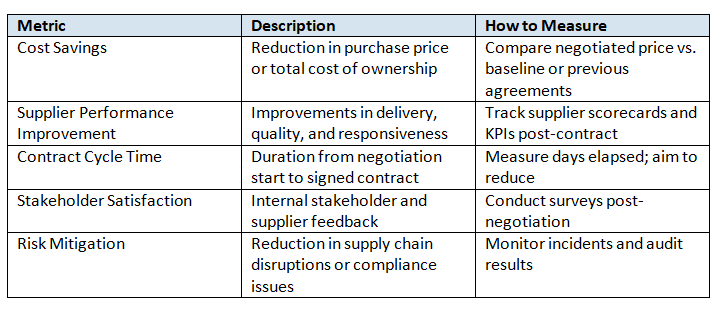
Procurement leaders should establish dashboards that combine these metrics and review them regularly. For example, a global CPG company implemented a negotiation performance dashboard that highlighted top-performing procurement teams and identified areas for targeted training.
· Tips for metric-driven negotiation management:
· Set SMART (Specific, Measurable, Achievable, Relevant, Time-bound) goals for each negotiation
· Benchmark results against industry standards
· Use data analytics to identify negotiation trends and supplier opportunities
· Incorporate feedback loops to refine negotiation playbooks
Frequently Asked Questions
Q1: How can procurement teams handle power imbalances in supplier negotiations?
A1: Power imbalances often occur when suppliers hold unique capabilities or scarce resources. Procurement teams can mitigate this by strengthening their BATNA—identifying alternative suppliers or internal substitutes. Additionally, building long-term partnerships rather than one-off deals increases collaboration. Utilizing objective criteria and involving higher management in critical negotiations can also balance power dynamics.
Q2: What role does technology play in procurement negotiations?
A2: Technology enhances procurement negotiations by providing data analytics, supplier performance dashboards, and e-auction platforms that increase transparency and competitiveness. AI-driven tools can forecast pricing trends and simulate negotiation outcomes. Virtual meeting technologies facilitate multi-stakeholder involvement and real-time document collaboration, speeding up decision-making.
Q3: How do cultural differences impact B2B procurement negotiations?
A3: Cultural differences affect communication styles, decision-making processes, and perceptions of time and trust. For example, some cultures prioritize relationship-building over directness, while others focus strictly on contract terms. Procurement teams must research cultural norms, adapt communication styles, and be patient with negotiation pacing. Employing local experts or cultural liaisons can improve outcomes.
Q4: When should procurement involve legal teams during negotiations?
A4: Legal teams should be involved early in complex negotiations involving contract terms, intellectual property, liability, or compliance issues. Early legal input helps identify risks and ensures contract language aligns with organizational policies, reducing delays during contract finalization. For standard procurement deals, legal involvement can be limited to final reviews.
Q5: How can procurement professionals recover from negotiation impasses?
A5: To recover from impasses, negotiators can:
· Revisit underlying interests to identify new options
· Introduce objective third-party benchmarks or mediators
· Break down negotiations into smaller, manageable issues
· Explore creative trade-offs such as staggered payments or volume discounts
· Take breaks to reduce tension and reassess strategies
Conclusion
Handling procurement in B2B negotiations is a sophisticated discipline that blends strategic preparation, psychological insight, and precise communication. By mastering frameworks like BATNA and ZOPA, aligning internal stakeholders, and employing data-driven metrics, procurement leaders can transform negotiations into powerful engines for value creation rather than mere cost battles.
As global supply chains continue to evolve, procurement professionals who invest in continuous learning, negotiation agility, and collaborative supplier relationships will drive competitive advantage and organizational resilience. Begin applying these proven strategies today to elevate your procurement negotiation outcomes and secure lasting business success.
References
· Fisher, R., Ury, W., & Patton, B. (2011). Getting to Yes: Negotiating Agreement Without Giving In. Penguin Books.
· Lewicki, R. J., Barry, B., & Saunders, D. M. (2015). Negotiation. McGraw-Hill Education.
· Thompson, L. (2014). The Mind and Heart of the Negotiator. Pearson Education.
· Monczka, R. M., Handfield, R. B., Giunipero, L. C., & Patterson, J. L. (2016). Purchasing and Supply Chain Management. Cengage Learning.
· Harvard Business Review. (2014). HBR Guide to Negotiating. Harvard Business Review Press.