How to Improve Negotiation Skills Quickly

Negotiation is one of the most essential skills in both professional and personal contexts. Whether you are closing a business deal, resolving conflicts, or advocating for yourself at work, your ability to negotiate effectively can dramatically impact outcomes. In today’s fast-paced and complex environment, mastering negotiation skills quickly is more critical than ever for career advancement, leadership, and relationship building.
Despite its importance, many people struggle with negotiation due to anxiety, lack of preparation, or misunderstanding key psychological dynamics. The good news is that negotiation skills can be developed rapidly through targeted strategies grounded in behavioral science and real-world practice. This article will equip you with actionable techniques, psychological principles, and exercises to accelerate your skill improvement and negotiate with confidence.
You will learn how to prepare systematically, apply proven tactics such as BATNA and anchoring, harness active listening and mirroring, and build your emotional intelligence to influence outcomes positively. Whether you are a beginner or looking to refine your approach, this comprehensive guide covers the theory and practical application necessary to become a more persuasive negotiator quickly.
· Table of Contents
· Understanding the Foundations of Effective Negotiation
· Preparing for Negotiations: Research and BATNA
· Psychological Principles in Negotiation: Anchoring, Mirroring, and Framing
· Communication Skills: Active Listening and Persuasion Techniques
· Managing Emotions and Building Rapport
· Practical Exercises and Role Plays to Accelerate Skill Development
· Frequently Asked Questions
· Conclusion
· References
Understanding the Foundations of Effective Negotiation
Negotiation is fundamentally a process of communication where two or more parties seek to reach a mutually beneficial agreement. Understanding the core components of negotiation provides a solid base for skill improvement.
Negotiations typically involve interests, positions, options, and criteria. Distinguishing between positions (what parties say they want) and interests (the underlying needs or motivations) is critical. This distinction was popularized by Fisher and Ury in their seminal book *Getting to Yes*, which introduced the principled negotiation framework. Principled negotiation emphasizes focusing on interests rather than entrenched positions to find win-win solutions.
A key psychological framework underpinning successful negotiation is the Dual Concern Model. It posits that negotiators balance concern for their own outcomes with concern for the other party’s outcomes. Effective negotiators adapt their style—competitive, collaborative, or accommodating—based on context and goals.
Real-world example: In merger discussions between two companies, negotiators who focused on shared interests such as market growth and innovation rather than rigid demands on price were able to craft creative deals that benefited both sides.
By internalizing these foundational concepts, you set the stage for applying more advanced tactics and communication strategies.
Preparing for Negotiations: Research and BATNA
Preparation is widely cited as the single most important factor in negotiation success. Thorough preparation involves gathering information about the other party, the context, and your own objectives.
One of the most powerful preparation tools is BATNA—Best Alternative to a Negotiated Agreement—developed by Roger Fisher and William Ury. Knowing your BATNA means understanding your fallback option if negotiations fail. This knowledge strengthens your position by clarifying your minimum acceptable outcome and preventing you from accepting unfavorable terms.
Preparation steps include:
· Research the other party’s background, needs, and constraints
· Define your goals and prioritize them (e.g., must-haves vs. nice-to-haves)
· Anticipate objections and prepare responses
· Identify your BATNA and estimate the other party’s BATNA
Practical exercise: Before your next negotiation, create a BATNA worksheet listing your alternatives, their feasibility, and their value. Compare this against your negotiation goals to determine reservation points.
Example: A sales executive preparing for a client deal researches the client’s budget constraints and competitive offers. Armed with this insight and a clear BATNA (other clients willing to sign), the executive negotiates assertively without fear of walking away.
Psychological Principles in Negotiation: Anchoring, Mirroring, and Framing
Negotiation is as much psychology as it is logic. Skilled negotiators leverage cognitive biases and behavioral techniques to influence outcomes.
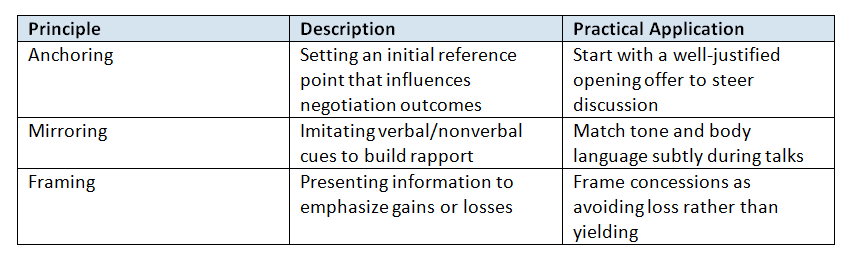
Anchoring is the cognitive bias where the first number or offer presented sets a reference point that heavily influences subsequent discussion. For instance, opening with a high but reasonable price anchor can shift the negotiation in your favor. Research shows that initial anchors affect final prices even when they are arbitrary.
Mirroring involves subtly mimicking the other party’s speech patterns, body language, or tone to build rapport and trust. It activates the principle of similarity, which increases likeability and cooperation. For example, if the other person speaks slowly and softly, matching that style can create a subconscious bond.
Framing refers to how information is presented. Positive framing (highlighting gains) or loss aversion framing (emphasizing what could be lost) can impact decision-making. Prospect Theory by Kahneman and Tversky explains that people weigh losses more heavily than gains, so framing proposals to minimize perceived losses can be effective.
Exercise: Practice anchoring by role-playing a pricing negotiation with a partner. Experiment with different opening offers and observe how the final agreement shifts.
Communication Skills: Active Listening and Persuasion Techniques
Strong communication underpins every successful negotiation. Active listening is the foundation; it involves fully concentrating, understanding, responding, and remembering what the other party says.
Active listening techniques include:
· Paraphrasing: Restate their points to confirm understanding
· Asking open-ended questions to elicit deeper information
· Using minimal encouragers like “I see” or “Go on” to show engagement
· Avoiding interruptions and distractions
Active listening reduces misunderstandings and demonstrates respect, increasing trust and openness.
Persuasion tactics grounded in Robert Cialdini’s six principles of influence are also invaluable: reciprocity, commitment and consistency, social proof, authority, liking, and scarcity. For example, highlighting your expertise (authority) or the popularity of a product (social proof) can sway decisions.
Script example for active listening:
Negotiator A: “I’m concerned about the delivery timeline.”
Negotiator B: “So, timely delivery is a key priority for you. Can you tell me more about the impact if deadlines aren’t met?”
Practicing these communication skills enhances your ability to uncover interests and move discussions constructively.
Managing Emotions and Building Rapport
Negotiations can evoke strong emotions such as frustration, anxiety, or excitement. Emotional intelligence (EI) is the ability to recognize, understand, and manage your own emotions and those of others. High EI negotiators maintain composure and use emotional cues strategically.
Strategies for emotion management include:
· Self-awareness: Monitor your emotional triggers and reactions
· Self-regulation: Use deep breathing or brief pauses to stay calm
· Empathy: Acknowledge the other party’s feelings to build rapport
Building rapport goes beyond mirroring; it involves genuine connection. Techniques include finding common ground, using inclusive language (“we” instead of “I vs. you”), and expressing appreciation.
Real-world example: During a labor negotiation, a manager noticed rising tension and paused to validate the union representative’s concerns. This acknowledgment defused hostility and opened the door for collaborative problem-solving.
Exercise: Before your next negotiation, write down three rapport-building phrases you can use and practice delivering them naturally.
Practical Exercises and Role Plays to Accelerate Skill Development
Theory alone won’t make you a better negotiator; deliberate practice is essential. Role plays with colleagues or coaches simulate real negotiation scenarios and provide immediate feedback.
Effective role play exercises include:
· Preparing and delivering opening offers with anchoring and BATNA awareness
· Practicing active listening and mirroring responses
· Handling objections calmly using emotional regulation techniques
· Framing proposals to highlight benefits and minimize perceived losses
A useful exercise is the “Win-Win Scenario”: Participants identify interests and collaboratively brainstorm options, aiming to satisfy both parties. This reinforces principled negotiation.
Another technique is video recording your role plays to observe body language and communication style objectively.
To measure progress, track outcomes and reflect on what tactics worked or need improvement. Consistent practice accelerates skill acquisition exponentially.
Frequently Asked Questions
Q1: How long does it take to improve negotiation skills?
A1: While foundational concepts can be learned quickly, mastery requires ongoing practice. With focused effort and deliberate exercises, noticeable improvement can occur within weeks. Real expertise develops over months or years through varied experiences.
Q2: What is the most effective negotiation technique for beginners?
A2: Beginners should focus on preparation, especially developing a clear BATNA and practicing active listening. These create a strong foundation and boost confidence, which is crucial early on.
Q3: How can I overcome anxiety during negotiations?
A3: Techniques such as deep breathing, visualization of positive outcomes, and thorough preparation reduce anxiety. Role-playing in low-stakes settings builds confidence progressively.
Q4: Should I always aim for a win-win outcome?
A4: Win-win outcomes are ideal as they preserve relationships and create value. However, some negotiations may require competitive tactics if interests are strictly opposed. Assess the context and balance collaboration with assertiveness.
Q5: How does culture affect negotiation styles?
A5: Cultural norms influence directness, formality, and decision-making processes. Being culturally aware and adapting your style fosters respect and effectiveness, especially in international negotiations.
Conclusion
Improving negotiation skills quickly is achievable through a blend of theoretical understanding, psychological insight, and deliberate practice. By mastering foundational concepts like BATNA, applying cognitive techniques such as anchoring and framing, honing communication skills like active listening, and managing emotions effectively, you can significantly enhance your influence and outcomes.
Commit to systematic preparation, engage in practical exercises, and seek feedback to accelerate your growth. The ability to negotiate well opens doors to better deals, stronger relationships, and greater professional success. Begin applying these strategies today to transform your negotiation approach and achieve your goals with confidence.
References
· Fisher, R., Ury, W., & Patton, B. (2011). *Getting to Yes: Negotiating Agreement Without Giving In*. Penguin Books.
· Cialdini, R. B. (2006). *Influence: The Psychology of Persuasion*. Harper Business.
· Thompson, L. (2015). *The Mind and Heart of the Negotiator*. Pearson Education.
· Mayer, J. D., Salovey, P., & Caruso, D. R. (2004). *Emotional Intelligence: Theory, Findings, and Implications*. Psychological Inquiry.
· Ury, W. (1993). *Getting Past No: Negotiating in Difficult Situations*. Bantam Books.