
How to Increase Prices Without Losing Clients: The Definitive Guide for Sales Professionals and Business Owners

Imagine you are a seasoned account executive negotiating a SaaS renewal with a Fortune 500 client. You’ve just informed them of a 15% price increase for the upcoming year. Suddenly, the client’s tone shifts — “We appreciate your service, but this is a significant jump. We’re not sure if this fits our budget.” This familiar scenario is the crucible where many pricing battles are won or lost. How do you push through without giving in to discount demands or sacrificing your margins?
This challenge is more critical than ever. According to a McKinsey report, unnecessary discounting erodes profit margins by up to 30%, often for deals that could have closed at full price. Yet, price remains the most sensitive lever in sales negotiations. Buyers’ psychological biases about price, fairness, and value shape their reactions in complex ways. Mismanaging these perceptions results in lost revenue, commoditization, and client churn.
In this comprehensive guide, you will master the science and art of increasing prices without losing clients. You will learn the underlying behavioral economics that govern price perceptions, proven frameworks to structure your pricing approach, a tactical step-by-step process for implementation, scripts to handle objections with confidence, and advanced expert-level techniques to capture maximum value. Real-world case studies from Apple, McKinsey, and Salesforce will illuminate what works at scale. Whether you lead a SaaS sales team, professional services firm, or manufacturing business, this is your blueprint to protect margins and close deals at premium prices.
· Table of Contents
· The Psychology of Price: Behavioral Economics Behind Buyer Perceptions
· Key Frameworks for Pricing Strategy Comparison
· Step-by-Step Process to Increase Prices Without Losing Clients
· Real-World Examples of Successful Price Increases
· Objection Handling: Exact Responses to Common Price Pushbacks
· Advanced Tactics to Maximize Price Acceptance
· Scripts and Templates for Price Increase Conversations
· Frequently Asked Questions About Price Increases
· Conclusion and Call to Action
· References and Further Reading
The Psychology of Price
Price is not just a number; it is a powerful signal shaping buyer behavior, often irrationally. Understanding the psychological underpinnings of price perception is essential to raising prices without alienating clients.
The seminal work of Kahneman and Tversky on prospect theory reveals that buyers experience losses more acutely than gains. A price increase is perceived as a loss relative to their reference price, triggering loss aversion. This explains why even modest increases can provoke outsized resistance.
Anchoring is another potent cognitive bias. Buyers rely heavily on an initial price reference to judge subsequent prices. Ariely’s research in "Predictably Irrational" showed that arbitrary anchors — like a high sticker price — can shift willingness to pay dramatically. Using anchoring strategically during negotiations can set favorable expectations before revealing price increases.
The price-quality heuristic leads buyers to associate higher prices with better quality or prestige, especially relevant when your product or service is a Veblen good — a luxury item where demand increases with price. Apple exemplifies this by positioning its products as premium and aspirational, allowing consistent price increases without losing loyal customers.
The decoy effect can nudge buyers toward higher-priced options by presenting a third “decoy” product that makes the premium offering seem more attractive. This behavioral economics insight is frequently leveraged in SaaS pricing tiers to gently steer clients to higher value plans.
Understanding these psychological drivers enables you to frame price increases not as losses but as justified investments in superior value, innovation, or exclusivity.
Key Frameworks
To operationalize price increases, applying robust frameworks helps structure your strategy and communication.
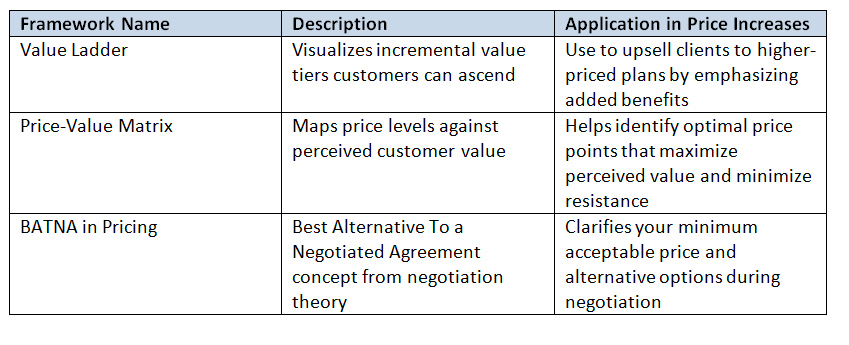
The value ladder framework guides clients through incremental upgrades, aligning price increases with tangible added value. The price-value matrix aids in segmenting clients by sensitivity and tailoring increases accordingly. BATNA equips sales professionals with fallback positions to negotiate confidently without conceding margins.
Step-by-Step Process
Step 1: Conduct Rigorous Value Analysis
Begin by quantifying the unique benefits your product or service delivers. Use customer ROI studies, case data, and competitive benchmarking to articulate the value justifying your price increase. This shifts conversations from cost to investment.
Step 2: Segment Clients Based on Price Sensitivity
Not all clients react identically. Segment your base into categories such as strategic partners, price-sensitive, and premium adopters. Tailor your messaging and increase magnitude per segment to reduce churn risk.
Step 3: Prepare Transparent Communication
Develop clear, honest messaging that explains why prices are increasing, focusing on enhanced features, inflation, or rising costs. Transparency builds trust and counters perceptions of unfairness.
Step 4: Use Anchoring and Decoy Pricing
Introduce new pricing with higher-tier options to anchor client expectations upward. Present decoy packages to steer clients toward premium offerings that justify the increase.
Step 5: Train Sales Teams on Objection Handling
Equip account managers with scripts and frameworks to confidently respond to price pushback, emphasizing value and alternatives. Role-play scenarios to build preparedness.
Step 6: Implement Phased Rollouts with Incentives
Roll out increases gradually where possible, offering early renewal discounts or bundled value-added services to ease transitions. This mitigates sticker shock and preserves relationships.
Step 7: Monitor Client Feedback and Adjust
Collect qualitative and quantitative data post-increase. Use Net Promoter Scores and churn metrics to identify pain points and fine-tune future pricing strategies.
Real-World Examples
Apple’s premium pricing strategy exemplifies how strong brand equity and innovation justify consistent price increases without significant loss of clients. They combine the price-quality heuristic with aspirational branding to make higher prices a badge of value.
McKinsey & Company employs value-based fees rather than hourly billing, tying price increases directly to measurable client outcomes. This reduces price sensitivity by framing fees as proportional to delivered impact.
Salesforce uses tiered enterprise contracts with decoy pricing to push clients toward larger packages during renewal negotiations. By anchoring with higher-priced tiers and emphasizing ROI, they successfully raise prices while maintaining retention.
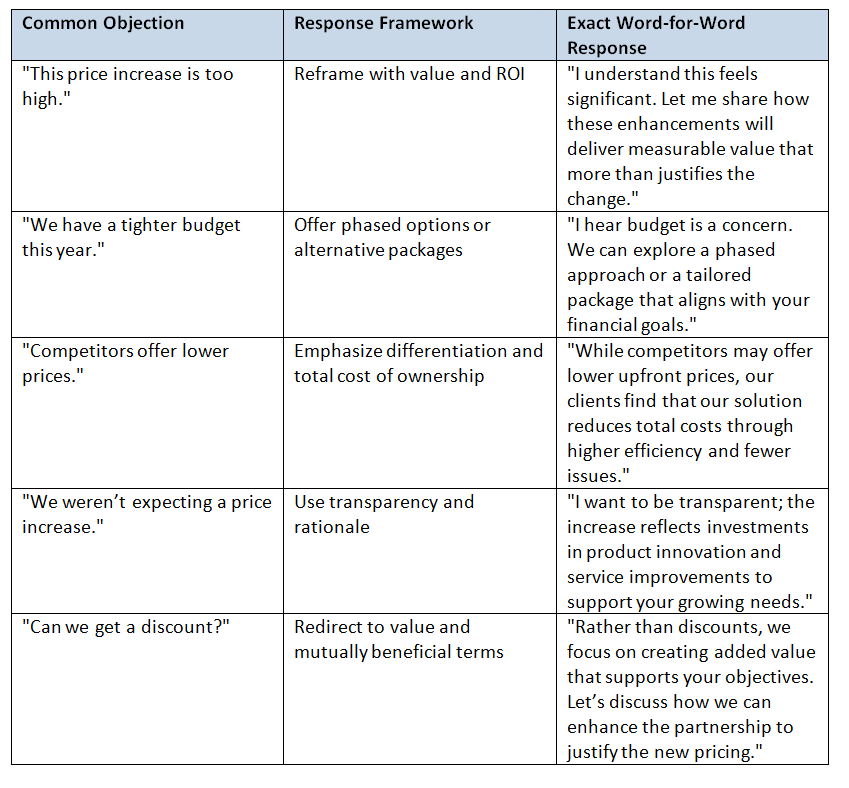
Objection Handling
Advanced Tactics
Beyond basics, expert sales teams leverage behavioral economics and negotiation psychology to maximize price acceptance:
· Use the reciprocity principle by offering a small free service or upgrade before announcing the increase, creating a sense of obligation to accept the new price.
· Employ scarcity messaging — limit the availability of grandfathered pricing to trigger urgency and reduce procrastination.
· Apply decoy pricing with artificially inflated options to make the new price look reasonable.
· Leverage social proof by sharing case studies of peers who accepted and benefited from the price increase.
· Frame increases as exclusive access to premium features or services, tapping into exclusivity biases.
Scripts and Templates
Script 1: Initial Price Increase Announcement Email
"Dear [Client Name],
We value our partnership and continuously strive to deliver exceptional value through [Product/Service]. To maintain and enhance this level of quality, we will be updating our pricing effective [Date]. This adjustment reflects our investments in new features and improved support tailored to your evolving needs.
We are committed to working closely with you during this transition. Please feel free to reach out with any questions or to discuss options that best fit your goals.
Thank you for your understanding and continued trust.
Best regards,
Script 2: Phone Conversation for Price Increase Introduction
"Hi [Client Name], I wanted to personally update you on some changes to our pricing that will take effect next quarter. These adjustments enable us to continue delivering the high-impact service and innovation you rely on. I’d love to walk you through the enhancements driving this and explore how we can maximize value for your team."
Script 3: Objection Handling – Price Too High
"I completely understand your concern. The increase aligns with significant improvements, including [specific feature or service]. Many clients have seen a [specific ROI or benefit] that offsets the change. Let’s review how this aligns with your priorities."
Script 4: Negotiation Close with Value Emphasis
"Our goal is to ensure you receive measurable results that justify your investment. If budget constraints are a factor, we can explore a customized plan or phased rollout. What is most important for you to achieve with this partnership moving forward?"
Frequently Asked Questions
Q1: How much can I increase prices without losing clients?
A1: There is no one-size-fits-all number; successful increases depend on client segmentation, value delivery, and communication. Studies suggest that increases up to 10-15% are often absorbed if justified with added value and transparency.
Q2: Should I inform clients before or after increasing prices?
A2: Always inform clients well in advance. Early communication allows time to explain rationale, address concerns, and negotiate terms, reducing churn risk.
Q3: How do I handle clients who threaten to leave because of price increases?
A3: Use BATNA analysis to evaluate the cost of losing the client versus margin protection. Engage in value-focused dialogue, offer tailored packages, or phased increases. If churn is unavoidable, ensure smooth offboarding and maintain a positive relationship for future upselling.
Q4: Can offering discounts during price increases be effective?
A4: Discounts can undermine long-term pricing power. Instead, consider value-added incentives or limited-time offers that preserve price integrity while easing transition.
Q5: How do I measure the success of a price increase?
A5: Track metrics such as churn rate, renewal rates, average deal size, customer satisfaction (NPS), and revenue growth. Qualitative feedback also provides insights for future adjustments.
Conclusion
Raising prices without losing clients is a nuanced challenge that blends rigorous analysis, psychological insight, and skilled communication. By understanding buyer biases, leveraging proven strategic frameworks, and executing a disciplined step-by-step process, you can protect and grow margins while strengthening client relationships. The real-world examples of Apple, McKinsey, and Salesforce illuminate that premium pricing is achievable when value is clear and trust is earned.
Now is the time to apply these insights and transform your price negotiations. Start by mapping your value, segmenting your clients, and crafting transparent, compelling communications. Equip your sales teams with objection-handling scripts and deploy advanced tactics to secure acceptance. Doing so will elevate your business from competing on price to commanding premium fees that reflect true value. For tailored guidance and custom pricing frameworks, contact our expert consultants today and safeguard your profitability for the long term.
References
1. Kahneman, D., & Tversky, A. (1979). Prospect Theory: An Analysis of Decision under Risk. Econometrica.
2. Ariely, D. (2008). Predictably Irrational: The Hidden Forces That Shape Our Decisions. HarperCollins.
3. Cialdini, R. B. (2006). Influence: The Psychology of Persuasion. Harper Business.
4. McKinsey & Company. (2020). The Hidden Cost of Discounting. McKinsey Insights.
5. Nagle, T. T., Hogan, J. E., & Zale, J. (2016). The Strategy and Tactics of Pricing: A Guide to Growing More Profitably. Routledge.
6. Thaler, R. H. (1985). Mental Accounting and Consumer Choice. Marketing Science.