
How to Negotiate a Salary Offer (Even If You Are Inexperienced)

Negotiating your salary offer can feel daunting, especially if you are new to the workforce or have never had to navigate this process before. Many candidates accept the first offer out of fear of rocking the boat or uncertainty about how to ask for more. However, mastering salary negotiation is a critical skill that can significantly impact your lifetime earnings and career trajectory.
This comprehensive guide will empower you with actionable strategies, psychological principles, and practical scripts designed specifically for those with limited experience in negotiation. You will learn how to research effectively, build confidence, frame your requests persuasively, and handle counteroffers like a seasoned negotiator.
By the end of this article, you will be equipped not only to negotiate a fair salary but also to set a professional tone for your future career discussions. Whether you are negotiating your first job offer or seeking a raise early in your career, these proven techniques will help you maximize your compensation with confidence.
· Table of Contents
· Understanding the Importance of Salary Negotiation
· Preparing for Your Salary Negotiation: Research and Mindset
· Effective Communication Techniques for Inexperienced Negotiators
· Using Psychological Principles to Strengthen Your Case
· Practical Salary Negotiation Scripts and Templates
· Handling Objections and Counteroffers Gracefully
· FAQs About Salary Negotiation for Beginners
· Conclusion and Next Steps
Understanding the Importance of Salary Negotiation
Negotiating your salary is more than just securing a higher paycheck; it sets the foundation for your financial growth and professional value. Research by the University of Chicago shows that individuals who negotiate their salary early in their careers can earn up to 30% more over their lifetime. This is because initial salary often determines future raises, bonuses, and benefits.
Many people avoid negotiation out of fear or misinformation. However, employers often expect some level of negotiation, especially for skilled roles. In fact, a 2023 PayScale survey found that 70% of hiring managers respect candidates who professionally negotiate and often offer better packages to those who do.
For inexperienced candidates, the key to successful negotiation is preparation and confidence. Understanding that negotiation is a dialogue, not a demand, helps reframe the process into a collaborative conversation aiming for mutual benefit.
Real-World Example: How One Graduate Increased Her Offer by 15%
Sarah, a recent marketing graduate, received an initial offer of $50,000. Using research on market rates and a polite negotiation script, she requested a meeting to discuss the offer. By highlighting her internship achievements and local salary data, she secured a $7,500 increase. This early boost set a higher baseline for her subsequent raises.
Preparing for Your Salary Negotiation: Research and Mindset
Preparation is the cornerstone of effective negotiation. Start by gathering data about the typical salary range for your role, industry, and location. Websites like Glassdoor, LinkedIn Salary, and PayScale provide transparent benchmarks based on real employee reports. Understanding this range helps you set a realistic target.
Beyond salary, consider the full compensation package: bonuses, stock options, vacation days, flexible work hours, and professional development funds. These elements can be negotiated if the base salary has limited flexibility.
Adopting the right mindset is equally important. Remember the negotiation is a normal part of the hiring process, not a confrontation. Visualize the discussion as a problem-solving session where both parties aim to achieve a win-win agreement.
· Key Preparation Steps:
· Research salary benchmarks for your position and area
· Identify your minimum acceptable salary and ideal target
· Prepare a list of your unique skills, achievements, and value-adds
· Practice your pitch aloud or with a trusted friend
· Plan for possible counteroffers or questions
The BATNA Concept: Know Your Alternatives
BATNA, or Best Alternative to a Negotiated Agreement, is a concept from negotiation theory developed by Fisher and Ury. Knowing your BATNA means understanding your options if the negotiation fails—such as accepting the original offer, pursuing other job leads, or staying in your current role. This knowledge provides leverage and confidence during discussions.
Effective Communication Techniques for Inexperienced Negotiators
How you communicate during negotiation profoundly affects the outcome. Using assertive yet respectful language fosters collaboration and leaves a positive impression.
Frame your requests around your needs and contributions rather than demands. For example, say, “I believe my internship experience and skills justify a salary of $55,000,” instead of “You should pay me more.”
This classic negotiation approach acknowledges the employer’s position before presenting your perspective:
· “I understand how you feel about the budget constraints.”
· “Others have felt similarly.”
· “But they found that increasing the offer slightly was beneficial for both sides.”
Mirroring involves repeating the last few words your counterpart says to encourage elaboration. Labeling names emotions or concerns, like “It sounds like budget is a big concern,” to build rapport.
After making a request or stating your case, pause to allow the employer to respond. Silence can prompt them to provide additional information or concessions.
Example Script for Initiating Salary Negotiation
“Thank you for the offer. I am very excited about the opportunity to join your team. Before I accept, I was hoping we could discuss the salary. Based on my research and the skills I bring, I was expecting something in the range of $X to $Y. Is there flexibility to consider this?”
Using Psychological Principles to Strengthen Your Case
Understanding human psychology can give you an edge during salary negotiations. Several principles are particularly relevant:
The first number mentioned sets a psychological benchmark. When negotiating, try to be the first to state a salary range or figure to anchor the discussion favorably.
People feel compelled to return favors. Expressing appreciation and flexibility can encourage the employer to reciprocate with a better offer.
Citing examples of peers in similar roles with comparable compensation can validate your request.
People fear losing more than they value gains. Framing your negotiation as helping the employer avoid losing a valuable candidate can motivate concessions.
· Psychological Strategies to Apply:
· Anchor your salary expectations early and confidently
· Show gratitude and express enthusiasm for the role
· Provide data and peer comparisons to justify your ask
· Frame requests to emphasize mutual benefits and risk avoidance
Real-World Negotiation Insight: Anchoring in Action
A junior software developer, Alex, was offered $70,000. When asked about salary expectations, he confidently stated a desired salary of $80,000 based on his research. The employer adjusted the offer to $78,000, influenced by the initial anchor, resulting in a better deal.
Practical Salary Negotiation Scripts and Templates
Having ready-made scripts can reduce anxiety and boost your confidence. Here are examples tailored for common scenarios:
Dear [Hiring Manager’s Name],
Thank you very much for extending the offer for the [Job Title] position. I am excited about the possibility of joining [Company Name] and contributing to your team.
After reviewing the offer, I would like to discuss the base salary. Based on my research and relevant experience, I was expecting a salary in the range of [$X - $Y]. Is there room to consider this adjustment?
I appreciate your consideration and look forward to your response.
Best regards,
Interviewer: “Do you have any questions about the offer?”
You: “Yes, I’m very excited about the opportunity. Before finalizing, I wanted to discuss the salary. Given my internship experience and skills, I was hoping for something closer to [$X]. Is that possible?”
Interviewer: “Our budget is tight, but let me check.”
You: “I understand. I am very motivated to contribute and am open to exploring options that work for both of us.”
Thank you for considering my request and for the revised offer. I appreciate the flexibility. Before making a final decision, could we discuss potential additional benefits such as professional development funds or flexible working arrangements?
Handling Objections and Counteroffers Gracefully
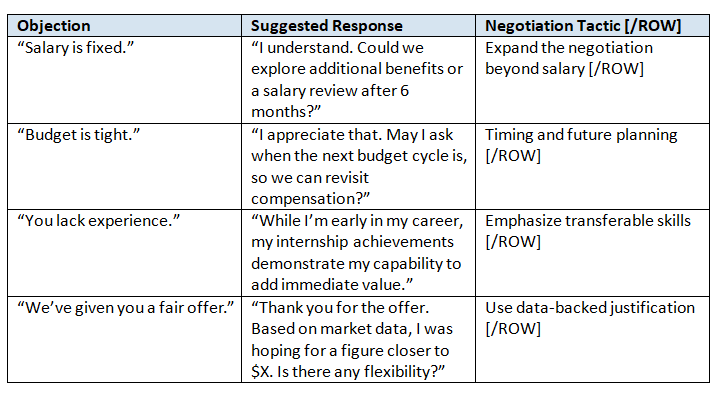
Objections are a natural part of negotiation. How you respond can determine the outcome.
· “The salary is non-negotiable.”
· “We have budget constraints.”
· “You don’t have enough experience to warrant a higher salary.”
When faced with “non-negotiable” offers, pivot to negotiating other benefits such as signing bonuses, extra vacation, or flexible hours. For budget constraints, express understanding but ask about performance reviews or salary reevaluation timelines.
If experience is questioned, highlight transferable skills, certifications, and your eagerness to learn quickly. Use the “Feel-Felt-Found” method to empathize and reframe:
“I understand you’re concerned about my experience. I felt the same initially, but I found that my proactive approach and quick learning allowed me to contribute effectively in my internship.”
· Techniques for Handling Objections:
· Stay calm and professional; avoid emotional reactions
· Acknowledge the employer’s position sincerely
· Redirect the conversation to areas with potential flexibility
· Prepare alternative requests beyond salary
Table: Negotiation Objections and Sample Responses
FAQs About Salary Negotiation for Beginners
1. Is it really necessary to negotiate my first salary offer?
Absolutely. Negotiating your first salary can set a higher baseline for future earnings and demonstrates professionalism and confidence. Even a modest increase can compound significantly over time.
2. What if I’m afraid of losing the job by negotiating?
While concerns are natural, most employers expect negotiation. Approaching the conversation respectfully and with data reduces risk. If an employer rescinds an offer solely due to negotiation, it may signal a poor fit for your future.
3. How do I know what salary to ask for if I have no experience?
Use salary research tools to find entry-level benchmarks in your field and region. Factor in your education, internships, and relevant skills. Aim for a range rather than a fixed number to show flexibility.
4. Should I negotiate salary before or after receiving a formal offer?
It’s best to wait for a formal offer to have full details. However, if asked about salary expectations earlier, provide a researched range. After the offer, you have more leverage to negotiate specifics.
5. Can I negotiate other benefits if salary isn’t flexible?
Yes. Negotiable benefits include signing bonuses, extra vacation days, flexible hours, remote work options, professional development funds, and stock options. These can add significant value to your overall compensation.
Conclusion and Next Steps
Negotiating a salary offer, even as an inexperienced candidate, is a vital career skill that can dramatically influence your financial future. By preparing thoroughly, communicating effectively, and applying psychological insights, you can confidently advocate for fair compensation without alienating employers.
Remember, negotiation is a conversation aimed at mutual benefit. Approach it with professionalism and a collaborative mindset. Practice the scripts and techniques shared here, and over time, you will build the confidence and skill to negotiate successfully in any role.
Take the next step today: research your target salary, prepare your pitch, and schedule a conversation with your prospective employer. Your career and wallet will thank you.
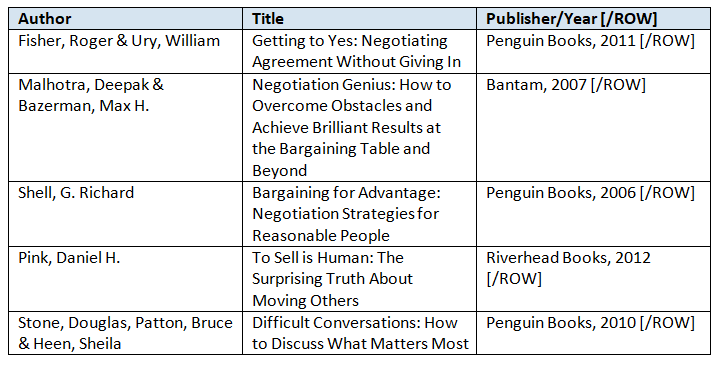
References
Mastering how to negotiate is not about tricks — it's about clarity, positioning, and control. If you want to go deeper into advanced negotiation strategies, negotiation psychology, handling objections, and negotiating under pressure, explore our full library of articles designed for professionals operating in high-stakes business environments.