How to Negotiate Better Deals in Business

Negotiation is the lifeblood of successful business transactions. Whether you are closing a sales contract, securing a supplier agreement, or navigating a partnership deal, the ability to negotiate better deals can significantly impact your bottom line. Yet, many professionals miss out on opportunities because they approach negotiations unprepared or rely on guesswork rather than proven strategies.
In this comprehensive guide, you will learn how to negotiate better deals in business by applying time-tested techniques, understanding psychological principles, and using practical tools. With insights drawn from negotiation experts and real-world examples, this article will equip you to close deals that enhance value for you and your counterparts, foster long-term relationships, and create win-win outcomes.
From mastering the art of preparation to leveraging advanced tactics like anchoring and framing, this pillar page covers everything you need to become a more effective negotiator. Whether you are a business owner, sales professional, or executive, the strategies here will help you gain confidence, control, and success in your next negotiation.
· Table of Contents
· Understanding the Fundamentals of Business Negotiation
· Preparing Effectively: Research and Goal Setting
· Key Negotiation Techniques and Psychological Principles
· Communication Skills That Influence Outcomes
· Handling Difficult Negotiations and Objections
· Closing Deals and Securing Commitments
· Common Mistakes to Avoid in Business Negotiations
· Frequently Asked Questions (FAQ)
Understanding the Fundamentals of Business Negotiation
Negotiation in business is a strategic discussion aimed at reaching a mutually beneficial agreement. At its core, negotiation involves exchanging offers and concessions to resolve differences and create value. Understanding the foundational elements of negotiation is crucial before diving into tactics.
· Preparation – gathering information and setting objectives
· Opening – establishing rapport and initial offers
· Bargaining – exchanging concessions and proposals
· Closing – finalizing agreement and commitments
· Implementation – ensuring compliance and follow-up
Real-World Example: The Apple-Foxconn Contract Negotiation
When Apple negotiates contracts with suppliers like Foxconn, they leverage their massive purchasing power and brand reputation to obtain favorable terms, while also ensuring quality and innovation. This integrative approach balances cost with long-term partnership benefits, demonstrating the importance of leveraging power responsibly.
Preparing Effectively: Research and Goal Setting
Preparation is often cited as the most critical phase of negotiation. As negotiation expert Roger Fisher famously stated, “You don’t negotiate to win; you negotiate to reach a wise agreement.”
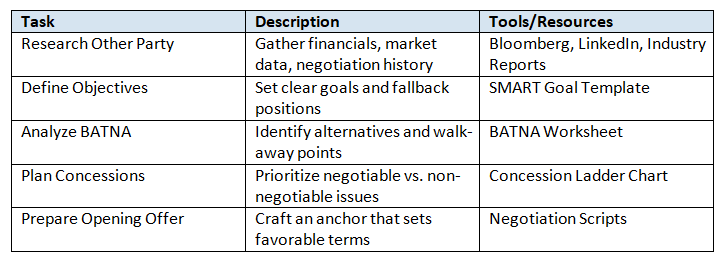
· Company financials and market position
· Decision-makers’ backgrounds and negotiation styles
· Industry norms and competitive benchmarks
· Previous deals and contract terms
Preparation Checklist for Business Negotiation
Key Negotiation Techniques and Psychological Principles
Mastering negotiation techniques and understanding the underlying psychology can transform your ability to close better deals.
Techniques in Action: The “Good Cop, Bad Cop” Strategy
This classic tactic involves one negotiator taking a tough stance while the other appears more reasonable. The contrast encourages the counterpart to align with the “good cop” for a better deal. However, overuse can damage trust if detected.
Psychological Principle: Loss Aversion
People prefer avoiding losses to acquiring gains. Highlighting what the other party stands to lose by not agreeing can be more persuasive than emphasizing benefits alone. For example, “If we don’t finalize this contract now, you may miss out on early market access.”
Communication Skills That Influence Outcomes
Effective communication is the backbone of successful negotiation. Beyond what you say, how you say it matters.
Sample Negotiation Script for Opening Dialogue
“Thank you for taking the time today. We believe this partnership has great potential. Based on our research and your company’s goals, we’ve prepared a proposal that we think aligns well. Could you share your thoughts on the key priorities you want to address in this deal?”
Handling Difficult Negotiations and Objections
Not all negotiations go smoothly. When faced with objections, deadlock, or tough counterparts, specific strategies can help.
“I understand how you feel about the price. Others have felt the same way initially, but they found that the quality and long-term savings justified the investment.”
Example: Turning a Price Objection into a Value Discussion
A vendor quoted $120,000 for software, but the client balked. Instead of lowering the price immediately, the vendor asked about the client’s priorities and demonstrated how features reduced operational costs by 20%, reframing the conversation from price to total value.
Closing Deals and Securing Commitments
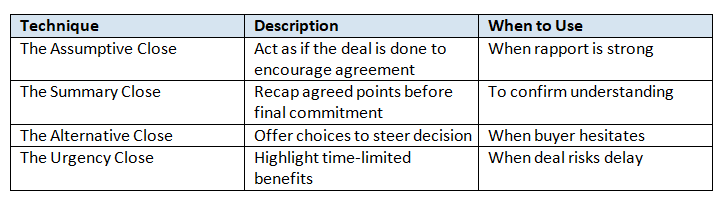
Knowing how and when to close a deal is as important as the negotiation itself.
Closing Techniques Table
Common Mistakes to Avoid in Business Negotiations
Avoiding pitfalls can save deals and enhance your reputation.
· Entering negotiations without clear objectives or BATNA
· Making the first offer without research or strategy
· Overconceding early, reducing leverage
· Ignoring the other party’s interests and motivations
· Displaying impatience or emotional reactions
· Failing to document agreements properly
· Neglecting relationship building for short-term gains
Case Study: The Cost of Poor Preparation
A mid-size manufacturer agreed to a supplier contract without researching market prices. The supplier later increased costs citing “unforeseen expenses.” The manufacturer had no BATNA and was forced to accept unfavorable terms, illustrating the importance of preparation and contract clarity.
Frequently Asked Questions (FAQ)
1. What is the most important skill for negotiating better deals?
The most important skill is effective preparation combined with active listening. Preparation equips you with knowledge and clear goals, while active listening helps uncover the other party’s true interests, enabling mutually beneficial solutions.
2. How do I handle a negotiation when the other party is aggressive or uncooperative?
Maintain composure and use assertive communication. Set boundaries politely, use objective criteria to depersonalize issues, and if necessary, suggest a break or mediation. Avoid mirroring aggression, which can escalate conflict.
3. When should I make the first offer in a negotiation?
It depends on your confidence and information. Making the first offer can set a favorable anchor if you have strong data. However, if uncertain, it may be better to let the other party reveal their position first to gather information.
4. How can I improve my BATNA?
Improving your BATNA involves developing alternative options or backup plans. This might include identifying other potential partners, exploring substitute products, or enhancing your internal capabilities to reduce dependency.
5. What role does emotional intelligence play in negotiation?
Emotional intelligence helps you recognize and manage your emotions and those of others, improving communication, empathy, and conflict resolution. High emotional intelligence enables better rapport and more adaptable negotiation strategies.
Conclusion
Negotiating better deals in business is a multifaceted process that combines preparation, psychological insight, communication skills, and strategic tactics. By understanding the fundamentals, honing your approaches, and avoiding common mistakes, you can elevate your negotiation outcomes and build stronger business relationships.
Start applying these techniques today: research thoroughly, set clear goals, leverage psychological principles like anchoring and reciprocity, communicate assertively, and close deals with confidence. With practice and persistence, you will consistently secure better deals that drive your business forward.
Take the next step now—review your upcoming negotiations and use this guide as a blueprint to transform your approach and results.
References
· Fisher, R., Ury, W., & Patton, B. (2011). Getting to Yes: Negotiating Agreement Without Giving In. Penguin Books.
· Shell, G. R. (2006). Bargaining for Advantage: Negotiation Strategies for Reasonable People. Penguin Books.
· Cialdini, R. B. (2006). Influence: The Psychology of Persuasion. Harper Business.
· Malhotra, D., & Bazerman, M. H. (2007). Negotiation Genius: How to Overcome Obstacles and Achieve Brilliant Results at the Bargaining Table and Beyond. Bantam.
· Lewicki, R. J., Saunders, D. M., & Barry, B. (2015). Negotiation. McGraw-Hill Education.