How to Negotiate Enterprise Deals

In today’s hyper-competitive B2B marketplace, the ability to negotiate enterprise deals effectively can be the defining factor between winning lucrative contracts and losing out to competitors. Imagine leading a sales team pitching a multimillion-dollar software solution to a Fortune 500 company. The stakes are high, and every word, every concession, and every proposal could tip the scales. Negotiation in this arena is not about haggling over price alone; it’s a sophisticated dance involving strategy, psychology, and deep understanding of the buyer’s needs.
Enterprise deals, characterized by their complexity, long sales cycles, and multiple stakeholders, require a tailored approach. In a market where buyers have access to abundant information and increasingly stringent procurement processes, sales leaders must master negotiation frameworks that maximize value for both parties. In this guide, you will learn actionable strategies, proven negotiation tactics, and expert-level dialogue examples that will empower you to navigate complex enterprise sales negotiations confidently and close deals that drive sustainable growth.
· Table of Contents
· Understanding the Enterprise Deal Landscape
· Preparing for Negotiation: Research and Strategy
· Core Negotiation Frameworks and Techniques
· Managing Stakeholders and Decision-Makers
· Pricing and Concession Strategies for Enterprise Deals
· Negotiation Scripts and Real-World Dialogue Examples
· Measuring Success: KPIs and Post-Negotiation Analysis
· Frequently Asked Questions
· Conclusion
· References
Understanding the Enterprise Deal Landscape
Negotiating enterprise deals differs fundamentally from transactional or SMB sales. Enterprise agreements often involve multi-year contracts, complex service level agreements (SLAs), and integration with existing systems. Additionally, the buyer’s decision process is layered across technical, financial, and executive stakeholders, each with unique priorities.
In this environment, it is essential to recognize the long-term nature of relationship-building and the impact of organizational politics. For example, a healthcare IT vendor negotiating with a large hospital system must align their proposal not only with the CIO’s technological goals but also with the CFO’s budget constraints and the compliance officer’s risk criteria. Understanding these dimensions upfront sets the foundation for a negotiation approach that is consultative rather than confrontational.
Moreover, enterprise buyers often employ formal procurement processes, including RFPs, vendor scorecards, and committee reviews. This means sellers must be prepared to engage multiple times, provide detailed documentation, and maintain flexibility without conceding strategic value. Real-world case studies from companies like Salesforce and IBM demonstrate the importance of leveraging internal champions and creating value beyond price to differentiate in competitive bids.
Preparing for B2B Negotiation: Research and Strategy
Preparation is the cornerstone of successful enterprise negotiations. This phase includes deep research on the client’s business challenges, market position, and previous vendor relationships. Using tools like LinkedIn Sales Navigator, industry reports, and internal CRM data can provide insights into the decision-making hierarchy and potential objections.
A critical step is defining your BATNA (Best Alternative to a Negotiated Agreement). Knowing your fallback options enables you to negotiate from a position of strength. For instance, if an enterprise prospect is unwilling to meet your pricing threshold, having a secondary target client or a scaled-back proposal can prevent unfavorable compromises.
Strategic preparation also involves mapping out the Zone of Possible Agreement (ZOPA)—the range within which both parties’ interests overlap. Accurately estimating ZOPA requires understanding the buyer’s budget and value drivers, which can be uncovered through discovery calls and stakeholder interviews.
· Preparation checklist for enterprise deal negotiation:
· Identify all decision-makers and influencers
· Understand buyer’s business objectives and pain points
· Analyze competitive landscape and alternative solutions
· Define your BATNA and reservation price
· Develop a multi-tiered value proposition aligned with buyer needs
· Prepare negotiation scenarios and fallback positions
Core Negotiation Frameworks and Techniques
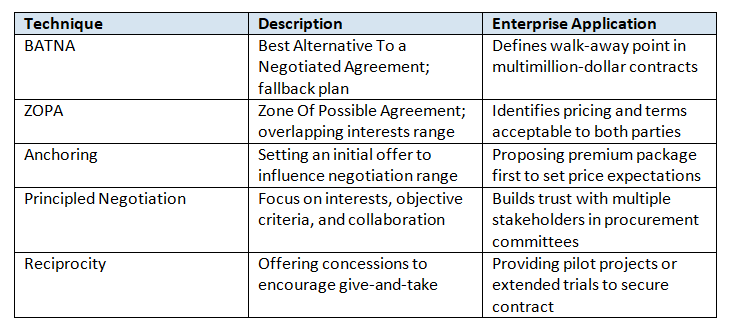
Enterprise negotiation success hinges on applying structured frameworks and psychological principles to manage complex discussions. Key frameworks include:
BATNA and ZOPA
BATNA provides clarity on when to walk away, while ZOPA identifies the mutually agreeable range. For example, a cybersecurity vendor may have a BATNA of pursuing smaller clients and a ZOPA defined by contract length and service tiers acceptable to the buyer.
Anchoring
Anchoring involves setting an initial reference point that influences the negotiation’s direction. In enterprise deals, anchoring can be used by proposing a premium-priced package first, which frames subsequent offers as concessions rather than starting points. Anchoring exploits cognitive bias where initial numbers disproportionately affect decision-making.
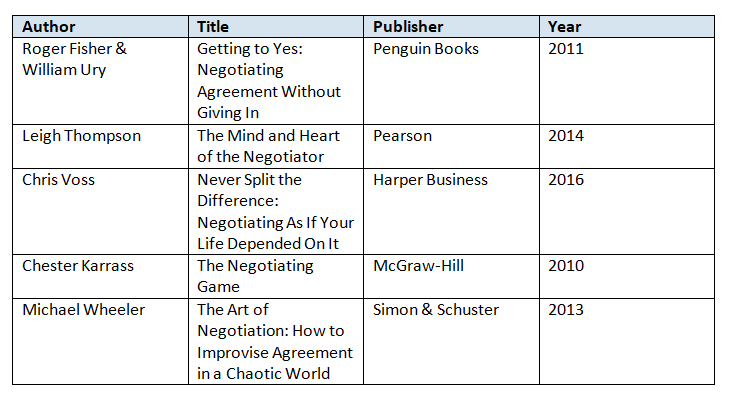
The Principled Negotiation Model (Fisher and Ury)
This model advocates separating people from the problem, focusing on interests not positions, inventing options for mutual gain, and insisting on objective criteria. Using this in enterprise deals encourages collaborative problem-solving and long-term relationship building.
Psychological Techniques
Understanding buyer psychology is vital. Techniques such as reciprocity (offering small concessions to encourage reciprocation), framing (presenting information in a way that highlights benefits), and scarcity (emphasizing limited availability or time-bound offers) can accelerate agreement.
Managing Stakeholders and Decision-Makers
Enterprise deals typically involve a web of stakeholders: procurement officers, technical evaluators, finance executives, and business unit leaders. Each has distinct motivations and concerns. Successful negotiation requires stakeholder mapping and tailored communication.
Start by identifying key decision-makers and influencers through organizational charts, LinkedIn profiles, and direct discovery. Engage with technical stakeholders to address product fit and integration concerns, while framing ROI and cost-benefit analyses for finance teams.
Use the Consensus Building technique, which involves facilitating alignment among stakeholders by uncovering shared goals and addressing conflicting interests proactively. For example, a SaaS provider negotiating a deal with a multinational might hold workshops or joint webinars to educate and align users and decision-makers.
· Tips for stakeholder management:
· Build internal champions who can advocate for your solution
· Customize messaging for each stakeholder’s priorities
· Use data-driven insights and case studies to build credibility
· Anticipate and neutralize objections before escalation
· Maintain transparency to foster trust across functions
Pricing and Concession Strategies for Enterprise Deals
Pricing enterprise deals requires balancing profitability with buyer expectations. It is critical to develop a pricing model that reflects value delivered rather than cost-plus pricing. Value-based pricing aligns contract terms with outcomes important to the client, such as efficiency gains or risk reduction.
Concession strategies should be planned and deliberate. The "Concession Ladder" technique involves starting with minimal concessions and escalating only as necessary, ensuring each concession is reciprocated. For example, a cloud services provider might offer a discount on onboarding fees in exchange for a longer contract term.
Avoid the common pitfall of conceding on price early. Instead, negotiate non-monetary terms such as support levels, training, or customization to preserve margins. Bundling services can create perceived value while protecting revenue.
Sample concession script:
Sales Rep: "Given your interest in an extended support package, we can offer a 10% discount on onboarding fees if you're comfortable committing to a 36-month term. Would that align with your budget plans?"
Buyer: "A longer contract is possible, but we’re concerned about flexibility."
Sales Rep: "Understood. We can include a clause for periodic service reviews to ensure the solution continues to meet your evolving needs."
This approach uses concession reciprocity and risk mitigation to close the deal on favorable terms.
Negotiation Scripts and Real-World Dialogue Examples
Having structured scripts for critical negotiation moments can boost confidence and effectiveness. Below is an example of a negotiation opening focusing on anchoring and establishing value:
Sales Rep: "Based on our assessment, the enterprise package that covers your full scope of needs is priced at $1.2 million annually. This includes dedicated support, integration services, and future upgrades."
Buyer: "That’s above our initial budget. We were expecting closer to $900,000."
Sales Rep: "I appreciate your budget constraints. Let's explore which features are most critical to you, and we can tailor a solution that fits your financial goals without sacrificing key capabilities."
This script uses anchoring by presenting the higher-priced package first, followed by flexibility to customize, which encourages buyer engagement rather than immediate discount demands.
Another example illustrates handling procurement pushback with principled negotiation:
Procurement: "We require a 20% price reduction to consider your proposal."
Sales Rep: "I understand price is a key factor. However, we’ve benchmarked our solution against industry standards and believe our pricing reflects the value and risk mitigation provided. Could we discuss adjusting contract terms or payment schedules to meet your budget objectives instead?"
This reframes the conversation away from pure price cuts, inviting collaborative problem-solving.
Measuring Success: KPIs and Post-Negotiation Analysis
Negotiation effectiveness should be measured beyond closed deals. Key performance indicators (KPIs) include:
· Win rate of enterprise deals
· Average deal size and contract length
· Margin preservation after concessions
· Sales cycle duration
· Stakeholder satisfaction and feedback
Post-negotiation analysis involves reviewing what worked and identifying areas for improvement. Conducting a negotiation debrief with your team helps codify best practices and refine future strategies.
Use CRM tools to track negotiation stages and outcomes systematically. Combining quantitative data with qualitative insights from client feedback can reveal patterns, such as which concession tactics yield the best returns or which stakeholders require additional engagement.
Frequently Asked Questions
1. How do I handle multiple stakeholders with conflicting priorities in an enterprise deal?
Start by mapping all stakeholders and understanding their individual goals. Use consensus-building techniques to uncover common ground and address conflicts through transparent communication. Engage stakeholders early and tailor your value proposition to resonate with each group’s needs.
2. What is the best way to prepare for a negotiation with a complex procurement process?
Thorough research is essential. Understand the buyer’s procurement policies, timelines, and evaluation criteria. Develop a BATNA and identify your ZOPA. Preparing detailed documentation and aligning your proposal with the procurement’s objective criteria increases credibility and reduces friction.
3. How can I avoid excessive discounting during negotiations?
Anchor with a strong value proposition and premium package first. Use concession ladders to make concessions gradually and only in exchange for reciprocal gains. Focus on negotiating non-price terms such as service levels or contract flexibility to maintain profitability.
4. What psychological principles can I apply to improve negotiation outcomes?
Leverage anchoring to set favorable starting points, reciprocity by offering small concessions to encourage give-back, and framing to highlight benefits aligned with buyer priorities. Scarcity and social proof can also create urgency and confidence in your offer.
5. How do I measure the success of an enterprise negotiation beyond closing the deal?
Track KPIs such as margin preservation, deal size, and sales cycle time. Solicit stakeholder feedback to assess satisfaction and identify areas for improvement. Conduct post-mortem reviews to analyze negotiation dynamics and incorporate lessons learned into future deals.
Conclusion
Mastering enterprise deal negotiation is a strategic imperative for B2B sales leaders aiming to secure high-value contracts while preserving margins and fostering long-term partnerships. By combining rigorous preparation, applying proven negotiation frameworks like BATNA and principled negotiation, and managing complex stakeholder landscapes thoughtfully, you can consistently deliver outcomes that satisfy both your organization and your clients.
Use the tactics outlined here—from anchoring to concession ladders and stakeholder engagement—to elevate your negotiation approach. Remember, negotiation is not a zero-sum game but a collaborative process designed to create mutual value. Start applying these strategies today to transform your enterprise sales results.