How to Negotiate in a Team Setting

Negotiation is often portrayed as a one-on-one interaction, but in many real-world scenarios, negotiations happen within or between teams. Whether you are representing your department in a company-wide discussion, working with a project team to decide on resource allocation, or collaborating across organizations, understanding how to negotiate effectively in a team setting is critical. Negotiating as a team adds layers of complexity — including managing internal dynamics, aligning goals, and presenting a united front — yet it also offers unique opportunities for leveraging diverse perspectives and strengths.
Why does mastering team negotiation matter? Because teams that negotiate effectively can achieve outcomes that are not only favorable but sustainable and relationship-enhancing. Poorly coordinated team negotiations can result in mixed messages, internal conflict, and lost opportunities. This guide will equip you with actionable insights and proven techniques to navigate the challenges of negotiating in teams. You’ll learn how to prepare collaboratively, communicate persuasively, manage conflict within your group, and strategically engage with opposing parties to reach agreements that satisfy everyone’s interests.
In the following sections, we’ll break down essential strategies, psychological principles, and real-world examples that demonstrate how teams can negotiate with confidence and clarity. Whether you lead a team or are a key member, this comprehensive resource will help you harness the power of collective negotiation to drive superior results.
· Table of Contents
· Understanding Team Negotiation Dynamics
· Preparing Your Team for Negotiation
· Communication Strategies Within the Team
· Managing Internal Conflict During Negotiations
· Collaborative Negotiation Techniques
· Presenting a United Front to Opposing Parties
· Post-Negotiation Follow-Up and Team Debrief
· Frequently Asked Questions (FAQ)
Understanding Team Negotiation Dynamics
Negotiating in a team setting involves more variables than individual negotiation because you must balance internal coordination with external engagement. The dynamics within your team can either empower or undermine the negotiation process. Recognizing these dynamics early is crucial to developing a strategy that leverages your team’s collective strengths.
One fundamental concept is the difference between **intra-team negotiation** and **inter-team negotiation**. Intra-team negotiation happens when members within your own group debate and align their positions before going to the negotiating table. Inter-team negotiation refers to the actual negotiation between your team and the opposing party’s team.
Psychological principles such as **social identity theory** come into play; team members identify strongly with their group, which can boost cohesion but also create internal biases. Additionally, **groupthink** is a risk — when the desire for harmony leads to poor decision-making. Awareness of these psychological tendencies allows team leaders to encourage open dialogue and critical thinking.
For example, consider a multinational corporation negotiating a joint venture. The internal team consists of finance, legal, and marketing experts, each with different priorities. Without clear understanding and management of these intra-team dynamics, the team might present conflicting demands, weakening their position.
Key Challenges in Team Negotiations
· Aligning individual team member interests with collective goals
· Managing varied communication styles and personalities
· Preventing dominance by more vocal or senior members
· Coordinating strategy and messaging effectively
· Handling disagreements without fracturing the team
Understanding these challenges early allows you to design processes that mitigate risks and leverage your team’s diverse expertise.
Preparing Your Team for Negotiation
Preparation is the cornerstone of successful team negotiation. Unlike solo negotiation, preparation here must involve systematic coordination and role assignment.
Start with a **pre-negotiation meeting** where the team clarifies its objectives, identifies negotiable and non-negotiable issues, and discusses the other party’s potential interests. Use tools such as a **Negotiation Matrix** to map out priorities and possible trade-offs.
Assign clear roles based on expertise and interpersonal skills. For example:
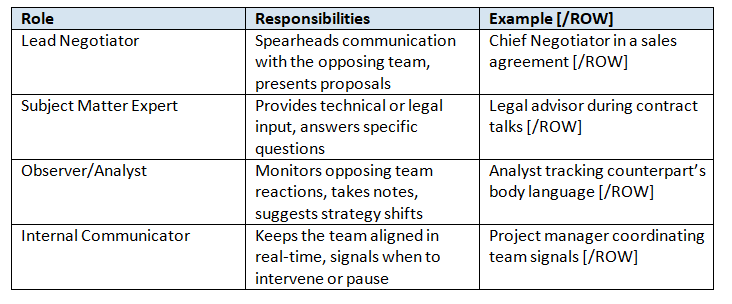
Utilize role-playing exercises within your team to simulate negotiation scenarios. This practice helps identify gaps in knowledge, test arguments, and build team confidence. One useful technique is the **“Red Team” method**, where a subset of the team adopts the opposing party’s stance to challenge assumptions and sharpen responses.
Psychological preparation is equally important. Encourage team members to adopt a **collaborative mindset** rooted in the **principle of reciprocity** — a tendency to respond positively when others make concessions. This helps shift the negotiation focus from adversarial to problem-solving.
Communication Strategies Within the Team
Effective communication inside the team during negotiations is critical to avoid misunderstandings and present a cohesive stance. Since negotiations can be fast-moving and high-pressure, establishing clear protocols for intra-team communication is essential.
One technique is to develop **non-verbal signals** or subtle cues that team members can use during meetings to indicate agreement, disagreement, or the need to interject without disrupting the flow. For example, a nod can mean “go ahead,” while a hand gesture might signal “pause and reconsider.” This method is especially useful in virtual negotiations where multiple video feeds require discreet coordination.
During the negotiation, the team should designate a **communication liaison** responsible for synthesizing inputs and feeding real-time updates to the lead negotiator. This minimizes interruptions and keeps the message clear.
Another crucial communication strategy is **active listening** within the team. Members should practice paraphrasing others’ points to confirm understanding before responding. This reduces internal conflict and helps clarify complex positions.
· Tips for intra-team communication during negotiation:
· Set clear communication protocols before the negotiation begins
· Use agreed-upon signals for quick, discreet coordination
· Encourage all voices to be heard during preparation to avoid surprises
· Keep internal debates outside the negotiation session to maintain unity
· Document key points and decisions in real-time for shared reference
An example from a technology company negotiating a supplier contract showed that teams who rehearsed their communication signals beforehand reduced internal confusion by 40%, according to a post-negotiation survey.
Managing Internal Conflict During Negotiations
Conflict within a negotiating team can undermine the entire effort if not managed effectively. Differences in opinions, priorities, or personalities are natural, but how these conflicts are addressed determines the team’s success.
Adopt a **conflict resolution framework** such as **Thomas-Kilmann’s model**, which outlines five conflict styles: competing, collaborating, compromising, avoiding, and accommodating. Encourage team members to identify their default styles and strive for collaboration or compromise during preparation.
Establish ground rules for respectful discourse, emphasizing that disagreements should be about ideas, not individuals. Use **facilitation techniques** like the **“round-robin” method**, where each member speaks in turn to ensure equal participation.
If conflict arises during the negotiation itself, the team leader can call for brief caucuses — private team discussions — to realign and address issues away from the opposing party’s view. This prevents internal conflicts from becoming public and weakening the team’s position.
· Steps to manage internal conflict effectively:
· Recognize and acknowledge differing viewpoints early
· Use structured dialogue techniques to ensure all voices are heard
· Focus on shared goals rather than individual agendas
· Practice emotional intelligence to manage stress and frustration
· Seek consensus but be prepared to make executive decisions when necessary
A classic example is the 2015 labor negotiations at a major airline where internal divisions among union representatives threatened the talks. The lead negotiator’s ability to mediate internal disagreements and present a unified stance was key to securing a successful contract.
Collaborative Negotiation Techniques
Team negotiation benefits from collaborative techniques that emphasize mutual gain rather than zero-sum competition. One highly recommended approach is **Interest-Based Negotiation (IBN)**, also known as **Principled Negotiation**, popularized by the Harvard Negotiation Project.
IBN encourages teams to:
· Separate the people from the problem
· Focus on interests, not positions
· Generate options for mutual gain
· Use objective criteria to evaluate options
Teams that employ IBN techniques create an environment where creative solutions emerge, benefiting all parties involved. For example, in a joint venture negotiation between two firms, instead of arguing over fixed budget numbers, the teams explored shared goals such as market expansion and resource sharing, leading to an innovative profit-sharing agreement.
Another technique is the **“Multiple Equivalent Simultaneous Offers” (MESO)** approach, where the team prepares several packages of offers that are equally valuable to them but differ in terms of concessions. Presenting MESOs allows the opposing team to choose the option that best suits their preferences, increasing the likelihood of agreement.
Applying **BATNA (Best Alternative to a Negotiated Agreement)** analysis as a team ensures that members understand their fallback options collectively, which strengthens their negotiating power and prevents settling for unfavorable terms.
Sample Script Using Interest-Based Negotiation in a Team Setting
Lead Negotiator: “Our goal is to find a solution that meets both our needs. Let’s identify the underlying interests behind your requests so we can explore options that work for everyone.”
Team Member (after caucus): “We’ve identified that their priority is quicker delivery. If we can adjust our timeline in exchange for a larger order volume, that could be a win-win.”
Lead Negotiator: “That’s a great insight. We’d be willing to accelerate delivery if the order size increases. Does that align with your interests?”
Opposing Team: “Yes, that proposal addresses our concerns.”
Presenting a United Front to Opposing Parties
When negotiating as a team, the opposing party closely watches for signs of disunity or mixed messaging. Presenting a united front builds credibility and strengthens your bargaining position.
To achieve this, the team should agree on key messages and stick to them consistently. Avoid contradicting each other in tone or substance. It’s useful to prepare a **team negotiation charter** — a document outlining agreed goals, key messaging, and fallback positions.
During the negotiation, designate a **spokesperson** to deliver the main points, while other members support with data, expertise, or clarifications. This prevents confusion and keeps the dialogue streamlined.
Psychological phenomenon known as the **“consistency principle”** means that people perceive consistent messages as more trustworthy and authoritative. Teams that demonstrate cohesion are more likely to influence the opposing party favorably.
In addition, use **mirroring techniques** — subtly reflecting the opposing team’s language and body language — to build rapport while maintaining your team’s composure.
· Best practices for presenting a united front:
· Pre-define who speaks and when
· Rehearse key messaging as a team
· Maintain consistent body language and tone
· Support the lead negotiator without interrupting
· Handle disagreements internally and discreetly
For example, during a high-stakes merger negotiation, a team that rehearsed their unified presentation and roles outperformed a counterpart that showed visible internal disagreement, leading to a more favorable deal.
Post-Negotiation Follow-Up and Team Debrief
The negotiation does not end when the agreement is signed. Post-negotiation follow-up and internal debriefing are crucial for consolidating gains and preparing for future negotiations.
Conduct a **team debrief session** soon after the negotiation to review what worked well and what could be improved. Use structured questions:
· Were our objectives met?
· How effectively did we communicate internally and externally?
· Did we manage internal conflicts well?
· What tactics from the opposing team surprised us?
· What lessons can we apply next time?
Document the outcomes and insights to build a knowledge base for future negotiations. Sharing this feedback promotes continuous learning and team development.
Additionally, maintain open communication with the opposing party to ensure the agreement’s terms are implemented smoothly. This reinforces trust and lays the groundwork for long-term collaboration.
Frequently Asked Questions (FAQ)
1. How do you handle a team member who dominates the negotiation and sidelines others?
Managing dominant personalities requires setting clear ground rules before negotiation begins. The team leader should intervene privately to remind the individual of the importance of inclusive participation. Techniques like structured speaking turns or the “round-robin” method can ensure balanced contributions. Encouraging quieter members to prepare points in advance also helps balance dynamics.
2. What if team members disagree on the negotiation strategy?
Disagreements on strategy are common. Use a pre-negotiation caucus to discuss differing views openly. Employ decision-making frameworks such as majority voting or consensus-building techniques. The leader may need to make the final call but should explain the rationale to maintain buy-in. Role-playing potential scenarios can also reveal the best strategies collectively.
3. How can a team avoid leaking information during negotiation?
Information security relies on trust and protocols. Limit sensitive information sharing to essential team members. Use confidential communication channels and designate a single point of contact for external communication. Training on information sensitivity and regular reminders help reinforce good practices.
4. How do you build trust within a negotiation team quickly?
Building trust requires transparency and reliability. Encourage open sharing of information and concerns during preparation. Establish norms of respect and accountability. Team-building exercises prior to negotiation can accelerate rapport. Psychological safety, where members feel safe to express views without judgment, is key.
5. Can virtual teams negotiate effectively compared to in-person teams?
Yes, virtual teams can negotiate effectively with proper preparation and tools. Video conferencing allows for real-time interaction and non-verbal cues. However, virtual teams need to be more deliberate about communication protocols and managing technology. Using collaborative platforms for document sharing and note-taking improves coordination. Scheduling brief caucuses and using chat functions for side communication also help.
Conclusion
Negotiating in a team setting presents unique challenges but also powerful advantages. By understanding team dynamics, preparing thoroughly, communicating clearly, managing conflict effectively, and employing collaborative techniques, teams can unlock superior negotiation outcomes. Presenting a united front and conducting post-negotiation debriefs further strengthens your team’s capability over time.
Whether you are new to team negotiation or looking to refine your skills, applying the strategies outlined in this guide will enhance your confidence and success. Start implementing these actionable steps today, and transform your team into a formidable negotiating force.
References
· Fisher, Roger, William Ury, and Bruce Patton. Getting to Yes: Negotiating Agreement Without Giving In. Penguin Books, 2011.
· Lewicki, Roy J., Bruce Barry, and David M. Saunders. Negotiation. McGraw-Hill Education, 7th Edition, 2015.
· Thompson, Leigh. The Mind and Heart of the Negotiator. Pearson, 7th Edition, 2014.
· Shell, G. Richard. Bargaining for Advantage: Negotiation Strategies for Reasonable People. Penguin Books, 2006.
· Bazerman, Max H., and Margaret A. Neale. Negotiating Rationally. Free Press, 1992.