How to Negotiate in Email (Templates Included)

Negotiating effectively over email is a critical skill in today’s business world. Unlike face-to-face or phone negotiations, email communication lacks immediate feedback and vocal cues, making it essential to craft messages that are clear, persuasive, and strategically structured. Whether you’re discussing contract terms, salary, project deadlines, or vendor agreements, your ability to negotiate successfully via email can directly impact your professional outcomes.
Understanding the nuances of email negotiation is more than just polite phrasing—it involves applying psychological principles, mastering the timing of your messages, and using templates that provide a reliable framework for success. This guide will equip you with actionable strategies, real-world examples, and ready-to-use email templates to help you negotiate confidently and close better deals through email.
In this comprehensive article, you will learn how to prepare for email negotiations, structure your messages for maximum impact, handle objections, and use proven psychological tactics to influence outcomes. Additionally, you’ll find templates designed for various negotiation scenarios, ensuring you have practical tools at your fingertips.
· Table of Contents
· Understanding the Unique Challenges of Email Negotiation
· Preparing for Your Email Negotiation
· Writing Effective Negotiation Emails: Structure and Tone
· Psychological Principles to Apply in Email Negotiations
· Handling Objections and Counteroffers via Email
· Proven Email Negotiation Templates for Common Scenarios
· Frequently Asked Questions About Email Negotiation
· Conclusion and Next Steps
Understanding the Unique Challenges of Email Negotiation
Email negotiation differs fundamentally from in-person or phone negotiations because it removes immediate interpersonal feedback. This asynchronous communication style presents both advantages and pitfalls. On the positive side, email allows you time to carefully craft your response, reflect on offers, and consult with others before replying. On the downside, the lack of tone, facial expressions, and vocal inflections can lead to misunderstandings or perceived coldness.
One significant challenge is the risk of ambiguity. Without vocal cues, phrases can be misinterpreted, potentially escalating conflict or causing confusion. For example, a direct refusal in email might come across as blunt or dismissive, even if that was not the intention.
Another challenge is maintaining engagement. Since email threads can become long and unwieldy, it’s easy for both parties to lose focus or delay responses, stalling the negotiation process.
A sales manager once tried to negotiate a contract extension solely by email. Without clear, empathetic language and timely replies, the client felt ignored and ultimately chose to switch providers. This example underscores the importance of clarity, tone, and responsiveness in email negotiations.
To overcome these challenges, it’s essential to approach email negotiation with a strategic mindset, blending clarity, psychological insight, and a methodical structure.
Preparing for Your Email Negotiation
Preparation is the foundation of any successful negotiation, and email is no exception. The more you understand your objectives, the other party’s interests, and the context, the better your chances of reaching a favorable agreement.
Before drafting your email, clearly define your goals. Are you negotiating price, timelines, responsibilities, or something else? Establish your ideal outcome as well as your minimum acceptable terms.
Gather as much information as possible about the other party’s needs, constraints, and previous negotiation behavior. For instance, if negotiating a vendor contract, review past agreements or any public information about their pricing strategies.
Think through potential objections or counteroffers the recipient might raise. Preparing responses in advance will help you craft a more compelling initial email and avoid being caught off guard.
BATNA, or Best Alternative to a Negotiated Agreement, is a key negotiation concept introduced by Fisher and Ury in their book "Getting to Yes." Knowing your BATNA gives you leverage and confidence. If the email negotiation stalls or fails, what alternatives do you have?
Consider the timing when sending your negotiation email. Avoid sending critical offers late on Fridays or during holidays when responses may be delayed. Also, ensure you’re in a distraction-free environment to respond thoughtfully to replies.
Checklist for Preparing to Negotiate via Email
· Clearly outline negotiation objectives and priorities
· Research the other party’s background and interests
· Anticipate objections and prepare responses
· Establish your BATNA and reservation point
· Choose appropriate timing for sending emails
· Prepare any supporting documentation or references
Writing Effective Negotiation Emails: Structure and Tone
Crafting an effective negotiation email requires precision in structure and tone to ensure your message is clear, persuasive, and respectful.
1. Subject Line: Concise, relevant, and attention-grabbing. Examples: “Proposal for Contract Terms,” “Request to Discuss Project Deadlines,” or “Negotiation on Pricing Terms.”
2. Opening Greeting: Use a polite, professional greeting that matches your relationship with the recipient.
3. Opening Statement: Briefly acknowledge the current situation or prior communication to set context.
4. State Your Position Clearly: Present your proposal or request in clear terms, avoiding ambiguity.
5. Justify Your Position: Use data, logic, or mutual benefits to support your request.
6. Invite Collaboration: Encourage dialogue and express openness to feedback or counteroffers.
7. Closing: Politely close with a call to action or request for response.
8. Signature: Include your full name, title, and contact information.
The tone should be professional yet warm. Avoid overly aggressive language, which can provoke defensiveness, and steer clear of excessive politeness that may dilute your position. Aim for assertiveness balanced with empathy.
“Thank you for your continued partnership. I wanted to revisit the terms of our current agreement to explore opportunities for mutual benefit as our project scope evolves.”
Techniques to Enhance Clarity and Persuasion
· Use concise sentences and avoid jargon or overly complex language.
· Employ positive framing; for example, “I propose a revised delivery timeline to ensure quality” rather than “We can’t meet the original deadline.”
· Use bullet points or numbered lists to organize complex information.
· Highlight benefits for both parties to foster a collaborative tone.
· Incorporate polite hedging phrases such as “I would appreciate your thoughts on…” to invite input without sounding confrontational.
Psychological Principles to Apply in Email Negotiations
Understanding and leveraging psychological principles can dramatically improve your email negotiation outcomes. Here are some key concepts:
People feel compelled to return favors or concessions. Offering a small concession early in your email can encourage the other party to reciprocate.
The first number or offer mentioned sets the reference point for the negotiation. Carefully craft your initial offer to anchor the discussion favorably.
Referencing past successful collaborations or industry standards can build credibility and reduce resistance.
Communicating limited availability or time-sensitive offers can motivate quicker decisions.
How you present information influences perception. Framing an offer as a gain rather than a loss increases acceptance.
In an email negotiating a software subscription, you might say, “Based on our long-standing relationship and your status as a valued client (social proof), we are pleased to offer a 10% discount if the contract is renewed by the end of this month (scarcity).”
Using the “Foot-in-the-Door” Technique
This technique involves making a small, reasonable request first to gain agreement, then following with a larger request. In email negotiation, begin by asking for a minor concession before proposing your main terms.
Handling Objections and Counteroffers via Email
Objections are a natural part of negotiation. Responding effectively to them via email requires patience, clarity, and tact.
Always begin by acknowledging the other party’s concerns to show empathy and respect. For example, “I understand your concerns about the proposed timeline.”
This classic negotiation technique can be adapted for email:
- Feel: “I understand how you feel about the pricing.”
- Felt: “Others have felt similarly.”
- Found: “What they found is that adjusting the scope allowed for cost savings without impacting quality.”
Reiterate your key points with supporting evidence, avoiding emotional language.
Encourage collaboration by asking, “What adjustments would you propose to address your concerns?”
“Thank you for sharing your thoughts on the budget constraints. I understand this is an important factor (feel). Several clients have felt the same way initially (felt). However, they found that by extending the payment schedule, the investment became more manageable (found). Would you be open to discussing a phased payment plan?”
Managing Counteroffers
When you receive a counteroffer, review it carefully against your BATNA. Respond with appreciation and analysis, highlighting where there is alignment and where further discussion is needed.
Use clear, numbered points to address each aspect of the counteroffer to avoid confusion.
Proven Email Negotiation Templates for Common Scenarios
Below are several templates tailored to common negotiation contexts. Customize these to fit your specific situation.
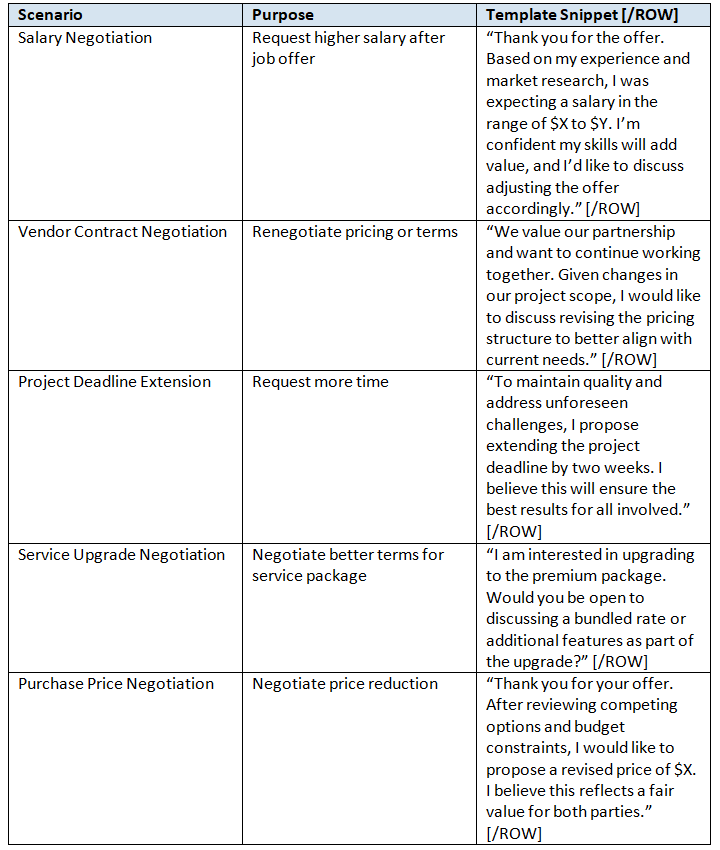
Template for Initial Negotiation Email
Subject: Proposal for [Negotiation Topic]
Dear [Recipient’s Name],
I hope this message finds you well. I am writing to discuss [briefly state the negotiation topic]. After reviewing our current agreement and considering recent developments, I would like to propose the following adjustments:
· Point 1: [Clear statement of request or offer]
· Point 2: [Supporting justification or benefits]
· Point 3: [Invitation for feedback or alternative options]
I believe these changes will support our mutual goals and strengthen our collaboration. I look forward to hearing your thoughts and working together toward a solution that benefits both parties.
Best regards,
Frequently Asked Questions About Email Negotiation
1. How can I maintain a positive tone in a negotiation email without sounding weak?
Maintaining positivity while being assertive involves using respectful language, clearly stating your position, and focusing on mutual benefits. Avoid passive or apologetic phrases, and instead use confident wording like “I propose” or “I suggest.” Balancing firmness with empathy ensures your message is taken seriously without creating hostility.
2. How quickly should I respond to negotiation emails?
Timeliness is important. Responding within 24 hours shows respect and engagement. However, don’t rush responses; take time to consider offers and objections carefully. If more time is needed, send a brief acknowledgment email indicating that you are reviewing the matter and will reply with a detailed response soon.
3. What should I do if the other party is unresponsive?
Follow up politely after 3-5 business days with a concise reminder, reiterating your interest in resolving the issue. Avoid multiple rapid follow-ups, which can seem pushy. If unresponsiveness persists, evaluate your BATNA and consider alternative approaches, such as phone calls or involving a mediator.
4. Can I use humor in negotiation emails?
Humor can build rapport but is risky in email due to lack of tone and potential cultural differences. Use humor sparingly and only if you have an established relationship where it is appropriate. Otherwise, keep the tone professional to avoid misunderstandings.
5. How do I close a negotiation email effectively?
End with a clear call to action, such as requesting a meeting, asking for confirmation, or inviting counteroffers. Use polite closing statements like “I look forward to your response” or “Please let me know your thoughts.” This encourages continued dialogue and signals your openness to collaboration.
Conclusion and Next Steps
Negotiating via email requires a careful blend of preparation, clear communication, and psychological insight. By understanding the unique challenges of asynchronous written communication and applying structured strategies, you can negotiate effectively, maintain strong relationships, and achieve your goals. Using the templates and techniques provided in this guide will give you a solid foundation to approach any negotiation confidently.
Now is the time to put these strategies into practice. Start by reviewing your upcoming negotiations and drafting emails using the templates as a guide. Remember, successful negotiation is not about winning at all costs but creating mutually beneficial agreements. Take control of your email negotiations today and watch your professional outcomes improve.
References
· Fisher, R., Ury, W., & Patton, B. (2011). Getting to Yes: Negotiating Agreement Without Giving In. Penguin Books.
· Cialdini, R. B. (2006). Influence: The Psychology of Persuasion. Harper Business.
· Malhotra, D., & Bazerman, M. H. (2007). Negotiation Genius: How to Overcome Obstacles and Achieve Brilliant Results at the Bargaining Table and Beyond. Bantam.
· Stone, D., Patton, B., & Heen, S. (2010). Difficult Conversations: How to Discuss What Matters Most. Penguin Books.
· Shell, G. R. (2006). Bargaining for Advantage: Negotiation Strategies for Reasonable People. Penguin Books.