How to Negotiate in Meetings vs. Online Calls

Negotiation is a critical skill in business, influencing outcomes from contract deals to team collaborations. While the fundamentals of negotiation remain consistent, the medium—whether an in-person meeting or an online call—significantly affects the approach and effectiveness of your negotiation tactics. As remote work and virtual communication become ubiquitous, mastering negotiation across both environments is essential for professionals aiming to achieve optimal results.
Understanding the nuances between negotiating face-to-face and through digital platforms can empower you to adapt your strategies, leverage psychological cues, and overcome common barriers such as reduced nonverbal signals or technical glitches. This article will dive deep into the distinct challenges and opportunities presented by each setting, provide actionable techniques, and equip you with scripts and frameworks to negotiate successfully regardless of the context.
By the end of this comprehensive guide, you will know how to tailor your negotiation preparation, communication style, and closing techniques specifically for in-person meetings and online calls. You’ll learn how to read body language, manage rapport, handle distractions, and use proven psychological principles like anchoring and reciprocity to tip the scales in your favor.
· Table of Contents
· Understanding the Key Differences Between In-Person and Online Negotiations
· Preparing for Negotiations: Meeting vs. Online Call
· Communication Techniques: Leveraging Verbal and Nonverbal Cues
· Psychological Principles to Apply in Each Format
· Handling Challenges Unique to Each Environment
· Real-World Negotiation Scripts and Templates
· Measuring Success and Follow-Up Strategies
· FAQ: Common Questions About Negotiating in Different Settings
· Conclusion and Next Steps
Understanding the Key Differences Between In-Person and Online Negotiations
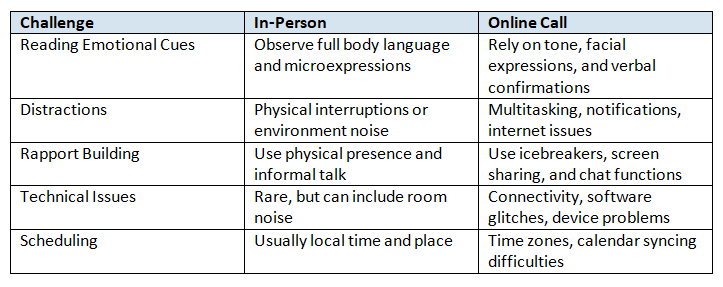
Negotiating in person and negotiating online are fundamentally different experiences that require tailored approaches. The most obvious distinction lies in the quality and quantity of communication channels available. In-person meetings provide rich, synchronous cues such as body language, eye contact, and physical presence, which can be crucial for building rapport and detecting sincerity or hesitation.
In contrast, online calls often limit these cues due to screen size, camera angles, and potential technological issues like lag or poor audio. This reduction in nonverbal communication can increase misunderstandings and make it harder to build trust quickly. Furthermore, online settings tend to encourage multitasking or distractions that dilute engagement.
Another critical difference is the psychological environment. Physical presence can induce stronger emotional responses and social pressure, sometimes leading to more collaborative or pressured decisions. Online negotiations may feel more detached, which can be an advantage if you want to maintain composure or a disadvantage if you need to build warmth and connection.
Preparing for Negotiations: Meeting vs. Online Call
Preparation is the foundation of any successful negotiation, but your prep work should differ based on the medium.
For in-person meetings:
· Scout the meeting location to anticipate seating arrangements and potential distractions.
· Prepare physical materials like printed contracts, product samples, or visual aids.
· Plan your attire and body language carefully to project confidence and professionalism.
· Practice active listening and nonverbal mirroring techniques to build rapport.
For online calls:
· Test all technology beforehand—camera, microphone, internet speed, and any software platforms.
· Prepare digital materials such as slides, shared documents, or real-time data dashboards.
· Choose a quiet, well-lit space with a neutral background to minimize distractions.
· Plan for engagement by scheduling breaks or interactive segments to combat screen fatigue.
Regardless of format, establish your Best Alternative to a Negotiated Agreement (BATNA) before the meeting. Knowing your fallback options increases confidence and clarity. For virtual meetings, have digital resources ready to demonstrate alternatives if needed.
Communication Techniques: Leveraging Verbal and Nonverbal Cues
Nonverbal communication accounts for up to 93% of communication effectiveness according to research by Albert Mehrabian. In face-to-face meetings, use eye contact, open posture, and nodding to encourage openness. Employ the “mirroring technique”—subtly copying your counterpart’s body language—to build subconscious rapport.
Voice modulation, including tone, pace, and volume, plays a vital role in conveying confidence and empathy. Pausing before responding can signal thoughtfulness and control. Observe microexpressions to detect concealed emotions, adjusting your strategy accordingly.
Since much nonverbal data is lost, verbal communication must be more deliberate. Use clear, concise language and confirm understanding frequently. Employ verbal affirmations like “I see your point” or “That’s a valid concern” to replace nods.
Enhance your presence by maintaining eye contact through the camera lens rather than the screen. Use gestures within the camera frame to emphasize points. To prevent disengagement, invite participation through direct questions and encourage the use of chat features for quick feedback.
“Thanks for joining today. To make sure we’re aligned, could we quickly review the main goals you have for this discussion? I want to ensure my proposal addresses your top priorities.”
Using Silence Effectively
Silence can be a powerful negotiation tool in both settings but requires nuance.
· In person, a pause after an offer can pressure the other party to fill the gap, often revealing additional information or concessions.
· Online, silence may signal technical issues; clarify by saying, “I’m pausing here to give you space to consider.”
Psychological Principles to Apply in Each Format
Understanding psychological principles can dramatically improve your negotiation outcomes.
Handling Challenges Unique to Each Environment
Each negotiation environment presents distinct obstacles requiring proactive solutions.
· Dominance or intimidation from the other party can escalate tension. Use grounding techniques such as slow breathing or focused eye contact to maintain composure.
· Physical distractions like interruptions or uncomfortable seating can derail focus; set ground rules or suggest breaks.
· Cultural nuances in body language may cause misinterpretation; do prior research on cross-cultural communication styles.
· Technical failures disrupt flow. Have a backup communication method ready (e.g., phone dial-in).
· Reduced attention spans due to screen fatigue; keep meetings concise and interactive.
· Difficulty reading emotional cues; ask clarifying questions and use explicit verbal feedback.
· Time zone differences causing scheduling stress; offer multiple time options and confirm calendar invites promptly.
Real-World Negotiation Scripts and Templates
Having a flexible script can boost confidence and guide the flow of negotiation.
“Thank you for meeting with me today. I value the opportunity to explore how we can create a solution that benefits both of us. Before we dive in, could you share your key priorities so I can ensure my proposal aligns with your goals?”
“Hello everyone, I appreciate you taking the time for this call. To keep us aligned, let’s briefly outline our objectives. I’d also like to confirm that everyone can hear and see the presentation clearly before we start.”
“In light of [reason], I was wondering if there’s any flexibility on [specific term]. For example, adjusting [detail] slightly could help us move forward more smoothly. What are your thoughts?”
“I believe we’ve covered all key points. To confirm, we’ve agreed on [summary]. What are the next steps from your side? I look forward to our continued collaboration.”
Measuring Success and Follow-Up Strategies
Negotiation doesn’t end when the meeting or call concludes; follow-up is critical.
· Achievement of initial objectives (price, terms, timeline)
· Relationship quality and rapport—measured through post-negotiation feedback or ongoing cooperation
· Efficiency of negotiation time versus value achieved
· Stakeholder satisfaction on both sides
· Send a summary email within 24 hours reiterating agreed points and next steps.
· For online calls, attach digital copies of documents or recordings if appropriate.
· For in-person meetings, consider a handwritten note or a call to reinforce goodwill.
· Schedule a follow-up meeting or check-in to address any arising issues or finalize details.
FAQ: Common Questions About Negotiating in Different Settings
Use deliberate verbal affirmations, maintain eye contact through the camera, and encourage open dialogue to invite feedback. Utilize video whenever possible to capture facial expressions, and ask clarifying questions to confirm intent.
Start with personalized icebreakers or small talk relevant to their interests or recent events. Use screen sharing to create a collaborative atmosphere and demonstrate transparency with real-time data or documents.
Set clear ground rules at the beginning regarding muting, chat use, and minimizing multitasking. If interruptions occur, gently steer focus back by summarizing the last point or asking a direct question.
Generally, keep your BATNA confidential unless revealing it strengthens your position. Instead, use it internally to set boundaries and know when to walk away.
Cultural cues can be harder to detect online, making misunderstandings more likely. Research cultural norms beforehand and use clear, respectful language. In-person, you can often sense discomfort or confusion more readily through body language, allowing faster adjustments.
Conclusion
Mastering negotiation in both in-person meetings and online calls is essential for today’s dynamic business environment. Each setting demands a nuanced approach that respects the medium’s strengths and limitations. By preparing meticulously, leveraging verbal and nonverbal communication strategically, and applying psychological principles thoughtfully, you can enhance your influence and achieve better outcomes regardless of where or how you meet.
Invest time in practicing these tailored techniques, employ the scripts and templates provided, and remain adaptable as technology and business landscapes evolve. Strong negotiation skills across formats will not only improve your deal-making but also strengthen professional relationships and long-term success.
Ready to elevate your negotiation skills? Start by analyzing your next negotiation opportunity and applying the strategies outlined here. For personalized coaching or advanced negotiation workshops tailored to your industry, contact a certified negotiation expert today.
Mastering how to negotiate is not about tricks — it's about clarity, positioning, and control. If you want to go deeper into advanced negotiation strategies, negotiation psychology, handling objections, and negotiating under pressure, explore our full library of articles designed for professionals operating in high-stakes business environments.