How to Negotiate Internationally: A Complete Guide for Global Dealmakers

In 2018, a high-stakes US-China technology licensing negotiation collapsed abruptly after weeks of intense discussions. Despite promising technical terms, the deal unraveled when American negotiators pushed for direct contract clauses that clashed with the Chinese partners’ preference for relational trust and indirect communication. This cultural misalignment, compounded by differing expectations on decision-making hierarchy and time orientation, led to a breakdown that cost both parties millions and delayed market entry by years. Conversely, the 2020 EU-UK Brexit trade talks demonstrated how nuanced cultural intelligence and principled negotiation helped navigate complex political and economic interests, paving the way for an agreement despite deep-rooted differences.
International negotiation differs fundamentally from domestic dealmaking due to its layered complexity. Beyond contract terms, negotiators must navigate diverse cultural norms, legal systems, language barriers, time zone challenges, and varying trust paradigms. Whereas domestic deals often assume shared cultural frames and legal recourse, international contexts require acute awareness of power distance, communication styles, and decision-making processes shaped by culture. Many professionals dangerously underestimate these factors, leading to misunderstandings, stalled talks, or failed agreements that could have been prevented.
This comprehensive guide equips global dealmakers with proven cultural frameworks — including Geert Hofstede’s dimensions, Richard Lewis’s cultural types, Edward Hall’s context models, and Erin Meyer’s Culture Map — alongside step-by-step strategies, real-world case studies, and exact negotiation scripts. Whether preparing for a multinational M&A, diplomatic talks, or supplier contracts in emerging markets, readers will master actionable tools to bridge cultural gaps, manage political risks, and close deals confidently across borders.
· Table of Contents
· The Foundations of International Negotiation
· Key Frameworks and Cultural Models
· Step-by-Step Strategy for International Deals
· Real-World Case Studies
· Country-Specific Negotiation Insights and Tactics
· Advanced Strategies for Complex Contexts
· Scripts and Templates for International Communication
· Frequently Asked Questions
· Conclusion
· References
The Foundations of International Negotiation
International negotiation is not simply domestic negotiation played out on a global stage. It involves multiple layers of cultural, psychological, and structural complexity that affect how parties communicate, build trust, and arrive at agreements. Understanding these foundational differences is critical to avoid costly missteps.
International negotiation success requires integrating these cultural, psychological, and structural insights into every stage of the process — from preparation to closing and follow-up.
Key Frameworks and Cultural Models
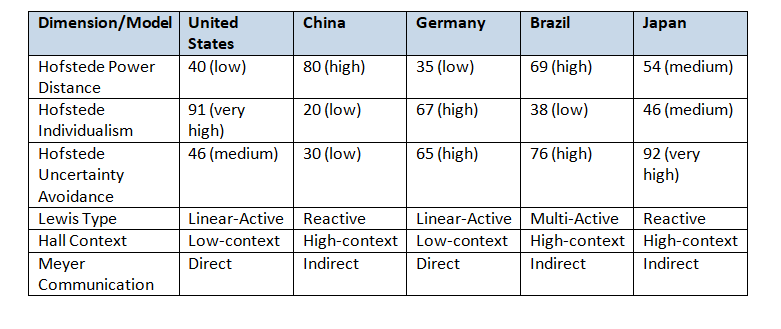
Understanding and applying cultural models creates a strategic advantage for global negotiators. Below are three essential frameworks with a comparative table highlighting key country profiles.
Hofstede’s Cultural Dimensions
Hofstede’s research enables negotiators to predict preferences for hierarchy, individualism, and risk. For instance, in China’s high power distance and collectivist culture, decision-making tends to be centralized, and relationships (“guanxi”) are paramount. In contrast, the US’s low power distance and individualism promote egalitarian participation and contractual clarity.
Richard Lewis Model
Lewis’s classification helps tailor communication style. Linear-Active negotiators prefer agenda-driven, fact-based discussions, whereas Multi-Active cultures focus on personal relationships and flexibility. Reactive cultures prioritize listening and harmony, requiring patience and indirect phrasing.
Erin Meyer’s Culture Map
Meyer’s eight dimensions provide granular tools to adapt behavior. For example, in “trusting,” Americans emphasize task-based trust, while Asians and Arabs build trust through relationships. Understanding these nuances helps avoid misinterpretation and fosters collaboration.
These frameworks are interrelated and provide a multi-angle lens to prepare for international negotiations effectively.
Step-by-Step Strategy for International Deals
A successful international negotiation follows a strategic process adapted for cross-cultural complexity. Below is a detailed six-step framework.
Step 1: Preparation — Research and Cultural Intelligence
Thoroughly research the counterpart’s culture, legal environment, business customs, and negotiation style. Use Hofstede scores, Lewis types, and Meyer’s Culture Map to anticipate behavioral patterns. Assess political and economic risks, define your BATNA (Best Alternative to a Negotiated Agreement), and establish your ZOPA (Zone of Possible Agreement). Prepare culturally adapted opening remarks and questions.
Step 2: Opening — Establish Rapport and Set the Tone
Begin with relationship-building appropriate to the culture. In Brazil or the Middle East, invest time in personal connection; in Germany or the US, prioritize agenda clarity. Use formal titles where required (e.g., “san” in Japan), and acknowledge cultural protocols. Clarify negotiation objectives and agenda collaboratively, setting expectations on communication style and decision-making pace.
Step 3: Exploration — Information Exchange and Needs Assessment
Use open-ended, culturally sensitive questions to understand priorities. In indirect cultures (Japan, China), read between the lines and observe nonverbal cues. In direct cultures (US, Germany), expect explicit statements. Validate understanding regularly, paraphrasing key points to avoid misinterpretation. Explore underlying interests beyond stated positions for principled negotiation.
Step 4: Bargaining — Proposal, Concessions, and Problem Solving
Frame proposals respecting the counterpart’s cultural preferences. In high-context cultures, emphasize mutual benefit and long-term relationship gains; in low-context, focus on data and contract specifics. Manage face-saving by offering options rather than ultimatums. Use silence effectively in reactive cultures. Employ integrative bargaining to expand the pie rather than positional bargaining.
Step 5: Closing — Agreement and Finalization
Confirm consensus verbally and in writing, adapting contract language to local legal norms. In collectivist cultures, consensus may require additional approvals; be patient. Use clear, unambiguous language in low-context cultures. Agree on implementation steps and follow-up protocols. Consider third-party mediation or arbitration clauses for enforcement.
Step 6: Follow-Up — Relationship Maintenance and Compliance
Maintain contact to ensure contract adherence and address emerging issues. Respect cultural norms for ongoing communication frequency and style. In high power distance cultures, follow hierarchical channels; in egalitarian cultures, direct communication is acceptable. This phase is critical for long-term partnerships and future deals.
This stepwise approach, grounded in cultural intelligence and legal awareness, maximizes international negotiation success.
Real-World Case Studies
US-China Trade and Technology Negotiations
The 2018 US-China trade talks highlighted the clash between American directness and Chinese indirectness. American negotiators’ emphasis on clear contract terms conflicted with China’s relational focus and preference for long-term alignment through guanxi. The lack of cultural adaptation contributed to the failure of a major technology transfer deal. Later, incorporating cultural advisors and adopting more patient, relationship-centered approaches allowed partial agreements.
EU-UK Brexit Trade Negotiations
The Brexit talks exposed cultural and political differences within Europe and between the UK and EU. The UK’s low-context, confrontational style contrasted with the EU’s complex multi-nation consensus-building. Applying Erin Meyer’s framework helped negotiators understand divergent trust models and decision-making processes. Use of principled negotiation and phased agreements helped bridge gaps.
Japan-US Automotive M&A Deal
A 2017 acquisition of a Japanese automotive supplier by a US firm required navigating Japan’s consensus-oriented nemawashi process. US negotiators initially frustrated Japanese partners with direct demands. Adjusting to indirect communication, investing in pre-negotiation consensus-building, and respecting hierarchy enabled deal closure. This case illustrates how cultural patience and process respect are indispensable.
These examples underscore how cultural intelligence transforms challenges into opportunities.
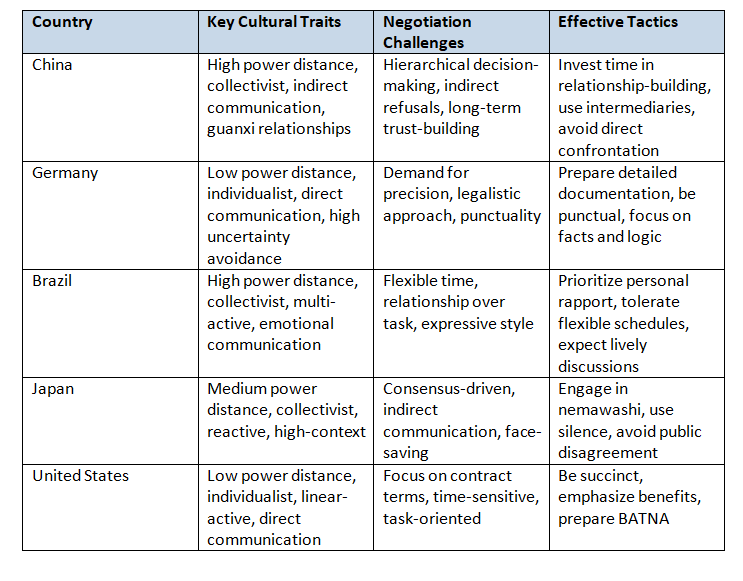
Country-Specific Negotiation Insights and Challenge-Specific Tactics
Advanced Strategies for Complex Contexts
Managing interpreters effectively is essential. Brief them on technical terms and cultural nuances beforehand. Speak slowly, avoid idioms, and check for comprehension regularly.
Building guanxi (China), wasta (Middle East), or other relationship networks requires investing time outside formal meetings, exchanging gifts appropriately, and demonstrating respect for social hierarchies.
Navigating hierarchy means knowing when to engage decision-makers versus gatekeepers. In high power distance cultures, showing deference to senior executives is crucial.
Handling face-saving involves avoiding public criticism, using indirect language, and framing negative feedback constructively.
Managing time requires adapting to monochronic cultures’ punctuality and tight deadlines or polychronic cultures’ flexible scheduling and multitasking preferences. Virtual negotiation protocols should include clear agendas, time zone consideration, and video etiquette.
Mastering these advanced tactics deepens trust and facilitates smoother negotiations.
Scripts and Templates for International Communication
Dear Mr. Wang,
I hope this message finds you well. It was a pleasure meeting your team last month. We greatly value the opportunity to collaborate and would like to propose a meeting to discuss our potential partnership in more detail. Please let us know a convenient time for you.
Looking forward to building a strong and lasting relationship.
Best regards,
Dear Ms. Schmidt,
Thank you for the productive discussion yesterday. As agreed, please find attached the detailed proposal with all specifications. We look forward to your feedback and hope to proceed to the next stage promptly.
Best regards,
“Thank you very much for welcoming us today. We appreciate the opportunity to understand your perspectives better. Our goal is to work together harmoniously to find solutions that benefit both our companies.”
“Bom dia, Carlos. I wanted to check in and see if there’s anything we can help with regarding the timeline. We understand schedules can be flexible, and we value our partnership. Please let us know how you’d like to proceed.”
Dear Sheikh Ahmed,
Thank you sincerely for your generous proposal and the trust you have shown. After careful consideration, we believe it may be best to explore alternative approaches that better align with both our strategic goals. We look forward to continuing our collaboration and finding mutually beneficial opportunities.
Warm regards,
Frequently Asked Questions
Preparation involves researching implicit communication styles, building relationships before discussing business, and paying close attention to nonverbal cues. Avoid rushing the process and allow time for consensus-building.
Use professional interpreters, avoid slang and idioms, speak clearly and slowly, confirm understanding regularly, and provide written summaries to ensure clarity.
Cultural preferences determine how detailed or flexible contracts should be. For example, German negotiators expect precise, comprehensive contracts, whereas Chinese counterparts rely more on trust and relationship, favoring adaptable agreements.
Plan meetings at mutually convenient times, share agendas in advance, limit meeting length, and use asynchronous communication tools to complement live discussions.
Political risk affects contract enforceability and operational stability. Incorporate risk assessments, use international arbitration clauses, and consider insurance to mitigate exposure.
Conclusion
International negotiation is both an art and a science demanding rigorous cultural intelligence, legal knowledge, and strategic flexibility. By deeply understanding cultural dimensions from Hofstede to Meyer, applying systematic step-by-step processes, and adapting communication styles with scripts and tactics, global dealmakers can avoid costly misunderstandings and foster durable cross-border partnerships.
As global markets grow more interconnected yet complex, mastering these tools is not optional but essential. We encourage professionals to integrate these frameworks into their negotiation playbooks and seek continuous learning through cross-cultural experiences. Start today by assessing your upcoming international deals for cultural and legal nuances—your next successful negotiation awaits.
References
1. Hofstede, G. (2001). Culture’s Consequences: Comparing Values, Behaviors, Institutions and Organizations Across Nations. Sage Publications.
2. Lewis, R. D. (2006). When Cultures Collide: Leading Across Cultures. Nicholas Brealey Publishing.
3. Hall, E. T. (1976). Beyond Culture. Anchor Books.
4. Meyer, E. (2014). The Culture Map: Breaking Through the Invisible Boundaries of Global Business. PublicAffairs.
5. Fisher, R., Ury, W., & Patton, B. (2011). Getting to Yes: Negotiating Agreement Without Giving In. Penguin Books.
6. United Nations Commission on International Trade Law (UNCITRAL). (1980). United Nations Convention on Contracts for the International Sale of Goods (CISG).