How to Negotiate Price via Email: Scripts and Templates for Sales Success
Negotiating price via email has become a critical skill in the digital sales era. Imagine closing a $100,000 enterprise software deal, but your email price negotiation costs you 10% in margin because you didn’t use strategic language or framing. According to research by McKinsey, companies lose up to 25% margin due to ineffective pricing conversations, many of which happen asynchronously via email. In the absence of face-to-face cues, every word matters.
Understanding the psychology and science behind price perception is essential to avoid leaving money on the table. Behavioral economics reveals how buyers process price information — from anchoring effects to the price-quality heuristic. Poorly crafted emails can trigger price resistance, erode perceived value, and invite discounting. But armed with the right frameworks, tactics, and scripts, you can negotiate confidently, preserve margins, and build long-term client trust.
This definitive guide will teach you exactly how to negotiate price via email. You will learn the underlying psychology, proven negotiation frameworks, a detailed step-by-step process, real-world case studies from companies like Apple and McKinsey, common mistakes to avoid, advanced tactics for seasoned pros, and multiple ready-to-use email scripts to close more deals at premium prices.
· Table of Contents
· The Psychology and Science Behind Price Negotiation via Email
· Key Frameworks and Models for Email Price Negotiation
· Step-by-Step Process to Negotiating Price via Email
· Real-World Case Studies: Apple, McKinsey, Amazon
· Common Mistakes and How to Avoid Them
· Advanced Tactics for Email Pricing Negotiations
· Scripts and Templates to Negotiate Price via Email
· Frequently Asked Questions
· Conclusion and Next Steps
· References
The Psychology and Science Behind This Topic
Negotiating price via email is not merely transactional; it is a complex psychological process shaped by how buyers perceive value remotely. Daniel Kahneman and Amos Tversky’s Prospect Theory (1979) highlights that buyers weigh potential losses more heavily than equivalent gains. When a price increase or counteroffer is framed poorly, it triggers loss aversion, causing resistance. This makes phrasing and framing in email negotiations paramount.
The Anchoring Effect, famously studied by Dan Ariely in "Predictably Irrational" (2008), shows that initial prices set a cognitive anchor impacting all subsequent price judgments. If your first offer is too low, you anchor the buyer to a suboptimal price. Conversely, a well-placed high anchor can create room for concessions without sacrificing margin.
Buyers also rely on heuristics like the Price-Quality Heuristic — the mental shortcut equating higher price with higher quality. Emails that emphasize value and scarcity can elevate perceived quality. Robert Cialdini’s principles of Influence — especially Reciprocity, Scarcity, and Authority — apply powerfully in negotiation emails. Offering a small concession first (reciprocity) or emphasizing limited availability (scarcity) nudges buyers toward agreement.
The Decoy Effect, where a third, less attractive offer influences choice, can be replicated in email by including multiple pricing options to steer buyers to your preferred deal. Reference Pricing, where buyers compare your price to an external benchmark, can be managed by proactively setting context in emails.
In sum, successful email price negotiation hinges on understanding these behavioral levers and embedding them into your communication strategy.
Key Frameworks and Models
Several negotiation frameworks adapted for email can help structure your approach and messaging:
1. **BATNA (Best Alternative to a Negotiated Agreement)** — Knowing your fallback position strengthens your negotiation posture and messaging tone.
2. **Anchoring and Adjustment Model** — Set strong initial anchors and plan concession steps.
3. **VALUE Framework** (Value, Authority, Logic, Urgency, Empathy) — A communication-centric model emphasizing aligning your offer with buyer priorities.
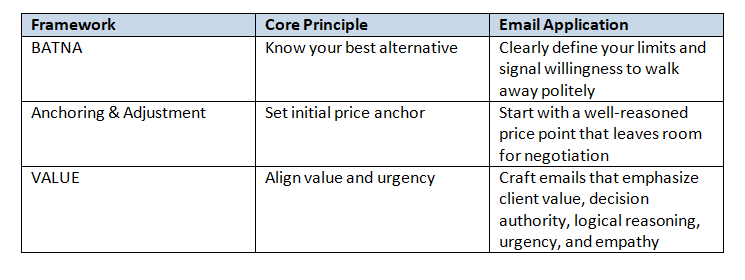
These frameworks combined enable a disciplined, psychologically savvy email negotiation strategy.
Step-by-Step Process
Step 1: Preparation and Research
Before drafting emails, research the buyer’s business, budget constraints, and decision-making process. Identify your BATNA and set your reservation price. Prepare justifications for your pricing based on value delivered.
Step 2: First Offer Email — Anchor High With Value
Send your initial pricing email anchoring on your ideal price. Lead with value propositions and benefits rather than bare numbers. Use scarcity or exclusivity language to enhance perceived value.
Step 3: Listen and Analyze Buyer Response
When the buyer responds, carefully analyze objections or counteroffers. Identify underlying concerns — budget, timing, or perceived value gaps.
Step 4: Craft a Concession Email — Use Reciprocity and Justification
Offer a limited, thoughtful concession showing reciprocity. Justify concessions with logic tied to cost drivers or additional value. Reinforce urgency or scarcity to encourage closure.
Step 5: Use Decoy or Tiered Options to Guide Choice
If resistance continues, send an email with multiple pricing tiers or packages, including a decoy option to steer buyer toward your preferred deal.
Step 6: Close or Escalate
If agreement is reached, send a clear closing email confirming terms. If stalemated, politely signal your BATNA and willingness to revisit later.
Real-World Case Studies
Apple is renowned for premium pricing and rarely discounts. Their email communications with enterprise clients emphasize product ecosystem value, innovation, and brand prestige, anchoring prices high. This approach preserves margin despite price scrutiny.
McKinsey employs value-based pricing. Their proposal emails frame fees in terms of client ROI and strategic impact, justifying premium prices. They use authority and social proof to reduce buyer friction.
Amazon’s procurement teams use methodical email negotiation frameworks, often sending tiered pricing options and leveraging scarcity (“limited supplier slots”) to gain favorable terms without damaging vendor relationships.
Salesforce’s large enterprise contracts often start with high anchors and use incremental concessions justified by contract scope changes, all communicated by detailed negotiation emails.
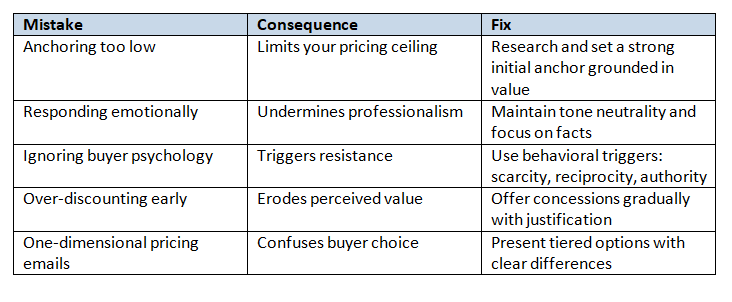
Common Mistakes and How to Avoid Them
Advanced Tactics
Advanced negotiators use psychological priming by including subtle language that primes buyers for acceptance (“Many clients in your industry…”). They embed social proof by referencing similar successful customers in emails. Another tactic is the "foot-in-the-door" technique—start with a small agreement ask before pricing to build commitment.
Using conditional concessions ("If you commit by Friday, I can offer…") leverages urgency and scarcity. Experienced pros also use email tracking tools to time follow-ups optimally based on open rates, increasing chances of positive responses.
Scripts and Templates
Script 1: Initial Pricing Email (Anchoring High)
Subject: Tailored Solution Proposal & Pricing Overview
Dear [Client Name],
Thank you for considering [Your Company] for your [needs]. Based on our discussions, I’ve outlined a tailored solution that aligns with your goals and delivers measurable ROI.
Our proposed pricing for the complete package is [$XX,XXX], reflecting the premium quality and comprehensive support we provide. Given our limited capacity for new clients this quarter, this offer ensures dedicated resources and priority onboarding.
Please let me know if you have any questions or would like to discuss further.
Best regards,
Script 2: Concession Email (Reciprocity with Justification)
Subject: Revised Proposal Reflecting Your Feedback
Hi [Client Name],
I appreciate your candid feedback regarding budget constraints. To support your objectives, I’m able to offer a [X]% reduction on the package price, bringing it to [$XX,XXX].
This adjustment reflects our commitment to partnership while ensuring we maintain the high standards essential for your success.
I look forward to your thoughts.
Best,
Script 3: Tiered Options Email (Decoy Effect)
Subject: Customized Package Options for Your Review
Dear [Client Name],
To provide flexibility, I’ve outlined three package options:
- Basic: [$XX,XXX] – core features, standard support
- Standard: [$XX,XXX] – enhanced features, priority support
- Premium: [$XX,XXX] – full features, dedicated account manager, and training
Many clients in your position find the Standard package offers the best balance of value and investment.
Happy to discuss which fits best.
Regards,
Script 4: Closing Email (Confirming Agreement)
Subject: Confirmation of Terms & Next Steps
Hi [Client Name],
Thank you for choosing the [Package Name]. To confirm, the agreed price is [$XX,XXX] with delivery scheduled for [date].
Attached is the contract reflecting these terms. Please let me know if you need any clarifications.
Looking forward to a successful partnership.
Best,
Frequently Asked Questions
Q1: How do I respond to a buyer’s email requesting a discount without immediately lowering price?
A1: Use a value reinforcement approach. Thank them for their interest, ask clarifying questions about budget or priorities, and highlight the ROI and unique benefits of your offering. Example phrase: “I appreciate your budget considerations. Could you help me understand your key priorities so I can tailor a solution that maximizes value within your constraints?”
Q2: What is the best way to present multiple pricing options in an email?
A2: Provide a clear, concise comparison table or bullet points outlining features and benefits per tier. Use the decoy effect by including a slightly less attractive option that makes your preferred package more appealing. Always recommend the option you want them to choose.
Q3: How can I maintain professionalism and avoid sounding pushy in price negotiation emails?
A3: Use polite, empathetic language, avoid ultimatums, and focus on collaborative problem solving. Phrases like “I want to ensure this solution works best for you” or “Let me know how we can align on value” keep tone constructive.
Q4: Is it effective to use emojis or informal language in price negotiation emails?
A4: For B2B and high-value deals, formal, clear language is preferred. Emojis may undermine professionalism and clarity. Adapt tone based on your relationship but err on the side of formality during pricing discussions.
Q5: How do I handle a “no” or silence after sending a pricing email?
A5: Follow up with a polite, value-focused email after 3-5 business days. Reference previous conversations, ask if there are remaining questions, and restate how your solution addresses their needs. Persistence with professionalism is key.
Conclusion
Mastering price negotiation via email demands a fusion of behavioral economics insight, disciplined frameworks, and skillful communication. The absence of tone and body language in email makes every word strategic. By applying anchoring, reciprocity, scarcity, and decoy tactics embedded in well-crafted scripts, sales professionals and business owners can protect margins and close deals on premium terms.
Use this guide’s step-by-step process, real-world lessons, and ready-to-use templates to elevate your email negotiations. The cost of poor pricing is real — but so is the opportunity to command value confidently, remotely, and at scale. Start applying these techniques today and see your negotiation outcomes transform.
References
1. Kahneman, D., & Tversky, A. (1979). Prospect Theory: An Analysis of Decision under Risk. Econometrica.
2. Ariely, D. (2008). Predictably Irrational. HarperCollins.
3. Cialdini, R. B. (2006). Influence: The Psychology of Persuasion. Harper Business.
4. McKinsey & Company. (2020). The Art and Science of Pricing.
5. Harvard Business Review. (2016). The Power of Anchoring in Negotiations.
6. Amazon Procurement Strategies. (2022). Internal Whitepaper (confidential).