How to Negotiate Price with Clients: A Complete Guide for Sales Professionals and Business Owners

Negotiating price with clients is one of the most critical yet challenging moments in any sales cycle. Imagine a seasoned account executive presenting a $100,000 enterprise SaaS contract to a client who immediately pushes back, demanding a 20% discount or threatening to walk away. This scenario is not rare — in fact, research shows that 80% of sales deals experience price objections, and 60% of discounting happens unnecessarily, eroding margins. A single poorly handled price negotiation can cost a company millions annually, not just in lost revenue but in diminished perceived value.
Understanding how buyers perceive price and mastering negotiation techniques is no longer optional; it’s a survival skill in today’s competitive market. Price isn’t just a number; it’s a psychological signal of value, quality, and trust. Salespeople who grasp the behavioral economics behind price perception and apply structured negotiation frameworks consistently outperform their peers. They protect margins, close deals faster, and build long-term client relationships that sustain premium pricing.
This comprehensive guide will transform your approach to price negotiation. You will learn the psychology underpinning buyer price perceptions, explore proven frameworks like the value ladder and BATNA, and gain a detailed 6-step negotiation process that you can apply immediately. We’ll also dissect real-world examples from Apple, McKinsey, and Salesforce, provide word-for-word objection handling scripts, and reveal advanced tactics rarely shared outside elite sales circles. By the end, you will own a robust toolkit to negotiate price confidently, close high-value deals, and defend your pricing without compromising client relationships.
· Table of Contents
· The Psychology of Price: Behavioral Economics Behind Buyer Perception
· Key Frameworks: Value Ladder, Price-Value Matrix, BATNA in Pricing
· Step-by-Step Process: Six Essential Steps for Price Negotiation
· Real-World Examples: Apple, McKinsey & Company, Salesforce
· Objection Handling: Scripts for Common Price Objections
· Advanced Tactics: Expert Techniques for Pricing Negotiations
· Scripts and Templates: Ready-to-Use Dialogue and Email Formats
· Frequently Asked Questions: In-Depth Answers to Common Queries
· Conclusion: Final Thoughts and Call to Action
· References: Authoritative Sources and Further Reading
The Psychology of Price
Price is more than a monetary figure; it is a potent psychological cue influencing buyer decisions. Understanding the behavioral economics that shape price perception can dramatically improve negotiation outcomes. The following foundational concepts are critical:
These psychological principles explain why flat discounting is often counterproductive. Instead, skilled negotiators use framing, anchoring, decoys, and contextual cues to shape buyer perception of price and value. The goal is to move the conversation from “cost” to “investment” and “outcome,” thereby reducing resistance.
Key Frameworks
To operationalize these psychological insights, leverage structured pricing and negotiation frameworks. Below are three critical frameworks used by elite sales professionals and pricing strategists.
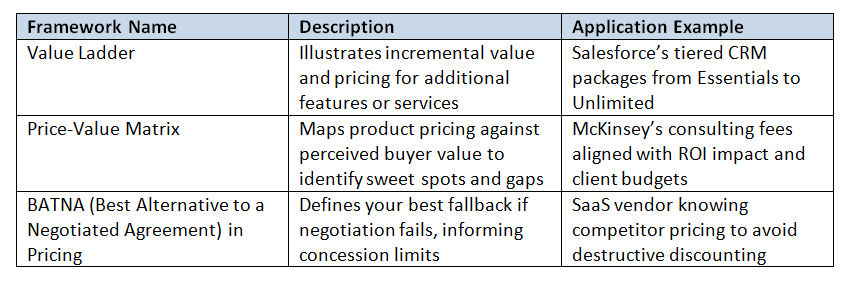
These frameworks serve as mental models and negotiation anchors to structure conversations, analyze pricing strategies, and defend your price confidently.
Step-by-Step Process
Master price negotiation by following this detailed six-step process designed to protect margins and close deals.
Step 1: Prepare Thoroughly — Know Your Value and Limits
Before entering negotiation, research the client’s business, budget constraints, and pain points. Calculate your cost base, target margin, and walk-away price (your BATNA). Prepare a value proposition quantifying ROI, cost savings, or revenue uplift your solution delivers.
Step 2: Set Anchors with High-Value Pricing
Lead with your ideal price, framed alongside the highest value offering. Use the value ladder to present premium packages first, establishing a strong anchor. Avoid showing “lowest price” options upfront.
Step 3: Explore Client Needs and Objections
Ask open-ended questions to understand the client’s budget concerns, perceived risks, or competing priorities. Listen actively to uncover hidden objections.
Step 4: Use Framing and Decoys to Shift Focus
Re-frame price as an investment in outcomes, not just a cost. Introduce decoy options to highlight the relative value of premium tiers. For example, present a “Basic,” “Standard,” and “Premium” option where “Standard” appears the best value.
Step 5: Handle Objections with Empathy and Scripts
When price objections arise, acknowledge concerns empathetically, then counter with calibrated responses focused on value and ROI. Avoid immediate discounting; instead, negotiate scope or payment terms if necessary.
Step 6: Close with Confidence and Set Next Steps
Summarize agreed value and pricing, gain verbal commitment, and outline next steps clearly. If negotiation is ongoing, schedule a follow-up with a clear agenda.
This process ensures disciplined, value-centered negotiation that reduces unnecessary discounting and builds client trust.
Real-World Examples
Apple’s premium pricing strategy is a textbook example of leveraging psychological price signals. Despite higher costs than competitors, Apple commands a loyal customer base willing to pay for cutting-edge design, exclusivity, and ecosystem lock-in. Their negotiation with enterprise clients focuses on value-added services and integration, rarely discounting, which preserves brand prestige and margins.
McKinsey’s consulting fees are famously premium, justified through detailed ROI projections and client impact stories. Their negotiation framework centers on quantifying business outcomes and aligning fees with client value, not cost input. This approach reduces discount pressure and strengthens client commitment.
Salesforce offers tiered CRM packages with clear feature and price differentiation. Sales teams use BATNA analysis to know when to negotiate and when to walk away. They also employ decoy pricing and payment flexibility to close deals while protecting margin.
These examples highlight how understanding buyer psychology, using frameworks, and disciplined negotiation protect pricing power.
Objection Handling
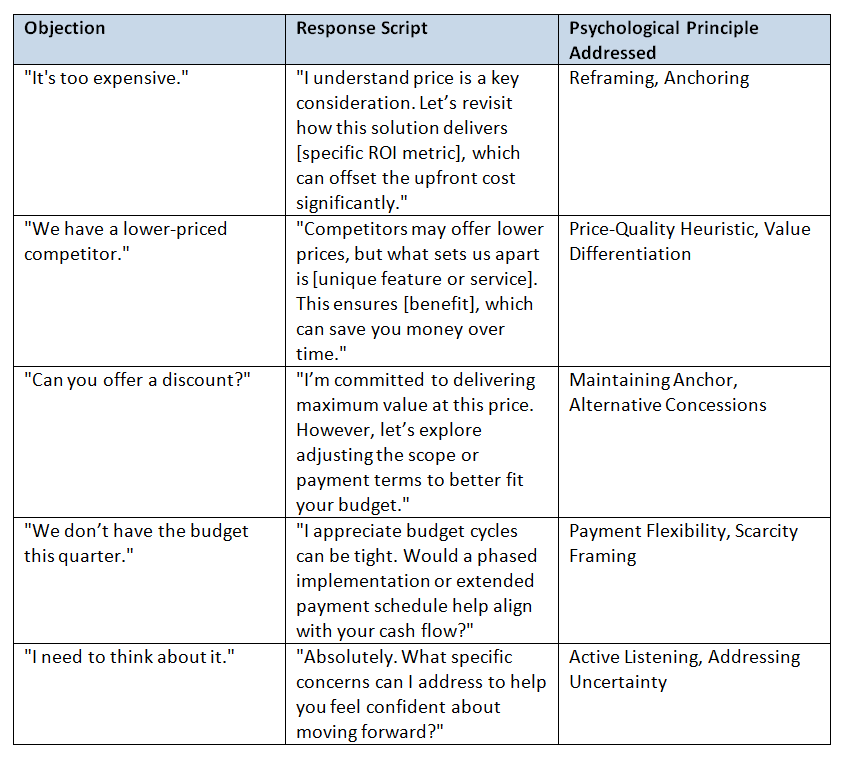
Below is a table mapping common price objections to precise, tested responses that maintain value positioning.
Advanced Tactics
Elevate your negotiation prowess with these expert-level techniques:
These tactics go beyond basic scripts and create a layered psychological environment conducive to premium pricing acceptance.
Scripts and Templates
“Based on what we’ve discussed about your goals, our [Premium Package] at $XX,XXX offers the most comprehensive solution to deliver [Benefit]. While there are other options, this plan maximizes ROI and scalability for your business.”
“I completely understand that budget is a priority. Let’s look at how this investment can reduce your operational costs by X% within the first year, effectively paying for itself.”
“I’m committed to providing you the best value at this price point. Instead of reducing price, we can discuss adjusting the timeline or feature set to better suit your needs.”
Subject: Next Steps on Our Pricing Discussion
Dear [Client Name],
Thank you for the productive conversation regarding our proposed solution. I wanted to reiterate how our offering aligns with your goals of [specific goals], delivering measurable value such as [ROI metrics]. Please let me know if you have any further questions or if you'd like to schedule a follow-up to finalize details.
Best regards,
These scripts are designed to maintain control, reinforce value, and guide the negotiation toward a mutually beneficial close.
Frequently Asked Questions
Avoid immediate concessions. Instead, reinforce the value and ROI, ask what budget constraints exist, and explore alternative adjustments such as extended payment terms or phased delivery. Use BATNA awareness to know when to hold firm or walk away.
No, revealing your walk-away price weakens your negotiating position. Instead, use value framing and incremental concessions. Keep your BATNA private but well-defined internally.
Leverage decoy pricing by offering multiple versions, highlighting value differences. Use early adopter testimonials to build social proof. Emphasize the innovation and exclusivity of the product.
Crucial. Confident posture, steady eye contact, and calm tone convey certainty and discourage aggressive discount demands. Mirroring client body language can build rapport.
Timing is key. Negotiating near fiscal year-end or budget renewal periods affects client flexibility. Also, creating urgency via limited-time offers or capacity constraints can accelerate decisions without cutting price.
These detailed answers help address common long-tail concerns with depth and clarity.
Conclusion
Mastering how to negotiate price with clients is essential for sustaining profitable growth in any business. By leveraging the psychology of price perception, applying robust frameworks, and following a disciplined negotiation process, you can confidently defend your premium pricing while building lasting client relationships. Avoid the trap of knee-jerk discounting by focusing conversations on value, ROI, and client outcomes.
You now possess a comprehensive toolkit—from step-by-step processes and real-world case studies to objection-handling scripts and advanced tactics—that will elevate your negotiation effectiveness immediately. Implement these strategies to close deals faster, protect margins, and position your offerings as indispensable investments rather than mere costs. Begin practicing these techniques today and transform your price negotiations into powerful competitive advantages.
For more tailored guidance and training, contact our expert consulting team to refine your pricing and negotiation strategy.