How to Negotiate Price Without Losing the Deal
Negotiating price is a critical skill that can make or break business transactions, sales deals, and even personal purchases. Yet, many people approach price discussions with anxiety or aggression, often risking the loss of the deal entirely. The ability to negotiate price without alienating the other party or undermining the relationship is an essential competence in any professional or personal context.
Why does this matter? Because every negotiation involves balancing value and cost, perception and reality, and strategy and empathy. When done well, negotiating price can lead to win-win outcomes where both parties feel satisfied and respected. When done poorly, it can end in deadlock, resentment, or missed opportunities.
In this comprehensive guide, you will learn proven negotiation strategies, psychological principles, and real-world examples that will empower you to negotiate price confidently. You will discover how to prepare effectively, communicate persuasively, handle objections gracefully, and close deals successfully without losing value or goodwill.
· Table of Contents
· Understanding the Psychology Behind Price Negotiations
· Preparing for Price Negotiation: Research and Planning
· Effective Communication Techniques in Price Negotiation
· Techniques to Negotiate Price Without Undermining the Deal
· Handling Objections and Pushback Professionally
· Closing the Deal: Securing Agreement and Setting Future Terms
· Frequently Asked Questions (FAQ)
Understanding the Psychology Behind Price Negotiations
Price negotiation is more than just numbers; it is deeply rooted in human psychology. Understanding the mental and emotional drivers behind price discussions can transform your approach and increase your chances of success. One foundational principle is the concept of **anchoring**. Anchoring occurs when the first number put on the table strongly influences the negotiation outcome. For example, if a seller quotes a high initial price, the buyer tends to adjust their counteroffer upward, even if the true value is lower.
Another relevant psychological concept is **loss aversion**, which means people prefer avoiding losses more than acquiring equivalent gains. This principle can be used to frame price adjustments as avoiding a loss rather than a missed gain, making concessions more palatable.
The **principle of reciprocity** also plays a vital role. When one party makes a concession, the other feels psychologically obliged to reciprocate. For instance, if a seller offers a small discount, the buyer is more likely to respond with a concession on contract terms or volume commitments.
Real-world example: In a B2B software negotiation, a vendor who starts by emphasizing the unique value and ROI of the software sets a high anchor. When the buyer pushes back on price, the vendor then offers a small discount but requests a longer contract term in return. This leverages reciprocity and loss aversion to maintain deal value while accommodating price concerns.
Psychological Techniques to Keep in Mind
· Use anchoring to set favorable expectations early.
· Frame concessions as avoiding loss, not just giving discounts.
· Apply reciprocity by linking price to value or contract terms.
· Maintain a collaborative tone to reduce perceived conflict.
Preparing for Price Negotiation: Research and Planning
Preparation is the cornerstone of successful price negotiation. Without adequate research and planning, you risk being reactive rather than proactive, which often leads to unfavorable outcomes. Begin by clearly defining your objectives: what is the lowest acceptable price, what concessions you can make, and what your ideal outcome looks like.
Next, gather intelligence about the other party’s needs, constraints, and alternatives. Understanding their BATNA (Best Alternative To a Negotiated Agreement) helps you gauge their flexibility. For example, if a supplier has few alternative buyers, you have a stronger negotiating position. Conversely, if the buyer can easily source from competitors, your pricing must be more competitive or value-packed.
Use tools such as SWOT analysis (Strengths, Weaknesses, Opportunities, Threats) to assess your position relative to the other party. Develop a negotiation agenda, including key points to discuss, potential objections, and planned responses.
Real-world example: A procurement manager preparing to negotiate with a raw materials supplier researches current market prices, competitor offers, and the supplier’s financial health. Armed with this data, the manager sets a target price, prepares justifications, and anticipates supplier pushback on volume discounts.
Preparation Checklist
· Define your target price and bottom line.
· Research the other party’s alternatives and constraints.
· Identify value drivers that justify your price.
· Prepare negotiation scripts and responses to objections.
· Plan timing and setting for the negotiation meeting.
Effective Communication Techniques in Price Negotiation
How you communicate during negotiation can be as important as what you communicate. Tone, body language, and word choice influence perceptions and outcomes. Start by establishing rapport to build trust and reduce defensiveness. Use active listening to show empathy and understand the other party’s perspective.
Avoid making price the initial focus. Instead, discuss value, needs, and desired outcomes before delving into numbers. When presenting your price, use positive language and frame it in terms of the benefits the buyer will receive. For example, instead of saying, “The price is $10,000,” say, “For $10,000, you gain access to premium features that will enhance your productivity and reduce costs.”
Employ the **“feel-felt-found”** technique to address objections: acknowledge how the other party feels, relate with a similar experience, and explain what you found that helped resolve concerns. For example, “I understand you feel the price is high. Others have felt the same initially, but they found that the long-term savings justify the investment.”
Communication Tips for Negotiators
· Use open-ended questions to uncover needs.
· Mirror language and tone to build rapport.
· Pause after making an offer to allow silent reflection.
· Avoid absolute language (“never,” “always”) that can trigger defensiveness.
Techniques to Negotiate Price Without Undermining the Deal
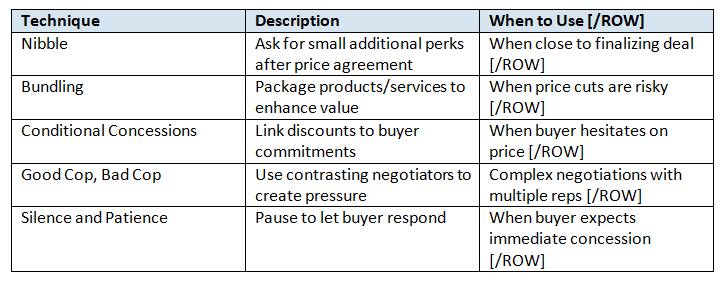
Successful price negotiation balances firmness with flexibility. Several proven techniques can help you negotiate price without losing the deal:
· **The “Nibble” Technique:** After reaching an agreement on the main price, ask for a small additional concession (e.g., free shipping or an extended warranty). This can increase value without major price changes.
· **Bundling:** Combine products or services to create perceived value that justifies price. For example, offering a package deal rather than individual item discounts.
· **Conditional Concessions:** Tie price reductions to specific commitments, such as higher volume orders or longer contract terms. This ensures you do not lose value while responding to price concerns.
· **The “Good Cop, Bad Cop” Strategy:** Use two negotiators where one is more rigid on price, and the other more accommodating, creating pressure and options for the buyer.
· **Silence and Patience:** Sometimes the best tactic is to remain silent after making your offer, compelling the other party to respond rather than rushing to fill the void with concessions.
Real-world example: A car salesperson uses bundling by including free maintenance services with the price, making the offer more attractive without cutting the vehicle’s price. When the buyer requests a discount, the salesperson offers it only if the buyer agrees to purchase an extended warranty, a conditional concession that increases overall revenue.
Handling Objections and Pushback Professionally
Objections are inevitable in price negotiations. Handling them professionally can keep the discussion constructive rather than confrontational. The key is to remain calm, listen fully, and respond with empathy and facts.
Use the **“Feel-Felt-Found”** method mentioned earlier, or try the **“Boomerang” technique**, which turns objections into opportunities. For example, if the buyer says, “Your price is too high,” respond with, “I understand price is a concern. That’s why we focus on delivering unmatched quality and support that reduce your costs in the long run.”
Avoid escalating conflict by steering clear of personal or emotional language. If negotiations stall, suggest taking a break or scheduling a follow-up meeting rather than forcing an immediate decision. This preserves goodwill and provides time for both parties to reassess.
Real-world example: In a freelance contract negotiation, the client pushes back on hourly rates. The freelancer responds by detailing how their expertise reduces project duration and risk, justifying the rate. When the client remains hesitant, the freelancer offers a trial period at a reduced rate with the understanding that full pricing applies afterward—addressing objections without losing the deal.
Closing the Deal: Securing Agreement and Setting Future Terms
Closing a price negotiation requires tactful summarization and confirmation to avoid misunderstandings. Restate the agreed price and terms clearly, emphasizing the mutual benefits and next steps. Use closing techniques such as the **“Assumptive Close,”** where you proceed as if the deal is done by saying, “I’ll prepare the contract for your review.”
Set expectations for future communication and delivery timelines. This reinforces trust and reduces post-negotiation friction. Also, consider leaving room for future negotiations by discussing options for upgrades, renewals, or volume discounts down the line.
Real-world example: After agreeing on a consulting project price, the consultant summarizes the scope, price, and timeline, then says, “I’ll send the agreement today so we can start next week.” This clear close reduces ambiguity and signals professionalism.
· Closing Tips
· Summarize key points before final agreement.
· Use positive, assumptive language.
· Confirm next steps and timelines.
· Leave door open for future negotiations or add-ons.
Frequently Asked Questions (FAQ)
1. How can I negotiate price without offending the seller or buyer?
Always approach price discussions with respect and professionalism. Use collaborative language such as “Let’s explore options” instead of confrontational phrases like “Your price is too high.” Focus on mutual value and be ready to explain your position with facts rather than emotions. For example, say, “Based on market research, this price seems above average; can we discuss possible adjustments?”
2. What if the other party refuses to budge on price?
If the price is firm, explore other areas for value such as payment terms, delivery schedules, or additional services. Employ conditional concessions or bundling techniques to create win-win options. Alternatively, evaluate your BATNA and decide if walking away is better than accepting unfavorable terms.
3. How do I set an initial price anchor effectively?
Set your anchor by presenting a well-justified and value-based initial price. Use data, testimonials, or case studies to support your figure. Avoid underpricing as it weakens your position. For example, say, “Our service is priced at $5,000 because of its proven ability to increase efficiency by 30%.”
4. Can silence really help in price negotiations?
Yes. Silence creates psychological pressure for the other party to fill the void, often leading them to reveal more information or make concessions. After stating your price or counteroffer, pause and maintain eye contact without rushing to speak. This technique leverages discomfort with silence to your advantage.
5. Should I always reveal my bottom line price?
It is generally better to keep your bottom line confidential to avoid weakening your negotiating position. Instead, focus on your target price and use flexibility strategically. Revealing your lowest acceptable price too early can encourage the other party to push harder for concessions.
Conclusion
Mastering how to negotiate price without losing the deal requires a blend of preparation, psychological insight, communication skills, and tactical flexibility. By understanding the underlying principles of human behavior and applying proven negotiation techniques, you can secure favorable pricing while maintaining strong, collaborative relationships. Remember, negotiation is not a battle to win but a process to create mutual value.
Start applying these strategies today by preparing thoroughly, communicating effectively, and responding to objections with confidence and empathy. Whether you are a buyer or seller, these skills will empower you to negotiate smarter, close more deals, and build lasting partnerships.
References
· Fisher, Roger, and William Ury. *Getting to Yes: Negotiating Agreement Without Giving In*. Penguin Books, 2011.
· Cialdini, Robert B. *Influence: The Psychology of Persuasion*. Harper Business, 2006.
· Malhotra, Deepak, and Max Bazerman. *Negotiation Genius: How to Overcome Obstacles and Achieve Brilliant Results at the Bargaining Table and Beyond*. Bantam, 2007.
· Shell, Gerry. *Bargaining for Advantage: Negotiation Strategies for Reasonable People*. Penguin Books, 2006.
· Ury, William. *The Power of a Positive No: How to Say No and Still Get to Yes*. Bantam, 2007.