How to Negotiate When Emotions Run High: The Definitive Guide for Leaders and Negotiators

In April 2013, a tense standoff unfolded at a small Texas bank. A desperate hostage-taker had barricaded himself with multiple employees inside, emotions running at a fever pitch. FBI negotiators faced a volatile mix of fear, anger, and desperation — any wrong word could trigger violence. Amid the swirling chaos, the negotiators’ ability to regulate their own emotions and apply precise psychological tactics would determine whether lives were saved or lost. This real-world crisis exemplifies the grueling challenges leaders face when negotiating under extreme emotional duress.
Negotiating when emotions run high is a deceptively complex psychological and strategic challenge. Most negotiators succumb to instinctual “System 1” reactions — impulsive, emotionally charged responses that escalate conflict rather than resolve it. Behavioral research from Nobel laureate Daniel Kahneman illustrates how emotional hijacking of the amygdala short-circuits rational “System 2” thinking under pressure. Yet, as FBI negotiator Chris Voss’s work reveals, mastering tactical empathy and emotional regulation can turn these fraught moments into opportunities for breakthrough agreements. Too often, negotiators either avoid emotional conversations or confront them with ultimatums and demands, triggering defensive responses that harden positions.
This comprehensive guide will equip you with scientifically validated psychological insights and actionable frameworks to negotiate effectively when emotions threaten to overwhelm. You will master proven models like Voss’s FBI method, William Ury’s “Going to the Balcony,” and John Gottman’s trust repair. You’ll learn a detailed six-step negotiation process incorporating emotional state management, tactical labeling, and calibrated questions. Real-world case studies from hostage crises to corporate boardroom battles will illustrate key lessons. Advanced techniques such as controlled breathing, mirroring, and reframing ultimatums provide expert-level tools. Finally, you will gain ready-to-use scripts and countermeasures for defusing the most difficult emotional dynamics. Whether you manage high-stakes client conflicts, labor disputes, or internal corporate negotiations, this guide will make you a confident, effective negotiator when emotions run high.
· Table of Contents
· The Psychology Behind This Challenge
· Key Frameworks and Models
· Step-by-Step Process for High-Emotion Negotiations
· Real-World Case Studies
· Recognizing and Countering Difficult Dynamics
· Advanced Psychological and Strategic Techniques
· Scripts and Templates for High-Emotion Scenarios
· Frequently Asked Questions
· Conclusion
· References
The Psychology Behind This Challenge
Negotiating under intense emotional conditions is fundamentally a battle between the brain’s primitive survival mechanisms and higher-order cognitive control. At the core lies the amygdala hijack — a term popularized by psychologist Daniel Goleman. The amygdala, the brain’s emotional alarm center, triggers rapid fight-flight-freeze responses when it detects threats. This “hijack” bypasses the neocortex’s slower, rational thinking faculties, precipitating impulsive reactions.
Daniel Kahneman’s Nobel-winning framework of System 1 and System 2 thinking elucidates this dynamic. System 1 operates automatically and quickly, driven by heuristics and emotional shortcuts. System 2 is slower, analytical, and deliberative. Under threat or stress, negotiators default to System 1, often responding with anger, defensiveness, or withdrawal. This cognitive shortcut can sabotage negotiation by escalating conflict, triggering ultimatums, or freezing dialogue altogether.
Chris Voss, a former FBI lead hostage negotiator, emphasizes the power of “tactical empathy” — actively recognizing and validating the counterpart’s emotions without agreement or concession. Tactical empathy helps downregulate amygdala activation by making the other party feel heard and understood, which lowers their emotional intensity and opens pathways for rational dialogue.
John Gottman’s research on emotional flooding in couples has parallels in negotiation. Flooding occurs when emotions overwhelm the individual’s ability to process, leading to shutdown or aggressive “four horsemen” behaviors: criticism, contempt, defensiveness, and stonewalling. Recognizing flooding allows negotiators to pause, de-escalate, and repair trust, rather than compound the conflict.
Trust repair theory is also critical in emotional negotiation. High-conflict negotiations often suffer from broken trust and perceived betrayal. Restoring trust requires acknowledgment of harm, taking responsibility, and rebuilding reliability incrementally — a process Gottman describes in his trust repair frameworks.
Behavioral economics research on the ultimatum game reveals how people in emotional states overweight fairness and perceived disrespect over economic gain, often rejecting offers to punish perceived injustice. Understanding this helps negotiators avoid triggering hostile rejection through tone or framing.
The neuropsychology of fight-flight-freeze responses, combined with Kahneman’s dual-process model, Gottman’s emotional flooding, Voss’s tactical empathy, and trust repair theory, provides a multidimensional psychological map of why emotions derail negotiations — and how expert negotiators can regain control.
Key Frameworks and Models
Several frameworks from negotiation science provide structured approaches to managing emotions and conflict. Below is a comparison of three leading models: Chris Voss’s FBI Negotiation Method, William Ury’s “Going to the Balcony,” and the Thomas-Kilmann Conflict Mode Instrument (TKI). Each offers distinct tools for emotional regulation, communication, and strategic positioning.
Voss’s FBI method excels in real-time emotional labeling and empathy to reduce tension and gain influence. Ury’s “Going to the Balcony” metaphor encourages negotiators to mentally step outside the fray, enabling clearer thinking and strategic patience. The TKI model offers insight into one’s default conflict style and how to flexibly shift modes to meet the emotional context.
Together, these models provide a toolkit for recognizing emotional triggers, regulating one’s own responses, and choosing appropriate communication tactics to guide the negotiation toward resolution.
Step-by-Step Process for Difficult High-Emotion Negotiations
Successful negotiation when emotions run high requires a disciplined, stepwise approach that integrates psychological insight with tactical communication.
Step 1: Prepare Your Emotional Baseline
Before entering the negotiation, assess and regulate your own emotional state. Use controlled breathing (e.g., 4-7-8 breathing), mindfulness, or power posing (Amy Cuddy’s research) to activate calm, confident presence. Label your own feelings internally (“I feel anxious but focused”) to engage System 2 thinking and avoid amygdala hijack.
Step 2: Establish Connection Through Tactical Empathy
Begin by actively listening and demonstrating understanding of the other party’s emotions. Use Voss’s mirroring (“It sounds like you’re frustrated”) and labeling (“It seems like this situation has been really stressful for you”). This validates their feelings and lowers emotional defenses.
Step 3: Create a “Balcony” Perspective
Encourage both yourself and the counterpart to mentally step back and see the bigger picture. Reframe the conflict from a shared problem rather than a personal attack. Use language like, “Let’s take a moment to look at this from a different angle” to promote cognitive distancing and reduce emotional flooding.
Step 4: Identify Underlying Interests and Emotions
Use calibrated questions (“What’s most important to you here?” “How can we solve this without making anyone lose face?”) to uncover deeper motivations and emotional needs. This shifts focus from positions to interests, reducing zero-sum thinking.
Step 5: Manage Ultimatums and Threats Strategically
If the counterpart issues ultimatums, do not respond with counter-threats. Instead, label the ultimatum (“It sounds like you feel backed into a corner”) and ask calibrated questions (“How can we work together to find a solution you feel good about?”). This diffuses hostility and invites collaboration.
Step 6: Repair Trust and Close with Clear Commitments
If trust has been damaged, acknowledge it explicitly and outline steps for rebuilding. Use Gottman’s trust repair techniques: express regret, accept responsibility without excuses, and propose concrete actions to restore reliability. Confirm clear, mutually understood next steps to solidify agreement.
This process is cyclical — continually monitor emotional states, apply tactical empathy, and adjust communication to maintain constructive dialogue.
Real-World Case Studies
Studying successful and failed negotiations under high emotional stress reveals practical lessons.
Case Study 1: FBI Hostage Negotiation in the 1993 Waco Siege
During the 51-day standoff, FBI negotiators faced highly emotional, armed Branch Davidians. Initial failures to apply tactical empathy escalated violence. Later, negotiators adopted labeling and mirroring techniques to build rapport, though ultimately the siege ended tragically. Lesson: Early emotional recognition and calibrated questioning can prevent escalation.
Case Study 2: 2018 General Motors Labor Strike Resolution
Negotiations between GM and the United Auto Workers union involved high emotions over job security and benefits. Both sides used Ury’s “Going to the Balcony” approach to detach from personal attacks and focus on shared interests. Mediated dialogue incorporated trust repair steps after contentious bargaining rounds. Result: a compromise agreement avoiding prolonged strike. Lesson: Emotional regulation and interest-based negotiation preserve relationships.
Case Study 3: 2019 Brexit Negotiations between UK and EU
The Brexit negotiations were marked by intense political emotions and ultimatums from both sides. Failure to adopt calibrated questions and tactical empathy led to entrenched positions and repeated deadlocks. Applying Thomas-Kilmann conflict styles showed predominance of competing mode, hindering collaboration. Lesson: Recognizing and flexibly shifting conflict modes is critical in emotionally charged diplomacy.
Recognizing and Countering Difficult Dynamics
High-emotion negotiations often feature tactics that exacerbate conflict. The table below maps common difficult dynamics, their psychological mechanisms, and recommended counter-responses.
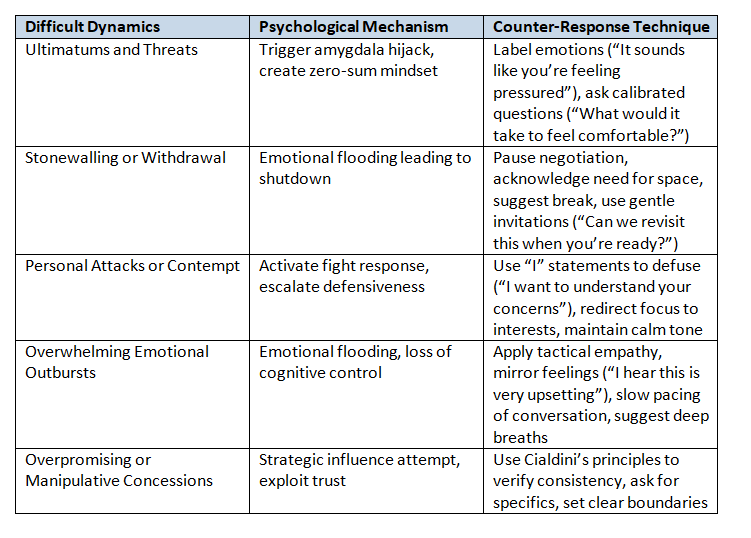
Recognizing these dynamics early allows negotiators to respond deliberately rather than react impulsively, preserving constructive dialogue.
Advanced Psychological and Strategic Techniques
Beyond foundational tactics, expert negotiators deploy advanced methods:
· Controlled Breathing and Presence: Amy Cuddy’s power posing combined with paced 4-7-8 breathing to sustain calm and project confidence under pressure.
· Emotional Labeling Nuances: Integrating Paul Ekman’s microexpressions research to detect subtle emotional cues and adjust labeling accordingly.
· Strategic Use of Silence: Employed as a calibrated question to induce reflection and soften resistance.
· Reframing Ultimatums as Options: Converting ultimatums into “no-risk” choices to reduce defensiveness.
· Cognitive Reappraisal: Coaching oneself and counterpart to reinterpret emotional triggers as solvable problems rather than threats.
These techniques require practice and situational awareness but markedly increase negotiation success in emotional contexts.
Scripts and Templates for High-Emotion Scenarios
Below are sample scripts for common difficult moments:
· Responding to Ultimatum
“I hear that this is very important to you and that you feel there’s limited room for movement. What would need to happen for us to find a solution that works for you without anyone losing face?”
· Defusing Anger with Labeling
“It sounds like this situation has been really frustrating and stressful. I want to understand what’s driving your concerns so we can find a way forward.”
· Inviting a Break During Flooding
“I can see this is a lot to take in right now. Would it help if we pause for a few minutes and come back fresh? I want to make sure we hear each other clearly.”
· Repairing Trust
“I realize that recent events have damaged the trust between us. I want to acknowledge that and work with you on steps to rebuild it. What can I do to demonstrate my commitment?”
· Redirecting Personal Attacks
“I want to focus on resolving the issue together. Can we set aside frustrations and explore what’s most important to you about this?”
Frequently Asked Questions
Q1: How can I manage my own emotions when the other party is aggressive?
A1: Begin with physiological regulation techniques such as deep breathing to calm your nervous system (Amy Cuddy’s presence research). Use self-labeling to engage System 2 thinking (“I feel tense but am staying focused”). Pause before responding. Mirror the counterpart’s words to build rapport without escalating.
Q2: What if the other negotiator refuses to engage in emotional discussion?
A2: Use calibrated questions to gently probe (“Can you help me understand what matters most to you right now?”). Employ tactical empathy by acknowledging their reluctance without pushing. Suggest breaks or third-party mediation if emotions remain blocked.
Q3: How do I respond to ultimatums without escalating?
A3: Avoid counter-threats. Instead, label the underlying emotion (“It seems like you’re feeling stuck”) and ask open questions (“What would it take for us to find a middle ground?”). This invites collaboration rather than confrontation.
Q4: Can emotional negotiation techniques be used in virtual meetings?
A4: Absolutely. Though nonverbal cues are limited, vocal tone, pacing, and calibrated questioning remain effective. Use explicit check-ins (“How are you feeling about this so far?”) to gauge emotional climate.
Q5: How do I rebuild trust after a negotiation breakdown?
A5: Follow Gottman’s trust repair framework: express sincere regret, accept responsibility without excuses, validate the other’s feelings, and make concrete commitments for change. Consistency over time is essential.
Conclusion
Negotiating when emotions run high is among the most challenging tasks for leaders, managers, and professionals. The interplay of amygdala hijack, cognitive biases, and emotional flooding can derail even the most rational discussions. However, by understanding the neuroscience behind emotional reactivity and mastering frameworks such as Voss’s tactical empathy, Ury’s balcony perspective, and Gottman’s trust repair, negotiators can transform conflict into collaboration.
This guide has equipped you with a robust, stepwise process, advanced psychological tools, and practical scripts to navigate the most volatile negotiations with confidence and skill. The path to effective negotiation under pressure is paved with self-awareness, disciplined emotional regulation, and strategic communication. Begin applying these techniques today — your next high-stakes conversation may depend on it.
References
· Kahneman, Daniel. (2011). Thinking, Fast and Slow. Farrar, Straus and Giroux.
· Voss, Chris & Raz, Tahl. (2016). Never Split the Difference: Negotiating As If Your Life Depended On It. Harper Business.
· Ury, William. (1993). Getting Past No: Negotiating with Difficult People. Bantam.
· Gottman, John & Silver, Nan. (1999). The Seven Principles for Making Marriage Work. Three Rivers Press.
· Cialdini, Robert B. (2006). Influence: The Psychology of Persuasion. Harper Business.
· Ekman, Paul. (2003). Emotions Revealed: Recognizing Faces and Feelings to Improve Communication and Emotional Life. Times Books.