How to Negotiate with a Strong Counterpart

Negotiating with a strong counterpart can feel like an uphill battle. Whether you’re dealing with a seasoned corporate executive, a tough supplier, or a skilled adversary in any negotiation scenario, facing a counterpart with more experience, power, or confidence can be intimidating. But negotiation is not solely about power dynamics; it is about strategy, preparation, and understanding human behavior. With the right approach, you can level the playing field and secure outcomes that serve your interests effectively.
The importance of mastering negotiation against strong counterparts cannot be overstated. In business, career advancement, legal settlements, or even personal interactions, the ability to withstand pressure and negotiate skillfully when the other side is dominant can transform your results. This guide will teach you how to prepare mentally and strategically, employ proven negotiation techniques, leverage psychological principles, and use real-world examples and templates to negotiate confidently and successfully.
By reading this comprehensive article, you will learn how to identify the strengths of your counterpart, manage your own mindset, use tactical concessions, apply principled negotiation, and utilize communication techniques that empower you. We’ll also cover common pitfalls and how to avoid them, plus answer frequently asked questions that can arise when dealing with tough negotiators. Prepare to build your negotiation skills to a professional level, even against the strongest counterparts.
· Table of Contents
· Understanding Your Strong Counterpart
· Preparing Yourself Mentally and Strategically
· Key Negotiation Techniques for Dealing with Strong Opponents
· Leveraging Psychological Principles in Negotiation
· Communication Strategies and Tactical Concessions
· Handling High-Pressure and Intimidation Tactics
· Real-World Examples and Negotiation Scripts
· FAQ: Negotiating with a Strong Counterpart
· Conclusion and Next Steps
· References
Understanding Your Strong Counterpart
Before engaging in negotiation, it’s critical to analyze and understand the strengths and tactics your counterpart brings to the table. Strong negotiators often possess advantages such as greater authority, extensive experience, superior information, or a reputation for toughness. Recognizing these elements helps you prepare a tailored strategy rather than reacting blindly.
A strong counterpart may demonstrate one or more of the following:
· Positional power (e.g., seniority, decision-making authority)
· Expertise and technical knowledge
· Emotional control and psychological resilience
· Superior information or intelligence on the issue
· Aggressive or intimidating negotiation style
For example, a CEO negotiating a contract likely commands positional power and experience, while a veteran lawyer may deploy psychological pressure and expert knowledge. Identifying which strengths your counterpart wields allows you to anticipate their approach and prepare responses.
BATNA (Best Alternative to a Negotiated Agreement) is a foundational concept from Roger Fisher and William Ury’s “Getting to Yes.” Understanding your counterpart’s BATNA gives insight into how hard they may push. If their alternatives are strong, they might be less willing to compromise. Research, ask probing questions, and gather intelligence to estimate their BATNA.
During a major supplier negotiation, a procurement manager discovered the supplier had no other large customers lined up (weak BATNA). This knowledge empowered the manager to negotiate more aggressively on price and delivery terms. Conversely, if the supplier had strong alternative buyers, the manager would have needed a different approach.
Preparing Yourself Mentally and Strategically
Facing a strong counterpart requires more than tactical knowledge—it demands mental preparation and strategic planning. Psychological readiness ensures you maintain composure and confidence, crucial under pressure.
Strong negotiators often use intimidation or pressure tactics to rattle the other side. Anchoring yourself in emotional control prevents reactive behavior. Techniques include:
· Deep breathing and mindfulness to maintain calm
· Visualization of successful negotiation outcomes
· Reframing the negotiation as a problem-solving exercise, not a personal battle
Define your goals precisely, including your ideal outcome, fallback positions, and walk-away point. This preparation prevents you from conceding too easily or accepting unfavorable terms out of pressure.
Map out potential scenarios and responses. Consider your counterpart’s likely tactics and prepare counters. Planning also includes deciding on concessions you can afford and identifying value-adding options to propose.
A startup founder negotiating with a large venture capitalist prepared a tiered funding and equity structure proposal. By anticipating investor demands, the founder was ready to present alternatives that protected company control while satisfying investor return expectations.
Key Negotiation Techniques for Dealing with Strong Opponents
Certain negotiation techniques are especially effective when facing a strong counterpart. These methods help balance power and encourage collaboration rather than confrontation.
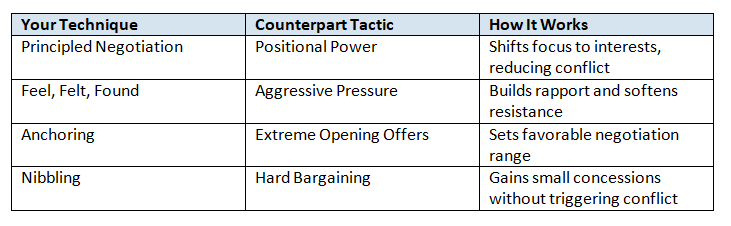
Developed by Fisher and Ury, principled negotiation focuses on interests rather than positions. Instead of arguing over fixed demands, seek to understand underlying needs and create mutually beneficial solutions. This reduces adversarial tension.
This script helps defuse resistance:
· “I understand how you [feel] about this.”
· “Others have [felt] the same way.”
· “But what they [found] was that…”
This approach acknowledges your counterpart’s concerns while gently guiding them toward a new perspective.
Make the first offer to set the negotiation anchor, influencing the range of outcomes. Strong counterparts may attempt to anchor low or high; be ready to counter-anchor with objective data. Frame proposals in terms of gains, not just concessions.
After agreeing on major points, request small additional concessions. This tends to be less resisted and can improve your deal incrementally.
Leveraging Psychological Principles in Negotiation
Understanding the psychology behind negotiation can provide an edge against strong counterparts who rely on psychological tactics themselves.
Humans tend to reciprocate concessions or favors. By making a small, strategic concession early, you can encourage your counterpart to respond in kind, even if they are initially tough.
People fear losses more than they value gains. Framing proposals to highlight what your counterpart stands to lose by not agreeing can motivate concessions.
Referencing credible third-party data, industry standards, or expert endorsements can add authority to your position, making it harder for a strong negotiator to dismiss your arguments.
Be mindful of your own susceptibility to anchoring and that of your counterpart. Counteract this bias by preparing objective benchmarks and facts.
When faced with aggressive tactics, calmly say:
This script reasserts control and signals you won’t be manipulated.
Communication Strategies and Tactical Concessions
Effective communication is crucial when negotiating with strong counterparts. Your tone, language, and timing can influence outcomes significantly.
Demonstrate genuine attention by paraphrasing your counterpart’s points and asking clarifying questions. This builds rapport and uncovers hidden interests.
Use confident, clear language without aggression. For example:
Avoid tentative words like “maybe” or “I think,” which can undermine your position.
Plan concessions in advance, and only offer them if you receive something in return. Use concession patterns such as:
· Make concessions gradually rather than all at once
· Link concessions to specific counterpart actions (conditional concessions)
· Use “if… then…” statements to reinforce reciprocity
Maintain steady eye contact, an open posture, and controlled gestures. These signals convey confidence and help resist intimidation.
Handling High-Pressure and Intimidation Tactics
Strong negotiators sometimes employ pressure tactics such as deadlines, threats, or emotional manipulation. Handling these requires composure and strategy.
· The “Take It or Leave It” Ultimatum
· The Good Cop / Bad Cop Routine
· Silent Treatment or Deliberate Delays
· Personal Attacks or Blame-Shifting
· Call out the tactic politely but firmly: “I want to work toward a solution that benefits us both, so let’s avoid ultimatums.”
· Ask for time to consider offers rather than responding immediately.
· Reframe deadlines as opportunities for better planning rather than threats.
· Keep discussions fact-based and avoid emotional reactions.
During a salary negotiation, the hiring manager threatened to withdraw the offer if the candidate requested a higher base. The candidate responded calmly: “I appreciate the offer and want to make this work. Could we explore how the total compensation package might better reflect my experience?” This diffused tension and led to a better overall deal.
Real-World Examples and Negotiation Scripts
Applying theory to practice is essential. Below are examples and scripts to illustrate how to negotiate effectively with strong counterparts.
A company faced a vendor with a history of firm pricing. The procurement team used principled negotiation, uncovering that the vendor valued long-term contracts more than short-term gains. By proposing a two-year contract with early payments, they secured a 7% discount. This aligned interests rather than antagonizing.
A candidate negotiating salary with a strong HR negotiator used anchoring by opening with a well-researched top salary figure. The HR rep countered with a lower offer. The candidate employed “Feel, Felt, Found”: “I understand you feel this is the standard offer. I’ve felt the same in previous negotiations. What I found is that a salary closer to $X better reflects my skills and market rates.” This softened resistance and led to a midpoint agreement.
FAQ: Negotiating with a Strong Counterpart
Building confidence starts with preparation—know your facts, define your objectives, and practice your scripts. Use mental rehearsal and mindfulness to stay calm. Remember that negotiation is a skill you can improve. Also, remind yourself that strong counterparts often rely on bluster, which you can counter with calm, rational responses.
Recognize and label the tactics calmly without escalating. Use scripts like “Let’s focus on the issues rather than pressure.” Maintain emotional control and do not respond with aggression. Ask for breaks if needed to regain composure.
Making the first offer can be advantageous by anchoring the negotiation range, but only if you have done thorough research and know reasonable values. If uncertain, you can invite the counterpart to open. Assess the situation and your information advantage.
Research publicly available information, ask indirect questions during negotiation, and listen carefully to clues. Sometimes, you can test assumptions by proposing alternatives and gauging reactions. Understanding BATNA helps you assess how much leverage you have.
If you reach an impasse, consider bringing in a neutral third party, such as a mediator, or suggest taking a break to reassess. Sometimes shifting focus to shared interests or creative alternatives can break deadlocks. Always keep your BATNA in mind to know when to walk away.
Conclusion and Next Steps
Negotiating with a strong counterpart is challenging but entirely manageable with the right preparation, mindset, and techniques. By understanding your counterpart’s strengths, preparing strategically, leveraging psychological insights, and communicating assertively, you can turn even tough negotiations into opportunities for mutual gain. The key is to approach negotiations as problem-solving exercises rather than power struggles.
Start applying these strategies today by analyzing your next negotiation scenario, setting clear objectives, and practicing scripted responses. Remember, every negotiation is a chance to build skill and confidence. Don’t shy away from strong counterparts—use these proven methods to engage them effectively and achieve your goals.
Take action now: identify an upcoming negotiation, prepare using the techniques in this guide, and commit to continuous improvement. Your ability to negotiate successfully with strong counterparts will become a vital asset in your professional and personal life.
Mastering how to negotiate is not about tricks — it's about clarity, positioning, and control. If you want to go deeper into advanced negotiation strategies, negotiation psychology, handling objections, and negotiating under pressure, explore our full library of articles designed for professionals operating in high-stakes business environments.
References
· Fisher, Roger, William Ury, and Bruce Patton. Getting to Yes: Negotiating Agreement Without Giving In. Penguin Books, 2011.
· Shell, G. Richard. Bargaining for Advantage: Negotiation Strategies for Reasonable People. Penguin Books, 2006.
· Cialdini, Robert B. Influence: The Psychology of Persuasion. Harper Business, 2006.
· Malhotra, Deepak, and Max Bazerman. Negotiation Genius: How to Overcome Obstacles and Achieve Brilliant Results at the Bargaining Table and Beyond. Bantam, 2007.
· Ury, William. The Power of a Positive No: How to Say No and Still Get to Yes. Bantam, 2007.