How to Negotiate with Difficult People

Negotiating with difficult people is an inevitable challenge in both professional and personal contexts. Whether you are navigating a high-stakes business deal, managing conflicts at work, or resolving disagreements in your personal life, encountering someone who is uncooperative, aggressive, or emotionally charged can derail the process. Understanding how to engage effectively with difficult negotiators is essential to achieving your desired outcomes without escalating tensions.
Why does negotiating with difficult people matter? Because poor handling of such interactions can lead to lost opportunities, damaged relationships, and heightened stress. On the other hand, mastering proven negotiation techniques tailored for difficult personalities can transform conflict into collaboration. This article will equip you with actionable strategies, psychological insights, and real-world examples to turn challenging negotiations into successful agreements.
In this comprehensive guide, you will learn how to identify difficult negotiation behaviors, apply advanced communication tactics, leverage psychological principles like anchoring and mirroring, and use scripts to maintain control and rapport. By the end, you will be confident in negotiating with even the toughest opponents and preserving strong relationships.
· Table of Contents
· Understanding Difficult Negotiators: Types and Behaviors
· Psychological Principles Behind Difficult Negotiations
· Preparing Strategically for Negotiations with Difficult People
· Communication Techniques to Manage and Influence
· Conflict Resolution and De-escalation Strategies
· Leveraging Negotiation Frameworks and Techniques
· Real-World Examples and Negotiation Scripts
· Frequently Asked Questions
· Conclusion and Next Steps
Understanding Difficult Negotiators: Types and Behaviors
Negotiators who are difficult generally fall into several identifiable categories, each requiring a tailored approach. Recognizing the type of difficult person you face helps you adjust your strategy effectively.
· The Aggressor: Uses intimidation, threats, or pressure tactics to dominate the discussion.
· The Passive-Aggressive: Appears agreeable but undermines progress subtly through procrastination or indirect resistance.
· The Know-It-All: Overconfident and dismissive of alternative views, often dominating the conversation.
· The Silent or Withdrawn: Avoids giving information or responding, creating frustration and uncertainty.
· The Emotional Reactor: Easily triggered, prone to outbursts that disrupt logic and calm negotiations.
Understanding these behaviors allows you to anticipate challenges and prepare appropriate responses. For example, the Aggressor demands firm boundaries and calm assertiveness, while the Passive-Aggressive may require persistent follow-up and clarifying commitments.
- Interrupting or talking over others
- Refusing to answer questions directly
- Using sarcasm, ridicule, or condescension
- Changing demands frequently
- Exhibiting hostility or coldness
In addition to these behavioral cues, difficult negotiators often operate from psychological motivations such as fear of loss, desire for control, or protecting self-image. Recognizing these underlying drivers allows you to address root causes rather than just symptoms.
Psychological Principles Behind Difficult Negotiations
Effective negotiation with difficult people depends heavily on understanding key psychological mechanisms that influence behavior and decision-making.
Anchoring refers to the cognitive bias where individuals rely heavily on the first piece of information offered (the "anchor") when making decisions. Setting a strong initial anchor can frame the negotiation favorably. For example, if a difficult negotiator demands an unrealistically high price, counter with a reasonable but strategically lower offer to reset the anchor point.
People tend to feel obliged to return favors or concessions. Offering a small, genuine concession early can encourage a difficult person to reciprocate, breaking down resistance. This technique must be authentic to avoid appearing manipulative.
Mirroring the body language, tone, and speech patterns of your counterpart builds subconscious rapport and trust. For example, if the difficult negotiator speaks slowly and softly, adjusting your style similarly can reduce their defensiveness.
Recognizing and managing your own emotions, while empathizing with the other party's feelings, is critical to defusing tension. Techniques such as active listening and labeling emotions ("It seems like this issue is very important to you") validate feelings and promote collaboration.
The party who appears less invested in the outcome holds more power. Maintaining a calm, composed demeanor and demonstrating willingness to walk away reduces your leverage for the difficult negotiator to exploit.
Humans fear losses more than they value equivalent gains. Framing proposals to highlight what the other party stands to lose by not agreeing can be persuasive.
Understanding these psychological principles enables you to craft strategies that tap into natural human tendencies, turning difficult interactions into opportunities for agreement.
Preparing Strategically for Negotiations with Difficult People
Preparation is critical when facing difficult negotiators. Proper groundwork increases your confidence and improves your ability to respond effectively.
Gather as much information as possible about the person’s negotiation style, history, motivations, and interests. For example, if negotiating with a known aggressive colleague, anticipate pressure tactics and prepare calm responses.
Establish your ideal outcomes, acceptable compromises, and absolute walk-away points. Knowing these boundaries helps prevent concessions under pressure.
Plan for different negotiation trajectories including stalemates or emotional outbursts. Prepare scripted responses or interventions for each.
Having a strong BATNA empowers you to negotiate from a position of strength and resist unreasonable demands.
Formulate open-ended questions that encourage the difficult party to reveal their true concerns and priorities.
If possible, choose a neutral, private location conducive to calm discussion. Control distractions and seating arrangements to promote equality.
Preparing strategically ensures you enter negotiations with confidence, clarity, and flexibility—key factors in managing difficult people effectively.
Communication Techniques to Manage and Influence
Communication is the linchpin in negotiations with difficult personalities. The right techniques can transform hostility into cooperation.
This classic method acknowledges emotions, relates through empathy, and redirects with evidence. For example:
"I understand how you [feel] about the price increase. Others have [felt] similarly at first, but they have [found] that the added value justifies the cost."
This approach validates feelings without conceding your position.
Frame concerns from your perspective to avoid sounding accusatory. For example, "I feel concerned when deadlines shift because it impacts our overall project."
At the outset, agree on respectful behavior and turn-taking. For instance, "Let's ensure we each have time to speak without interruptions."
Silence can compel the difficult negotiator to fill gaps, often revealing more information or softening demands.
If the other party uses aggressive or blaming language, calmly reframe it positively. For example, "Instead of focusing on what went wrong, let's explore how we can move forward."
Periodically restate key points to ensure mutual understanding and prevent miscommunication. "So, to confirm, you are requesting X, and I have proposed Y."
Words like "never," "always," or "impossible" may escalate defensiveness. Opt for neutral language.
"When you raise your voice, I find it difficult to focus on the issue. Let’s take a moment to calm down so we can resolve this together."
Mastering these communication tools allows you to maintain control, build rapport, and guide negotiations productively.
Conflict Resolution and De-escalation Strategies
Difficult negotiators often provoke conflict or emotional escalation. Applying conflict resolution techniques can restore balance and foster progress.
Your emotional regulation sets the tone. Use deep breathing or grounding techniques to remain composed.
Identify your default conflict style (competing, collaborating, compromising, avoiding, accommodating) and adapt it. For example, shift from competing to collaborating when possible.
Naming emotions (labeling) reduces their intensity. "It sounds like this issue has caused frustration."
A structured method to assertively address problems:
· Describe the behavior objectively.
· Express your feelings.
· Specify desired changes.
· Consequences if changes don’t happen.
For example: "When meetings start late (Describe), I feel frustrated (Express) because it wastes time. Please start on time going forward (Specify), or we risk missing critical deadlines (Consequences)."
If emotions run too high, suggest a short break to cool down.
Uncover underlying needs rather than rigid demands to find mutually acceptable solutions.
If stalemates persist, a mediator can facilitate dialogue and reduce bias.
Conflict resolution skills enable you to defuse tension and keep negotiations moving toward agreement.
Leveraging Negotiation Frameworks and Techniques
Several proven frameworks and techniques are particularly effective with difficult negotiators.
Focus on merits, separate people from the problem, and invent options for mutual gain. This approach neutralizes personal conflict.
Always know your BATNA and estimate theirs. This knowledge informs concessions and walk-away points.
Use carefully in teams: one negotiator takes a firm stance, the other is more conciliatory to create leverage.
Start with small requests to build momentum toward larger agreements.
Begin with an extreme request you expect to be refused, followed by a moderate request that seems reasonable by comparison.
Difficult negotiators may rush or stall. Control pacing to apply pressure or allow reflection.
Well-timed silence encourages the other party to fill the void, often yielding concessions or clarifications.
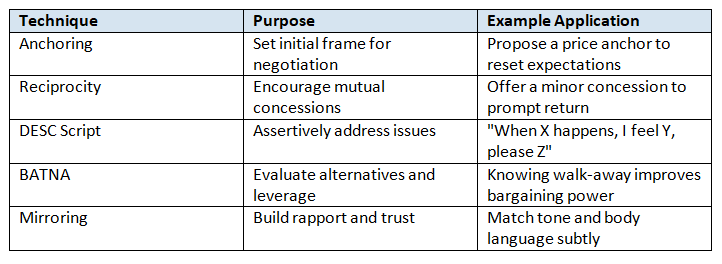
Applying these frameworks strategically enhances your ability to influence difficult negotiators and achieve favorable outcomes.
Real-World Examples and Negotiation Scripts
A procurement manager faced a supplier demanding a sudden price increase with threats to withdraw service. Using principled negotiation, the manager separated the person from the problem, acknowledged the supplier’s challenges, and proposed a phased price increase combined with volume commitments. The vendor softened, and a win-win agreement was reached.
A project lead noticed a team member consistently missing deadlines and providing vague excuses. The lead scheduled a private conversation employing the DESC script:
"When you miss deadlines without notice (Describe), I feel concerned because it delays the project (Express). Please communicate any issues early so we can adjust plans (Specify). If not, we risk project failure (Consequences)."
The team member admitted feeling overwhelmed, and together they adjusted workloads, improving performance.
- Start with rapport-building: "I appreciate your time today."
- State your purpose clearly: "I want to discuss how we can resolve the current issues."
- Use the Feel-Felt-Found technique: "I understand you feel the deadlines are too tight. Others have felt the same but found that adjusting priorities helped."
- Ask open-ended questions: "What are the main challenges you’re facing?"
- Summarize and confirm: "So, you need more flexibility on delivery dates?"
- Propose solutions: "How about we set interim milestones to track progress?"
- End with agreement or next steps: "Does this approach work for you?"
Using such templates maintains structure and control while allowing flexibility.
Frequently Asked Questions
Remaining calm requires emotional regulation techniques such as deep breathing, mindfulness, and focusing on facts rather than emotions. Prepare responses in advance to avoid reactive behavior. Remember that responding with calm assertiveness often defuses aggression and maintains your credibility.
If the counterpart is rigid, try to uncover their underlying interests through open-ended questions. Reframe the discussion around mutual benefits rather than positions. If stalemate persists, consider involving a neutral mediator or be prepared to walk away if the negotiation is detrimental.
While understanding psychological principles helps influence negotiation, overt manipulation risks damaging trust and relationships. Ethical negotiation focuses on transparency, respect, and creating value for all parties. Using techniques like reciprocity and mirroring should be authentic and aligned with your values.
Give them space and use strategic silence to encourage them to speak. Ask open-ended questions and express empathy to create a safe environment. Sometimes, providing written summaries or alternative communication methods (email) can help them express concerns more comfortably.
Thorough preparation includes researching their style and interests, setting clear objectives and BATNA, anticipating challenges, and practicing communication techniques. Role-playing with a colleague can simulate difficult scenarios and help develop confidence and adaptive strategies.
Conclusion and Next Steps
Negotiating with difficult people is a complex but manageable challenge when approached with the right mindset, preparation, and techniques. By understanding the types of difficult negotiators, leveraging psychological principles, employing effective communication, and applying structured negotiation frameworks, you can transform potential conflicts into productive agreements. Persistence, empathy, and strategic thinking are your strongest assets in these situations.
Now that you have a comprehensive toolkit to negotiate with difficult people, put these insights into practice in your next challenging interaction. Start by preparing thoroughly, controlling your emotions, and using the communication and conflict resolution strategies outlined here. With deliberate effort, you will improve your negotiation outcomes and build stronger, more resilient relationships.
Take action today: identify an upcoming negotiation with a challenging counterpart and apply at least two techniques from this guide. Reflect on the results and continue refining your approach to become a master negotiator in all circumstances.
Mastering how to negotiate is not about tricks — it's about clarity, positioning, and control. If you want to go deeper into advanced negotiation strategies, negotiation psychology, handling objections, and negotiating under pressure, explore our full library of articles designed for professionals operating in high-stakes business environments.
References
· Fisher, R., Ury, W., & Patton, B. (2011). Getting to Yes: Negotiating Agreement Without Giving In. Penguin Books.
· Shell, G. R. (2006). Bargaining for Advantage: Negotiation Strategies for Reasonable People. Penguin.
· Cialdini, R. B. (2007). Influence: The Psychology of Persuasion. Harper Business.
· Lewicki, R. J., Barry, B., & Saunders, D. M. (2015). Negotiation. McGraw-Hill Education.
· Stone, D., Patton, B., & Heen, S. (2010). Difficult Conversations: How to Discuss What Matters Most. Penguin Books.