How to Negotiate with Procurement Departments and Win: The Definitive Guide for Buyers and Sellers

Imagine a supplier on the cusp of losing a $50 million contract with a major automotive OEM because negotiations stalled over pricing and contract terms. The supplier had invested months navigating the buyer’s complex RFP process, only to be squeezed by aggressive procurement demands that ignored the true cost and value of their offering. The buyer’s procurement team, measured on cost reduction KPIs and under pressure from executive leadership, leveraged asymmetric information and supplier competition to push prices to unsustainable levels. This stalemate not only threatened the supplier’s margins but also jeopardized the buyer’s production schedules and long-term supplier relationships.
This scenario encapsulates the high-stakes, intricate world of procurement negotiations where both buyers and suppliers face conflicting priorities and asymmetrical power. Procurement departments often operate with opaque decision criteria, using frameworks like the Kraljic Matrix and category management to balance risk and cost. Meanwhile, suppliers struggle to communicate value beyond price, falling prey to transactional negotiations focused solely on cost cutting. What many fail to realize is that procurement negotiation is as much about psychology, relationship leverage, and strategic frameworks as it is about price haggling.
In this comprehensive guide, you will master the full spectrum of procurement negotiation: the strategic landscape of buyer incentives and KPIs, essential frameworks like TCO and BATNA, a step-by-step negotiation strategy from both buyer and seller perspectives, real-world case studies from Toyota to Amazon, tactical counters to procurement squeeze tactics, advanced deal structuring techniques, and ready-to-use scripts for your next negotiation. Whether you are a procurement manager aiming to optimize supplier value or a sales director seeking to protect margins, this article will equip you to negotiate with procurement departments and win.
· Table of Contents
· The Strategic Landscape: How Procurement Really Works
· Key Frameworks and Models in Procurement Negotiations
· Step-by-Step Strategy for Successful Negotiations
· Real-World Case Studies: Lessons from Industry Leaders
· Tactics and Counter-Tactics: Procurement Moves and Responses
· Advanced Strategies for Expert Negotiators
· Scripts and Templates for Common Procurement Scenarios
· Frequently Asked Questions
· Conclusion: Synthesizing Key Insights and Next Steps
· References
The Strategic Landscape: How Procurement Really Works
Procurement is not merely a transactional function focused on cost reduction; it is a strategic capability that balances cost, risk, quality, and supplier relationships to deliver maximum value. Understanding how procurement departments operate is fundamental to negotiating successfully.
The Procurement Process: At most Fortune 500 companies, procurement follows a structured lifecycle beginning with category management and spend analysis, followed by supplier identification, competitive bidding (RFP/RFQ), negotiation, contract award, and ongoing supplier performance management. Category managers segment spend into logical groups to tailor sourcing strategies and leverage volume.
Buyer Incentives and KPIs: Procurement teams are typically evaluated on KPIs such as cost savings, compliance rates, supplier risk mitigation, and supplier diversity. While cost savings often dominate, modern procurement increasingly incorporates Total Cost of Ownership (TCO) metrics that account for delivery reliability, quality defects, and post-contract support costs. Procurement professionals also contend with internal stakeholders’ demands and cross-functional alignment challenges.
Psychology of Professional Buyers: Applying Daniel Kahneman’s behavioral economics, procurement professionals are subject to loss aversion—they weigh potential losses from overpaying heavily against the gains of securing a deal quickly. This often results in risk-averse behavior and rigid adherence to benchmarks or internal targets. Buyers use reference prices, should-cost models, and benchmarking data to justify negotiation stances, seeking to minimize perceived supplier opportunism.
Supplier Segmentation and the Kraljic Matrix: Introduced by Peter Kraljic, this matrix segments suppliers based on supply risk and profit impact into four quadrants: strategic, bottleneck, leverage, and non-critical. This segmentation guides procurement’s negotiation approach—strategic suppliers engage in collaborative partnerships with joint value creation, whereas leverage suppliers face more transactional squeeze tactics.
Category Management and Value Engineering: Procurement applies category management to align sourcing strategies with company goals. Value engineering during negotiations looks beyond price to optimize product design, reduce complexity, or substitute materials, delivering cost reductions without sacrificing quality.
In sum, procurement departments are strategic, data-driven, and risk-focused organizations that use rigorous frameworks and internal metrics to manage suppliers effectively. Successful negotiation requires understanding these incentives and adapting accordingly.
Key Frameworks and Models in Procurement Negotiations
Understanding and applying key procurement frameworks provides a tactical advantage. Below are three foundational models every negotiator should master.
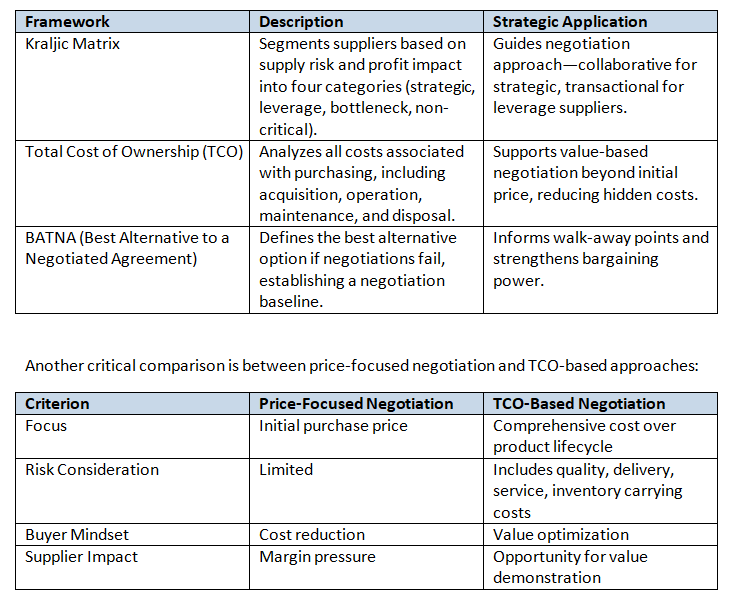
Finally, supplier segmentation via category management influences negotiation tactics:
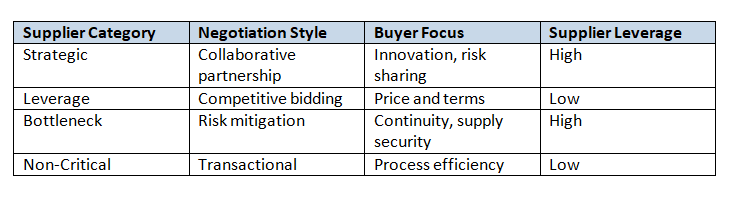
Mastering these frameworks allows negotiators to tailor their strategy effectively.
Step-by-Step Strategy for Successful Negotiations
Successful procurement negotiation unfolds in deliberate stages. Below is a detailed six-step process with buyer and seller tactics and example language.
Step 1: Preparation and Research
Buyer Perspective: Conduct rigorous spend analysis and supplier segmentation. Develop should-cost models by benchmarking market prices and internal costs. Define clear objectives and KPIs for the negotiation.
Seller Perspective: Analyze the buyer’s industry pressures, procurement KPIs, and category strategy. Prepare value-based arguments highlighting TCO benefits and unique differentiators.
Step 2: Establish Rapport and Set the Agenda
Buyer: Begin with an agenda-setting meeting outlining objectives and timelines. Use cooperative language to build trust.
Seller: Acknowledge buyer’s priorities and establish a collaborative tone. Example script: “We understand cost reduction is critical for your team; we want to explore solutions that deliver savings without compromising quality.”
Step 3: Information Exchange and Needs Assessment
Buyer: Share specifications and expected outcomes but avoid revealing walk-away points. Probe supplier capabilities and constraints.
Seller: Ask open-ended questions to uncover buyer pain points and decision criteria. Share relevant case studies.
Step 4: Proposal and Initial Offer
Buyer: Request a detailed proposal including cost breakdowns and value-added services. Use should-cost insights to challenge pricing.
Seller: Present a transparent cost model, emphasizing TCO advantages and risk mitigation elements.
Step 5: Negotiation and Concession Management
Buyer: Use anchoring techniques and reference benchmarks. Apply loss aversion psychology by framing concessions as preventing losses. Example language: “Accepting this price helps avoid costly supply disruptions.”
Seller: Prepare counteroffers that reframe value, e.g., extended warranty or faster delivery. Use conditional concessions: “If you can increase volume commitment, we can offer a 3% price reduction.”
Step 6: Closing and Contract Finalization
Buyer: Summarize agreed terms, confirm KPI alignment, and outline contract milestones.
Seller: Clarify post-contract support and dispute resolution mechanisms. Use language to reinforce partnership: “We look forward to a long-term collaboration that drives mutual growth.”
This structured approach ensures disciplined negotiations that balance rigor and relationship building.
Real-World Case Studies: Lessons from Industry Leaders
Examining how industry giants manage procurement negotiations provides actionable insights.
Toyota’s Supplier Partnership Model: Toyota applies the Kraljic Matrix rigorously, identifying strategic suppliers for long-term collaboration. Their famous “keiretsu” network fosters joint value engineering and risk sharing. Toyota’s procurement teams negotiate not just on price but jointly optimize designs, reducing total costs. Lesson: Collaborative negotiation transcends price and requires trust and transparency.
Apple’s Procurement Leverage: Apple uses its immense buying power to push suppliers hard on cost and quality. However, Apple invests heavily in supplier development and capacity building, balancing squeeze tactics with partnership incentives. For example, Apple’s negotiation with Foxconn involves volume guarantees and premium contract terms. Lesson: High buyer power must be balanced with supplier enablement to sustain innovation.
Walmart’s Supplier Squeeze Tactics: Walmart’s procurement is notorious for aggressive cost-cutting demands, leveraging its position to extract price concessions through competitive bidding and payment term manipulation. Suppliers often face thin margins but gain access to massive volume. Lesson: Buyers with strong leverage can use transactional tactics but risk supplier attrition.
Amazon’s Vendor Negotiations: Amazon combines data analytics with negotiation playbooks to drive down costs while maintaining supplier diversity. They segment suppliers precisely and deploy category management techniques to optimize spend. Lesson: Data-driven procurement enables precise negotiation strategies aligned with supplier segmentation.
Boeing’s Supply Chain Disputes: Boeing’s negotiations with key aerospace suppliers have occasionally escalated to disputes due to scope changes and cost overruns. Boeing’s heavy reliance on a few strategic suppliers illustrates Kraljic’s bottleneck quadrant, where risk mitigation is critical. Lesson: Understanding supply risk dynamics is vital to avoid breakdowns.
Tactics and Counter-Tactics: Procurement Moves and Responses
Procurement teams use a variety of tactics to gain advantage. Sellers must be prepared with calibrated countermeasures. The table below summarizes common tactics, their purpose, and exact scripted counters.
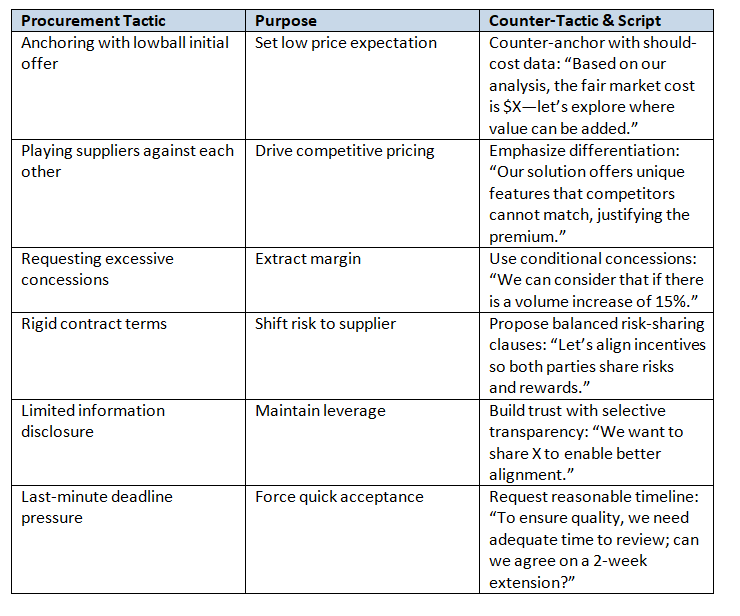
Being prepared with exact language neutralizes procurement tactics and keeps negotiations productive.
Advanced Strategies for Expert Negotiators
Beyond basics, expert negotiators deploy sophisticated techniques to maximize outcomes.
Relationship Leverage: Use historical performance data and mutual dependencies to negotiate beyond price. For example, referencing joint cost savings achieved in prior contracts to build credibility.
Multi-Year Deal Structuring: Propose multi-year agreements with predefined price and volume escalation clauses tied to market indices. This reduces buyer uncertainty and protects supplier margins.
Value-Based Positioning: Quantify and communicate value in business terms—revenue uplift, risk reduction, innovation enablement—rather than cost alone. Use financial models to demonstrate ROI for the buyer.
Lean Procurement Integration: Collaborate with procurement to identify and eliminate waste in processes and product design, reducing total costs and increasing speed.
BATNA Enhancement: Continuously develop alternative supplier or buyer options to strengthen your negotiation position.
Negotiation Simulation and Role-Playing: Conduct internal rehearsals mimicking procurement counter-tactics to prepare responses and build confidence.
Scripts and Templates for Common Procurement Scenarios
Below are exact word-for-word scripts and email templates tailored for procurement negotiation situations.
1. Initial Meeting Request Email (Seller to Buyer)
Subject: Exploring Strategic Partnership Opportunities for [Category]
Dear [Buyer Name],
I hope this message finds you well. We have reviewed your recent RFP for [Category] and believe our solutions align closely with your strategic objectives.
I would appreciate the opportunity to schedule a meeting to discuss how we can deliver value beyond pricing through quality improvements and risk mitigation.
Please let me know your availability next week.
Best regards,
2. Buyer’s Cost Clarification Request
“Thank you for your proposal. To better understand your pricing, could you please provide a detailed cost breakdown including materials, labor, overhead, and any one-time charges? This will help us evaluate total cost of ownership accurately.”
3. Seller’s Conditional Concession Offer
“We appreciate your budget constraints. If you are able to commit to a 20% volume increase over the next 12 months, we can offer a 4% price reduction while maintaining quality standards.”
4. Buyer’s Contract Extension Negotiation
“Given the positive results from our initial contract term, we are interested in discussing a multi-year agreement. Can we explore options for volume discounts and price escalation tied to market indices?”
5. Supplier’s Request for Timeline Extension
“To ensure delivery meets your quality expectations, we kindly request an extension of the final contract signing deadline by two weeks. This will allow us to finalize internal approvals and align resource allocation.”
Frequently Asked Questions
Q1: How can suppliers protect margins when negotiating with cost-driven procurement teams?
A1: Suppliers should leverage should-cost models to demonstrate justified pricing and emphasize total cost of ownership benefits such as quality, reliability, and service. Proposing value-added services and conditional concessions linked to volume or contract length can protect margins.
Q2: What negotiation frameworks are most effective for procurement managers?
A2: The Kraljic Matrix helps segment suppliers and tailor negotiation strategies; TCO analysis ensures comprehensive cost evaluation; BATNA defines walk-away points. Combining these with category management optimizes outcomes.
Q3: How do procurement professionals handle supplier competition?
A3: Procurement uses competitive bidding and benchmarking to create pricing pressure. To counter this, suppliers must differentiate through innovation, reliability, and partnership value rather than price alone.
Q4: What psychological tactics do buyers use in negotiations?
A4: Buyers often use anchoring with low initial offers, deadline pressure, and loss aversion framing to influence supplier concessions. Awareness of these tactics enables effective counter-strategies.
Q5: How can long-term contracts benefit both buyers and suppliers?
A5: Multi-year contracts provide stability, reduce negotiation frequency, and enable joint investments in innovation or process improvements. Properly structured with clear KPIs and escalation clauses, they align interests.
Conclusion
Mastering procurement negotiation requires more than price haggling—it demands a strategic understanding of buyer incentives, rigorous application of frameworks like the Kraljic Matrix and TCO, and deft use of psychology and relationship leverage. By following a disciplined, step-by-step process and preparing for common procurement tactics with precise countermeasures, both buyers and suppliers can unlock value and protect margins.
Whether you are a procurement manager seeking to optimize supplier partnerships or a supplier navigating complex buyer demands, this guide equips you to negotiate confidently and effectively. Start applying these proven techniques, scripts, and frameworks today to transform procurement negotiations from adversarial standoffs into mutually beneficial collaborations.
References
1. Kraljic, P. (1983). Purchasing Must Become Supply Management. Harvard Business Review.
2. Kahneman, D. (2011). Thinking, Fast and Slow. Farrar, Straus and Giroux.
3. Porter, M.E. (1979). How Competitive Forces Shape Strategy. Harvard Business Review.
4. Williamson, O.E. (1985). The Economic Institutions of Capitalism. Free Press.
5. Monczka, R.M., Handfield, R.B., Giunipero, L.C., & Patterson, J.L. (2015). Purchasing and Supply Chain Management. Cengage Learning.
6. Harvard Business Review. (2019). Negotiation Strategies for Procurement Leaders. HBR Press.