How to Practice Negotiation Skills

In today’s fast-paced, interconnected world, negotiation skills have become a critical asset for professionals across all industries. Whether closing a business deal, managing team conflicts, or navigating salary discussions, the ability to negotiate effectively can determine your success or failure. Yet, negotiation is not an innate talent—it is a skill that requires deliberate practice, psychological insight, and strategic application.
This comprehensive guide will help you understand the core principles behind effective negotiation and provide actionable methods to practice and refine these skills. By integrating psychological frameworks such as BATNA (Best Alternative to a Negotiated Agreement), active listening, and anchoring, you will learn how to prepare for negotiations, communicate persuasively, and build rapport with counterparts. Through real-world examples and practical exercises, you will develop confidence and competence in negotiating under a variety of circumstances.
Whether you are a sales executive, entrepreneur, or team leader, mastering negotiation can unlock better deals, stronger relationships, and more satisfying outcomes. Read on to discover how to practice negotiation skills systematically and make negotiation a powerful tool in your professional arsenal.
· Table of Contents
· Understanding the Psychology Behind Negotiation
· Preparing Effectively for Negotiations
· Core Negotiation Techniques and Frameworks
· Practical Exercises to Enhance Negotiation Skills
· Handling Difficult Negotiation Scenarios
· Building Long-Term Negotiation Competence
· Frequently Asked Questions
· Conclusion
· References
Understanding the Psychology Behind Negotiation
Negotiation is fundamentally a psychological interaction between two or more parties aiming to reach a mutually acceptable agreement. Recognizing the underlying psychological principles can elevate your negotiation strategy from reactive to proactive.
One foundational theory is Daniel Kahneman’s Prospect Theory, which explains how people perceive gains and losses asymmetrically, often valuing avoiding losses more than acquiring equivalent gains. This insight allows negotiators to frame proposals in ways that minimize perceived risk for counterparts, increasing the likelihood of agreement.
Another critical psychological principle is the concept of **anchoring**. First introduced by psychologists Amos Tversky and Daniel Kahneman, anchoring occurs when the initial offer or piece of information strongly influences subsequent judgments and counteroffers. For example, in salary negotiations, the first number put on the table sets the tone and range for the entire discussion. Skilled negotiators use anchoring to their advantage by making the first offer when appropriate, creating a reference point favorable to their goals.
**Active listening**, a cornerstone of interpersonal communication, is equally vital in negotiation. Rooted in Carl Rogers' client-centered therapy, active listening involves fully concentrating, understanding, and responding thoughtfully to the speaker’s words and emotions. Practicing active listening builds trust and uncovers underlying interests beyond surface demands.
· Key Psychological Concepts in Negotiation:
· Prospect Theory — framing gains vs. losses
· Anchoring Effect — setting the initial reference point
· BATNA — knowing your Best Alternative to a Negotiated Agreement
· Active Listening — empathetic engagement and validation
· Mirroring — subtly reflecting counterpart’s language and body language to build rapport
Real-World Example: Anchoring in Action
In a 2014 Harvard Business Review case study, a tech startup founder negotiated with a venture capitalist. By confidently anchoring the valuation at $10 million during the first meeting, the founder influenced the VC's perception of the company’s worth. Although the final deal closed at $9 million, the initial anchor prevented the valuation from dropping below $7 million, demonstrating anchoring’s powerful effect.
Preparing Effectively for Negotiations
Preparation is the single most critical factor in negotiation success. According to negotiation expert Leigh Thompson, thorough preparation can increase your chance of achieving optimal outcomes by over 50%. Preparation involves research, objective setting, and scenario planning.
Start by defining your goals clearly. What is your ideal outcome? What concessions are acceptable? Establish your **BATNA** — your best alternative if negotiations fail. Knowing your BATNA empowers you to negotiate from a position of strength and avoid unfavorable compromises.
Research your counterpart thoroughly. Understand their business objectives, negotiation style, past deals, and cultural background. This intelligence allows you to anticipate their priorities and potential objections.
Use role-play to simulate negotiation scenarios. Practicing with a colleague or coach helps identify weaknesses in your approach and builds muscle memory for key phrases and tactics. Prepare opening statements that incorporate anchoring and framing techniques. For example, instead of "We want to reduce the price," say, "Given current market trends, a price adjustment to X would reflect fair value."
· Essential Preparation Steps:
· Define your objectives and minimum acceptable terms
· Identify and evaluate your BATNA
· Research counterpart’s goals, history, and style
· Prepare opening offers and concessions roadmap
· Conduct practice role-plays with feedback
Practical Exercise: BATNA Assessment
Write down three alternative options if the negotiation fails. Rate each by feasibility and value. Knowing which alternative is strongest helps you set a reservation price and avoid accepting suboptimal agreements.
Core Negotiation Techniques and Frameworks
Mastering a set of core negotiation techniques grounded in research and practice enhances your versatility and effectiveness.
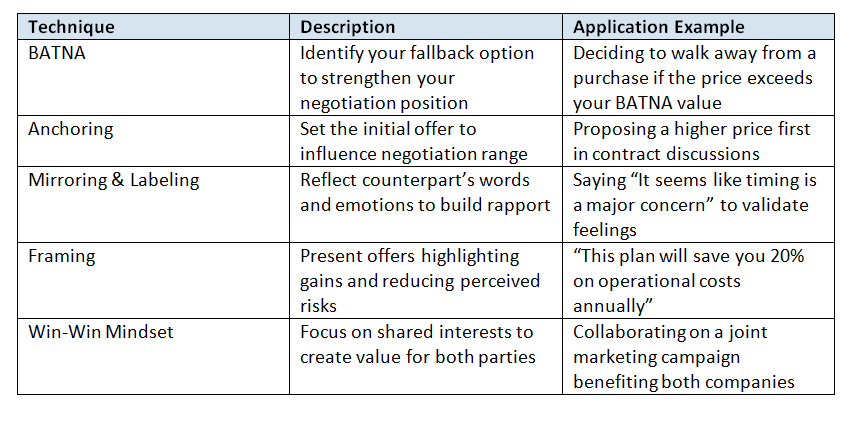
Coined by Roger Fisher and William Ury in "Getting to Yes," BATNA represents your fallback plan. Always clarify your BATNA before negotiating to avoid desperation and weak concessions.
Use the first offer strategically to influence the negotiation range, but be mindful not to alienate your counterpart with unrealistic anchors.
From Chris Voss’s "Never Split the Difference," mirroring (repeating the last few words your counterpart says) and labeling (naming their emotions or concerns) build trust and encourage disclosure.
Present proposals in ways that highlight benefits and minimize risks, leveraging Prospect Theory’s insights.
Aim for integrative negotiation where both parties’ interests are met, fostering long-term relationships rather than zero-sum outcomes.
Script Example: Using Mirroring and Labeling
Counterpart: "We're worried about the delivery timeline."
You: "The delivery timeline is a concern?" (mirroring)
Counterpart: "Yes, we need it within three weeks."
You: "It sounds like meeting that deadline is critical for your launch." (labeling)
This approach encourages openness and fosters collaboration.
Practical Exercises to Enhance Negotiation Skills
Regular practice is essential to internalize negotiation techniques and improve performance under pressure. Below are exercises designed to build specific competencies:
· Role-Play Simulations
Partner with a colleague to simulate negotiation scenarios relevant to your industry. Rotate roles to understand different perspectives.
· Active Listening Drills
Practice summarizing your counterpart’s points without judgment. Use reflective phrases such as “What I hear you saying is...” to confirm understanding.
· Anchoring Practice
Set initial offers in mock negotiations and observe how the anchor influences counteroffers.
· BATNA Workshop
List alternatives for various negotiation cases. Evaluate and discuss the strength of each BATNA.
· Emotional Regulation Techniques
Use mindfulness or breathing exercises before negotiations to maintain composure and think clearly.
Exercise Example: The "Why" Ladder Technique
Inspired by the “Five Whys” root cause analysis, this exercise helps uncover underlying interests:
During a role-play, ask “Why is that important to you?” five times in a row to move beyond positions to interests. For example:
You: “Why do you want a lower price?”
Counterpart: “To stay within budget.”
You: “Why is staying within budget important?”
Counterpart: “So we can fund other projects.”
… and so on.
This technique fosters creative problem-solving.
Handling Difficult Negotiation Scenarios
Not all negotiations proceed smoothly. Difficult counterparts, high stakes, or emotional tensions can complicate the process. Developing strategies for these challenges is crucial.
Use the “Broken Record” technique—calmly and repeatedly restate your position without escalating conflict. For example, “I understand your point, but our budget limit remains firm.”
Pause the discussion if emotions run high. Deploy active listening to acknowledge feelings and defuse tension.
Study cultural norms and communication styles beforehand. For example, high-context cultures (e.g., Japan) value indirect communication, while low-context cultures (e.g., USA) prefer directness.
Introduce new options or reframe the negotiation to create fresh value. Consider involving a neutral mediator if necessary.
Case Study: Resolving an Impasse
A multinational supplier and client reached deadlock over delivery penalties. By reframing the issue from penalty fees to shared responsibility and offering a joint risk-sharing agreement, they broke the impasse and preserved a valuable partnership.
Building Long-Term Negotiation Competence
Negotiation is a lifelong skill that improves with experience, reflection, and continuous learning.
· Keep a Negotiation Journal
Record key takeaways, successful tactics, and lessons learned from each negotiation.
· Seek Feedback
Request honest feedback from peers or mentors to identify blind spots.
· Engage in Continuous Education
Attend workshops, read negotiation literature, and analyze case studies regularly.
· Develop Emotional Intelligence
Understanding your emotions and those of others enhances interpersonal influence and resilience.
· Practice Ethical Negotiation
Build reputation by negotiating transparently and fairly, fostering trust and repeat business.
Frequently Asked Questions
There is no fixed timeline; however, with deliberate practice, feedback, and reflection, noticeable improvement often occurs within 3 to 6 months. Mastery requires ongoing learning and real-world application.
Yes, many reputable online courses and simulations exist. However, combining online theory with live role-plays and mentorship accelerates skill acquisition.
Negotiation is not about confrontation but about dialogue and problem-solving. Techniques like active listening and framing can shift your mindset from adversarial to collaborative.
Focus on strengthening your BATNA, building relationships, and uncovering shared interests. Sometimes, offering creative value beyond price can compensate for power imbalance.
Avoid rushing decisions, failing to prepare, neglecting emotional cues, making ultimatums too early, and ignoring the counterpart’s interests. These errors reduce trust and limit outcomes.
Conclusion
Negotiation skills are indispensable in achieving professional and personal goals. By understanding psychological principles, preparing meticulously, and practicing core techniques such as BATNA, anchoring, and active listening, you can transform your negotiation approach from tentative to confident and strategic. Regular exercises and reflection foster continuous growth, enabling you to handle complex scenarios and build lasting relationships.
Start integrating these practices today—whether by role-playing with colleagues, journaling your experiences, or mastering emotional intelligence—to enhance your negotiation outcomes dramatically. Take control of your next negotiation by preparing thoughtfully and applying these proven strategies.
References
· Fisher, R., Ury, W., & Patton, B. (2011). Getting to Yes: Negotiating Agreement Without Giving In. Penguin Books.
· Voss, C., & Raz, T. (2016). Never Split the Difference: Negotiating As If Your Life Depended On It. Harper Business.
· Kahneman, D. (2011). Thinking, Fast and Slow. Farrar, Straus and Giroux.
· Thompson, L. (2014). The Mind and Heart of the Negotiator. Pearson.
· Cialdini, R. B. (2006). Influence: The Psychology of Persuasion. Harper Business.