How to Prepare for a Negotiation: Step-by-Step Guide
Negotiation is a critical skill in both professional and personal contexts. Whether you are closing a business deal, securing a salary raise, or resolving a conflict, how well you prepare can determine the outcome. Many negotiators focus solely on what happens during the negotiation itself, but the groundwork laid beforehand is often the decisive factor between success and failure.
Effective negotiation preparation involves more than just knowing your desired outcome. It requires understanding the other party’s interests, anticipating objections, and developing a flexible strategy that balances assertiveness with empathy. This comprehensive guide will walk you through the exact steps to prepare for your next negotiation with confidence and precision. You will learn actionable techniques, psychological insights, and real-world examples that will transform your approach.
By the end of this article, you’ll be equipped with a structured framework to analyze, plan, and execute negotiations that maximize value for all parties involved. Whether you are a beginner or a seasoned negotiator, these strategies will improve your ability to influence, build rapport, and close deals effectively.
· Table of Contents
· Understand the Negotiation Context and Objectives
· Research and Gather Intelligence
· Define Your Goals and Best Alternatives (BATNA)
· Develop Your Negotiation Strategy and Tactics
· Prepare Communication and Psychological Techniques
· Plan Logistics and Practice Your Approach
· FAQ: Common Questions About Negotiation Preparation
· Conclusion and Next Steps
Understand the Negotiation Context and Objectives
The very first step in preparing for any negotiation is to clearly understand the context and what you aim to achieve. Without a thorough grasp of the situation, your efforts may be unfocused or misguided.
At this stage, you should identify the type of negotiation you are entering: is it distributive (win-lose), integrative (win-win), or a mix? Distributive negotiations typically revolve around dividing a fixed pie, such as price haggling, whereas integrative negotiations seek to expand value through creative problem-solving.
Understanding the negotiation context also includes recognizing who the stakeholders are, what their interests might be, and the power dynamics involved. For example, negotiating with a supplier who has many competitors differs significantly from negotiating with a sole provider.
Key questions to answer during this phase include:
· What is the primary objective of this negotiation?
· Who are all the parties involved, and what are their interests?
· What is the context or history behind this negotiation?
· What are the external factors influencing this negotiation (market conditions, deadlines, etc.)?
This foundational understanding sets the stage for targeted research and strategic planning.
Research and Gather Intelligence
Thorough research is the backbone of successful negotiation preparation. The more you know about the other party and the relevant context, the better positioned you are to craft persuasive arguments and anticipate challenges.
Start by gathering information on the other party’s background, needs, constraints, and negotiation style. Public records, industry reports, news articles, and even social media can provide valuable insights. In professional negotiations, platforms like LinkedIn may reveal common connections or shared interests that can help build rapport.
Additionally, learn about the market standards or benchmarks related to your negotiation. For example, if negotiating a salary, research industry salary ranges, company compensation philosophies, and recent hiring trends.
· Useful Research Sources:
· Company websites and annual reports
· Industry publications and market analysis
· Social media profiles and professional networks
· Previous contract terms or public negotiation outcomes
· Informal conversations and network intelligence
Investing time in research dramatically increases the likelihood of reaching a beneficial agreement.
Define Your Goals and Best Alternatives (BATNA)
Before entering any negotiation, it is essential to clearly define your goals as well as your BATNA — Best Alternative to a Negotiated Agreement. Your goals represent what you want to achieve, while your BATNA is your fallback option if the negotiation fails.
When setting goals, be specific and realistic. Instead of saying “I want a better price,” specify “I want at least a 10% discount.” Define primary objectives, secondary objectives, and acceptable concessions.
Use the following framework to clarify your goals and BATNA:
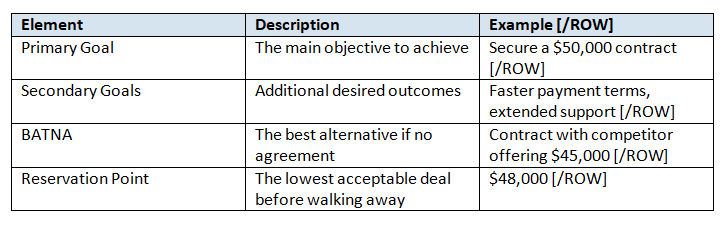
This clarity helps you negotiate assertively and avoid making unnecessary compromises.
Develop Your Negotiation Strategy and Tactics
Strategy involves the overall plan for how you will approach the negotiation, while tactics are the specific actions or techniques used during the discussion. Developing both is critical for effective preparation.
First, decide on your negotiation style: competitive, collaborative, compromising, accommodating, or avoiding. The choice depends on your goals, the relationship with the other party, and the negotiation context.
· Anchoring — Setting the initial offer high or low to influence the negotiation range. For example, a car buyer might start with a low offer to anchor the price.
· Framing — Presenting information in a way that highlights benefits or minimizes drawbacks, such as emphasizing long-term savings rather than upfront costs.
· Silence — Using pauses strategically to encourage the other party to fill the gap, often revealing more information or concessions.
· “Good Cop, Bad Cop” — A classic tactic where negotiators play contrasting roles to pressure the other party.
Consider also how you will handle objections or difficult questions. Preparing scripted responses can increase your confidence and effectiveness.
Plan your concessions carefully. Use the “foot-in-the-door” technique by getting agreement on small issues first, creating a positive pattern before tackling more significant demands.
Prepare Communication and Psychological Techniques
Effective negotiation is as much about communication as it is about numbers and terms. Preparing your verbal and non-verbal communication can significantly impact outcomes.
Start by crafting clear, concise messages that emphasize mutual benefits. Use “I” statements to express your position without sounding confrontational (e.g., “I believe this project timeline will help us deliver better results”).
Active listening is crucial. Techniques such as paraphrasing (“So what you’re saying is...”) and summarizing demonstrate understanding and build rapport.
· Mirroring — Subtly imitating the other party’s body language or speech patterns to build subconscious rapport.
· Labeling — Naming emotions or concerns expressed by the other party to validate their feelings (e.g., “It sounds like you’re worried about the timeline”).
· The “Feel-Felt-Found” Method — A script to handle objections: “I understand how you feel. Others have felt similarly, but they found that…”
Prepare questions that uncover underlying interests rather than positions. For example, instead of asking “Can you lower the price?” ask “What constraints do you have around pricing?”
Non-verbal communication is equally important. Maintain open body language, steady eye contact, and a calm tone to convey confidence and sincerity.
Plan Logistics and Practice Your Approach
The final phase of preparation involves practical logistics and rehearsing your negotiation approach. The environment and your readiness can influence the negotiation atmosphere and outcomes.
Choose a neutral, comfortable location where both parties feel at ease. If the negotiation is virtual, ensure technical setups are tested and distractions minimized.
Schedule the negotiation at a time when both parties are likely to be alert and unhurried. Avoid rushing or scheduling at stressful times.
Practice your script, key points, and responses aloud. Role-playing with a colleague or mentor can simulate real scenarios and provide valuable feedback. This rehearsal helps identify gaps and builds confidence under pressure.
Prepare all necessary documents, data, and visual aids to support your position. Organize your materials so you can access them quickly during the discussion.
· Checklist for Logistics and Practice:
· Confirm date, time, and venue or virtual platform
· Test all technology in advance
· Prepare documents and data for reference
· Role-play with a partner and adjust scripts
· Plan attire and personal presentation for professionalism
Being fully prepared on logistical fronts reduces stress and allows you to focus on negotiation substance.
FAQ: Common Questions About Negotiation Preparation
What is the most important factor in preparing for a negotiation?
The most important factor is understanding your BATNA. Knowing your best alternative gives you leverage and confidence to avoid unfavorable agreements. Alongside this, thorough research on the other party’s interests and constraints is essential to craft a strategic approach.
How far in advance should I start preparing for a negotiation?
Ideally, start preparing as soon as you know the negotiation will occur. For complex negotiations, beginning weeks in advance allows time for research, strategy development, and practice. For smaller or informal negotiations, a few days of focused preparation may suffice.
How do I handle a situation where I have very little information about the other party?
In cases of limited information, focus on asking open-ended questions early in the negotiation to uncover interests and constraints. Use active listening and observe non-verbal cues carefully. Prepare flexible strategies that allow adjustment as you gather information during the discussion.
Can emotional intelligence be developed to improve negotiation outcomes?
Yes. Emotional intelligence (EQ) — the ability to recognize and manage your own emotions and those of others — can be cultivated through practice and reflection. High EQ helps in managing stress, building rapport, and responding empathetically, all of which enhance negotiation effectiveness.
Should I reveal my BATNA during negotiations?
It depends on context. Revealing a strong BATNA can increase your negotiating power by signaling you have alternatives. However, if your BATNA is weak or unknown to the other party, premature disclosure might weaken your position. Use discretion and consider signaling strength without full disclosure when tactically advantageous.
Conclusion
Preparation is the foundation of successful negotiation. By systematically understanding the context, conducting thorough research, defining your goals and BATNA, developing strategy and communication techniques, and rehearsing logistics, you set yourself up to negotiate with confidence and effectiveness. Preparation not only improves your chances of achieving favorable terms but also fosters better relationships and long-term collaboration.
Don’t leave your negotiation outcomes to chance. Invest the time and effort in preparation outlined in this guide, and watch your ability to influence and close deals improve dramatically. Start today by analyzing your upcoming negotiations and applying these step-by-step tactics to gain a competitive edge.
Mastering how to negotiate is not about tricks — it's about clarity, positioning, and control. If you want to go deeper into advanced negotiation strategies, negotiation psychology, handling objections, and negotiating under pressure, explore our full library of articles designed for professionals operating in high-stakes business environments.