How to Respond When Your Price Is Too High: The Definitive Guide for Sales Professionals

A seasoned SaaS account executive sits across from a prospective enterprise client. The demo went well, the product checks all the boxes, and the client is visibly interested—until the dreaded phrase drops: "Your price is too high." In that moment, the deal hangs in the balance. A knee-jerk discount offer may save the sale but erodes margins, damages perceived value, and sets a dangerous precedent for future negotiations. According to a Salesforce survey, 62% of salespeople give discounts too early in price snegotiations, losing up to 20% margin unnecessarily. This scenario is all too common yet avoidable with the right mindset and strategies.
Why is mastering the response to "your price is too high" so critical? Because price objections are not just about numbers — they tap deeply into buyer psychology, perceived value, and salesperson confidence. Improperly handled, they lead to a race to the bottom, commoditization, and margin destruction. Properly handled, they create opportunities for value reinforcement, differentiation, and even premium pricing justification. Understanding the behavioral economics behind price perception—from Kahneman's prospect theory to Ariely's anchoring effect—allows sales professionals to re-frame objections and negotiate from strength.
This comprehensive guide will equip you with everything you need to confidently handle price objections. You will master the psychology behind price perception, learn key pricing and negotiation frameworks, follow a step-by-step process to respond, and explore real-world company examples that illustrate best practices. You will also get access to exact objection-handling scripts, advanced negotiation tactics, and templates to immediately implement. By the end, you will never fear "your price is too high" again—instead, you will use it as a lever to close more deals at premium prices.
· Table of Contents
· The Psychology of Price: Behavioral Economics Behind Buyer Perception
· Key Frameworks for Price Objection Handling
· Step-by-Step Process to Respond to "Your Price Is Too High"
· Real-World Examples of Successful Price Objection Responses
· Objection Handling Matrix: Common Price Objections and Exact Responses
· Advanced Tactics for Expert-Level Negotiations
· Scripts and Templates: Ready-to-Use Dialogue and Email Examples
· Frequently Asked Questions on Price Objections
· Conclusion and Next Steps
· References and Further Reading
The Psychology of Price
Price is not just a number—it's a complex psychological signal that influences buyer decisions in counterintuitive ways. Behavioral economics and psychology have extensively studied how buyers perceive price and value, revealing critical insights for sales professionals.
One foundational concept is Kahneman and Tversky's Prospect Theory (1979), which explains how buyers weigh losses and gains asymmetrically. A price increase feels more painful than an equivalent discount feels pleasurable. This loss aversion explains why buyers often resist price increases or perceive your price as "too high" even when value justifies it.
Another powerful phenomenon is the Anchoring Effect, well documented by Dan Ariely in "Predictably Irrational" (2008). Buyers anchor their expectations on an initial reference price—often a competitor quote, a previous purchase price, or a psychological benchmark (e.g., $999 vs. $1000). Establishing a high but reasonable anchor early in negotiations sets the stage for premium pricing acceptance.
The Price-Quality Heuristic is a mental shortcut where buyers equate higher price with higher quality or prestige. Apple leverages this heuristic masterfully, pricing its products at a premium to reinforce their status as luxury tech. Conversely, discounting can trigger perceptions of inferior quality.
The Decoy Effect is a subtle cognitive bias where the presence of a third less-attractive option shifts buyer preference toward the premium offering. For example, presenting three pricing tiers—basic, decoy, and premium—can nudge buyers to select the higher-margin option.
Veblen goods theory explains how some products become more desirable precisely because their prices are high, signaling exclusivity and prestige. This luxury pricing psychology underpins brands like Rolex and Tesla's Model S.
Understanding these psychological levers helps sales professionals re-frame price objections—not as obstacles but as opportunities to reinforce value, reset anchors, and justify premium price points.
Key Frameworks
To systematically handle price objections, three frameworks stand out for their practical utility in sales negotiations: The Value Ladder, The Price-Value Matrix, and BATNA in Pricing.
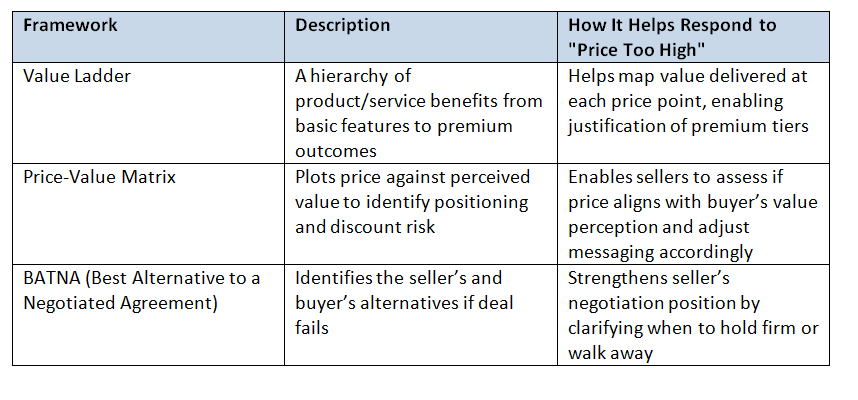
The Value Ladder framework encourages salespeople to articulate and emphasize incremental benefits that justify higher prices. For instance, Salesforce uses this to upsell enterprise features that correspond to premium pricing tiers.
The Price-Value Matrix is essential for diagnosing when a buyer’s "price too high" objection signals a mismatch in perceived value rather than absolute price. This insight allows tailored positioning or product configuration to bridge gaps.
BATNA awareness, a concept from negotiation theory (Fisher and Ury, 1981), empowers sellers to negotiate confidently knowing their alternatives are viable. This reduces the temptation for premature discounting.
Step-by-Step Process
Effectively responding to "your price is too high" requires a disciplined, consultative approach. Below is a detailed six-step process to guide you.
Step 1: Pause and Clarify
Do not rush into discounting or defensiveness. Pause briefly, maintaining composure. Ask open-ended questions to understand the objection’s root cause.
Example: "I appreciate your honesty. Could you share more about what specifically feels too high—compared to what, or in relation to which factors?"
Step 2: Validate the Concern
Acknowledge the buyer’s perspective to build rapport and trust. Validation reduces buyer resistance.
Example: "It makes sense that pricing is an important consideration given your budget constraints."
Step 3: Uncover Value Gaps
Probe to identify if the buyer fully understands the total value and ROI your solution delivers versus competitors or alternatives.
Example: "Let’s review the key outcomes you’re seeking and how our solution addresses them. Are there areas where you’d like more clarity on benefits?"
Step 4: Reinforce Differentiation and ROI
Reiterate unique value drivers, using data, case studies, or testimonials that quantify return on investment.
Example: "Clients like [Client X] saw a 30% reduction in operational costs within six months after adopting our platform, which more than justifies the investment."
Step 5: Explore Budget and Constraints
Ask about budget limitations and decision criteria to assess flexibility without conceding price prematurely.
Example: "What budget parameters are you working within? Are there other stakeholders whose input might influence the investment level?"
Step 6: Negotiate or Offer Alternatives
If price remains a sticking point, present alternative packages, payment terms, or value-added services rather than straight discounts.
Example: "We can explore a phased rollout or add a training package to maximize adoption. Would that help align with your budget while preserving value?"
This methodical approach turns price objections into collaborative problem-solving rather than adversarial haggling.
Real-World Examples
Examining how leading companies navigate price objections provides practical insights.
1. Apple Inc.: Apple never lowers prices to address objections. Instead, they emphasize design, ecosystem integration, and brand prestige to justify premium pricing. When customers balk, Apple sales teams highlight unique experiences and long-term value, tapping into the price-quality heuristic and Veblen effect.
2. McKinsey & Company: As a top-tier consulting firm, McKinsey faces frequent price resistance. They counter by focusing on value-based pricing rather than hourly rates, quantifying client ROI in millions to overshadow sticker shock. Their consultants use the BATNA framework to confidently push back on unreasonable discount requests.
3. Salesforce: Salesforce employs tiered pricing and the decoy effect by offering multiple editions—Essentials, Professional, Enterprise—to steer buyers towards the higher-margin middle or premium tiers. When faced with "too high" objections, sales reps re-anchor pricing by laying out total cost of ownership savings and productivity gains.
These examples demonstrate that premium pricing defense hinges on value articulation, anchoring, and strategic packaging—not cheap discounts.
Objection Handling
Below is a matrix of common price objections mapped to exact, psychologically informed responses proven to redirect the conversation and protect margins.
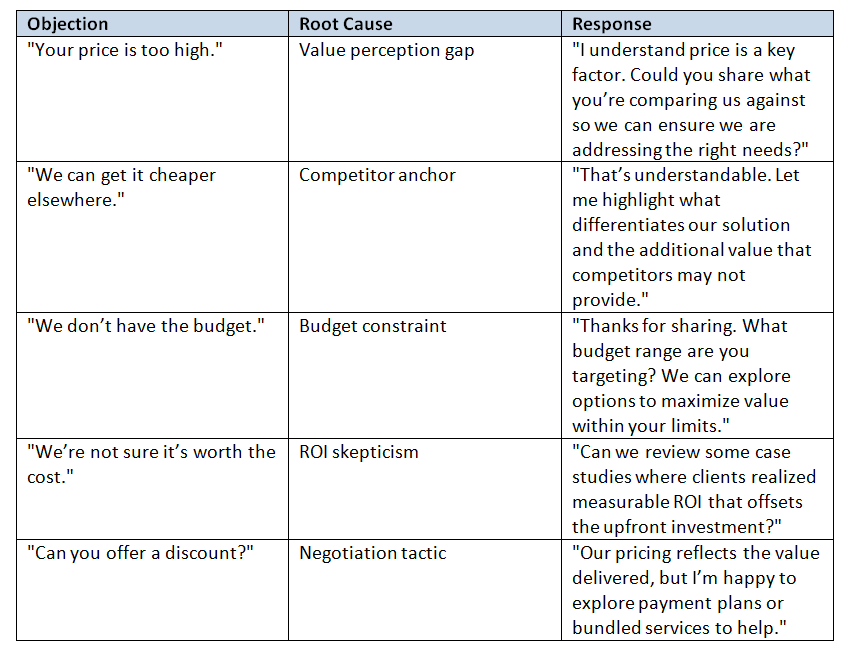
These responses combine validation, probing, and value reinforcement to move the buyer away from price fixation.
Advanced Tactics
For seasoned negotiators, these expert-level techniques elevate price objection responses beyond standard scripts.
· Use the "Feel-Felt-Found" Method with a Twist: Instead of generic empathy, share specific client stories that mirror the prospect’s hesitation and how they overcame it.
· Implement "Partitioned Pricing": Break down total cost into components (software, support, training) to highlight value in each segment and reduce sticker shock.
· Employ "Loss Aversion Framing": Emphasize what the prospect stands to lose by choosing a cheaper alternative—missed features, downtime, support risks.
· Integrate Scarcity and Urgency: Communicate limited availability of premium packages or upcoming price increases to leverage Cialdini’s scarcity principle.
· Use "Decoy Pricing": Introduce a less attractive option with higher price but fewer benefits to steer buyers toward your target offering.
These nuanced tactics require deep product knowledge and buyer insight but yield superior negotiation outcomes.
Scripts and Templates
Here are four exact dialogue scripts and email templates to deploy when responding to price objections:
1. Phone Script: Initial Price Objection
"Thank you for your feedback on pricing. I understand that it’s an important consideration. Can you help me understand what you’re comparing our price to? I want to make sure we're addressing your key priorities."
2. Email Template: After Initial Objection
Subject: Let’s Ensure You’re Getting Maximum Value
Hi [Name],
Thanks for sharing your concern about pricing. I’d like to walk you through how our solution delivers measurable ROI and unique benefits that justify the investment. Are you available for a 20-minute call this week?
Best,
3. Negotiation Script: Exploring Alternatives
"I hear that budget is tight. One approach we’ve successfully used with clients is a phased implementation that spreads costs over time. Would that be helpful to explore?"
4. Closing Script: Reinforcing Value Over Discount
"I appreciate that price is a factor. However, the total cost of ownership and long-term savings our solution delivers often outweigh initial sticker price—let me show you the numbers."
Frequently Asked Questions
Q1: How can I tell if a "price too high" objection is about budget or perceived value?
A1: Listen carefully for clues. If the buyer references competitors or previous prices, it’s often a perceived value issue. If they mention budget limits or approval processes, it’s a budget constraint. Tailor your approach accordingly—reinforce value or explore budget flexibility.
Q2: When is it appropriate to offer a discount?
A2: Only after thoroughly exploring value, budget, and alternatives. Discounts should be strategic—offered in exchange for concessions like longer contract terms or volume commitments, not as a knee-jerk reaction.
Q3: How do I use anchoring to defend my price?
A3: Introduce a higher-priced reference point early, such as a premium package or competitor rate, to set buyer expectations. Then position your price as reasonable in contrast.
Q4: What if the buyer insists on a lower price despite value proof?
A4: Reassess your BATNA. If the deal risks margin erosion, be prepared to walk away professionally. Sometimes losing a deal is better than damaging your pricing integrity.
Q5: How can I train my sales team to handle price objections better?
A5: Conduct role-plays using real scripts, teach psychological principles behind objections, and encourage discipline in following the six-step process. Use recorded calls for feedback and continuous improvement.
Conclusion
Price objections like "your price is too high" are inevitable in sales but do not have to be deal-breakers or margin killers. By understanding the deep psychology underlying price perception and deploying structured frameworks, sales professionals can re-frame objections as opportunities to reinforce value and negotiate from strength. This guide has equipped you with research-backed insights, practical processes, real-world examples, and ready-to-use scripts to master price objection handling.
The cost of unnecessary discounting is high—both in lost revenue and brand equity. Instead, use the techniques here to confidently uphold your pricing, differentiate your offering, and close deals that respect your value. Start applying these strategies today and transform price objections into stepping stones for premium sales success.
References
1. Kahneman, D., & Tversky, A. (1979). Prospect Theory: An Analysis of Decision under Risk. Econometrica.
2. Ariely, D. (2008). Predictably Irrational: The Hidden Forces That Shape Our Decisions. HarperCollins.
3. Cialdini, R. B. (2006). Influence: The Psychology of Persuasion. Harper Business.
4. Fisher, R., Ury, W., & Patton, B. (1981). Getting to Yes: Negotiating Agreement Without Giving In. Penguin Books.
5. Monroe, K. B. (2003). Pricing: Making Profitable Decisions. McGraw-Hill Education.
6. Nagle, T., Hogan, J., & Zale, J. (2016). The Strategy and Tactics of Pricing: A Guide to Growing More Profitably. Routledge.