How to Say No in Negotiation Without Destroying the Deal: The Definitive Guide for Professionals

Negotiations can quickly escalate into tense standoffs where the stakes are sky-high. Imagine a critical M&A deal teetering on collapse because one party refuses to accept key terms, and their counterpart’s insistence on ‘yes’ spirals into frustration and ultimatums. Emotions flare. Trust erodes. The deal you’ve painstakingly built over months is on the brink of disintegration — all because the word “no” was mishandled. Whether in high-stakes boardroom battles, diplomatic crises, or client engagements, the ability to say no without burning bridges is a rare and invaluable skill.
Understanding the psychological underpinnings of rejection and how to communicate refusal strategically can mean the difference between deadlock and breakthrough. Most negotiators either cave too easily or push too hard, triggering defensive responses that shut down dialogue. The truth is, difficult negotiations are often won or lost in the first few moments by how “no” is framed and delivered. Failure to manage emotional flooding, avoid amygdala hijack, or employ tactical empathy leaves negotiators vulnerable to breakdown.
In this comprehensive guide, you will master proven psychological insights and frameworks — from Daniel Kahneman’s System 1 and System 2 thinking to Chris Voss’s tactical empathy and William Ury’s “Going to the Balcony” — designed to help you say no with confidence and grace. You will gain actionable, step-by-step processes, expert-level techniques, and exact word-for-word scripts calibrated for high-conflict scenarios. Whether you are a senior manager, legal counsel, or negotiation leader, this article will equip you to protect your interests without destroying the deal.
· Table of Contents
· The Psychology Behind This Challenge
· Key Frameworks and Models
· Step-by-Step Process to Say No Effectively
· Real-World Case Studies
· Recognizing and Countering Difficult Tactics
· Advanced Techniques for Expert Negotiators
· Scripts and Templates for Saying No
· Frequently Asked Questions
· Conclusion and Next Steps
· References
The Psychology Behind This Challenge
Negotiation is a psychologically charged environment where cognitive biases, emotional reactions, and social identities intersect. Understanding these forces is crucial to saying no without destroying the deal.
At the core lies the amygdala hijack — a term coined by psychologist Daniel Goleman describing how the brain’s emotional center can override rational thinking during perceived threats. When a negotiator hears “no,” their amygdala may trigger fight, flight, or freeze responses, leading to aggression, withdrawal, or shutdown. This emotional flooding inhibits System 2 thinking — the deliberate, analytical thought process Daniel Kahneman highlights in his dual-process theory — and instead activates fast, intuitive System 1 thinking that is prone to bias and impulsivity.
Chris Voss, former FBI lead hostage negotiator, emphasizes tactical empathy — the ability to actively listen and acknowledge the counterpart’s emotions without agreeing — as a way to prevent emotional escalation. By validating feelings, negotiators reduce amygdala activation and create space for reasoned dialogue.
John Gottman’s research on emotional flooding in conflict reveals how overwhelming negative emotions can paralyze communication and decision-making. Effective negotiators recognize early signs of emotional flooding and apply calming techniques to regain emotional regulation.
Social identity theory also plays a role. Negotiators are often defensive when “no” challenges their self-concept or group affiliation, leading to moral rigidity as Jonathan Haidt explains. Recognizing this helps in framing refusal in ways that respect identity and avoid triggering identity threats.
Together, these psychological dynamics explain why blunt refusals often backfire and how subtle, empathetic, and strategic communication can preserve relationships and keep deals alive.
Key Frameworks and Models
Several established negotiation frameworks offer structured approaches to handling refusal gracefully. Below is a comparison of three influential models:
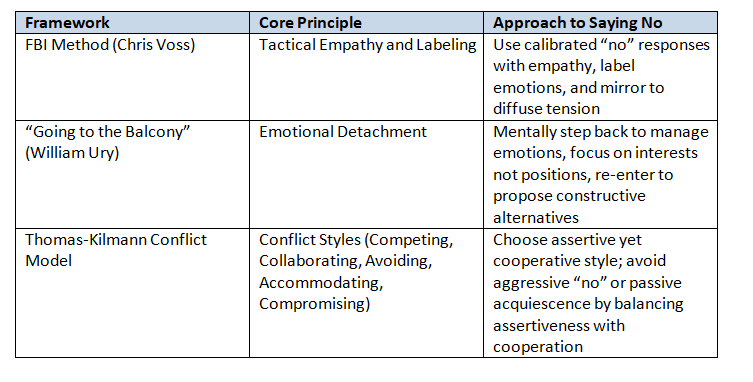
The FBI Method emphasizes emotional intelligence and tactical empathy to say no in a way that disarms hostility. Ury’s “Going to the Balcony” teaches negotiators to self-regulate and avoid reactive rejection that could escalate conflict. The Thomas-Kilmann Model provides insight into one’s conflict style and how it impacts refusal strategies.
Each framework complements the others, providing a toolkit to manage both the psychological and strategic complexity of saying no.
Step-by-Step Process to Say No Effectively
This detailed 6-step process integrates psychological theory and practical tactics for saying no without destroying the deal.
Step 1: Prepare Mentally Using “Going to the Balcony”
Before entering negotiation, consciously adopt William Ury’s “balcony” mindset: detach emotionally and observe the interaction from a calm, objective vantage point. This mental distancing prevents amygdala hijack and sets the stage for measured responses.
Techniques: Deep breathing, visualization, affirm your goals and boundaries.
Step 2: Listen Actively and Identify Emotional Underpinnings
Use Chris Voss’s tactical empathy tools: listen without interruption, label the counterpart’s emotions (“It seems like you’re frustrated…”), and mirror key phrases. Understanding emotional drivers reduces defensiveness.
Step 3: Use Calibrated “No” Responses
Avoid blunt refusals. Instead, use calibrated “no” phrases like “That’s a hard no for us right now, but let’s explore other options” or “I’m not able to agree to that at this moment.” This softens the impact and signals openness.
Step 4: Reframe the Refusal Around Interests, Not Positions
Shift from “I can’t do this” to “Our priority is X, so here’s what might work better.” This aligns with principled negotiation by separating people from the problem (Fisher & Ury). It reduces identity threat.
Step 5: Offer Constructive Alternatives or Trade-Offs
Instead of shutting down dialogue, propose creative alternatives that meet underlying interests. This shows collaboration and keeps the deal alive.
Step 6: Manage Your Emotional State and Watch for Flooding
Monitor your own signs of emotional flooding; use techniques like Amy Cuddy’s power poses or grounding exercises. If counterpart becomes flooded, pause and “go to the balcony” mentally again before proceeding.
This stepwise approach blends cognitive control, emotional intelligence, and strategic communication to transform “no” into a productive negotiation tool.
Real-World Case Studies
Examining real-world examples brings these principles to life.
Case Study 1: FBI Hostage Negotiations
In the 1993 Waco standoff, FBI negotiators used tactical empathy and calibrated refusal to avoid antagonizing David Koresh’s group. Rather than issuing ultimatums, they repeatedly acknowledged emotions and offered alternatives, which prolonged dialogue though the ultimate outcome was tragic. The lesson: saying no requires patience and emotional attunement.
Case Study 2: Corporate Boardroom Conflict
During the 2018 Disney-Fox merger talks, Disney executives faced aggressive demands from Fox. Disney’s leaders used “going to the balcony” to stay emotionally detached, then framed no responses around strategic priorities while proposing alternative deal structures. This preserved relationship and closed the deal.
Case Study 3: Diplomatic Crisis — Cuban Missile Crisis
President Kennedy’s refusal to accept Soviet nuclear missiles in Cuba was definite but framed through back-channel negotiations and alternative security guarantees. This calibrated no, paired with empathy for Soviet concerns, de-escalated potential nuclear war.
Recognizing and Countering Tactics
Negotiators often face manipulative or aggressive tactics designed to force compliance. Recognizing these and responding effectively is critical.
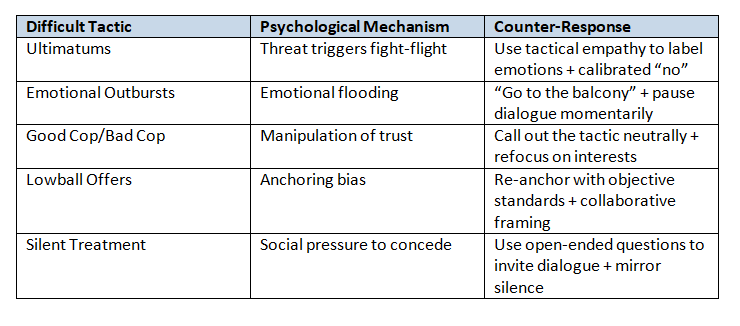
By mapping tactics to their psychological roots, negotiators can deploy precise countermeasures that reduce escalation and maintain control.
Advanced Techniques for Expert Negotiators
Beyond foundational tactics, expert negotiators employ advanced psychological strategies:
- Use of Micro-Expressions (Paul Ekman): Detect subtle emotional cues to time your “no” for maximum receptivity.
- Framing with Moral Psychology (Jonathan Haidt): Align refusals with counterpart’s moral values to reduce resistance.
- Presence Under Pressure (Amy Cuddy): Maintain confident body language to influence counterpart’s perception and reduce their defensiveness.
- The “Third Side” Perspective (William Ury): Engage neutral stakeholders or frame negotiations as community problems to depersonalize rejection.
- Preemptive “No”: Introduce boundaries early to set expectations and reduce surprise or backlash.
These nuanced techniques require practice but exponentially increase refusal effectiveness.
Scripts and Templates for Saying No
Below are exact dialogue examples tailored for common challenging scenarios:
Script 1: Saying No to an Unrealistic Price Demand
“I appreciate the value you’re placing on this, but that price is beyond what we can consider. Let’s explore other ways to create value that meet both our needs.”
Script 2: Refusing a Last-Minute Contract Change
“That’s a significant change at this stage, and we can’t agree to it now. However, we’re open to discussing adjustments in future contracts.”
Script 3: Rejecting a Toxic Client Request
“I understand your urgency, but we must adhere to our policies to ensure quality. Let’s find a solution that respects both our standards.”
Script 4: Declining to Accept Liability in a Dispute
“We’re not able to accept responsibility for that issue, but let’s collaborate on a path forward that addresses your concerns.”
Script 5: Saying No to a Pressuring Negotiator Using Ultimatums
“I hear your position clearly, and I’m committed to reaching an agreement. However, ultimatums make it harder to find common ground. Let’s work together on solutions.”
Frequently Asked Questions
Q1: How can I say no without making the other party defensive?
A1: Use tactical empathy to acknowledge their emotions, soften your refusal with calibrated language, and reframe the no around shared interests. Avoid blunt or absolute language.
Q2: What if the other party reacts with anger after I say no?
A2: Recognize emotional flooding and pause. Use labeling (“It seems this is upsetting you”) to validate feelings, then calmly restate your position. Employ “going to the balcony” to manage your own emotions.
Q3: Can saying no too often harm my reputation as a negotiator?
A3: Saying no is necessary but must be balanced with collaboration. Consistently provide alternatives and demonstrate willingness to solve problems. This builds trust and credibility.
Q4: How do cultural differences affect saying no in negotiation?
A4: Some cultures view direct no as impolite. Use indirect language and nonverbal cues aligned with cultural norms. Tactical empathy is critical to gauge and adapt appropriately.
Q5: What role does body language play when saying no?
A5: Confident but open body language (e.g., relaxed posture, steady eye contact) conveys presence and reduces perceived threat. Avoid defensive gestures like crossed arms that escalate conflict.
Conclusion
Mastering how to say no in negotiation without destroying the deal is an indispensable skill for any professional operating in high-stakes or high-conflict environments. By integrating psychological insights — from emotional regulation and tactical empathy to cognitive reframing — with proven frameworks like the FBI method and “Going to the Balcony,” negotiators can protect their interests while preserving relationships. Saying no does not have to mean a deal ends; it can be the catalyst for creative problem-solving and durable agreements.
The techniques, scripts, and case studies shared here provide a robust roadmap to navigate refusal with confidence and finesse. I encourage you to internalize these methods, practice them diligently, and transform your toughest negotiations into opportunities for mutual gain. If you want deeper personalized coaching on these skills or tailored negotiation strategies, reach out to experts specializing in conflict resolution and executive negotiation support today.
References
Fisher, R., Ury, W. L., & Patton, B. (2011). Getting to Yes: Negotiating Agreement Without Giving In. Penguin Books.
Kahneman, D. (2011). Thinking, Fast and Slow. Farrar, Straus and Giroux.
Voss, C., & Raz, T. (2016). Never Split the Difference: Negotiating As If Your Life Depended On It. HarperBusiness.
Goleman, D. (1996). Emotional Intelligence: Why It Can Matter More Than IQ. Bantam.
Ekman, P. (2003). Emotions Revealed: Recognizing Faces and Feelings to Improve Communication and Emotional Life. Times Books.
Ury, W. (1993). Getting Past No: Negotiating in Difficult Situations. Bantam Books.
Haidt, J. (2012). The Righteous Mind: Why Good People Are Divided by Politics and Religion. Pantheon.
Cuddy, A. (2015). Presence: Bringing Your Boldest Self to Your Biggest Challenges. Little, Brown and Company.
Gottman, J. M. (1994). What Predicts Divorce? The Relationship Between Marital Processes and Marital Outcomes. Lawrence Erlbaum Associates.