How to Stay Calm in Negotiation

Negotiation is a high-stakes arena where emotions often run high, and the ability to maintain composure can be the difference between success and failure. In today’s fast-paced, competitive business environment, staying calm during negotiation isn’t just a soft skill—it’s a strategic advantage. Whether negotiating a multi-million dollar contract or resolving an internal team conflict, calmness allows you to think clearly, listen actively, and respond effectively.
Yet, many negotiators struggle with anxiety, frustration, or impulsive reactions that cloud judgment and hinder outcomes. This article explores the psychological underpinnings of emotional control in negotiation and provides concrete, actionable strategies to help you stay calm under pressure. By mastering these techniques, you will not only improve your negotiation outcomes but also build stronger, more collaborative relationships.
In the following sections, you will learn foundational theory on emotional regulation, practical exercises to enhance your calmness, real-world examples illustrating effective calm negotiation, and how to integrate these negotiation skills into your daily practice. Prepare to transform your negotiation approach with scientifically supported methods to remain poised and persuasive.
· Table of Contents
· Understanding the Psychology of Calmness in Negotiation
· Preparing Mentally and Physically for Negotiation
· Techniques to Manage Stress and Anxiety During Negotiation
· Communication Strategies to Maintain Calm and Influence
· Leveraging Psychological Frameworks: BATNA, Anchoring, and Mirroring
· Practical Exercises and Role-Playing for Emotional Control
· Frequently Asked Questions
· Conclusion
· References
Understanding the Psychology of Calmness in Negotiation
Negotiation triggers a complex emotional response that can activate the body’s fight-or-flight system, leading to increased heart rate, shallow breathing, and cognitive narrowing. According to the dual-process theory (Kahneman, 2011), stress pushes negotiators toward fast, instinctive Type 1 thinking rather than reflective, analytical Type 2 thinking. This shift often results in reactive decisions rather than strategic ones.
Emotional regulation—the ability to monitor, evaluate, and modify emotional reactions—is critical in maintaining calm. Gross’s Process Model of Emotion Regulation (1998) identifies key points where negotiators can intervene: situation selection, situation modification, attentional deployment, cognitive change, and response modulation. For example, before entering a negotiation, you might choose to prepare thoroughly (situation selection) or reframe a challenging demand as an opportunity to collaborate (cognitive change).
Research in neuroscience highlights the role of the prefrontal cortex in regulating emotions, underscoring the importance of mindfulness and stress reduction practices to strengthen this brain region (Tang et al., 2015). By understanding these psychological mechanisms, negotiators can intentionally cultivate calmness as a competitive advantage.
Real-World Example: The Calm CEO
Consider Satya Nadella’s approach as Microsoft’s CEO during critical negotiations with partners and regulators. Nadella’s calm demeanor, grounded by deep preparation and emotional regulation, helped transform Microsoft’s culture and negotiation style. His ability to listen actively and respond thoughtfully exemplifies the power of calmness in high-stakes business environments.
Preparing Mentally and Physically for Negotiation
Preparation is a cornerstone of staying calm. Mental and physical readiness reduces uncertainty and builds confidence, which directly lowers anxiety levels.
Start with thorough research: understand the interests, BATNA (Best Alternative to a Negotiated Agreement), and potential pressures on the other party. Knowing your BATNA provides a psychological safety net that mitigates fear of loss, a major stress trigger (Fisher, Ury & Patton, 2011). Define clear objectives and acceptable concessions to avoid being caught off guard.
Physical preparation includes quality sleep, hydration, and nutrition to optimize cognitive function. Exercise before negotiation sessions can reduce cortisol—a stress hormone—and enhance mood (Salmon, 2001). Breathing exercises or progressive muscle relaxation can be practiced briefly before negotiations begin to calm the nervous system.
Practical Checklist for Preparation
· Research the other party’s goals, constraints, and BATNA
· Set clear personal objectives and fallback positions
· Engage in light physical exercise prior to the meeting
· Practice deep breathing or mindfulness meditation
· Visualize positive negotiation outcomes and calm responses
Techniques to Manage Stress and Anxiety During Negotiation
Even with preparation, stressful moments will arise. Employing in-the-moment techniques can help maintain calm.
Deep diaphragmatic breathing slows heart rate and activates the parasympathetic nervous system. The “4-7-8” breathing technique—inhaling for 4 seconds, holding for 7, and exhaling for 8—has been shown to reduce anxiety rapidly (Brown & Gerbarg, 2005).
Another method is cognitive reframing: consciously shifting your interpretation of the negotiation from a confrontation to a collaborative problem-solving exercise. This aligns with the cognitive-behavioral framework, which posits that changing thought patterns can alter emotions and behavior (Beck, 2011).
Using pauses strategically can also cool rising tension. Instead of responding immediately to provocative statements, take a moment to breathe and formulate a calm, deliberate response. This delay interrupts automatic emotional reactions.
Exercise: The Emotional Pause Script
When you feel triggered, silently say to yourself:
· “Pause.”
· Take a slow breath in through your nose.
· Count to three quietly.
· Respond with a neutral tone or ask a clarifying question.
This simple script can be practiced in role-plays to build automaticity.
Communication Strategies to Maintain Calm and Influence
Calmness is conveyed not only through internal emotion but also nonverbal and verbal communication cues. Mastering these signals enhances your influence and helps de-escalate tension.
Active listening is foundational. According to Carl Rogers’s client-centered therapy principles, listening attentively and reflecting back what you hear builds trust and lowers defenses. Simple phrases like “What I’m hearing is…” or “Help me understand your perspective…” demonstrate openness.
Mirroring, or subtly mimicking the other party’s body language and tone, fosters rapport on a subconscious level (Chartrand & Bargh, 1999). However, it must be subtle and natural to avoid suspicion.
Maintaining a steady, calm voice with measured pacing signals confidence and control. Avoid rising intonation that can be perceived as uncertainty or aggression.
Communication Tips to Stay Calm and Persuasive
· Use open body language—uncross arms, maintain eye contact
· Paraphrase to confirm understanding and show empathy
· Speak slowly and clearly, pausing for emphasis
· Use “I” statements to express needs without blame
· Avoid interrupting; allow silence to encourage dialogue
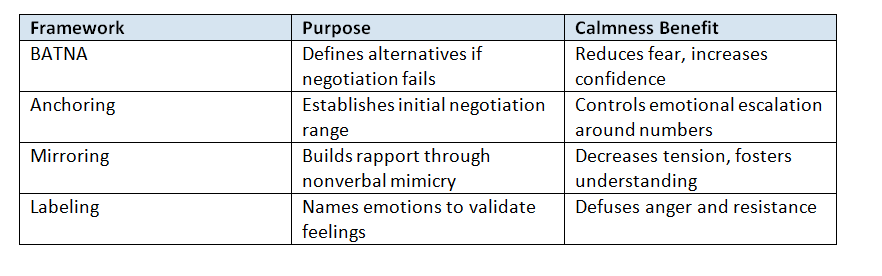
Leveraging Psychological Frameworks: BATNA, Anchoring, and Mirroring
Understanding and applying key negotiation frameworks can reduce emotional volatility by providing structure and clarity.
BATNA, as introduced by Fisher and Ury (1981), is your fallback option if negotiations fail. Knowing your BATNA empowers you to negotiate from a position of strength, reducing desperation and emotional reactivity.
Anchoring is a cognitive bias where the first number put on the table shapes the negotiation range (Tversky & Kahneman, 1974). By preparing an assertive yet reasonable opening offer, you can set the tone calmly and control expectations.
Mirroring (discussed above) and labeling emotions—naming the other party’s feelings—are techniques from Chris Voss’s “Never Split the Difference” (2016). Labeling (“It seems like you’re concerned about deadlines”) helps defuse negative emotions and build trust.
Practical Exercises and Role-Playing for Emotional Control
Skill-building through practice is essential for internalizing calmness techniques.
Role-playing exercises simulate real negotiation scenarios, allowing you to practice emotional pauses, active listening, and assertive communication. For example, practice a scenario where the counterpart makes an aggressive demand. Your task is to remain composed, use the Emotional Pause Script, and respond with a calibrated question instead of reacting defensively.
Mindfulness meditation, focused on observing thoughts and bodily sensations without judgment, strengthens emotional regulation over time. Daily practice of even 10 minutes can result in measurable reductions in stress reactivity (Kabat-Zinn, 1990).
Journaling post-negotiation helps identify triggers and emotional patterns. Reflect on what moments provoked stress and how you handled them. This insight informs targeted improvements.
Sample Role-Play Scenario
· Set up two participants: Negotiator and Counterpart
· Counterpart uses a high-pressure tactic (e.g., deadline threat)
· Negotiator uses deep breathing, labeling emotions, and BATNA reference
· Debrief to discuss emotional responses and communication effectiveness
Frequently Asked Questions
Q1: How can I stay calm if the other party is aggressive or hostile?
A1: Focus on emotional detachment techniques such as deep breathing and cognitive reframing. Avoid mirroring hostility; instead, use labeling to acknowledge their emotions (“I can see this issue is very important to you”) which helps de-escalate. Maintain open body language and a calm tone to model composure. If necessary, request a short break to reset.
Q2: What is the role of preparation in emotional control?
A2: Preparation reduces uncertainty, a major source of negotiation anxiety. Knowing your objectives, limits, and BATNA builds confidence and reduces fear-driven reactions. Physical preparation like exercise and hydration supports cognitive clarity and emotional balance.
Q3: Can mindfulness really improve negotiation outcomes?
A3: Yes. Mindfulness enhances present-moment awareness and reduces automatic emotional reactions. Studies show mindful negotiators are better at perspective-taking and problem-solving, leading to more integrative and less adversarial outcomes.
Q4: How do I handle internal pressure to concede quickly?
A4: Recognize this as a common stress response linked to loss aversion. Use the Emotional Pause Script to slow down. Remind yourself of your BATNA and negotiation goals. Anchoring your expectations early can help maintain a firm stance.
Q5: Are there any quick hacks to reduce stress right before negotiation?
A5: Yes. Practice 5 minutes of diaphragmatic breathing or the 4-7-8 technique. Visualize a successful, calm negotiation. Engage in light physical activity like stretching. Avoid caffeine or stimulants that increase anxiety.
Conclusion
Mastering how to stay calm in negotiation is a transformative skill that blends psychological insight with practical application. By understanding the emotional dynamics at play, preparing thoroughly, employing stress-management techniques, and communicating mindfully, negotiators can navigate even the most challenging discussions with poise and effectiveness. Calmness not only improves decision-making but also fosters trust and collaboration, leading to superior outcomes.
Begin integrating these strategies today through intentional practice and reflection. Your ability to remain composed under pressure will become a powerful tool in your negotiation arsenal—one that advances your professional success and builds lasting relationships. Commit to developing emotional regulation as a core negotiation competency and experience the difference it makes.
References
Fisher, R., Ury, W., & Patton, B. (2011). Getting to Yes: Negotiating Agreement Without Giving In. Penguin Books.
Kahneman, D. (2011). Thinking, Fast and Slow. Farrar, Straus and Giroux.
Voss, C., & Raz, T. (2016). Never Split the Difference: Negotiating As If Your Life Depended On It. Harper Business.
Gross, J. J. (1998). The Emerging Field of Emotion Regulation: An Integrative Review. Review of General Psychology, 2(3), 271–299.
Tang, Y. Y., Holzel, B. K., & Posner, M. I. (2015). The neuroscience of mindfulness meditation. Nature Reviews Neuroscience, 16(4), 213–225.
Brown, R. P., & Gerbarg, P. L. (2005). Sudarshan Kriya Yogic breathing in the treatment of stress, anxiety, and depression: Part II—clinical applications and guidelines. Journal of Alternative and Complementary Medicine, 11(4), 711–717.
Chartrand, T. L., & Bargh, J. A. (1999). The Chameleon Effect: The Perception-Behavior Link and Social Interaction. Journal of Personality and Social Psychology, 76(6), 893–910.
Salmon, P. (2001). Effects of physical exercise on anxiety, depression, and sensitivity to stress: A unifying theory. Clinical Psychology Review, 21(1), 33–61.
Kabat-Zinn, J. (1990). Full Catastrophe Living: Using the Wisdom of Your Body and Mind to Face Stress, Pain, and Illness. Delta.