Intercultural Conflict Resolution: How to Resolve Disputes Across Cultural Boundaries
Conflict is inevitable in any negotiation, but when parties come from different cultural backgrounds, misunderstandings can escalate disputes into costly failures. Imagine a high-stakes joint venture negotiation between a German manufacturing firm and a Brazilian distributor. The Germans’ direct, sachlich communication style collides with the Brazilian team’s warm, expressive approach and preference for relational harmony. Without cultural insight, what started as a minor disagreement over contract terms devolved into a breakdown of trust, jeopardizing millions of dollars in investment.
The stakes in intercultural conflict resolution are immense. Misreading cultural cues or applying a one-size-fits-all conflict strategy risks damaging relationships, losing deals, or even sparking diplomatic tensions. Most professionals dangerously underestimate how deeply cultural values shape conflict behavior—from how emotions are expressed, to the importance of hierarchy, to concepts of time and face-saving. Without a culturally intelligent approach, even the most experienced negotiators falter.
This definitive guide equips you to master intercultural conflict resolution with scientifically grounded frameworks, detailed country-specific insights, and practical tools. You will learn to decode cultural conflict dynamics with models by Hofstede, Erin Meyer, Edward Hall, and others; apply step-by-step strategies tailored for diverse cultures; analyze real-world case studies from Japan, China, the Middle East, and more; and use exact scripts that adapt tone and language for maximum rapport and resolution. Whether you’re a global executive, diplomat, or HR professional, this guide is your essential resource to turn cultural conflict into collaborative opportunity.
· Table of Contents
· The Theoretical Foundation: Key Cultural Frameworks Explored
· Key Frameworks and Models: Comparing Countries Across Dimensions
· Step-by-Step Strategy for Resolving Intercultural Conflicts
· Real-World Case Studies: Lessons from Global Disputes
· Country/Region-Specific Insights: Do’s, Don’ts, and Negotiation Styles
· Advanced Strategies: Expert Techniques for Complex Situations
· Scripts and Templates: Tailored Language for Diverse Cultures
· Frequently Asked Questions: Deep Dives into Common Challenges
· Conclusion: Synthesizing Insights and Next Steps
· References: Authoritative Sources for Further Study
The Theoretical Foundation — Deep Dive into Relevant Cultural Frameworks
Effective intercultural conflict resolution begins with a profound understanding of cultural differences and their impact on conflict behavior. Several landmark frameworks provide insights into national cultural profiles and interpersonal communication styles that shape how disputes arise and resolve.
Geert Hofstede’s six dimensions of national culture remain foundational. For example, Japan scores 92 on Uncertainty Avoidance, reflecting a strong need for formalized procedures to reduce ambiguity in conflicts, while the US scores 46, favoring more flexible, direct approaches. China’s high Power Distance (80) contrasts sharply with Scandinavian countries like Sweden (31), influencing hierarchical deference in conflict situations.
Erin Meyer’s Culture Map adds nuance with eight scales of communication and trust, such as Low-Context vs High-Context communication. The French, scoring high in Negative Feedback and High-Context communication, favor intellectual argumentation, whereas Americans prefer straightforward, explicit feedback and deal-focus.
Richard Lewis’s typology categorizes cultures as Linear-Active (e.g., Germans), Multi-Active (e.g., Brazilians), and Reactive (e.g., Koreans), providing a lens on how people process conflict information and express emotions. Edward Hall’s high-context vs low-context and monochronic vs polychronic time models explain why Middle Eastern cultures often prioritize relationship-building over strict schedules, contrasting with the German rigid-time orientation.
Richard Gesteland’s dimensions enrich understanding of deal-focus vs relationship-focus and expressive vs reserved communication, illuminating why Russians’ positional bargaining style can clash with Scandinavian egalitarianism. David Livermore’s Cultural Intelligence (CQ) framework highlights four capabilities—CQ Drive, CQ Knowledge, CQ Strategy, and CQ Action—that negotiators must develop to navigate cultural conflict effectively.
Trompenaars & Hampden-Turner’s seven dimensions, such as Universalism vs Particularism and Neutral vs Emotional, further clarify expectations about rules and emotional expression in conflict. The Thomas-Kilmann Conflict Mode Instrument complements these by identifying culturally preferred conflict handling styles, ranging from Avoiding and Accommodating to Competing and Collaborating.
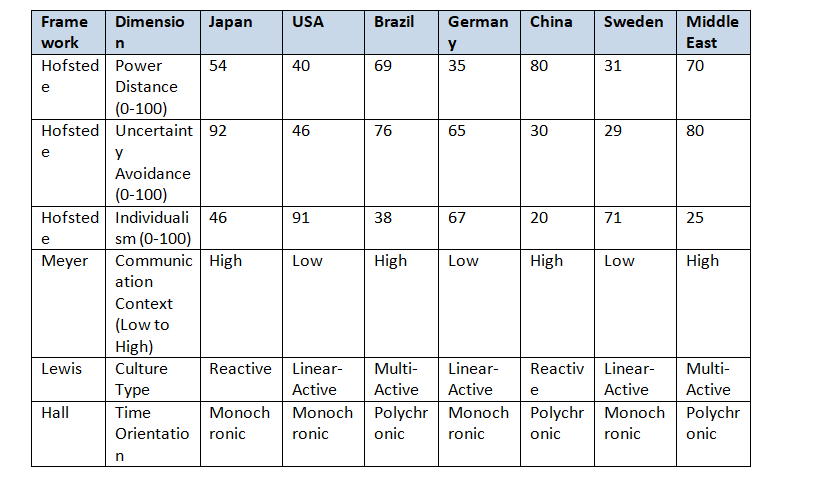
These quantitative scores and typologies highlight fundamental cultural variables shaping conflict resolution preferences. For instance, Japan’s high Uncertainty Avoidance and Reactive style suggest a preference for indirect communication and consensus-building (nemawashi), whereas the US’s low Uncertainty Avoidance and Linear-Active style favor direct confrontation and quick resolution.
Understanding these frameworks arms negotiators with predictive insight into how cultural values influence conflict behavior, enabling tailored strategies that respect cultural norms rather than impose one’s own.
Key Frameworks and Models — 2-3 Named Frameworks with Comparison Table
Among the numerous cultural models, three are particularly critical for intercultural conflict resolution: Hofstede’s Cultural Dimensions, Erin Meyer’s Culture Map, and the Thomas-Kilmann Conflict Mode Instrument (TKI). Each offers unique lenses to decode conflict dynamics and preferred resolution approaches.
Hofstede’s model quantifies national values on six dimensions, including Power Distance, Individualism, and Uncertainty Avoidance, which directly correlate with conflict styles. For example, high Power Distance cultures tend to accept hierarchical decision-making and may avoid open conflict with superiors.
Erin Meyer’s Culture Map provides actionable insights on communication and trust-building preferences, vital in conflict dialogue. Her scale of Confrontation (direct vs indirect negative feedback) predicts whether explicit disagreement is acceptable.
The Thomas-Kilmann Conflict Mode Instrument categorizes conflict handling into five modes: Competing, Collaborating, Avoiding, Accommodating, and Compromising. Cultures differ in dominant modes; for instance, Americans often favor Competing or Collaborating, while many Asian cultures lean toward Avoiding or Accommodating to preserve harmony.
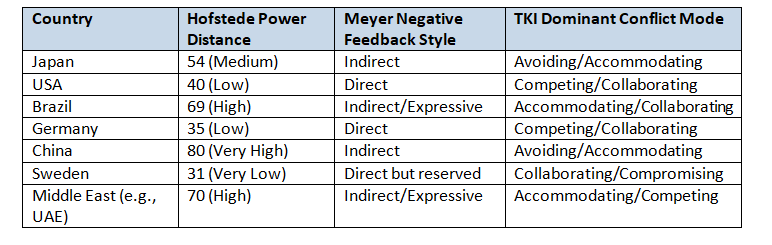
This table illustrates how cultural preferences shape conflict resolution behavior. Knowing these dominant styles allows negotiators to anticipate and adapt their approach, avoiding cultural faux pas and fostering productive dialogue.
Step-by-Step Strategy — Six Steps to Resolve Intercultural Conflicts
Mastering intercultural conflict resolution involves a systematic process incorporating cultural intelligence and adaptive communication. Here is a six-step strategy with concrete tactics and cultural guidance.
Step 1: Conduct Cultural Diagnosis
Before engagement, research the other party’s cultural profiles using Hofstede, Meyer, and other frameworks. Identify potential conflict triggers such as differing attitudes toward hierarchy, time, or emotional expression.
TACTIC: Use country-specific cultural intelligence checklists. For example, understand China’s emphasis on guanxi (relationship networks) and mianzi (face), which make direct confrontation risky.
Step 2: Build Cultural Trust Foundations
Invest in relationship-building consistent with cultural preferences. In Middle Eastern or Indian contexts, allocate time for informal socializing and demonstrating respect to establish wasta or hierarchical goodwill.
TACTIC: Use culturally appropriate honorifics and verbal acknowledgments. For instance, in Korea, show nunchi (emotional attunement) by reading subtle cues and responding with deferential language.
Step 3: Frame Conflict as Mutual Problem-Solving
Shift the narrative from adversarial to collaborative. Use inclusive language such as “we” and “our goals” aligned with the collective orientation of many Asian and Latin American cultures.
TACTIC: In Japan, employ nemawashi (informal consensus-building) by soliciting input privately before formal meetings to reduce public confrontation.
Step 4: Adapt Communication Style for Feedback
Adjust directness and emotional expressiveness to fit cultural norms. For example, when giving negative feedback to a French audience, prepare for intellectual debate; with Americans, be concise and explicit; with Brazilians, soften critiques with warmth.
TACTIC: Use Erin Meyer’s Culture Map scripts to calibrate feedback tone, balancing honesty with face-saving.
Step 5: Manage Time and Decision Pace
Respect monochronic vs polychronic time orientations. Germans prefer punctual, agenda-driven meetings; Middle Eastern partners expect flexible timing and extended discussions.
TACTIC: Communicate timelines clearly upfront but remain open to adjustments in polychronic cultures, signaling respect for relational priorities.
Step 6: Employ Conflict Resolution Modes Strategically
Select conflict modes suited to the cultural context. Use Collaborating in low Power Distance cultures like Sweden; Accommodating or Avoiding may be more effective in high Power Distance contexts like China to preserve harmony.
TACTIC: When dealing with Russian counterparts, anticipate positional bargaining and prepare firm, logical arguments; with Scandinavian teams, emphasize consensus and egalitarian decision-making.
This stepwise approach ensures that negotiators are culturally agile, minimize misunderstandings, and guide conflicts toward constructive resolution.
Real-World Case Studies — Lessons from Global Disputes
Case Study 1: Japanese Automotive Firm and American Supplier
A Japanese car company’s attempts to enforce strict contract terms with an American parts supplier failed when the Americans perceived the process as overly rigid and mistrustful. The Japanese team’s preference for nemawashi and consensus clashed with the American directness and deal-focus. The conflict escalated until both sides agreed to joint workshops to align expectations, blending Japanese consensus-building with American transparency.
LESSON: Understanding different approaches to negotiation pacing and communication directness can prevent escalation.
Case Study 2: German Tech Company and Brazilian Distributor
The German firm’s focus on punctuality and detailed contracts conflicted with the Brazilian distributor’s polychronic time orientation and preference for relational flexibility (jeitinho). Initial tensions arose over missed deadlines and informal renegotiations. The resolution involved Germans adapting to a warmer, less rigid communication style and Brazilians adhering more closely to timelines.
LESSON: Mutual adaptation in time management and communication style is critical.
Case Study 3: Middle Eastern Construction Project and European Consortium
A major Middle Eastern infrastructure project faced delays and disputes when European partners failed to appreciate the importance of wasta and relationship primacy. The Europeans’ deal-focus and low-context communication caused offense. Conflict was resolved after intensive cultural training and introducing liaison roles fluent in both cultures.
LESSON: Relationship-building and cultural liaison roles can bridge deep cultural divides.
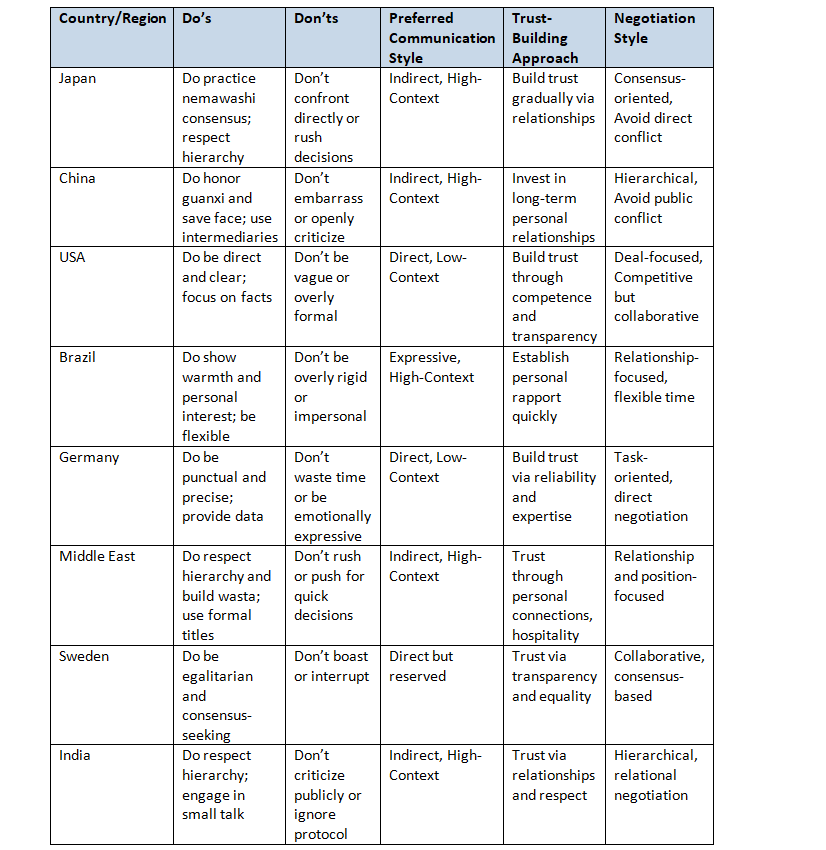
Country/Region-Specific Insights — Do’s and Don’ts Table
Advanced Strategies — Expert-Level Cross-Cultural Negotiation Techniques
Beyond foundational adaptation, advanced conflict resolution requires nuanced techniques:
· Cultural Meta-Communication: Explicitly discuss communication preferences at the start to avoid assumptions.
· Use of Cultural Mediators: Employ trusted intermediaries fluent in both cultures to translate not only language but cultural intent.
· Emotional Calibration: Apply Edward Hall’s proxemics and nunchi (Korean emotional attunement) to read unspoken tension and adjust responses in real-time.
· Face-Saving Negotiation Moves: Craft options allowing all parties to “win face,” such as offering indirect concessions or reframing compromises as joint victories.
· Scenario Planning: Prepare for potential cultural conflict flashpoints by role-playing with culturally diverse teams.
· CQ Action Flexibility: Train negotiators to shift their verbal and nonverbal behaviors dynamically across cultures, enhancing responsiveness under pressure.
Expert negotiators blend these strategies with foundational knowledge to navigate even the most complex intercultural conflicts successfully.
Scripts and Templates — Exact Word-for-Word Adaptations
Adapting language is critical in conflict dialogue. Below are scripts tailored to four cultural contexts.
Script 1: Japanese Context — Indirect and Consensus-Seeking
“I understand your concerns and appreciate the effort everyone has put in so far. Perhaps it would be helpful if we take some time to gather additional input from the team before making a final decision. Would that be acceptable?”
Script 2: American Context — Direct and Solution-Focused
“I see the issues clearly and believe we should address them head-on. Let’s outline the key points and agree on the next steps to resolve this efficiently.”
Script 3: Brazilian Context — Warm and Relationship-Oriented
“I value our partnership greatly, and I’m confident we can find a way to work through these challenges together. Let’s discuss how we can support one another moving forward.”
Script 4: Middle Eastern Context — Respectful and Indirect
“I deeply respect the importance of this matter for all involved. Perhaps we can explore alternative options that honor both our commitments and relationships.”
These scripts are starting points; negotiators should adjust tone, pacing, and formality as needed.
Frequently Asked Questions
Q1: How can I recognize when cultural factors are causing conflict rather than personality?
A1: Look for patterns such as misinterpretations of directness, time expectations, or emotional expression that align with known cultural dimensions (e.g., Hofstede’s scores). Consistent misalignment across interactions often signals cultural roots rather than individual behavior.
Q2: What is the best conflict mode to use in high power distance cultures?
A2: Accommodating or Avoiding modes often work best to respect hierarchy and preserve face. Collaborative modes may require more time and subtle consensus-building before open dialogue.
Q3: How do I handle conflict with a culture that prefers indirect communication?
A3: Listen carefully to what is unsaid and use probing, open-ended questions. Avoid pressing for blunt answers; instead, create safe spaces for dialogue and observe nonverbal cues.
Q4: Can cultural intelligence be developed quickly in a crisis?
A4: While deep cultural competence takes time, negotiators can rapidly increase CQ Drive and CQ Strategy by preparing with targeted cultural research and applying active listening and adaptive behaviors during the interaction.
Q5: How do I repair trust after a cultural misunderstanding escalates conflict?
A5: Initiate private, face-saving conversations acknowledging the misunderstanding, express genuine respect, and propose mutually beneficial solutions. Using a cultural mediator can facilitate this process.
Conclusion
Intercultural conflict resolution is essential for success in today’s globalized business and diplomatic arenas. By integrating comprehensive cultural frameworks, understanding diverse communication and conflict styles, and deploying adaptive strategies, negotiators can transform potentially destructive disputes into collaborative opportunities. The stakes are high—missteps can cost deals, reputations, and long-term partnerships—but with cultural intelligence and practical tools, conflict becomes a bridge rather than a barrier.
This guide has equipped you with the theoretical depth, actionable steps, country-specific insights, advanced techniques, and ready-to-use scripts necessary to excel at resolving disputes across cultural boundaries. Embrace cultural diversity as a strategic asset and apply these proven methods to lead your negotiations to harmonious, effective resolutions.
References
1. Hofstede, G. (2011). *Dimensionalizing Cultures: The Hofstede Model in Context*. Online Readings in Psychology and Culture.
2. Meyer, E. (2014). *The Culture Map: Breaking Through the Invisible Boundaries of Global Business*. PublicAffairs.
3. Lewis, R. D. (2006). *When Cultures Collide: Leading Across Cultures*. Nicholas Brealey Publishing.
4. Hall, E. T. (1976). *Beyond Culture*. Anchor Books.
5. Livermore, D. (2015). *Leading with Cultural Intelligence: The Real Secret to Success*. AMACOM.
6. Trompenaars, F., & Hampden-Turner, C. (2012). *Riding the Waves of Culture: Understanding Diversity in Global Business*. Nicholas Brealey Publishing.