International Deal Structure: How to Frame and Close Cross-Border Agreements

In 2018, a multibillion-dollar joint venture between a leading German automotive supplier and a Chinese state-owned enterprise unraveled after months of intense negotiations. Despite initial enthusiasm, the deal collapsed due to overlooked cultural nuances, misaligned legal expectations, and underestimated political risks. The German team’s direct, time-sensitive approach clashed with the Chinese partners’ preference for gradual consensus-building and indirect communication. Contractual terms failed to align with the Chinese legal environment and risk frameworks, resulting in escalating mistrust and financial losses exceeding $500 million.
This scenario underscores the strategic stakes involved in international deal structuring. Cross-border agreements are far more than transactional documents; they are complex, multilayered processes that require mastery of cultural intelligence, legal intricacies, risk assessment, and negotiation strategy. Many professionals approach these deals with a narrow view—focusing purely on price and contract terms—while neglecting the underlying systemic forces that cause deals to stall or fail outright.
This comprehensive guide will equip you to navigate the complexities of international negotiations with confidence. You will master proven frameworks such as Hofstede’s cultural dimensions, Erin Meyer’s Culture Map, and Edward Hall’s context and time models. You will learn step-by-step strategies for framing deals, managing cross-cultural communication, mitigating legal and political risks, and crafting culturally attuned negotiation scripts. Whether you are closing an M&A deal in Southeast Asia, structuring export contracts with the Middle East, or negotiating joint ventures in Latin America, these insights will empower you to structure and close agreements that deliver lasting value.
· Table of Contents
· The Strategic Foundation: Cultural, Legal, and Political Frameworks
· Key Frameworks and Models: Comparative Analysis
· Step-by-Step Strategy for Structuring and Closing Deals
· Real-World Case Studies: Lessons from Global Deals
· Country/Region-Specific Insights and Challenge Matrix
· Advanced Strategies: Relationship Building, Face-Saving, Legal Risk
· Scripts and Templates: Word-for-Word Negotiation and Email Samples
· Frequently Asked Questions on International Deal Structuring
· Conclusion and Call to Action
· References
The Strategic Foundation — Deep Dive into Relevant Frameworks, Models, and Research
Successful cross-border deal structuring demands an integrative understanding of cultural, legal, and political dimensions. The strategic foundation rests on three pillars:
1. Cultural Intelligence Frameworks
2. International Legal and Contractual Norms
3. Political and Economic Risk Assessment
Cross-cultural miscommunication is among the top causes of failed international deals. Hofstede’s cultural dimensions provide a systematic approach to understanding national cultural differences that influence negotiation styles and decision-making. Key dimensions include Power Distance (hierarchy acceptance), Individualism vs Collectivism, Uncertainty Avoidance, and Long-Term Orientation.
Erin Meyer’s Culture Map expands on these concepts with eight dimensions directly applicable to negotiation: Communication (low vs high context), Evaluating (direct vs indirect negative feedback), Persuading (principles-first vs applications-first), Leading (egalitarian vs hierarchical), Deciding (consensual vs top-down), Trusting (task vs relationship-based), Disagreeing (confrontational vs avoids confrontation), and Scheduling (linear vs flexible time).
Richard Lewis’s model classifies cultures as Linear-Active (task-oriented, factual), Multi-Active (emotional, relationship-driven), and Reactive (listening first, harmony-focused). These typologies help negotiators anticipate interaction styles and adapt their tactics accordingly.
Edward Hall’s theories of high vs low context communication and monochronic vs polychronic time management further nuance these understandings. For example, East Asian and Middle Eastern cultures tend to be high-context and polychronic, where implicit communication and flexible time frames dominate; Western cultures often prefer explicit communication and monochronic scheduling.
International deal structures must comply with multiple legal frameworks. The United Nations Convention on Contracts for the International Sale of Goods (CISG) standardizes contract formation and performance rules, but parties must carefully decide on its applicability. ICC arbitration rules provide globally recognized dispute resolution mechanisms, which are preferable to host-country courts with unknown impartiality.
Incoterms are critical to define delivery terms, risk transfer, and cost allocation in cross-border trade. Understanding the distinctions between EXW, FOB, CIF, and DDP terms helps prevent costly misunderstandings.
Contractual frameworks must also consider local legal peculiarities, such as foreign investment restrictions, intellectual property protections, and mandatory labor laws. Emerging markets often present additional legal uncertainty requiring more robust risk mitigation clauses.
Political risk frameworks like PESTLE (Political, Economic, Social, Technological, Legal, Environmental) analysis provide a structured approach to assessing country risks that impact deal viability. Country risk ratings from agencies such as Moody’s or Fitch guide investment decisions by quantifying sovereign risk.
Foreign exchange volatility and transfer pricing regulations also affect deal structuring. Effective FX hedging strategies and compliance with OECD transfer pricing guidelines are essential when structuring payments and profit repatriation.
By integrating these frameworks, negotiators build a solid strategic foundation enabling culturally aware, legally sound, and risk-mitigated international agreements.
Key Frameworks and Models — Comparative Analysis
This section compares the three primary cultural negotiation frameworks and their applicability to international deal structuring.
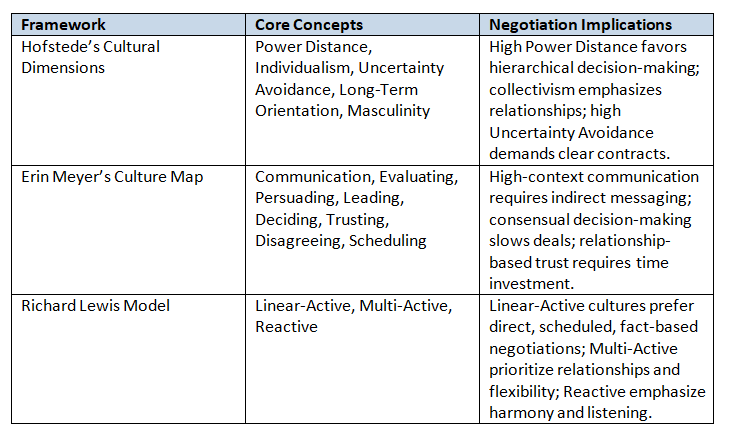
These frameworks complement each other — Hofstede gives broad cultural traits, Meyer offers negotiation-specific nuances, and Lewis provides behavioral typologies. Effective negotiators synthesize insights from all three to tailor strategies.
Step-by-Step Strategy — Six Essential Steps to Frame and Close Cross-Border Deals
Step 1: Conduct Comprehensive Cultural Due Diligence
Before negotiations commence, map the cultural profiles of all parties using Hofstede scores, Meyer’s Culture Map, and Lewis’s typology. Identify potential misalignments in communication, decision-making, and time orientation.
Tactics: Use cultural intelligence assessments; engage local cultural consultants; adapt your negotiation style (e.g., more indirect language with Japanese reactive cultures).
Language Example: “We value the opportunity to understand your organizational approach deeply to ensure our collaboration respects your ways of working.”
Step 2: Align Legal and Contractual Frameworks Early
Clarify which international conventions and legal systems will govern the agreement. Decide on arbitration venues and Incoterms before detailed commercial discussions.
Tactics: Propose ICC arbitration for neutrality; specify CISG applicability; use expert international counsel.
Language Example: “To foster mutual trust, we suggest adopting ICC arbitration and aligning contract terms with CISG provisions.”
Step 3: Build Relationship and Trust Through Face-to-Face or Virtual Protocols
Invest time in relationship-building tailored to cultural preferences — Brazilian and Middle Eastern partners prioritize long-term relationships; Germans and Scandinavians prefer task-focused interactions.
Tactics: Schedule informal meetings; exchange cultural tokens; engage interpreters skilled in diplomatic nuance.
Language Example: “We appreciate the importance of trust-building and look forward to deepening our collaboration through ongoing dialogue.”
Step 4: Structure Deal Elements with Clear Risk Mitigation Provisions
Define payment terms, delivery timelines (Incoterms), dispute resolution, and force majeure clauses aligned with both parties’ risk tolerances.
Tactics: Include FX hedging clauses; address political risk insurance; insert step-in rights for operational control.
Language Example: “Given market volatility, we propose incorporating currency adjustment mechanisms to protect both parties.”
Step 5: Navigate Hierarchies and Decision-Making Processes
Understand whether decisions require top-down approvals, consensus, or senior leader involvement.
Tactics: Map decision influencers; adjust meeting agendas; schedule multiple rounds if necessary.
Language Example: “We understand your organizational process involves multiple stakeholders and are prepared to engage accordingly.”
Step 6: Close with Principled Negotiation and Confirm Commitment
Use Fisher & Ury’s principled negotiation: separate people from problems, focus on interests, generate options, insist on objective criteria.
Tactics: Summarize agreed points; confirm commitments in writing; use culturally adapted closing scripts.
Language Example: “We appreciate your partnership and are confident this agreement reflects our shared goals and mutual respect.”
Real-World Case Studies — Lessons from Global Deals
Case Study 1: US-China Trade Agreement Negotiations (2019)
Context: The US-China trade talks involved complex tariff discussions compounded by divergent cultural communication styles and political risk.
Lessons: The US’s direct, time-pressured style clashed with China’s indirect approach and preference for gradual consensus (nemawashi). Legal frameworks differed, with China’s state involvement complicating contract enforcement.
Lesson: Incorporate flexible negotiation timelines, invest in relationship-building, and clarify dispute resolution mechanisms upfront.
Case Study 2: EU-UK Brexit Trade Deal (2020)
Context: Post-Brexit deal negotiations between the EU and UK involved intricate legal and political risk assessments, especially on customs, tariffs, and regulatory alignment.
Lessons: High-context communication and political sensitivities required layered stakeholder engagement and transparent legal frameworks (WTO rules + bespoke agreements).
Lesson: Conduct robust PESTLE analysis and design adaptive deal structures allowing phased implementation.
Case Study 3: Japanese Nemawashi in M&A Negotiations
Context: Japanese corporations emphasize nemawashi — informal consensus-building before formal negotiations.
Lessons: Western negotiators’ impatience with formal meetings overlooked the necessity of behind-the-scenes relationship cultivation, leading to deal delays.
Lesson: Respect local decision-making customs by allocating time for informal alignments and adjusting scheduling expectations.
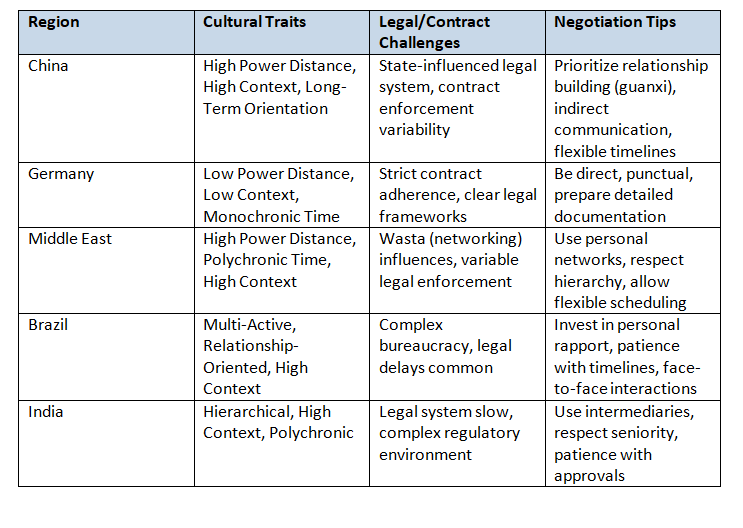
Country/Region-Specific Insights or Challenge Matrix
Advanced Strategies — Expert-Level Techniques
Managing Interpreters: Select interpreters with negotiation experience and cultural fluency. Brief them on technical terms and desired tone. Use simultaneous or consecutive interpreting depending on context.
Relationship Building Across Cultures: Invest in social rituals (meals, gifting) according to local norms. In Middle East and Latin America, personal trust precedes contracts. In Japan and Korea, engage in nemawashi and hierarchical respect.
Face-Saving Mechanisms: Use indirect language to prevent loss of face, especially in East Asian and Middle Eastern contexts. Employ euphemisms and private feedback channels.
Hierarchy Navigation: Map formal and informal hierarchies. Address senior decision-makers with appropriate honorifics and deferential language. Avoid public disagreements.
Legal Risk Mitigation: Incorporate force majeure clauses addressing political unrest, currency controls, and regulatory changes. Use ICC arbitration clauses. Employ political risk insurance and escrow arrangements where needed.
Scripts and Templates — Word-for-Word Negotiation and Email Samples
Script 1: Opening Meeting with Japanese Partners
“Thank you for the opportunity to meet today. We understand and respect the importance your company places on consensus-building and long-term collaboration. We look forward to learning from your perspectives and working together toward a mutually beneficial agreement.”
Script 2: Proposing ICC Arbitration Clause by Email
“Dear [Name],
To ensure a neutral and effective dispute resolution process, we propose incorporating ICC arbitration under the current contract framework. This approach has been successfully adopted in similar agreements and provides both parties with confidence in enforcement.
Please let us know your thoughts.
Best regards,
Script 3: Managing Deadlines with Brazilian Counterpart
“We appreciate the complexity involved and want to ensure we proceed with thorough understanding. Could we agree on a flexible timeline to accommodate necessary internal reviews without compromising the quality of our agreement?”
Script 4: Face-Saving Feedback to Middle Eastern Partner
“We highly value our partnership and want to share some observations to enhance our collaboration. Perhaps we could explore alternative approaches that might better align with our mutual objectives.”
Script 5: Closing Email Confirming Deal Terms
“Dear [Name],
Following our discussions, we are pleased to confirm the agreed terms as outlined in the attached draft. We look forward to your confirmation to proceed with the formal contract signing.
Thank you for your collaboration.
Kind regards,
Frequently Asked Questions
Q1: How do cultural differences impact the negotiation timeline in international deals?
A1: Cultures with high-context communication and consensual decision-making (e.g., Japan, China) typically require longer timelines to conduct informal alignments (nemawashi) and internal approvals. Conversely, low-context, task-oriented cultures (e.g., Germany, USA) prioritize efficiency and fixed deadlines. Awareness and accommodation of these differences prevent misunderstandings and frustration.
Q2: When should parties choose ICC arbitration over local courts?
A2: ICC arbitration is preferable when neutrality, enforceability, and international procedural standards are priorities, especially in countries with uncertain judicial independence or slow court processes. It provides a trusted forum recognized globally, reducing political and legal risks.
Q3: How can negotiators mitigate foreign exchange risks in cross-border agreements?
A3: Incorporating FX adjustment clauses, agreeing on payment currencies, using forward contracts or options, and involving treasury experts help mitigate currency volatility. Transparent discussion of FX risk allocation fosters trust.
Q4: What role does hierarchy play in cross-border deal approvals?
A4: In high Power Distance cultures (e.g., Korea, India), senior executives or family heads often have final authority, requiring multiple engagement layers. Understanding and respecting these hierarchies ensures timely approvals and avoids inadvertent disrespect.
Q5: How can virtual negotiations be adapted for cross-cultural deals?
A5: Virtual platforms should incorporate cultural cues such as allowing more time for responses, using video to capture non-verbal signals, scheduling meetings to respect time zones and polychronic preferences, and engaging skilled interpreters. Clear agendas and follow-up summaries help maintain alignment.
Conclusion
Mastering international deal structure requires a sophisticated blend of cultural intelligence, legal expertise, and strategic negotiation. This guide has provided you with an integrated foundation—from understanding cultural frameworks like Hofstede and Meyer, to legal instruments such as CISG and ICC arbitration, through to actionable negotiation scripts and risk mitigation tools. By applying these insights thoughtfully, you can navigate the complexities of cross-border deals, avoid costly missteps, and build enduring partnerships.
The stakes in global deal-making have never been higher amidst geopolitical uncertainty and market volatility. Equip yourself and your team with these proven frameworks and strategies to lead negotiations that close successfully and sustainably. Begin today by assessing your current negotiation approach against these models and tailoring your next deal with cultural and legal precision.
References
1. Hofstede, G. (2001). Culture’s Consequences: Comparing Values, Behaviors, Institutions and Organizations Across Nations. Sage Publications.
2. Meyer, E. (2014). The Culture Map: Breaking Through the Invisible Boundaries of Global Business. PublicAffairs.
3. Lewis, R. D. (2006). When Cultures Collide: Leading Across Cultures. Nicholas Brealey Publishing.
4. Hall, E. T. (1976). Beyond Culture. Anchor Books.
5. Fisher, R., Ury, W., & Patton, B. (2011). Getting to Yes: Negotiating Agreement Without Giving In. Penguin Books.
6. United Nations Commission on International Trade Law (UNCITRAL). (1980). United Nations Convention on Contracts for the International Sale of Goods (CISG).