International Negotiation Case Studies: Real Deals and the Lessons They Teach

International business negotiations often unfold on a complex stage where culture, law, language, and time zones intersect, creating a minefield of potential misunderstandings and missed opportunities. One vivid example is the 2005 failed merger attempt between General Electric (GE) and a major Chinese state-owned enterprise. Despite a seemingly strong commercial rationale, the deal collapsed due to fundamental cultural misunderstandings—GE’s American executives prioritized direct, data-driven bargaining, while their Chinese counterparts emphasized relationship-building (guanxi) and indirect communication. This cultural disconnect, combined with unfamiliarity with China’s legal and political frameworks, led to a breakdown in trust and negotiation impasse.
Such real-world instances highlight the strategic stakes in international negotiations. Unlike domestic deals, international negotiations must navigate multiple layers of complexity: cultural dimensions shaping communication and decision-making, different legal regimes influencing contract terms, language barriers that obscure intent, asynchronous time zones affecting cadence, and often, divergent expectations about trust and relationship-building. What most professionals dangerously underestimate is that strong technical expertise alone cannot bridge these gaps; cultural intelligence and tailored negotiation strategies are equally critical.
This comprehensive guide enables global business leaders, diplomats, and dealmakers to master the art and science of international negotiation. Readers will gain deep insights into foundational cultural models like Hofstede’s dimensions and Erin Meyer’s Culture Map, explore detailed step-by-step negotiation strategies, analyze landmark international negotiation case studies, and receive actionable scripts and templates calibrated for diverse cultural contexts. Whether preparing for a high-stakes M&A, a diplomatic dialogue, or a procurement negotiation, this article equips you to close deals smoothly across borders.
· Table of Contents
· The Foundations of International Negotiation
· Key Frameworks and Cultural Models
· Step-by-Step Strategy for International Negotiations
· Real-World Case Studies in International Negotiation
· Country-Specific Insights and Challenge-Specific Tactics
· Advanced Strategies for Managing Complex Negotiations
· Scripts and Templates for Cross-Cultural Negotiations
· Frequently Asked Questions
· Conclusion
· References
The Foundations of International Negotiation
International negotiation differs fundamentally from domestic negotiation due to the interplay of cultural, psychological, and structural factors. Understanding these foundational elements is vital before engaging across borders.
Geert Hofstede’s seminal research identified six cultural dimensions that influence negotiation behavior:
- Power Distance: The degree to which less powerful members accept hierarchical order. High power distance cultures (e.g., Malaysia, Mexico) tend to centralize decision-making, requiring negotiators to identify and engage with senior authority figures. Low power distance cultures (e.g., Denmark, New Zealand) prefer egalitarian approaches and group consensus.
- Individualism vs. Collectivism: Individualistic cultures (e.g., USA, Australia) emphasize personal goals and direct contracts, whereas collectivist cultures (e.g., Japan, South Korea) prioritize group harmony and long-term relationships.
- Uncertainty Avoidance: Cultures high in uncertainty avoidance (e.g., Germany, Greece) prefer detailed contracts and risk mitigation, while low uncertainty avoidance cultures (e.g., Singapore, Sweden) tolerate ambiguity and flexible agreements.
- Long-Term Orientation: A long-term focus (e.g., China, Japan) values perseverance and future rewards, influencing patience and consensus-building in negotiations.
- Masculinity vs. Femininity: Masculine cultures (e.g., Japan, Italy) emphasize competitiveness and achievement, while feminine cultures (e.g., Sweden, Netherlands) stress cooperation and quality of life.
- Indulgence vs. Restraint: Indulgent societies (e.g., USA, Mexico) allow gratification and optimism, while restrained societies (e.g., Russia, Egypt) regulate gratification through social norms.
Richard Lewis’s classification helps decode behavioral tendencies in negotiation:
- Linear-Active: Logical, task-oriented, scheduled communicators (e.g., Germans, Swiss).
- Multi-Active: Emotion-driven, relationship-focused, flexible with time (e.g., Brazilians, Italians).
- Reactive: Listening-focused, harmony-preserving, indirect communicators (e.g., Japanese, Chinese).
Edward Hall’s concepts enrich understanding of communication context:
- High-Context: Meaning is implicit, relationships and non-verbal cues dominate (e.g., Japan, Arab countries).
- Low-Context: Communication is explicit, direct, and detailed (e.g., USA, Germany).
- Monochronic vs. Polychronic Time: Monochronic cultures (e.g., Switzerland, USA) value punctuality and linear scheduling; polychronic cultures (e.g., Middle East, Latin America) prefer multitasking and fluid time.
Erin Meyer’s “Culture Map” adds eight dimensions relevant to negotiation, such as Communicating (low- vs. high-context), Evaluating (direct vs. indirect negative feedback), Leading (egalitarian vs. hierarchical), Deciding (consensual vs. top-down), Trusting (task-based vs. relationship-based), Disagreeing (confrontational vs. non-confrontational), Scheduling (linear vs. flexible), and Persuading (principles-first vs. applications-first).
International negotiations also contend with divergent legal frameworks such as the United Nations Convention on Contracts for the International Sale of Goods (CISG), International Chamber of Commerce (ICC) arbitration rules, and UNCITRAL model laws. Political risk—including expropriation, sanctions, and regulatory changes—further complicates deal-making.
Together, these factors require negotiators to blend cultural sensitivity, legal savvy, and psychological insight for successful outcomes.
Key Frameworks and Cultural Models
To navigate international negotiation complexity, three essential frameworks illuminate cultural differences and inform strategy.
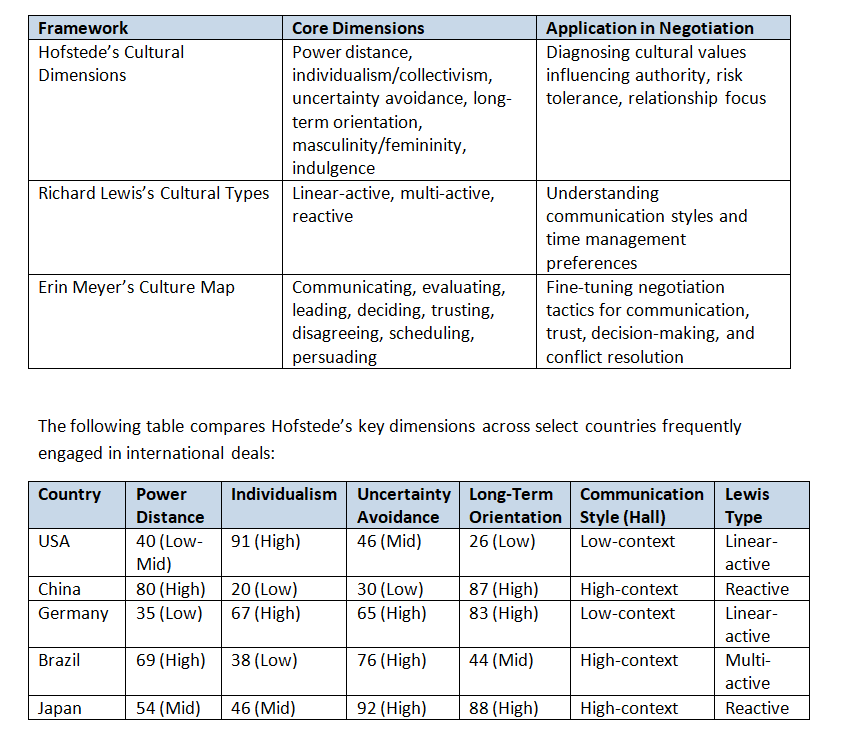
This comparative analysis reveals, for example, the high power distance and collectivist nature of China and Brazil, contrasting with the lower power distance and individualism of the USA and Germany, underscoring the need for tailored negotiation approaches.
Step-by-Step Strategy for International Negotiations
Successful international negotiation unfolds through structured phases. Below is a detailed six-step process with cultural adaptation considerations.
Step 1: Preparation and Cultural Research
- Conduct comprehensive cultural due diligence using Hofstede, Lewis, Meyer frameworks.
- Identify decision-makers, hierarchy levels, and preferred communication modes.
- Analyze legal and political risk environments; prepare fallback BATNA (Best Alternative to a Negotiated Agreement).
- Prepare multilingual materials and consider interpreter needs.
Step 2: Opening and Rapport Building
- Recognize the importance of relationship-building in collectivist cultures (China, Middle East, Latin America).
- Use appropriate greetings and rituals; avoid rushing into agenda.
- For reactive cultures (Japan, Korea), listen attentively and observe non-verbal cues.
- In direct low-context cultures (Germany, USA), be clear and precise from the outset.
Step 3: Exploration and Information Exchange
- Employ open-ended questions to uncover interests and constraints.
- Adapt degree of directness: Use indirect language and metaphor in high-context cultures; be candid in low-context cultures.
- Build trust by demonstrating cultural respect (e.g., showing awareness of local customs).
Step 4: Bargaining and Problem Solving
- Use principled negotiation methods (Fisher & Ury) adapted for culture: prioritize interests over positions, seek win-win outcomes.
- In hierarchical cultures, confirm approvals with senior stakeholders.
- Manage face-saving sensitively; avoid public confrontation in Asian and Middle Eastern contexts.
- Leverage multi-active cultures’ preference for lively discussions and emotional expression without perceiving it as aggression.
Step 5: Closing and Agreement Formalization
- Clarify contract terms in writing, considering different legal expectations (e.g., Germans prefer detailed contracts; Chinese may rely more on trust).
- Use ICC arbitration clauses or UNCITRAL guidelines to mitigate legal risk.
- Confirm mutual understanding verbally and in writing.
Step 6: Follow-Up and Relationship Maintenance
- In long-term oriented cultures, follow-up meetings and symbolic gestures reinforce commitment.
- Monitor implementation and remain flexible to cultural nuances during execution.
- Maintain communication channels for future opportunities.
Real-World Case Studies in International Negotiation
Analyzing landmark international negotiations provides invaluable lessons.
Context: Amid escalating tariffs, U.S. and Chinese negotiators engaged in complex dialogues balancing economic interests and political posturing.
Cultural Dynamics: The U.S. team’s direct, public negotiation style contrasted with China’s preference for behind-the-scenes consensus and indirect communication. The concept of face (mianzi) was critical—Chinese negotiators avoided overt confrontation to preserve dignity, while U.S. negotiators often pushed for transparency.
Outcome: A “phase one” trade deal was signed after months of protracted talks, demonstrating the importance of patience, understanding hierarchical decision-making in China, and the use of intermediaries.
Lesson: Recognizing and respecting the cultural emphasis on face and indirect communication can prevent stalemates; preparing for protracted timelines aligns expectations.
Context: The UK’s exit from the EU required intricate negotiations addressing citizens’ rights, financial settlements, and border arrangements.
Cultural Dynamics: EU negotiators, operating in a consensus-driven, rule-based system, contrasted with the UK’s adversarial, pragmatic negotiation style. The EU’s high uncertainty avoidance influenced detailed, binding agreements, while UK negotiators used more flexible, political bargaining.
Outcome: The Withdrawal Agreement was reached but only after multiple deadline extensions and political upheaval.
Lesson: Aligning negotiation processes and expectations about legal certainty versus political flexibility is critical; understanding the EU’s collective decision-making aids in managing timelines.
Context: U.S. pressure on Japan to open automotive markets involved negotiations with complex cultural underpinnings.
Cultural Dynamics: Japan’s nemawashi consensus-building process contrasted with the U.S. demand for immediate decisions. Japanese negotiators focused on building long-term relationships and internal alignment before formal negotiation.
Outcome: The U.S. eventually secured commitments but only after adapting to Japanese consensus rhythms.
Lesson: Patience with consensus-building processes and using intermediaries to facilitate nemawashi is essential when negotiating with Japan.
Country-Specific Insights and Challenge-Specific Tactics
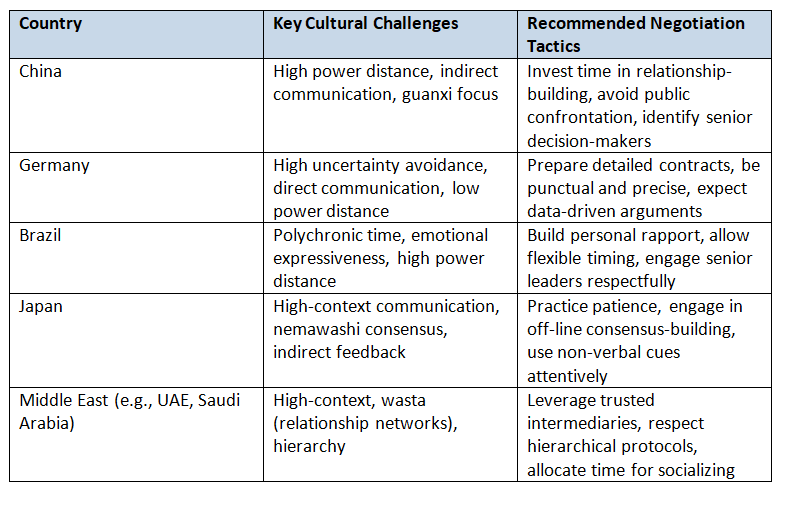
The following table summarizes negotiation challenges and tailored tactics for key countries:
Advanced Strategies for Managing Complex Negotiations
To excel in international negotiation, expert techniques are essential.
- Brief interpreters on technical terms and cultural sensitivities in advance.
- Use short, clear sentences to facilitate accurate translation.
- Maintain eye contact and speak slowly.
- Invest in social engagements; accept invitations to meals or cultural events.
- Recognize that trust often precedes transactional discussions in collectivist cultures.
- Identify formal and informal power holders; address them appropriately.
- Avoid overt disagreement; use indirect language or private feedback to preserve face.
- Adapt to polychronic cultures by allowing flexible schedules.
- Avoid rushing decisions; be prepared for multiple meetings.
Scripts and Templates for Cross-Cultural Negotiations
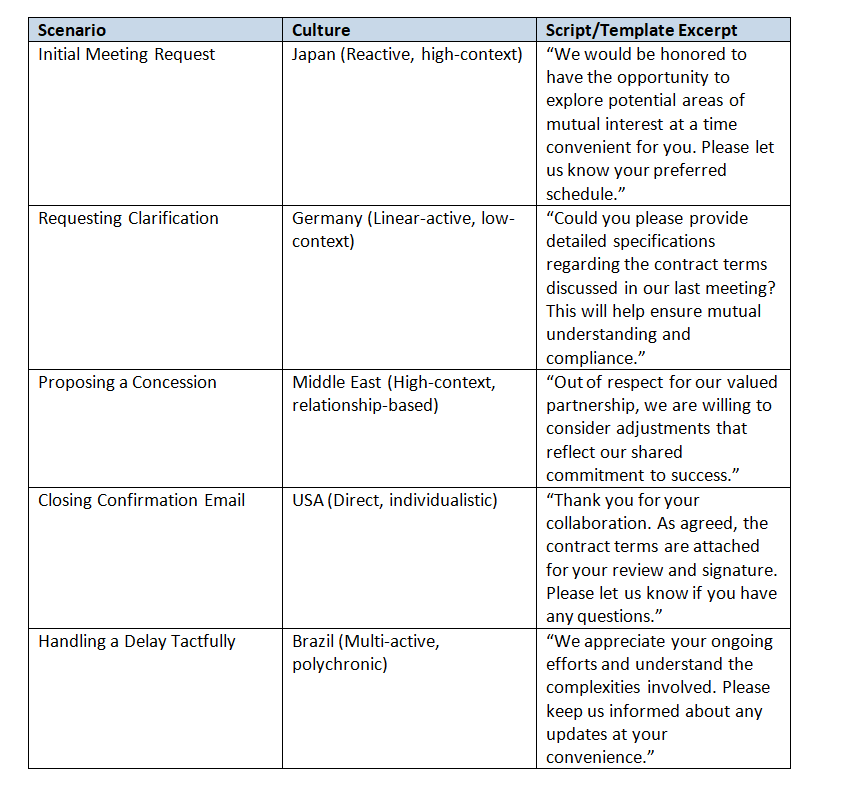
The following examples illustrate how negotiation language must adapt.
Frequently Asked Questions
Q1: How do I identify the decision-makers in high power distance cultures?
A1: In high power distance cultures such as China or Mexico, decision-making authority often rests with senior executives or family heads. Research organizational charts, seek introductions through intermediaries, and observe meeting dynamics for cues on hierarchy. Confirm decisions only after engaging with identified leaders to avoid surprises.
Q2: What are effective strategies to manage language barriers without interpreters?
A2: Simplify language by avoiding idioms and jargon, speak slowly, use visual aids, and confirm understanding frequently. Employ written summaries after discussions. However, for complex deals, professional interpreters are recommended to ensure nuance and accuracy.
Q3: How can I build trust quickly in cultures that prioritize relationships?
A3: Invest time in informal meetings, dinners, or cultural rituals. Demonstrate respect for local customs and values. Showing patience and consistency builds credibility. Avoid rushing to contract discussions until rapport is established.
Q4: How does uncertainty avoidance affect contract negotiations?
A4: High uncertainty avoidance cultures (e.g., Germany, Japan) prefer detailed, explicit contracts with comprehensive clauses to mitigate risk. Low uncertainty avoidance cultures (e.g., Singapore) may accept flexible, trust-based agreements. Tailor contract complexity accordingly to meet counterpart expectations.
Q5: What role does time orientation play in negotiation timelines?
A5: Long-term oriented cultures (e.g., China, Japan) prioritize sustainable agreements and may accept longer negotiation periods. Short-term oriented cultures may seek quick wins. Set realistic timelines reflecting cultural preferences and communicate these clearly to avoid frustration.
Conclusion
International negotiation is a multifaceted discipline that demands more than transactional skill; it requires cultural intelligence, legal awareness, and strategic adaptability. This article has dissected foundational cultural theories, presented actionable frameworks, and analyzed landmark case studies revealing how negotiation outcomes hinge on understanding and respecting cultural nuances. By integrating these insights with structured negotiation processes and advanced techniques, global business professionals can transcend barriers and forge successful cross-border deals.
To elevate your international negotiation capabilities, begin by assessing your own cultural biases, invest time in research, and apply the tailored scripts and strategies outlined here. Mastery in this domain transforms challenges into opportunities, fostering not only agreements but enduring global partnerships.
References
- Hofstede, G. (2011). *Dimensionalizing Cultures: The Hofstede Model in Context*. Online Readings in Psychology and Culture.
- Lewis, R. D. (2006). *When Cultures Collide: Leading Across Cultures*. Nicholas Brealey Publishing.
- Meyer, E. (2014). *The Culture Map: Breaking Through the Invisible Boundaries of Global Business*. PublicAffairs.
- Fisher, R., & Ury, W. (2011). *Getting to Yes: Negotiating Agreement Without Giving In*. Penguin Books.
- Lewicki, R. J., Barry, B., & Saunders, D. M. (2015). *Negotiation*. McGraw-Hill Education.
- UNCITRAL Secretariat (2020). *UNCITRAL Model Law on International Commercial Arbitration*. United Nations.