International Negotiation Strategies: Frameworks for Cross-Border Deals
International business negotiations often pivot on subtle cultural cues, legal frameworks, and trust dynamics. In 2018, a high-profile US-China technology joint venture collapsed after months of discussions, largely because American negotiators underestimated the importance of “guanxi” — the Chinese relational network critical to trust-building. Conversely, the 2020 EU-UK Brexit trade talks succeeded in part due to diplomats’ careful adaptation to each other’s communication styles and cultural expectations, demonstrating the power of cultural intelligence. These examples underscore that international negotiation is far more than simply discussing terms; it is a complex dance involving psychology, culture, law, and strategy.
What makes international negotiation fundamentally different from domestic negotiation is the multilayered complexity that spans diverse cultural norms, legal systems, languages, time perceptions, and relational trust. Unlike domestic deals where mutual assumptions and shared cultural codes often streamline communication, cross-border negotiations challenge even seasoned professionals. Common pitfalls include misreading indirect communication, mishandling hierarchical protocols, ignoring long-term orientation differences, or failing to account for political risk. Such errors can derail multi-million dollar deals, sour diplomatic relations, or provoke costly contract disputes.
This definitive guide equips global business professionals with the tools to master international negotiations. You will gain deep understanding of cultural frameworks such as Hofstede’s cultural dimensions, Lewis’s communication types, and Erin Meyer’s Culture Map. We provide actionable step-by-step negotiation strategies, real-world case studies from US-China, EU-UK, and Japan-US contexts, and country-specific insights for a wide range of cultures. You will also find expert-level tactics for managing interpreters, building relationships like guanxi and wasta, and navigating hierarchy and face-saving. Finally, practical scripts and templates tailored for different cultural settings will empower you to communicate with precision and confidence across borders.
· Table of Contents
· The Foundations of International Negotiation
· Key Frameworks and Cultural Models
· Step-by-Step Strategy for Cross-Border Negotiations
· Real-World Case Studies
· Country-Specific Negotiation Insights and Challenges
· Advanced Strategies for International Negotiation
· Scripts and Templates for Multicultural Communication
· Frequently Asked Questions
· Conclusion
· References
The Foundations of International Negotiation
International negotiation stands apart from domestic negotiation due to fundamental cultural, psychological, and structural differences. Understanding these foundations is essential to avoid costly missteps and to leverage cultural intelligence as a strategic advantage.
Geert Hofstede’s extensive research into cultural values highlights six core dimensions that influence negotiation behaviors globally: power distance, individualism vs collectivism, masculinity vs femininity, uncertainty avoidance, long-term orientation, and indulgence. For example, negotiators from high power distance cultures such as Malaysia or Russia tend to accept hierarchical authority and expect clear leadership, whereas low power distance cultures like Denmark prefer egalitarian dialogue. Similarly, collectivist cultures (China, India) prioritize group harmony and relationship building, contrasting with individualist cultures (US, Australia) that focus on direct outcomes and personal gain.
Richard Lewis’s model categorizes cultures into Linear-Active, Multi-Active, and Reactive types, offering insights into preferred communication and negotiation styles. Linear-Active cultures (Germany, Switzerland) value facts, planning, and punctuality, conducting negotiations in a task-oriented, logical sequence. Multi-Active cultures (Brazil, Italy) are more emotional, flexible, and relationship-driven, often negotiating in a lively, circular manner. Reactive cultures (Japan, China) emphasize listening, harmony, and indirect communication, responding carefully rather than initiating.
Edward Hall’s theory of high-context versus low-context communication explains how much meaning is embedded in implicit cues versus explicit words. High-context cultures (Japan, Saudi Arabia) rely heavily on nonverbal signals, shared history, and context, whereas low-context cultures (US, Germany) prefer clear, direct verbal communication. Hall’s monochronic versus polychronic time orientation further impacts negotiation pacing — monochronic cultures (Sweden, US) focus on strict schedules and deadlines, while polychronic cultures (Mexico, Egypt) are more flexible and multitasking.
Erin Meyer’s “Culture Map” expands on these themes with eight dimensions that directly affect negotiation behavior: communicating, evaluating, persuading, leading, deciding, trusting, disagreeing, and scheduling. For instance, persuading in principle-first cultures (France, Italy) involves building theoretical arguments, while applications-first cultures (US, Canada) emphasize practical results.
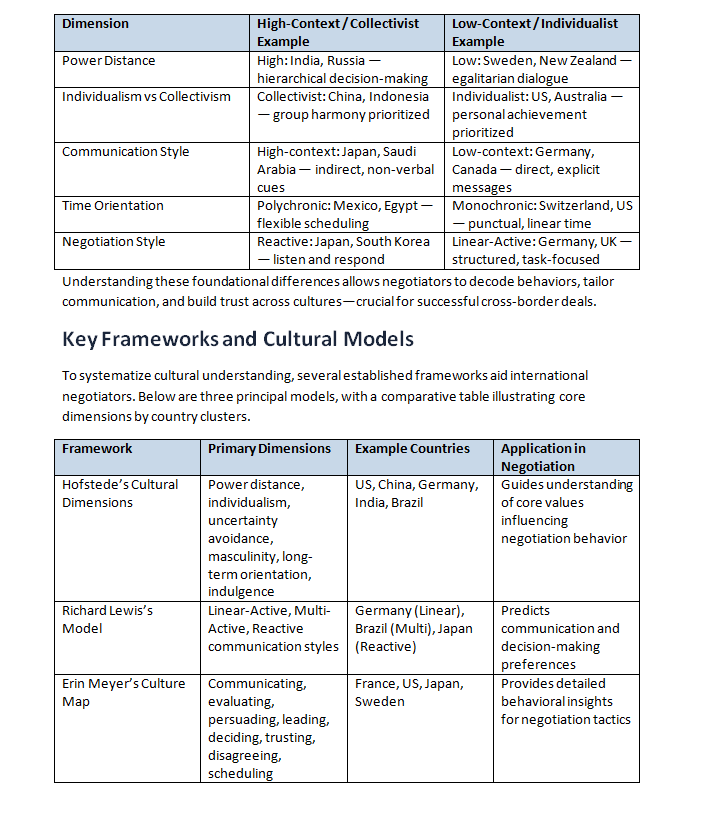
Each framework complements the others by providing unique lenses. Hofstede’s dimensions offer broad value-based insights, Lewis’s model focuses on communication and action styles, and Meyer’s map integrates nuanced behavioral traits relevant to negotiation phases.
Step-by-Step Strategy for Cross-Border Negotiations
Successful international negotiation requires structured yet flexible processes that respect cultural and legal diversity. Below is a detailed six-step strategy tailored for global deal-making.
Step 1: Preparation and Cultural Intelligence Gathering
Research the counterpart’s cultural profile using Hofstede’s dimensions and Lewis’s communication types. Understand legal jurisdictions, political risks, and language barriers. Identify your BATNA (Best Alternative to a Negotiated Agreement) and ZOPA (Zone of Possible Agreement) considering cross-border constraints. Prepare culturally adapted negotiation materials.
Step 2: Opening and Relationship Building
Start with informal relationship-building aligned to the counterpart’s culture. In collectivist or high-context cultures (China, Middle East), invest time in trust-building conversations and social rituals. In individualist or low-context cultures (US, Germany), begin with clear agenda setting and introductions. Use appropriate titles and honorifics to respect hierarchy.
Step 3: Exploration and Information Exchange
Use active listening and open-ended questions to uncover interests and priorities. Adapt communication style: reactive cultures may prefer indirect questioning; linear-active cultures expect directness. Clarify ambiguities gently to avoid loss of face in high-context cultures.
Step 4: Bargaining and Problem-Solving
Apply principled negotiation techniques (Fisher & Ury) emphasizing mutual interests over positions. Tailor persuasion strategies per Erin Meyer—principle-first arguments for European counterparts, application-first for Americans. Manage concessions considering power distance and uncertainty avoidance.
Step 5: Closing and Agreement Formalization
Confirm agreement details explicitly, respecting cultural preferences for formality. In high uncertainty avoidance cultures (Japan, South Korea), provide comprehensive written contracts referencing ICC arbitration clauses. In lower uncertainty avoidance contexts, verbal commitments may carry more weight.
Step 6: Follow-up and Relationship Maintenance
After closing, sustain relationships through regular communication adapted to cultural expectations. In collectivist cultures, ongoing contact is essential for long-term cooperation. Monitor contract implementation and be ready for renegotiation with cultural sensitivity.
Real-World Case Studies
Examining notable cross-border negotiations reveals how cultural intelligence influences outcomes.
1. US-China Technology Joint Venture (2018):
The deal faltered due to American underestimation of guanxi’s importance and Chinese indirect communication. US negotiators pushed for rapid contract finalization without investing adequate relationship-building, clashing with Chinese expectations for trust and consensus (nemawashi). Lesson: Prioritize relational groundwork and respect indirect communication in high-context, collectivist cultures.
2. EU-UK Brexit Trade Talks (2019-2020):
Negotiators navigated vast political and cultural differences. British linear-active pragmatism contrasted with EU’s consensus-driven, multi-layered processes. Success hinged on adapting communication styles — EU negotiators appreciated Britain’s directness when balanced with diplomatic patience. Use of shared legal frameworks (EU law) mitigated uncertainty avoidance. Lesson: Flexibility in style and legal clarity are key for complex multinational talks.
3. Japan-US Automotive Partnership (2005):
Japanese reactive, harmony-oriented negotiators employed nemawashi to build consensus behind the scenes before formal talks. US linear-active teams adjusted by incorporating more pre-meeting dialogue and indirect communication. This cultural adaptation prevented misunderstandings and facilitated smooth contract closure. Lesson: Understand and engage in hidden consensus processes for high-context cultures.
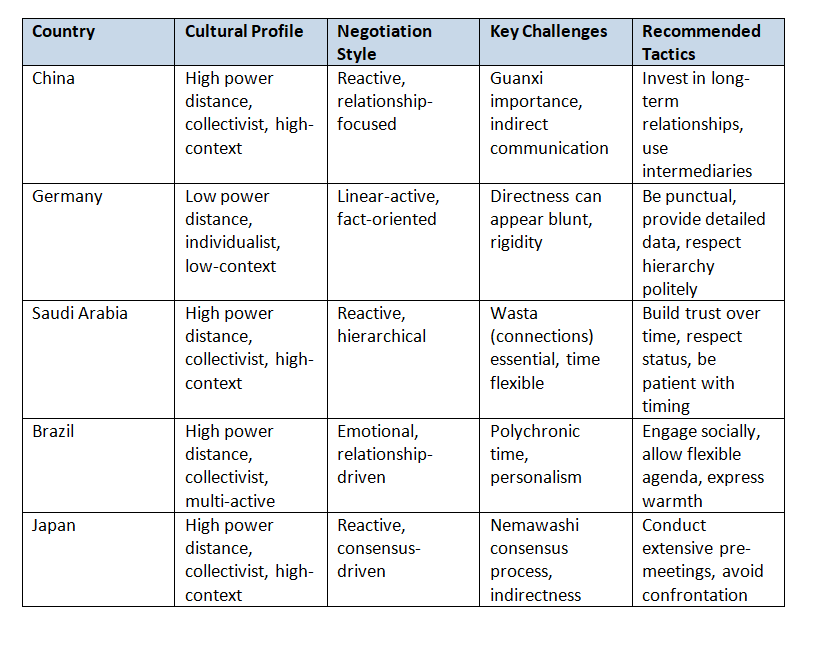
Country-Specific Negotiation Insights and Challenges
The following table summarizes key cultural and tactical considerations for top international negotiation contexts.
Advanced Strategies for International Negotiation
Beyond foundational knowledge, expert negotiators employ advanced techniques adapted to complex global environments.
Scripts and Templates for Multicultural Communication
Below are sample scripts illustrating culturally adapted language for negotiation phases.
1. Relationship-Building Email for China:
Dear Mr. Li,
I hope this message finds you well. Before we proceed with the formal discussions, I would appreciate an opportunity to learn more about your company and explore ways to build a long-lasting partnership. Please let me know a convenient time for a preliminary call.
Best regards,
2. Agenda-Setting Opening for Germany:
Good morning, everyone. Thank you for joining today’s meeting. Our agenda includes reviewing the contract terms, discussing delivery schedules, and clarifying any technical questions. Please feel free to raise points directly as we proceed. Let’s aim for a clear and efficient discussion.
3. Indirect Disagreement for Japan:
I appreciate your proposal and see its merits. Perhaps we might consider exploring alternative options to ensure the best outcome for both sides. Would it be possible to review some additional scenarios?
4. Concession Offering for Brazil:
We value our partnership and, to demonstrate our commitment, we are willing to offer more flexible payment terms. Let’s discuss how this can support your needs.
5. Follow-up Confirmation Email for Saudi Arabia:
Dear Sheikh Al-Fahad,
Thank you for the fruitful meeting last week. As agreed, I am sending the summary of our discussions and next steps. Please do not hesitate to advise if any adjustments are needed. We look forward to continuing our collaboration.
Kind regards,
Frequently Asked Questions
Q1: How can I prepare for negotiations with a culture that values indirect communication?
A1: Study high-context communication cues and avoid pressuring for explicit answers. Use open-ended questions and observe nonverbal signals. Build trust first before delving into sensitive topics.
Q2: What are effective ways to establish trust quickly in collectivist cultures?
A2: Engage in social rituals, show respect for hierarchy, and demonstrate interest in long-term partnership beyond immediate deal terms. Using local intermediaries can also help.
Q3: How do I handle negotiations when language barriers exist?
A3: Use professional interpreters, prepare clear, simple language, and confirm understanding frequently. Avoid idioms and culturally specific references.
Q4: What legal frameworks should I consider in international contracts?
A4: Familiarize yourself with CISG (United Nations Convention on Contracts for the International Sale of Goods), ICC arbitration rules, and UNCITRAL guidelines. Ensure contracts specify jurisdiction and dispute resolution mechanisms.
Q5: How do time orientation differences affect negotiation scheduling?
A5: Monochronic cultures expect punctuality and sequential task completion. Polychronic cultures may prioritize relationships over strict timing. Adjust your flexibility and communicate timelines clearly.
Conclusion
Mastering international negotiation requires more than transactional skills; it demands deep cultural intelligence, strategic frameworks, and adaptable communication. By integrating Hofstede’s dimensions, Lewis’s communication types, and Meyer’s Culture Map into a structured negotiation process, global professionals can transcend barriers and unlock value in cross-border deals. Real-world cases demonstrate that success lies in respect for relational nuances, legal awareness, and flexible tactics.
We invite international business executives, diplomats, and global dealmakers to apply these proven frameworks and scripts to their next negotiation. Invest in cultural preparation and principled strategies to turn complexity into competitive advantage. For tailored consulting and advanced workshops on international negotiation mastery, contact our expert team today.
References
1. Hofstede, G. (2001). Culture’s Consequences: Comparing Values, Behaviors, Institutions, and Organizations Across Nations. Sage Publications.
2. Lewis, R. D. (2006). When Cultures Collide: Leading Across Cultures. Nicholas Brealey Publishing.
3. Meyer, E. (2014). The Culture Map: Breaking Through the Invisible Boundaries of Global Business. PublicAffairs.
4. Fisher, R., Ury, W., & Patton, B. (2011). Getting to Yes: Negotiating Agreement Without Giving In. Penguin Books.
5. United Nations Commission on International Trade Law (UNCITRAL). (1980). United Nations Convention on Contracts for the International Sale of Goods (CISG).
6. International Chamber of Commerce (ICC). (2020). ICC Arbitration Rules.