International Pricing Negotiation: How to Set, Defend, and Adjust Prices Across Borders

Negotiating prices across borders is often a make-or-break moment for global deals, as illustrated vividly by a 2019 US-China technology supply agreement. When a major American semiconductor firm attempted to lock in a fixed price with a Chinese state-owned enterprise, misreading the cultural emphasis on relationship-building and indirect communication led to a breakdown in talks. The fallout delayed critical shipments, triggered penalties under the contract’s ICC arbitration clause, and severely weakened trust between the parties—showcasing the catastrophic consequences of failing to adapt pricing negotiation strategies internationally.
Such high-stakes scenarios underline the strategic and cultural complexity embedded in international pricing negotiations. Many professionals fall into the trap of transplanting domestic negotiation tactics to global contexts without accounting for underlying cultural dimensions like Hofstede’s Power Distance or Erin Meyer’s Communication styles. They underestimate how factors such as legal frameworks (CISG, Incoterms), political risk, currency volatility, and differing attitudes toward hierarchy and time can dramatically reshape pricing conversations and outcomes.
This comprehensive guide will enable you to master the multifaceted art of international pricing negotiation. You will gain actionable knowledge of cultural frameworks including Hofstede, Meyer, Lewis, and Hall; learn to apply negotiation principles such as BATNA and ZOPA across cultures; navigate legal frameworks; and deploy step-by-step strategies with culturally calibrated language and tactics. Additionally, you will explore real-world case studies, regional challenge matrices, advanced techniques for managing interpreters and hierarchy, and practical scripts tailored to diverse global contexts. By the end, you will be equipped to confidently set, defend, and adjust prices in any international negotiation scenario.
· Table of Contents
· The Strategic Foundation: Cultural and Legal Frameworks for Pricing Negotiations
· Key Frameworks and Models: Hofstede, Meyer, Lewis & Comparative Analysis
· Step-by-Step Strategy: Six Critical Phases of International Pricing Negotiation
· Real-World Case Studies: Lessons from US-China, EU-UK Brexit, and Brazil-India Deals
· Country/Region-Specific Insights and Challenge Matrix
· Advanced Strategies: Interpreter Management, Relationship Building, Face Saving
· Scripts and Templates: Word-for-Word Negotiation and Email Templates for Global Contexts
· Frequently Asked Questions: Deep Dives into Common International Pricing Challenges
· Conclusion and Call to Action
· References
The Strategic Foundation — Cultural and Legal Frameworks for Pricing Negotiations
International pricing negotiation is a multi-layered challenge involving several strategic pillars: understanding cultural communication nuances, legal frameworks, political and economic risks, and financial variables such as currency exposure.
From a cultural standpoint, Hofstede’s cultural dimensions provide a foundational lens. For example, countries with high Power Distance (e.g., India, Mexico) often expect hierarchical decision-making and defer to senior authority when agreeing on prices. Conversely, low Power Distance cultures (e.g., Australia, Germany) may expect egalitarian negotiation forums and direct price discussions. Similarly, uncertainty avoidance levels dictate how flexible negotiators are with contract terms or price adjustments.
Erin Meyer’s Culture Map deepens this understanding with eight dimensions critical to negotiation, including Communication (low vs. high context), Evaluation (direct negative feedback vs. indirect), and Trust (task-based vs. relationship-based). For instance, Japanese negotiators prefer indirect communication and high-context cues in pricing discussions, while Germans lean toward direct, fact-based negotiation.
Richard Lewis’s model categorizes cultures as Linear-Active (e.g., Germany, Switzerland), Multi-Active (e.g., Brazil, Italy), or Reactive (e.g., China, Japan). This informs pacing and sequencing during price talks—Linear-Active cultures value sticking to agenda and data, Multi-Active cultures prioritize personal relationships and flexible timing, and Reactive cultures emphasize listening and harmony.
Edward Hall’s high- vs. low-context communication and monochronic vs. polychronic time concepts further refine negotiation approaches. High-context cultures like Saudi Arabia rely on implicit cues and expect longer-term relationship investment before pricing is finalized. Monochronic cultures, such as the US, focus on punctuality and clear deadlines.
The legal frameworks governing international contracts are equally crucial. The United Nations Convention on Contracts for the International Sale of Goods (CISG) offers a baseline but is not universally adopted, necessitating knowledge of specific jurisdictional contract laws. ICC arbitration clauses, Incoterms 2020 for delivery and risk transfer, and UNCITRAL model laws further shape negotiation and enforcement of prices.
Political risk frameworks such as PESTLE analysis (Political, Economic, Social, Technological, Legal, Environmental) help evaluate country-specific risks affecting pricing, including currency volatility, trade sanctions, and regulatory changes. For example, during the EU-UK Brexit transition, pricing negotiations had to adapt rapidly to shifting tariffs and customs protocols.
In sum, the strategic foundation for international pricing negotiation integrates deep cultural insight, legal comprehension, and risk assessment to formulate adaptable, robust strategies.
Key Frameworks and Models
This section compares three pivotal frameworks often deployed in international pricing negotiations: Hofstede’s Cultural Dimensions, Erin Meyer’s Culture Map, and Richard Lewis’s Model. Understanding their intersections and applications empowers negotiators to tailor pricing approaches effectively.
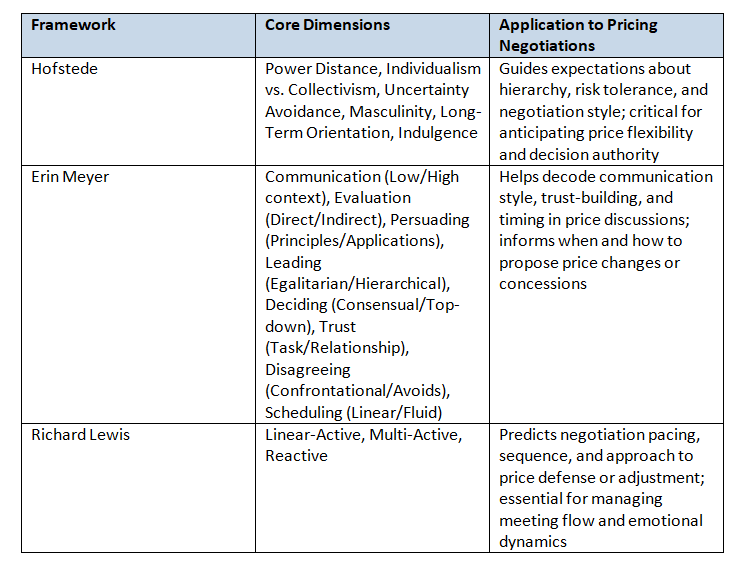
Each framework complements the others, enabling a nuanced strategic approach. For example, a negotiator dealing with a Multi-Active, High Power Distance country (Lewis + Hofstede) such as Brazil will prioritize relationship-building early, defer to senior decision-makers, and prepare for flexible timelines when defending prices.
Step-by-Step Strategy
Step 1: Pre-Negotiation Preparation — Cultural and Financial Due Diligence
Effective international pricing negotiation begins with rigorous preparation. This includes researching the counterparty’s cultural norms (Hofstede and Meyer scores), legal environment (applicable contract law, CISG adoption), and financial constraints (currency risk, inflation).
Use a political risk framework like PESTLE to identify macroeconomic and legal risks. Develop your BATNA (Best Alternative to a Negotiated Agreement) and estimate your ZOPA (Zone of Possible Agreement) based on global market benchmarks and internal cost-plus margins.
Step 2: Establishing Rapport and Trust — Relationship Building Across Cultures
In many cultures—Brazil, India, Middle East—relationship-building precedes price discussions. Use culturally appropriate wasta or nemawashi processes to warm up the negotiation atmosphere. In task-based cultures like Germany or the US, build trust through transparency and data.
Use Erin Meyer’s trust dimension to tailor your approach: engage in personal small talk with relationship-oriented cultures before discussing price.
Step 3: Setting the Initial Price — Anchoring with Cultural Sensitivity
Present your initial price assertively in low-context, linear-active cultures (Germany, US), but cautiously in high-context or reactive cultures (Japan, China) to avoid causing loss of face.
Use scripts that embed rationale with principles or applications depending on Meyer’s persuading dimension. For instance, in a principles-first culture (France), explain the strategic value before details.
Step 4: Defending Your Price — Managing Pushback and Concessions
Anticipate cultural negotiation styles for pushback: Multi-Active cultures may challenge price aggressively and expect concessions; Reactive cultures may avoid direct confrontation.
Use principled negotiation per Fisher & Ury: focus on interests, not positions. For example, when defending price to a Korean hierarchical team, direct your arguments to the senior member while showing deference.
Step 5: Adjusting Prices Amid Risks — Political, FX, and Supply Chain
In volatile emerging markets, incorporate clauses for price adjustment triggered by FX fluctuations, tariffs, or supply delays (using Incoterms for risk transfer clarity).
Communicate these flexibly in cultures with high uncertainty avoidance by offering formulas or trigger points rather than vague terms.
Step 6: Closing and Contract Finalization — Legal and Cultural Alignment
Ensure contract terms reflect negotiated pricing and adjustment mechanisms. Verify alignment with CISG or local contract law to avoid disputes.
Use culturally appropriate closing rituals: in Japan, confirm consensus through nemawashi before signing; in the US, direct contract signing is standard.
Real-World Case Studies
The following cases exemplify the application of international pricing negotiation frameworks in diverse contexts.
1. US-China Semiconductor Supply Deal (2019)
Cultural misalignment in communication styles and underestimating China’s high-context negotiation led to a breakdown. Lessons include the importance of indirect communication cues and hierarchical decision-maker engagement.
2. EU-UK Brexit Transition Pricing Negotiations (2020–2021)
Negotiators had to rapidly adjust prices due to new customs tariffs. Firms successfully used Incoterms to shift delivery risks and renegotiated contracts incorporating FX hedging.
3. Brazil-India Infrastructure Partnership (2018)
Brazil’s Multi-Active style contrasted with India’s hierarchical approach. Effective relationship-building and respecting decision authority helped finalize price terms with flexible payment schedules to mitigate currency risk.
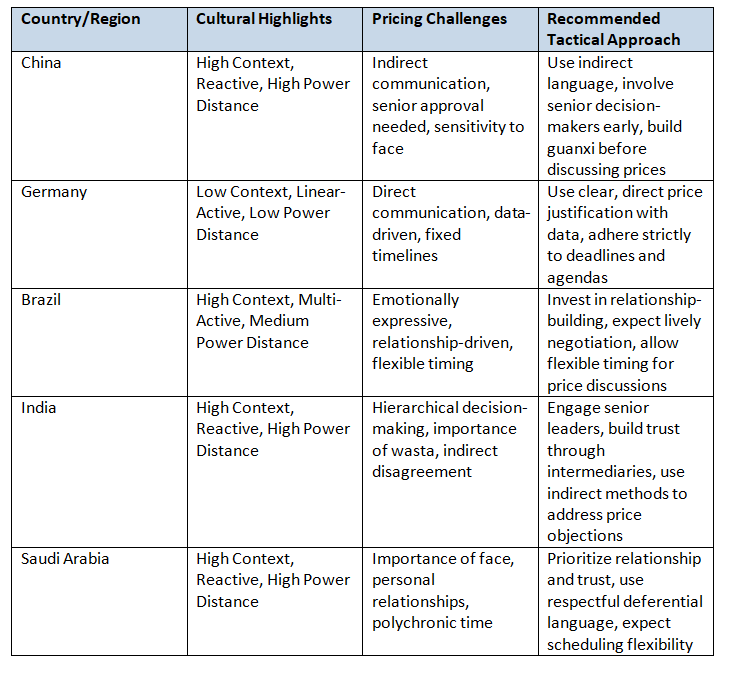
Country/Region-Specific Insights and Challenge Matrix
Advanced Strategies
Managing interpreters: Employ professional interpreters familiar with industry terminology and cultural nuances to avoid meaning loss in price discussions. Brief interpreters on key pricing terms and negotiation goals beforehand.
Relationship building: Use nemawashi in Japan to secure informal approvals; wasta networks in Middle East to navigate gatekeepers; social events in Brazil to build trust.
Face-saving: Avoid direct "no" in high-context cultures; use softening phrases (“perhaps we could consider…”) to propose price adjustments without embarrassment.
Hierarchy navigation: Identify key decision-makers early and direct negotiations accordingly. Use deferential language in high Power Distance cultures (e.g., "With your permission, may I suggest…").
Legal risk mitigation: Incorporate flexible price adjustment clauses linked to FX rates or political changes. Clarify delivery terms with Incoterms. Use ICC arbitration clauses to handle disputes.
Scripts and Templates
1. Initial Price Proposal Email for High-Context Culture (Japan)
Dear [Recipient Name],
I hope this message finds you well. Following our recent discussions, we have carefully considered the scope and value of the project. In light of this, we would like to propose a pricing structure that reflects the long-term partnership we envision. We are confident this will meet your expectations and foster mutual success.
We look forward to your valued feedback.
Kind regards,
2. Price Defense Phrase for Reactive Culture (South Korea)
"Respectfully, we believe the proposed price fairly reflects the quality and service we are committed to providing. We welcome any thoughts you may wish to share so we can find a way forward together."
3. Price Adjustment Clause Explanation Script (Emerging Market)
"As currency fluctuations may impact costs, we suggest including a price adjustment mechanism tied to the [currency] exchange rate, which will ensure fairness for both parties throughout the contract term."
4. Direct Price Negotiation Opening (Germany)
"Based on our cost analysis and market data, the price is set at €X per unit. We believe this is competitive and justified by the quality and delivery schedule. Let’s review any concerns you might have."
5. Concession Offer Email Template (Brazil)
Dear [Recipient Name],
We appreciate the constructive dialogue and value our relationship deeply. In recognition of your feedback, we are prepared to offer a [X]% concession on the initial price to support your budgetary needs while maintaining service excellence.
Looking forward to your response.
Best regards,
Frequently Asked Questions
Q1: How can I protect against currency risk when negotiating international prices?
A1: Use FX hedging strategies and include adjustment clauses in contracts that trigger price reviews based on exchange rate fluctuations. Clearly communicate these mechanisms during negotiation to build transparency and trust.
Q2: How do cultural differences influence price concession expectations?
A2: In Multi-Active cultures like Brazil or Mexico, concessions are often expected as part of bargaining, whereas Linear-Active cultures like Germany may view concessions as a sign of weakness. Tailor your concession strategy accordingly.
Q3: What legal frameworks should I consider when drafting cross-border pricing contracts?
A3: Consider CISG adoption, relevant national contract law, Incoterms for delivery terms, and ICC arbitration clauses for dispute resolution. Ensure clarity on price adjustment and penalty mechanisms aligned with these frameworks.
Q4: How do I handle negotiations where the counterparty avoids direct price discussions?
A4: In high-context cultures (China, Japan), build trust through relationship-building phases first. Use indirect language and ask open-ended questions to gauge pricing expectations without forcing direct confrontation.
Q5: What are best practices for virtual international pricing negotiations?
A5: Prepare for time zone differences with flexible scheduling, use video calls to read nonverbal cues, manage interpreters effectively, and send clear written summaries post-meetings to confirm pricing agreements and next steps.
Conclusion
Mastering international pricing negotiation requires more than just numbers—it demands a deep understanding of cultural, legal, and economic complexities layered into each interaction. This guide has equipped you with a strategic foundation, robust frameworks, actionable step-by-step tactics, and practical scripts to confidently set, defend, and adjust prices across borders. By integrating cultural intelligence with legal acumen and advanced negotiation techniques, you can avoid costly missteps and unlock value in global deals.
We encourage you to apply these insights in your next international negotiation and transform potentially contentious price discussions into collaborative, mutually beneficial agreements. For more personalized strategies and training, connect with our global negotiation experts to elevate your international pricing capabilities.
References
- Hofstede, G. (2001). Culture’s Consequences: Comparing Values, Behaviors, Institutions and Organizations Across Nations. Sage Publications.
- Meyer, E. (2014). The Culture Map: Breaking Through the Invisible Boundaries of Global Business. PublicAffairs.
- Lewis, R. (2006). When Cultures Collide: Leading Across Cultures. Nicholas Brealey Publishing.
- Fisher, R., Ury, W., & Patton, B. (2011). Getting to Yes: Negotiating Agreement Without Giving In. Penguin Books.
- UNCITRAL Secretariat (2020). United Nations Convention on Contracts for the International Sale of Goods (CISG).
- ICC (2020). Incoterms 2020 Rules. International Chamber of Commerce.