Language Barriers in Negotiation: How to Communicate Clearly and Win

In 2018, a major US tech company sought to finalize a lucrative partnership with a leading Chinese manufacturer. Despite months of talks, the deal collapsed abruptly during the final negotiation stage. The American team’s direct, low-context communication style clashed with the Chinese preference for high-context, relationship-based dialogue. Subtle linguistic nuances were lost in translation, and key terms were misunderstood, causing mistrust and confusion. This breakdown cost both parties millions and tarnished reputations. Conversely, a recent agreement between a European energy firm and a Japanese consortium succeeded due to painstaking cultural preparation, deep respect for hierarchical communication, and the use of expertly managed interpreters — showcasing how mastering language barriers can turn potential pitfalls into negotiation wins.
International negotiation is fundamentally different from domestic negotiation due to layers of complexity that extend far beyond mere language. Parties must navigate divergent cultural norms, varying legal frameworks, disparate time orientations, and fluctuating levels of trust — all filtered through the lens of communication styles and language proficiency. What many global professionals dangerously underestimate is how language barriers intersect with cultural dimensions such as indirectness vs. directness, power distance, and uncertainty avoidance, magnifying misunderstandings and increasing the risk of deal failure. Without a strategic approach to overcoming these barriers, negotiators risk losing value, damaging relationships, or escalating conflicts.
This definitive guide equips you to master language barriers in negotiation through a rigorous understanding of cultural frameworks — from Hofstede’s dimensions to Erin Meyer’s Culture Map — and introduces actionable techniques including how to effectively prepare, conduct, and close negotiations with linguistic clarity. You will gain access to proven, step-by-step strategies, culturally adapted scripts, risk mitigation checklists, and real-world international case studies that transform theoretical insights into practical tools to help you communicate clearly and win in any cross-cultural negotiation.
· Table of Contents
· The Foundations of International Negotiation
· Key Frameworks and Cultural Models
· Step-by-Step Strategy for Negotiating Across Language Barriers
· Real-World Case Studies: Successes and Failures
· Country-Specific Negotiation Insights and Tactics
· Advanced Strategies for Managing Language and Culture
· Scripts and Templates for Clear Communication
· Frequently Asked Questions
· Conclusion
· References
The Foundations of International Negotiation
International negotiation transcends transactional exchange; it is a complex interplay of cultural psychology, communication styles, legal expectations, and relationship building. Unlike domestic negotiations where shared cultural assumptions often smooth communication, international contexts require heightened awareness of subtle and overt cultural differences that impact every message exchanged.
Geert Hofstede’s seminal research reveals how six cultural dimensions influence negotiation behavior. For example, high power distance cultures (e.g., Malaysia, Mexico) expect hierarchical respect during talks, while low power distance cultures (e.g., Denmark, New Zealand) favor egalitarian dialogue. Collectivist societies (e.g., Japan, China) prioritize group harmony and indirect communication, whereas individualistic cultures (e.g., the US, Australia) value directness and personal achievement. High uncertainty avoidance cultures (e.g., Greece, Japan) demand detailed contracts and clarity, while low uncertainty avoidance cultures (e.g., Sweden, India) tolerate ambiguity more readily.
Richard Lewis categorizes cultures into Linear-Active (e.g., Germans, Swiss), Multi-Active (e.g., Latin Americans, Arabs), and Reactive (e.g., Asians) communicators. This typology explains differences in negotiation pacing, agenda adherence, and conflict handling. Edward Hall’s high-context vs. low-context communication theory further clarifies how much meaning is conveyed implicitly. High-context cultures (e.g., Japan, Arab countries) rely on shared knowledge and non-verbal cues, complicating direct translation. Monochronic cultures (e.g., the US, Germany) treat time linearly, valuing punctuality, whereas polychronic cultures (e.g., Mexico, India) have flexible time orientations, affecting meeting dynamics.
Erin Meyer’s Culture Map expands on these dimensions with eight scales, including communicating (low vs. high context), evaluating (direct vs. indirect negative feedback), persuading (principles-first vs. applications-first), and scheduling (linear vs. flexible). Understanding these layered models equips negotiators to anticipate linguistic nuances that transcend vocabulary — such as tone, pause, and implied meaning — which are critical to bridging language barriers.
The psychological dimension is equally important. Language barriers can trigger anxiety and mistrust, leading negotiators to prematurely concede or misinterpret intent. Structural factors such as the use of interpreters, contract law discrepancies (e.g., CISG vs. domestic law), and virtual meeting technologies further complicate clarity. Successful international negotiation requires deliberate cultural intelligence and communication competence to manage these intertwined factors effectively.
Key Frameworks and Cultural Models
Integrating multiple cultural frameworks provides a comprehensive lens to decode and overcome language barriers in negotiation. Below are three widely respected models with their key dimensions and how they apply to language and communication challenges.
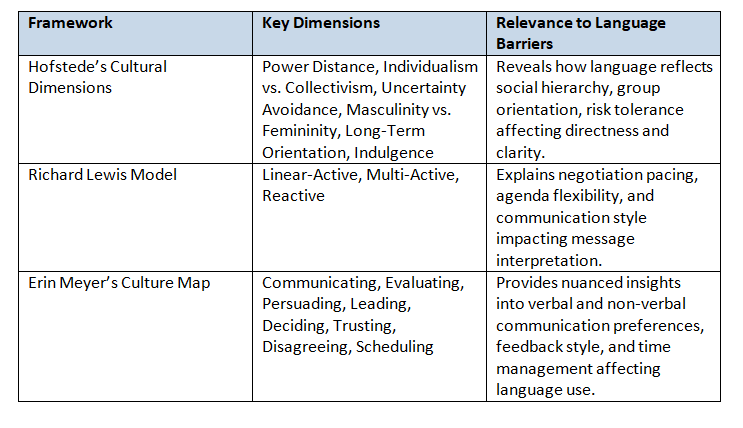
These frameworks complement each other. For instance, a Japanese negotiator (high-context, reactive, collectivist) may communicate indirectly and rely heavily on non-verbal cues, requiring interpreters skilled in cultural nuance and patience from their Western counterparts accustomed to low-context, linear-active styles. On the other hand, negotiating with a German partner (low-context, linear-active, low power distance) demands precise language, explicit terms, and adherence to agenda and deadlines.
Understanding this cultural matrix enables negotiators to tailor language, tone, and message structure, avoiding common pitfalls such as over-literal translations, culturally inappropriate idioms, or ignoring silence as communication.
Step-by-Step Strategy for Negotiating Across Language Barriers
Step 1: Comprehensive Cultural and Linguistic Preparation
Before engagement, conduct in-depth cultural research using Hofstede, Lewis, and Meyer’s tools to identify communication styles and potential language challenges. Assess the linguistic proficiency of all parties and decide on interpreter needs. Prepare glossaries of technical terms and confirm understanding of legal terminology under relevant international contract laws such as CISG or ICC rules.
Step 2: Establish Clear Communication Protocols
At the outset, agree on communication protocols including language use (native vs. lingua franca), interpreter roles, and turn-taking rules. Clarify expectations about speaking speed, pauses for translation, and the use of visual aids. Set norms for confirming understanding, such as summaries or “teach-back” techniques.
Step 3: Build Rapport and Trust with Cultural Sensitivity
Engage in relationship-building tailored to cultural expectations. For example, in Middle Eastern negotiations, invest time in wasta-based introductions. In Japan, utilize nemawashi (informal consensus-building) before formal talks. This foundation reduces language friction by fostering goodwill and patience.
Step 4: Use Simplified, Clear Language with Confirmations
Speak slowly and use simple sentence structures avoiding idiomatic expressions or jargon. Incorporate paraphrasing and clarifying questions to check comprehension. Encourage parties to verbalize understanding and flag ambiguities.
Step 5: Manage Negotiation Pace and Agenda with Flexibility
Adapt to preferred pacing—linear-active negotiators may demand strict adherence to agenda, while multi-active may prefer fluid discussions. Use agendas as guides but allow room for cultural negotiation rituals and indirect communication pauses. Employ visual aids and written summaries to reinforce clarity.
Step 6: Document Agreements Meticulously and Confirm Mutually
Draft clear, concise contracts with bilingual versions if possible. Review terms jointly, clarifying ambiguous language. Use international contract law frameworks to resolve discrepancies. Plan follow-up communications to sustain clarity and relationship.
Real-World Case Studies: Successes and Failures
Case Study 1: US-China Trade Negotiations (2019–2020)
The protracted US-China trade talks were riddled with language and cultural barriers. American negotiators’ direct and confrontational style clashed with Chinese indirectness and high-context communication. Key terms were lost in translation, and ambiguous phrases fueled mistrust. The US side’s underestimation of guanxi (relationship networks) and face-saving customs led to public escalations damaging negotiations. The lesson: linguistic clarity coupled with cultural intelligence and relationship management is essential to bridge divides.
Case Study 2: EU-UK Brexit Trade Talks (2017–2020)
The Brexit negotiations showcased challenges in multilingual, multi-jurisdictional dialogue. Differing interpretations of phrases like “level playing field” or “regulatory alignment” caused legal ambiguities. The EU’s preference for consensus and long-term orientation contrasted with the UK’s more adversarial, short-term tactical style, complicating language clarity. Expert use of legal linguists and iterative document revisions helped finalize the deal. The lesson: legal precision and multilingual expertise are critical in complex international contracts.
Case Study 3: Japan-US Automotive Joint Venture (2015)
A US automotive firm partnering with a Japanese counterpart succeeded due to deep cultural preparation. The US team engaged in nemawashi, building informal consensus before formal meetings. They employed expert interpreters familiar with automotive terminology and cultural nuances. Communication was slow, patient, and attentive to non-verbal cues. The result was a robust partnership with clear contractual terms and mutual trust. The lesson: integrating cultural frameworks with language support ensures negotiation success.
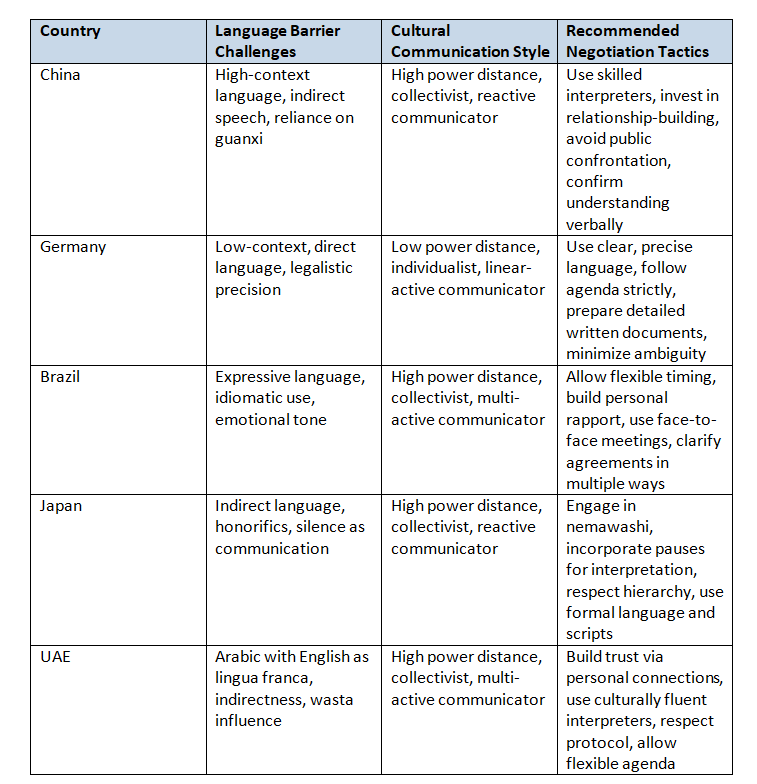
Country-Specific Negotiation Insights and Challenge-Specific Tactics
Advanced Strategies for Managing Language and Culture
Managing interpreters effectively is key: brief them thoroughly on technical terms and cultural context; position them to facilitate not just translation but mediation. Build guanxi (China), wasta (Middle East), or jeong (Korea) by investing in long-term relationship rituals beyond transactional talks. Navigate hierarchical communication by identifying decision-makers and respecting formal titles and protocols. Handle face-saving by using indirect negative feedback and reframing criticism positively. Adapt time management: embrace polychronic cultures’ flexible scheduling while maintaining your own deadlines via buffer planning.
Scripts and Templates for Clear Communication
Script 1: Opening a Meeting with a High-Context Asian Partner
“Thank you for meeting with us today. We appreciate the opportunity to deepen our partnership. Please feel free to share your thoughts openly. If at any point we are unclear, kindly let us know so we can ensure mutual understanding.”
Script 2: Confirming Understanding After a Complex Point (Multinational)
“Just to make sure we are aligned, could you please summarize what you understood from my explanation? I want to ensure we have a shared understanding before proceeding.”
Script 3: Politely Requesting Clarification (Middle Eastern Context)
“I appreciate your insights. For clarity, could you kindly elaborate a bit more on that point? Your perspective is very valuable to us.”
Script 4: Email Template for Follow-up Summary (European Partner)
Dear [Name],
Thank you for the productive discussion earlier. As agreed, please find attached a summary of key points and next steps. Kindly review and let us know if any clarifications are needed.
Best regards,
Script 5: Handling Disagreement Indirectly (Japanese Partner)
“I see your point and understand your concerns. Perhaps we might explore alternative options together that address both our interests. I look forward to your thoughts.”
Frequently Asked Questions
Q1: How can I ensure accurate translation when using interpreters in high-stakes negotiations?
Answer: Brief interpreters extensively on technical terms, cultural nuances, and negotiation objectives. Use pause-and-translate techniques, provide written materials in advance, and confirm understanding frequently with all parties.
Q2: What are effective ways to manage silent pauses in high-context cultures?
Answer: Recognize silence as part of reflection or respect. Avoid rushing to fill gaps. Use silence strategically to allow consideration, and if uncertain, gently ask if further explanation is needed.
Q3: How do I handle misunderstandings arising from idiomatic expressions?
Answer: Avoid idioms in international negotiation. If used, explain their meaning. When misunderstanding occurs, paraphrase and ask for clarification to ensure accurate interpretation.
Q4: How important is legal language precision in multilingual contracts?
Answer: Extremely important. Ambiguities can lead to disputes. Use bilingual contracts where possible and consult legal experts familiar with both jurisdictions’ laws and contract conventions.
Q5: Can virtual negotiation tools help overcome language barriers?
Answer: Yes, tools like real-time captioning and translation apps assist but are not substitutes for human interpreters. Virtual settings require extra attention to turn-taking and visual cues to maintain clarity.
Conclusion
Language barriers in international negotiation pose formidable challenges, but with deliberate cultural intelligence and strategic communication, negotiators can transform potential pitfalls into winning outcomes. By integrating foundational cultural frameworks such as Hofstede’s dimensions, Lewis’s communication types, and Meyer’s Culture Map, professionals can anticipate linguistic nuances and adapt their approach accordingly. Coupled with effective interpreter management, culturally tailored scripts, and flexible negotiation pacing, negotiators unlock the power to communicate clearly, build trust, and close deals across borders.
Mastering language barriers is not merely a linguistic exercise but a sophisticated cultural and strategic endeavor. Executives, diplomats, and global dealmakers who invest in these proven methodologies gain a decisive competitive advantage. Start applying these insights today to elevate your international negotiations to new heights of clarity and success.