Legal Aspects of International Negotiation: What Every Dealmaker Must Know
International negotiations can quickly escalate from routine business discussions to complex legal and cultural minefields, as dramatically illustrated during the 2018 US-China trade negotiations. When American and Chinese officials met to discuss tariffs and intellectual property protections, a misinterpretation of contract terms and cultural negotiation styles almost derailed months of progress, triggering market uncertainty and political tension. This scenario underscores how the intersection of legal frameworks and cultural nuances can make or break international deals, often with far-reaching consequences.
The stakes in international negotiation are multidimensional—strategic, legal, cultural, and political. While many professionals focus narrowly on price or contract clauses, they underestimate the layered complexity involving diverse cultural communication styles, international contract law standards such as CISG or UNCITRAL rules, and geopolitical risk factors. Missteps here risk invalid contracts, protracted disputes, or collapsed negotiations. Understanding the legal aspects within the broader cultural and strategic context is vital for negotiating success.
This comprehensive guide equips global dealmakers with a deep understanding of foundational cultural models including Hofstede, Meyer’s Culture Map, and Edward Hall’s context theory, alongside principled negotiation techniques and international legal frameworks. You will master step-by-step strategies, risk mitigation checklists, real-world case analyses, and practical scripts tailored to diverse cultures—empowering you to navigate and close international deals with confidence and legal precision.
· Table of Contents
· The Strategic Foundation: Cultural and Legal Frameworks
· Key Frameworks and Models: Comparative Analysis
· Step-by-Step International Negotiation Strategy
· Real-World Case Studies in Cross-Border Deals
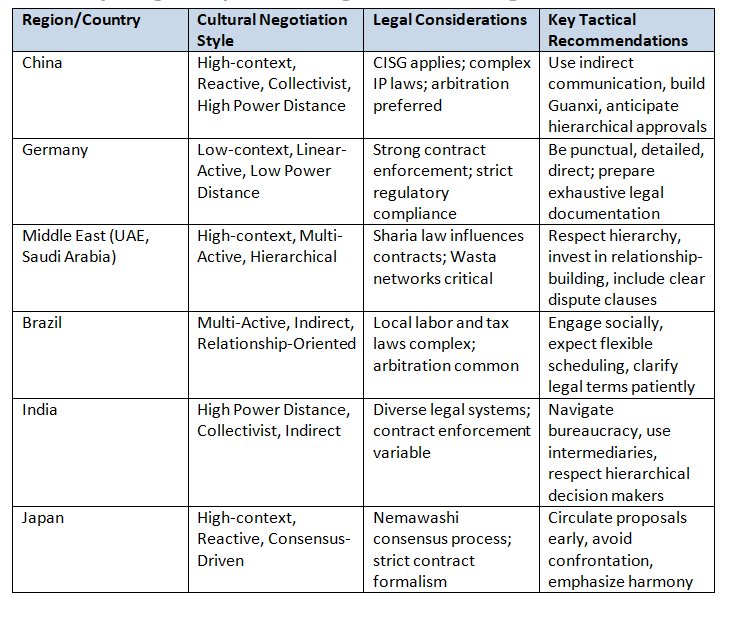
· Country/Region-Specific Insights and Challenge Matrix
· Advanced Strategies for Complex Negotiations
· Scripts and Templates for Global Negotiators
· Frequently Asked Questions on Legal Negotiation Issues
· Conclusion: Mastering Legal Aspects for Global Deals
· References
The Strategic Foundation — Deep Dive into Relevant Frameworks, Models, and Research
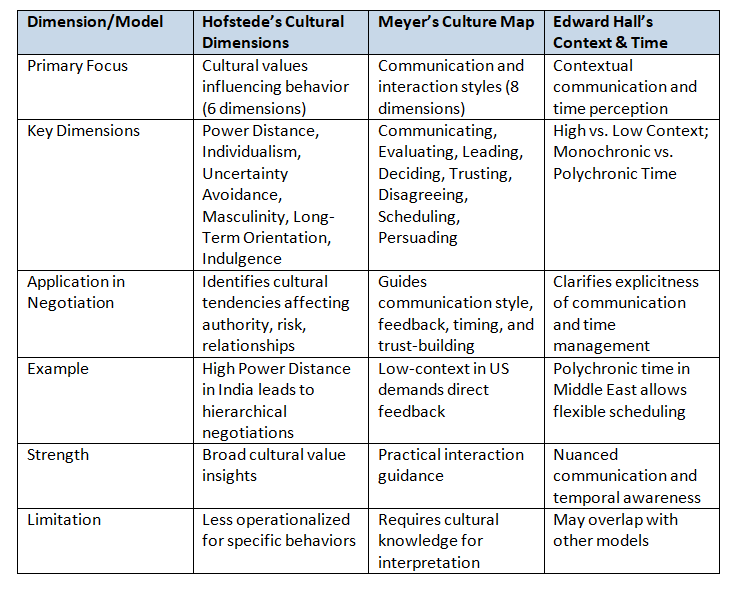
Successful international negotiation hinges on understanding the interplay between cultural dimensions and legal frameworks. Geert Hofstede’s cultural dimensions theory remains foundational, identifying six dimensions that influence negotiation behavior: Power Distance, Individualism vs. Collectivism, Uncertainty Avoidance, Masculinity vs. Femininity, Long-Term Orientation, and Indulgence. For example, high Power Distance cultures such as South Korea or Mexico emphasize hierarchy and respect for authority, affecting decision-making speed and negotiation protocol.
Erin Meyer’s Culture Map extends Hofstede by operationalizing cultural differences across eight dimensions relevant to communication and decision-making styles, including Communicating (low vs. high context), Evaluating (direct vs. indirect negative feedback), and Scheduling (linear vs. flexible time). Meyer’s framework is particularly useful for designing negotiation approaches that respect cultural expectations, such as understanding Japan’s indirect “nemawashi” consensus-building or Brazil’s relationship-focused dialogue.
Richard Lewis categorizes cultures into Linear-Active, Multi-Active, and Reactive types, reinforcing the need to adapt negotiation pacing and style. Linear-Active negotiators (typified by Germans and Americans) prefer data-driven, structured approaches, whereas Multi-Active (Latin American, Southern European) rely heavily on emotional engagement and relationships. Reactive cultures like the Japanese prioritize harmony and listening.
Edward Hall’s theory of high- and low-context communication further clarifies how much meaning is implicit versus explicit in negotiation dialogue. High-context cultures (China, Arab states) rely on nonverbal cues and long-term relationship context, while low-context cultures (US, Germany) expect clear and detailed verbal communication. Hall’s monochronic vs. polychronic time concepts also influence scheduling and deadline expectations.
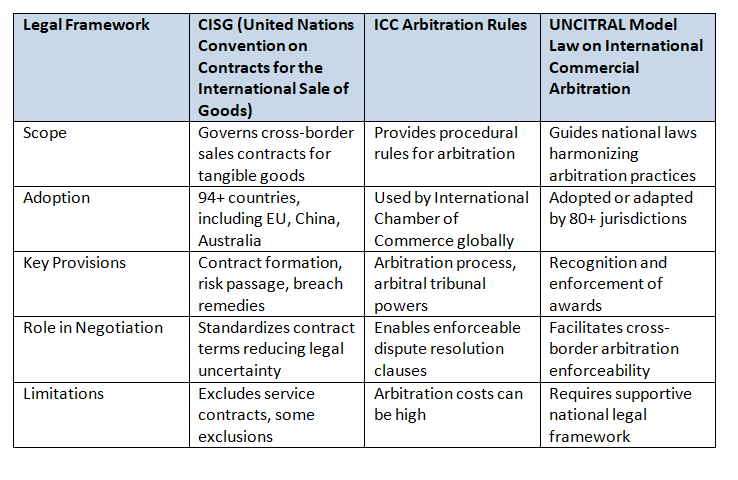
Crucially, international legal frameworks provide the backbone for enforceable contracts. The United Nations Convention on Contracts for the International Sale of Goods (CISG) standardizes sales contract rules for over 90 countries, reducing legal uncertainty. UNCITRAL model laws and ICC arbitration rules offer dispute resolution pathways. Understanding Incoterms (International Commercial Terms) is essential for defining delivery responsibilities and risk transfer in cross-border transactions.
Political and economic risk assessment frameworks such as PESTLE analysis and country risk ratings inform negotiation strategy by identifying external threats like regulatory instability or currency volatility. For instance, a deal in Venezuela or Nigeria requires heightened due diligence and risk mitigation protocols.
Together, these frameworks provide a strategic foundation to navigate the complexities of international negotiation at the intersection of culture and law.
Key Frameworks and Models — Comparative Analysis
This section compares three primary international negotiation frameworks: Hofstede’s Cultural Dimensions, Erin Meyer’s Culture Map, and Edward Hall’s Context and Time Model. Understanding their complementary perspectives enables dealmakers to design culturally attuned and legally sound strategies.
Step-by-Step Strategy — Six Essential Steps with Tactics and Cultural Guidance
Step 1: Comprehensive Pre-Negotiation Research and Risk Assessment
Begin with a thorough analysis of the counterpart’s cultural profile using Hofstede, Meyer, and Hall frameworks. Conduct a PESTLE analysis to evaluate political, economic, social, technological, legal, and environmental risks in the target country. Identify applicable legal frameworks (CISG, local contract law) and confirm enforceability of arbitration clauses. Prepare a BATNA (Best Alternative to a Negotiated Agreement) and estimate the ZOPA (Zone of Possible Agreement).
Language tip: Use neutral, respectful inquiry when gathering cultural information, e.g., “We aim to understand your preferred communication style to ensure mutual clarity.”
Step 2: Building Relationships and Establishing Trust
In collectivist cultures (China, Brazil), invest time in relationship-building through informal meetings and social rituals. Use the Richard Lewis model to adapt your style—be more personal and flexible with Multi-Active cultures, more formal and punctual with Linear-Active counterparts like Germans or Swiss.
Legal note: Avoid premature contract discussions before trust is established, as this can stall negotiations in high-context cultures.
Step 3: Setting Clear Agendas with Cultural Sensitivity
Draft agendas that respect cultural preferences for directness or indirectness. For example, in Japan’s nemawashi process, circulate agenda items well in advance to allow internal consensus-building. In Middle Eastern wasta-influenced contexts, acknowledge hierarchical participants explicitly.
Language tip: Use inclusive language, e.g., “We welcome your input on the agenda to ensure all voices are heard.”
Step 4: Conducting Negotiation Sessions with Principled Flexibility
Apply Fisher & Ury’s principled negotiation by focusing on interests rather than positions. Adjust communication styles: provide detailed data and timelines for Linear-Active cultures, adopt narrative and story-telling techniques for Reactive cultures.
Legal tactic: Clarify contract terms in simple language, confirm understanding, and note any jurisdictional preferences for dispute resolution.
Step 5: Drafting and Reviewing Contracts with International Legal Compliance
Work closely with legal counsel familiar with CISG, Incoterms, and local contract law. Ensure contract clauses address delivery terms, payment schedules, dispute resolution, confidentiality, and force majeure. Confirm language of contract and translation accuracy.
Risk mitigation: Include clear mechanisms for currency fluctuation adjustment and compliance with export controls.
Step 6: Closing, Follow-Up, and Relationship Maintenance
Conclude with explicit confirmation of agreed terms and next steps. In high-context cultures, provide ample time and follow-up communications maintaining goodwill. Schedule periodic reviews to address emerging issues and maintain compliance.
Language tip: Use culturally appropriate expressions of gratitude and commitment, e.g., in Arabic contexts, “Inshallah, we look forward to a fruitful partnership.”
Real-World Case Studies — Insights and Lessons from International Deals
Case Study 1: US-China Trade Negotiations (2018–2020)
Context: The US-China trade war involved complex tariff negotiations intertwined with intellectual property enforcement. Differing legal interpretations and cultural negotiation styles caused delays.
Lessons: Incorporate legal experts versed in both US and Chinese law early; recognize China’s indirect communication and consensus-building; deploy flexible BATNA strategies.
Case Study 2: EU-UK Brexit Trade Agreement (2016–2020)
Context: Brexit reshaped trade relations, requiring new legal frameworks and negotiation of customs protocols.
Lessons: Manage legal ambiguity via phased agreements; respect EU’s legal rigor and UK’s preference for direct dialogue; leverage multilateral arbitration clauses.
Case Study 3: Brazil-India Infrastructure Project Negotiations (2015)
Context: Brazilian Multi-Active style contrasted with Indian hierarchical and relationship-focused approach.
Lessons: Prioritize relationship-building and patience; adapt communication to indirect feedback culture; embed legal compliance with local regulations and international standards.
Country/Region-Specific Insights or Challenge Matrix
Advanced Strategies — Expert-Level Techniques for Complex Negotiations
Managing Interpreters: Ensure professional interpreters understand technical and legal terminology. Brief them beforehand on negotiation goals. Use short, clear sentences to reduce errors.
Relationship-Building: Incorporate cultural rituals such as gift-giving in Japan or coffee meetings in the Middle East to enhance trust. Document relationship milestones to reinforce commitment.
Face-Saving Techniques: Avoid public criticism or direct rejection in high-context or collectivist cultures. Use indirect language and allow space for private negotiations to resolve conflicts.
Hierarchy Navigation: Identify key decision-makers through local advisors. In Korea or India, secure endorsement from senior executives before substantive discussions.
Legal Risk Mitigation: Use multi-tiered dispute resolution clauses combining negotiation, mediation, and arbitration. Include force majeure provisions addressing political risks and currency controls.
Currency and Transfer Pricing: Hedge FX risks through forward contracts. Align transfer pricing policies with OECD guidelines to avoid tax disputes in multinational agreements.
Virtual Negotiation Protocols: Establish clear communication channels, provide pre-meeting cultural briefings, and use video to capture nonverbal cues. Schedule meetings considering time zone and monochronic/polychronic preferences.
Scripts and Templates — Word-for-Word Examples Adapted for International Contexts
1. Initial Email Request for Meeting (China, High-Context)
Dear Mr. Li,
I hope this message finds you well. We greatly value the opportunity to explore potential collaboration between our companies. To ensure our discussions are productive and respectful of your preferences, may we kindly request a brief meeting at your convenience? We are eager to listen and understand your perspectives in depth.
Warm regards,
2. Agenda Proposal (Germany, Low-Context)
Subject: Proposed Agenda for Upcoming Negotiation Meeting
Dear Ms. Müller,
Please find attached the proposed agenda for our meeting scheduled on [date]. The document outlines each discussion point with corresponding time allocations to ensure an efficient session. We welcome any feedback or additional topics you may wish to include.
Best regards,
3. Clarification Request During Negotiation (Brazil, Multi-Active)
Excuse me, I want to make sure I understand your point correctly. Could you please elaborate a bit more? We want to make sure we honor your perspective fully.
4. Contract Clause Confirmation (Japan, High-Context)
We appreciate your thorough review of the draft contract. To ensure mutual understanding, we would be grateful if you could share any concerns or suggestions at your earliest convenience. Our intention is to finalize an agreement reflecting our shared commitment.
5. Follow-up Email Post-Meeting (Middle East)
Dear Sheikh Ahmed,
Thank you for the warm hospitality during our recent meeting. We are optimistic about the promising discussions and look forward to strengthening our partnership, Inshallah. Please let us know if further information is required.
Best regards,
Frequently Asked Questions
Q1: How does the CISG impact international sales negotiations?
A1: The CISG creates a standardized legal framework governing contract formation, obligations, and remedies for the sale of goods between parties from different member countries. It reduces uncertainty by harmonizing rules but does not cover service contracts or all contractual aspects, so negotiators must clarify exclusions and local law applicability.
Q2: What key cultural differences affect contract drafting in international deals?
A2: High-context cultures may prefer vague contract wording to preserve flexibility and relationships, while low-context cultures demand precise, detailed clauses. Understanding these preferences helps balance clarity and relationship harmony, minimizing dispute risks.
Q3: How can negotiators mitigate political risk in emerging markets?
A3: Conduct thorough PESTLE analysis, include force majeure and stabilization clauses in contracts, consider political risk insurance, and structure payments and supply chains to minimize exposure to regulatory changes or instability.
Q4: What are best practices for dispute resolution clauses in international contracts?
A4: Use multi-tier dispute resolution combining negotiation, mediation, and arbitration to allow conflict de-escalation. Specify governing law, seat of arbitration, and rules (e.g., ICC or UNCITRAL). Ensure enforceability under New York Convention.
Q5: How to handle language barriers effectively during negotiations?
A5: Engage professional interpreters with technical knowledge, prepare concise statements, confirm understanding frequently, and provide written summaries. Avoid idioms and slang that may confuse non-native speakers.
Conclusion
Navigating the legal aspects of international negotiation demands more than legal expertise—it requires a sophisticated understanding of cultural nuances, strategic frameworks, and risk management tools. By integrating cultural models like Hofstede and Meyer with international contract law and principled negotiation techniques, dealmakers can avoid costly misunderstandings and craft agreements that stand the test of complexity and diversity.
This guide has equipped you with actionable steps, real-world insights, and practical scripts to elevate your negotiation prowess globally. Embrace these frameworks and strategies to transform challenges into opportunities and secure lasting, legally sound international partnerships.
To deepen your negotiation mastery and protect your global deals, subscribe to our expert briefing series and access exclusive templates and legal updates tailored for international dealmakers.
References
1. Hofstede, G. (2011). *Dimensionalizing Cultures: The Hofstede Model in Context*. Online Readings in Psychology and Culture.
2. Meyer, E. (2014). *The Culture Map: Breaking Through the Invisible Boundaries of Global Business*. PublicAffairs.
3. Hall, E.T. (1976). *Beyond Culture*. Anchor Books.
4. Fisher, R., Ury, W., & Patton, B. (2011). *Getting to Yes: Negotiating Agreement Without Giving In*. Penguin Books.
5. United Nations Commission on International Trade Law (UNCITRAL). (1980). *United Nations Convention on Contracts for the International Sale of Goods (CISG)*.
6. International Chamber of Commerce (ICC). (2021). *ICC Arbitration Rules*.