Managing Misunderstandings in Cross-Cultural Negotiation: Prevention and Recovery

In 2015, a major European automotive supplier lost a critical multi-million-dollar contract with a Chinese state-owned enterprise due to a seemingly minor but culturally charged misunderstanding. The European team’s direct and transactional negotiation style clashed with the Chinese emphasis on guanxi (relationship-building) and mianzi (face), causing the Chinese partners to feel insulted and withdraw. This costly failure highlighted how deeply cultural misunderstandings can sabotage even the most well-prepared deals.
Cross-cultural negotiation is a high-stakes arena where strategic business objectives collide with complex cultural norms. Misunderstandings not only delay or derail agreements but can damage long-term relationships and reputations. Unfortunately, many professionals mistakenly believe that universal business logic or English fluency alone guarantees success. They overlook critical cultural dimensions such as communication style, time orientation, hierarchy, and emotional expression — factors that shape perception and behavior during negotiations.
This comprehensive guide empowers international executives, diplomats, and global sales directors to master the prevention and recovery of misunderstandings in cross-cultural negotiations. You will explore foundational cultural frameworks such as Hofstede’s dimensions and Erin Meyer’s Culture Map, learn step-by-step strategies tailored to multiple cultural contexts, analyze real-world case studies, and gain access to ready-to-use scripts and checklists. By the end, you will be equipped to navigate and resolve misunderstandings with confidence, turning potential conflicts into successful, lasting partnerships.
· Table of Contents
· The Theoretical Foundation: Deep Dive into Cultural Frameworks
· Key Frameworks and Models: Cross-Country Comparison
· Step-by-Step Strategy for Managing Misunderstandings
· Real-World Case Studies: Successes and Failures
· Country/Region-Specific Insights: Do’s and Don’ts Table
· Advanced Strategies: Expert-Level Techniques
· Scripts and Templates: Language and Tone Adaptations
· Frequently Asked Questions: Detailed Q&A
· Conclusion: Synthesis and Call to Action
· References: Authoritative Sources
The Theoretical Foundation — Deep Dive into Relevant Cultural Frameworks
Understanding and managing misunderstandings in cross-cultural negotiation requires mastery of multiple cultural intelligence models that frame how different societies communicate, make decisions, manage conflict, and build relationships. Below is an overview of seminal frameworks with relevant dimensions and country-level data illustrating critical differences.
Geert Hofstede’s 6 Cultural Dimensions provide foundational insight into values driving behavior:
- Power Distance Index (PDI): The degree to which less powerful members expect and accept unequal power distribution. For example, India scores 77 (high), emphasizing hierarchy, while Denmark scores 18 (low), favoring egalitarianism.
- Individualism vs Collectivism (IDV): The extent to which people prioritize individual goals over group harmony. The US scores 91 (highly individualistic), China 20 (collectivist).
- Uncertainty Avoidance Index (UAI): Preference for structured situations and risk avoidance. Japan scores 92 (high UAI), Brazil 76, whereas Singapore scores 8 (very low).
- Masculinity vs Femininity (MAS): Preference for achievement and assertiveness versus care and quality of life. Japan (95) is highly masculine, Sweden (5) highly feminine.
- Long-Term Orientation (LTO): Focus on future rewards and perseverance. China scores 87, the US 26.
- Indulgence vs Restraint (IVR): Extent of gratification of desires. Mexico (97) scores high on indulgence, Russia (20) low.
Erin Meyer’s Culture Map complements Hofstede by focusing on communication and decision-making:
- Communicating (Low vs High Context): Japan and Arab cultures rely on high-context communication with implicit meaning, whereas Germany and the US use low-context, explicit communication.
- Evaluating (Direct vs Indirect Negative Feedback): Dutch and Germans give direct feedback, Asians tend to be indirect.
- Persuading (Principles-first vs Applications-first): French prefer theoretical reasoning, Americans practical applications.
- Leading (Egalitarian vs Hierarchical): Scandinavian countries are egalitarian, South Korea hierarchical.
- Deciding (Consensual vs Top-down): Japan’s nemawashi process contrasts with American top-down decisions.
Richard Lewis’s Model categorizes cultures as Linear-Active (Germany, US), Multi-Active (Brazil, Italy), and Reactive (Japan, China), each with distinct negotiation rhythms.
Edward Hall’s concepts of high- vs low-context communication, monochronic vs polychronic time, and proxemics further explain misunderstandings arising from timing and space perceptions.
Richard Gesteland’s dimensions emphasize deal-focus vs relationship-focus, formal vs informal styles, rigid vs fluid time, and expressive vs reserved communication, illustrated through American transactional versus Middle Eastern relational styles.
David Livermore’s Cultural Intelligence (CQ) framework — CQ Drive, Knowledge, Strategy, and Action — underpins practical intercultural adaptability.
Trompenaars & Hampden-Turner’s dimensions such as universalism vs particularism and neutral vs emotional also critically influence negotiation expectations and conflict resolution.
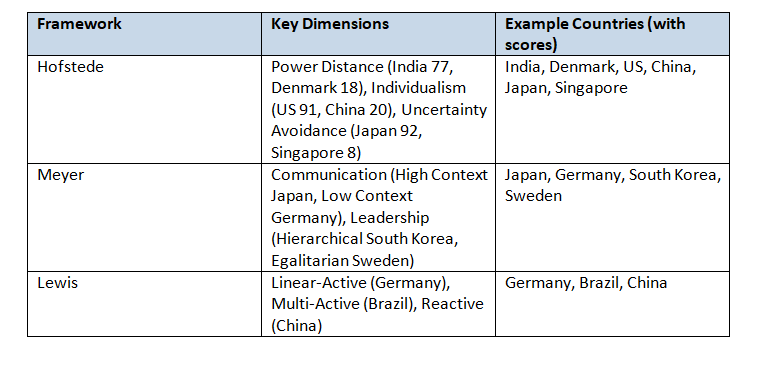
Key Frameworks and Models — 2-3 Named Frameworks with Comparison Table
Among the many frameworks, three models stand out for practical application in managing misunderstandings:
1. Geert Hofstede’s Cultural Dimensions — quantifies value differences with scores on six dimensions, enabling comparison and prediction of negotiation behavior.
2. Erin Meyer’s Culture Map — focuses on communication style and decision processes, critical for interpreting negotiation cues.
3. Richard Lewis’s Model — categorizes negotiation approaches by cultural rhythm and style, highlighting pacing and conflict management.
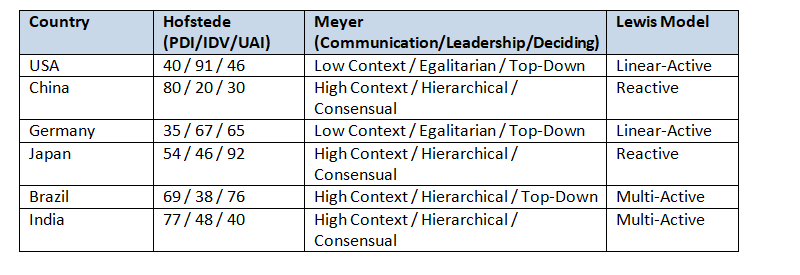
These models collectively inform how misunderstandings arise from differences in hierarchy acceptance, communication directness, time orientation, and decision-making processes.
Step-by-Step Strategy — Managing Misunderstandings in Cross-Cultural Negotiation
Step 1: Conduct In-Depth Cultural Research Before Negotiations
Investigate your counterpart’s cultural scores on Hofstede’s dimensions and qualitative insights from Meyer and Lewis. Use reliable sources like the Hofstede Insights database and Erin Meyer’s Culture Map. Focus on communication style, hierarchy, and time orientation.
Step 2: Establish Relationship Foundations Early
In relationship-focused cultures such as China (guanxi), Middle East (wasta), and India, invest time in building rapport before discussing business. Use small talk and shared social activities to build trust and avoid face loss (mianzi).
Step 3: Adapt Communication Style Explicitly
Match your communication style to counterpart expectations. For example, use indirect, high-context language with Japanese or Arab negotiators to avoid embarrassment. With Germans and Americans, be clear and direct but respectful.
Step 4: Clarify Decision-Making Processes and Roles
Avoid assumptions about authority. In hierarchical cultures like Korea or India, decisions may require consensus or approval up the chain. Confirm decision-makers early and adjust your strategy accordingly.
Step 5: Use Active Listening and Confirm Understanding
Paraphrase key points and ask open-ended questions to verify understanding. For example: “To ensure I fully understand, you are saying that...?” This is vital in low-context to high-context transitions.
Step 6: Prepare for and Manage Conflict with Cultural Sensitivity
Apply Thomas-Kilmann Conflict Mode Instrument tailored to culture: use accommodating or avoiding styles in high power distance or collectivist cultures to preserve harmony; use competing or collaborating in low power distance or individualist cultures.
Step 7: Have Recovery Protocols Ready
If misunderstandings occur, use face-saving language, apologize sincerely, and re-establish trust. For example, in China, use indirect language acknowledging unintended offense and offer to restart discussions with renewed respect.
Step 8: Document Agreements Clearly and Confirm Follow-Up Steps
Use written summaries and confirm via email to reduce ambiguity, especially when dealing with low-context cultures like the US or Germany.
Real-World Case Studies — Successes and Failures
Case Study 1: Daimler-Benz and Mitsubishi Motors (2000s)
The failed merger was partially attributed to German directness and Japanese indirect consensus-building clash. The Germans’ fast, linear negotiation style conflicted with the Japanese nemawashi and ringi consensus process, causing frustration and mistrust.
Lesson: Respect local decision-making norms and timing to prevent misunderstandings.
Case Study 2: Walmart’s Entry into Germany (1997)
Walmart’s American-style directness and informal friendliness conflicted with German formality and Sachlichkeit (objectivity). The failure to adapt communication and negotiation style contributed to Walmart’s exit.
Lesson: Match formality and communication norms to local expectations.
Case Study 3: Huawei’s Negotiations with Middle Eastern Partners
Huawei invested heavily in wasta-based relationship building, using local intermediaries to foster trust and respect. This relational approach helped overcome initial misunderstandings and build long-term partnerships.
Lesson: Prioritize relationship-building and respect face-saving in Middle Eastern contexts.
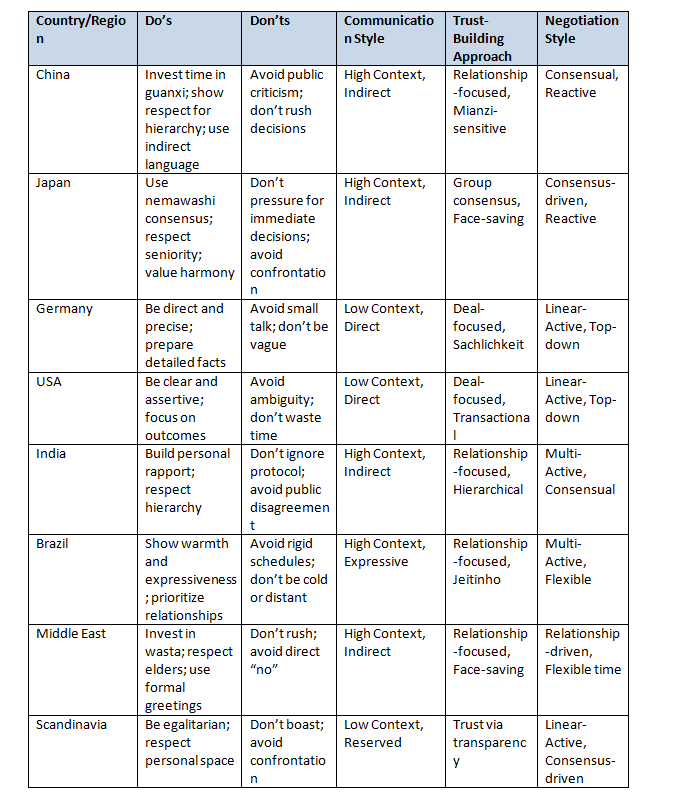
Country/Region-Specific Insights — Cultural Do’s and Don’ts Table
Advanced Strategies — Expert-Level Cross-Cultural Techniques
- Use Cultural Intelligence (CQ) Strategy to anticipate cultural misunderstandings before they arise by mentally rehearsing negotiation scenarios.
- Employ Trompenaars’ Universalism vs Particularism to determine when to apply standard rules vs adapt to exceptions based on relationship.
- Incorporate Edward Hall’s Monochronic vs Polychronic time by scheduling buffer periods to respect flexible time cultures.
- Utilize Thomas-Kilmann Conflict Modes dynamically: switch between accommodating and collaborating based on cultural conflict preferences.
- Leverage technology-enabled translation and video conferencing with cultural coaching to reduce misunderstandings in virtual negotiations.
Scripts and Templates — Exact Word-for-Word Scripts for Different Cultures
Script 1: Apologizing for Misunderstanding in China
“I realize that my previous comments may have caused unintended offense, and I sincerely apologize. It is very important to me that we maintain mutual respect and trust. Could we please take a moment to clarify any concerns and continue our discussion with renewed understanding?”
Script 2: Clarifying Decision-Making in Japan
“To ensure that we are aligned with your internal process, may I kindly ask how decisions are typically reached within your team? I want to respect your consensus-building approach and provide any additional information needed.”
Script 3: Requesting Direct Feedback in Germany
“Please feel free to provide candid feedback or raise any concerns directly. I value your honesty and want to ensure we address all points thoroughly.”
Script 4: Building Rapport in Brazil
“Before we begin, I would love to hear more about your recent experiences and interests. Building a strong and friendly partnership is very important to me.”
Script 5: Managing Time Expectations in Middle East
“I understand that building trust is a priority, and I am happy to proceed at a pace that suits your preferences. Please let me know how best we can accommodate your schedule.”
Frequently Asked Questions
Q1: How can I quickly identify potential cultural misunderstandings in a negotiation?
A1: Listen carefully to verbal and non-verbal cues, research cultural dimensions beforehand, and ask open-ended questions to clarify intent. Using frameworks like Meyer’s Culture Map helps anticipate areas prone to miscommunication.
Q2: What is the best way to recover if I realize I have offended a counterpart culturally?
A2: Apologize sincerely using indirect and face-saving language appropriate to their culture, avoid defensiveness, and seek to clarify misunderstandings privately and respectfully.
Q3: How do hierarchical cultures influence negotiation progress?
A3: In high power distance cultures (e.g., India, China), decisions may require approval from senior leaders, causing delays. Recognize these protocols and plan timelines accordingly.
Q4: How important is relationship-building compared to deal-making in different cultures?
A4: In collectivist and relationship-focused cultures (Middle East, Latin America, Asia), relationships often take precedence over transactional deal details. Prioritize trust and personal connections before negotiating terms.
Q5: Can virtual negotiations exacerbate cultural misunderstandings?
A5: Yes, absence of physical cues and limited informal interaction can increase misunderstandings. Use video calls, clarify explicitly, and apply cultural intelligence principles to maintain rapport.
Conclusion
Misunderstandings in cross-cultural negotiations are inevitable but manageable with the right knowledge, mindset, and tools. By integrating foundational cultural frameworks with practical strategies, tailored communication, and recovery protocols, international negotiators can transform potential conflicts into opportunities for deeper understanding and stronger partnerships. The stakes are high—both in financial terms and long-term reputation—but mastery of cross-cultural nuances unlocks sustainable success in the global arena.
Begin your journey today by applying the step-by-step strategies, leveraging country-specific insights, and practicing the provided scripts. Cultivate cultural intelligence not just as theory but as dynamic action to prevent and recover from misunderstandings. The result: negotiations that honor diversity, build trust, and deliver mutually beneficial outcomes.
References
- Hofstede, G. (2011). *Dimensionalizing Cultures: The Hofstede Model in Context*. Online Readings in Psychology and Culture.
- Meyer, E. (2014). *The Culture Map: Breaking Through the Invisible Boundaries of Global Business*. PublicAffairs.
- Lewis, R. D. (2006). *When Cultures Collide: Leading Across Cultures*. Nicholas Brealey Publishing.
- Hall, E. T. (1976). *Beyond Culture*. Anchor Books.
- Gesteland, R. R. (2012). *Cross-Cultural Business Behavior: Marketing, Negotiating and Managing Across Cultures*. Copenhagen Business School Press.
- Livermore, D. A. (2015). *Leading with Cultural Intelligence: The Real Secret to Success*. AMACOM.