Managing Tension in Negotiation: Keep the Table from Exploding

Negotiations at their peak intensity often resemble a powder keg ready to ignite. Imagine a high-stakes corporate merger meeting where two executive teams face off over contentious valuation terms. The room is charged with frustration, past grievances simmer beneath the surface, and every word feels like a potential spark. In this scenario, a single misstep could collapse weeks of painstaking work, costing millions and reputations. Such moments demand more than just business acumen—they require an expert command of human psychology and conflict dynamics to keep the negotiation table intact.
The reality is that most negotiators, even experienced ones, underestimate how emotion-driven and irrational human decision-making can become under pressure. Daniel Kahneman’s research on System 1 and System 2 thinking reveals how stress shifts negotiators into fast, intuitive, often flawed reactions rather than slow, deliberate reasoning. Meanwhile, the amygdala hijack can trigger fight-flight-freeze responses, shutting down rational dialogue. Without managing these forces, negotiations devolve into ultimatums, positional rigidity, or emotional flooding, ensuring breakdown instead of agreement.
In this comprehensive guide, you will master the art of managing tension in negotiation with cutting-edge psychological insights and tactical frameworks. Drawing on Chris Voss’s FBI negotiation techniques, William Ury’s conflict resolution models, and John Gottman’s trust repair strategies, you will learn exact step-by-step processes, expert-level approaches, and precise dialogue scripts designed to de-escalate conflict and rebuild trust. Whether you lead boardroom negotiations, mediate labor disputes, or navigate diplomatic standoffs, this definitive resource equips you to keep the table from exploding.
· Table of Contents
· The Psychology Behind This Challenge
· Key Frameworks and Models
· Step-by-Step Process for Managing Tension
· Real-World Case Studies
· Recognizing and Countering Difficult Dynamics
· Advanced Techniques for High-Stakes Negotiation
· Scripts and Templates for De-escalation
· Frequently Asked Questions
· Conclusion
· References
The Psychology Behind This Challenge
Understanding why tension escalates so quickly in negotiations requires a dive into the neuroscience and psychological mechanisms that govern human behavior under stress. At the core is the amygdala, the brain’s emotional alarm system. When negotiators perceive threat—whether to self-esteem, resources, or relationships—the amygdala can hijack the prefrontal cortex, the seat of rational thought, precipitating an emotional flood that undermines logical processing. This "amygdala hijack," as Daniel Goleman popularized, leads to impulsive fight, flight, or freeze reactions.
Daniel Kahneman’s dual-process model further clarifies this. System 1 thinking is fast, automatic, and emotional, while System 2 is slow, analytical, and deliberate. High tension pushes negotiators into System 1 dominance, making them prone to cognitive biases, such as anchoring on initial offers or confirmation bias that reinforces adversarial positions. Counteracting this requires targeted interventions to re-engage System 2 thinking.
Chris Voss's concept of tactical empathy highlights the importance of explicitly recognizing and labeling the counterpart’s emotions to reduce defensive barriers. By validating feelings without conceding positions, negotiators can de-escalate hostility. John Gottman’s research on emotional flooding reveals how physiological overwhelm leads to breakdowns in communication, underscoring the need for emotional regulation techniques.
The fight-flight-freeze response explains common impasses: fight manifests as aggression or ultimatums; flight as withdrawal or silence; freeze as indecision or stonewalling. Trust repair theory demonstrates that once trust fractures due to these responses, transparent communication and consistent behavioral signals are essential to rebuild it. Behavioral economics research on the ultimatum game reveals how fairness perceptions and loss aversion drive rejection of offers even at personal cost, illuminating why rigid stances emerge.
In sum, managing tension in negotiation necessitates deep psychological insight: recognizing emotional triggers, applying tactical empathy, regulating physiological responses, and repairing trust ruptures to restore productive dialogue.
Key Frameworks and Models
Several frameworks provide structured approaches to managing tension and conflict in hard negotiations. Below is a comparison of three essential models:
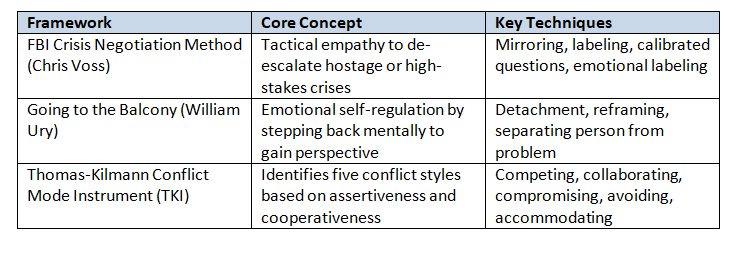
Chris Voss’s FBI method emphasizes active listening and emotional validation to lower hostility, critical when tension is high. “Going to the Balcony,” a metaphor from William Ury’s seminal work "Getting Past No," instructs negotiators to mentally remove themselves from the conflict’s heat, enabling System 2 thinking to override emotional impulses. The Thomas-Kilmann model helps negotiators identify their default conflict style and adapt to more effective modes depending on tension levels.
Another relevant model is John Gottman's Trust Repair Framework, which outlines steps to rebuild trust after emotional ruptures:
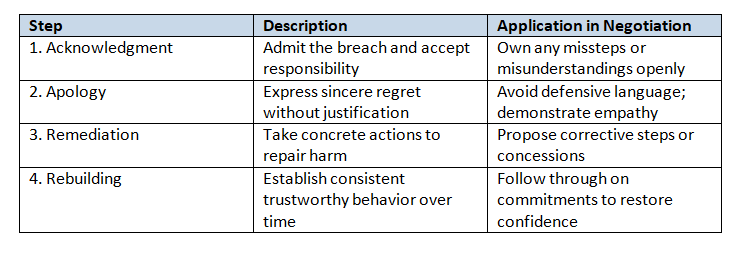
Understanding and integrating these frameworks equips negotiators to manage tension proactively and recover when conflicts escalate.
Step-by-Step Process for Managing Tension
Mastering tension management requires a deliberate sequence combining emotional intelligence, psychological techniques, and strategic communication. Below is a detailed six-step process with embedded psychological tools:
Step 1: Prepare and Self-Regulate
Before entering negotiations, engage in Amy Cuddy’s power posing or mindfulness exercises to boost presence and reduce cortisol. Anticipate triggers and rehearse calming strategies to prevent amygdala hijack. Preparation includes clarifying your goals and BATNA (Best Alternative to a Negotiated Agreement).
Step 2: Establish Rapport with Tactical Empathy
Begin by actively listening and employing Chris Voss’s mirroring (“So you’re concerned about...?”) and labeling (“It sounds like this issue is really frustrating you”) to validate emotions. This reduces defensiveness and builds trust.
Step 3: Identify Underlying Interests and Emotions
Use calibrated open-ended questions (“What’s the biggest challenge you’re facing here?”) to uncover hidden needs and fears. Recognize emotional flooding signs and pause dialogue to allow cooling if needed.
Step 4: Go to the Balcony When Tension Escalates
If hostility rises, mentally step back to observe without reacting. This reframing prevents reactive fight or flight responses. Verbally signal a pause (“Let’s take a moment to ensure we’re both clear on our goals”).
Step 5: Apply Trust Repair Techniques
If trust has eroded, acknowledge grievances sincerely, apologize if appropriate, and propose remediation steps. Use Gottman’s framework to rebuild confidence incrementally.
Step 6: Collaborate Toward Mutual Gain
Shift from positional bargaining to interest-based collaboration, leveraging the Thomas-Kilmann model’s collaborating style. Frame solutions as joint wins to reduce zero-sum mindset.
Each step integrates psychological insights to maintain constructive dialogue and prevent breakdown.
Real-World Case Studies
Examining real high-conflict negotiations reveals the application and impact of tension management.
Case Study 1: FBI Hostage Negotiation in the 1993 Waco Siege
During the Waco siege, FBI negotiators employed tactical empathy and labeling to build rapport with David Koresh’s followers. Despite initial success, escalation occurred due to command impatience and breakdown in trust. The lesson: sustained emotional regulation and trust-building are critical; tactical empathy alone cannot prevent all escalation without systemic support.
Case Study 2: 2018 UAW-GM Labor Strike
The United Auto Workers’ strike against General Motors featured high tension over wage and benefit disputes. GM’s negotiators used “going to the balcony” techniques to avoid reactive ultimatums, allowing time for UAW’s emotional flooding to subside. Trust repair steps helped bridge initial animosities, leading to a compromise agreement. The lesson: patience, emotional regulation, and trust repair frameworks prevent negotiation collapse.
Case Study 3: 2019 Brexit Withdrawal Agreement Negotiations
UK and EU negotiators faced intense political and emotional pressure, triggering System 1 reactive thinking and ultimatums. Failure to manage emotional flooding and trust ruptures delayed agreement. Later phases incorporated more tactical empathy and collaborative framing, enabling breakthrough. The lesson: in politically charged negotiations, managing emotional dynamics is as crucial as legal terms.
These cases underscore the necessity of integrating psychological techniques with strategic negotiation.
Recognizing and Countering Difficult Dynamics
Negotiators encounter specific challenging tactics that escalate tension and risk breakdown. The table below maps common difficult dynamics, their psychological mechanisms, and precise countermeasures.
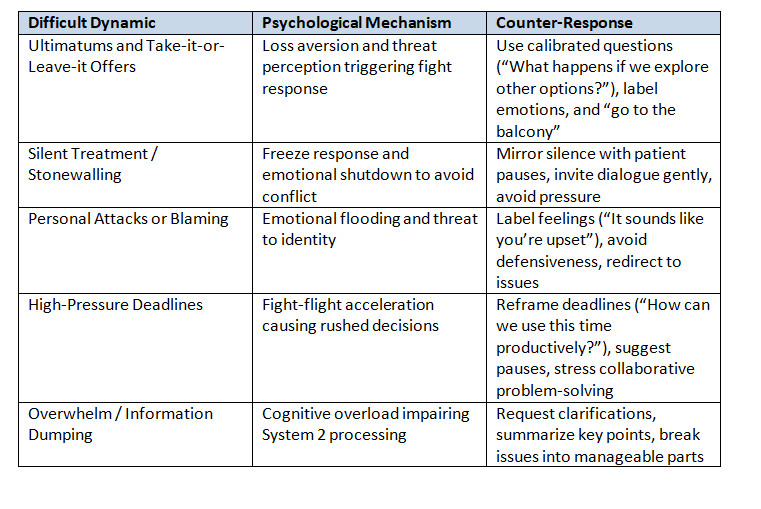
Recognizing these dynamics early and applying targeted psychological techniques keeps negotiations on track.
Advanced Techniques for High-Stakes Negotiation
Beyond foundational approaches, expert negotiators leverage advanced psychological and strategic tools:
· Emotional Labeling with Pause Timing: Strategic use of silence after labeling maximizes counterpart’s emotional processing and disclosure (Voss).
· Anchoring with Collaborative Framing: Present initial offers as joint problem-solving proposals to reduce resistance to anchoring biases.
· Physiological Reset Techniques: Use breathing exercises or brief breaks to downshift stress responses mid-negotiation (Amy Cuddy’s presence research).
· The Third Side Perspective: Adopt William Ury’s “Third Side” view to engage wider community or stakeholders as mediators, reducing dyadic tension.
· Behavioral Signal Monitoring: Apply Paul Ekman’s micro-expressions and emotional tells to identify concealed emotions and adjust tactics dynamically.
These techniques elevate negotiators’ ability to manage tension in the most volatile scenarios.
Scripts and Templates for De-escalation
Below are exact word-for-word dialogue scripts for common tension-filled moments:
1. When counterpart issues an ultimatum:
“I hear that this issue feels critical to you. Help me understand what would happen if we can’t resolve it today?”
2. When emotions run high and personal attacks emerge:
“It sounds like this topic is really frustrating you. I want to make sure we focus on solving the problem together.”
3. When silence or stonewalling occurs:
“I notice it’s quiet on your side — please take your time. When you’re ready, I’d appreciate hearing your perspective.”
4. When a deadline creates pressure:
“I understand the urgency here. How can we use this time to find a solution that works for both of us?”
5. When trust has been damaged:
“I want to acknowledge that things have been difficult, and I regret where things went off track. Let’s discuss how we can move forward together.”
Using these scripts with authentic tone and timing can defuse tension and restore dialogue.
Frequently Asked Questions
Q1: How can I prevent emotional flooding during negotiation?
A1: Emotional flooding can be prevented by practicing self-awareness and emotional regulation techniques such as deep breathing, mindfulness, and “going to the balcony” to detach mentally. Recognize signs of escalating stress and suggest brief pauses to reset.
Q2: What role does tactical empathy play in managing negotiation tension?
A2: Tactical empathy involves deliberately recognizing and labeling the counterpart’s emotions to reduce defensiveness. It builds trust and rapport, enabling more open communication and lowering the chance of escalation.
Q3: How should I respond to ultimatums without escalating tension?
A3: Avoid reacting impulsively. Use calibrated questions to explore alternatives and label the counterpart’s emotions. Suggest stepping back to review options collaboratively rather than accepting or rejecting demands outright.
Q4: When is it appropriate to use silence as a negotiation tactic?
A4: Silence can be powerful after making a point or labeling emotions. It encourages the other party to fill the gap, often revealing more information or softening their stance. Use silence strategically, not coercively.
Q5: How can I rebuild trust if the negotiation relationship has been damaged?
A5: Follow Gottman’s trust repair framework: acknowledge the breach, offer a sincere apology, propose remediation, and demonstrate consistent trustworthy behavior over time. Transparency and patience are essential.
Conclusion
Managing tension in negotiation is a complex interplay of psychological insight, strategic communication, and disciplined emotional regulation. As this guide has shown, understanding the neuroscience of stress and decision-making, applying proven frameworks like tactical empathy and trust repair, and employing precise step-by-step processes can transform volatile situations into collaborative opportunities. Whether you face boardroom standoffs, labor disputes, or international diplomacy, these skills are essential to keep the negotiation table from exploding.
By mastering these techniques and scripts, you equip yourself to navigate the inevitable emotional currents of high-stakes negotiation with presence and purpose. Commit to continual practice and reflection on these frameworks to become a negotiator who not only survives tension but harnesses it to forge durable agreements. Now is the time to integrate these insights and elevate your negotiation outcomes.
References
1. Kahneman, Daniel. 2011. "Thinking, Fast and Slow." Farrar, Straus and Giroux.
2. Voss, Chris. 2016. "Never Split the Difference: Negotiating As If Your Life Depended On It." HarperBusiness.
3. Ury, William. 1991. "Getting Past No: Negotiating in Difficult Situations." Bantam Books.
4. Gottman, John M., and Nan Silver. 1999. "The Seven Principles for Making Marriage Work." Crown Publishers.
5. Cialdini, Robert B. 2006. "Influence: The Psychology of Persuasion." Harper Business.
6. Ekman, Paul. 2003. "Emotions Revealed: Recognizing Faces and Feelings to Improve Communication and Emotional Life." Times Books.