Manipulation Tactics in Negotiation: How to Spot and Neutralize Them

Negotiation rooms are often battlegrounds where unseen psychological forces shape outcomes. In 2012, during a critical patent licensing negotiation between Apple and Samsung, Apple's lead negotiator faced relentless pressure tactics designed to distort perceived value and urgency. Samsung’s team employed a variety of manipulation strategies—anchoring with skewed numbers, calibrated questions designed to confuse, and subtle social proof claims referencing competitors—to gain leverage. The result threatened to derail months of progress until Apple’s negotiator recognized these ploys and skillfully neutralized them with tactical empathy and calibrated counter-questions. This high-stakes scenario vividly illustrates how manipulation tactics can dramatically alter negotiation trajectories, often to the detriment of the less-prepared party.
Most negotiators, even experienced ones, underestimate the psychological complexity behind manipulation tactics. They tend to focus on surface-level concessions or objective data, ignoring the behavioral economics and cognitive biases at play. Research by Daniel Kahneman on anchoring and loss aversion, combined with Robert Cialdini’s principles of influence such as scarcity and social proof, explains why manipulation tactics can be so effective. Yet, few negotiators are trained to identify these subtleties or deploy counter-strategies grounded in tactical empathy, labeling, and calibrated questioning, as recommended by Chris Voss. Consequently, they fall prey to manipulation, sacrificing value or control.
This comprehensive guide equips you to master manipulation tactics in negotiation. You will learn the underlying psychology, explore key frameworks like Cialdini’s influence principles, Voss’s tactical empathy toolkit, and Fisher & Ury’s principled negotiation. We provide a step-by-step process to detect and dismantle manipulation in real time, supported by detailed scripts and counter-response tables. Real-world case studies from corporate, sports, and diplomatic negotiations illustrate these lessons in action. By the end, you will confidently identify manipulative maneuvers and neutralize them with precision and ethical assertiveness.
· Table of Contents
· The Psychology and Science Behind Manipulation Tactics
· Key Frameworks and Models for Understanding Manipulation
· Step-by-Step Process to Spot and Neutralize Manipulation
· Real-World Case Studies of Manipulation in Negotiations
· Recognition and Counter-Response Guide (with Scripts)
· Advanced Insights: Expert-Level Manipulation Defenses
· Scripts and Templates for Common Scenarios
· Frequently Asked Questions
· Conclusion
· References
The Psychology and Science Behind This Topic
Manipulation in negotiation is rooted deeply in human cognitive biases and social influence mechanisms. Understanding these psychological underpinnings is essential to both spotting and neutralizing manipulation.
Anchoring, first identified by Tversky and Kahneman (1974), refers to the human tendency to rely heavily on the first piece of information offered (the "anchor") when making decisions. This bias makes negotiators susceptible to inflated initial offers or demands, which distort perceived value ranges.
Loss aversion, a central tenet of prospect theory (Kahneman & Tversky, 1979), explains why individuals feel the pain of losses more acutely than the pleasure of equivalent gains. Manipulators exploit this by framing concessions as potential losses, increasing pressure to concede prematurely.
Robert Cialdini’s (1984) six principles of influence—reciprocity, commitment/consistency, social proof, authority, liking, and scarcity—are frequently weaponized in negotiation. For example, scarcity tactics ("This offer expires today") create urgency that short-circuits deliberation, while social proof ("All your competitors have agreed") leverages conformity bias.
Chris Voss (2016), a former FBI hostage negotiator, emphasizes tactical empathy, labeling, and calibrated questions as cognitive tools to defuse manipulation. Tactical empathy involves actively understanding and verbalizing the opponent’s perspective without conceding ground, which reduces adversarial tension and reveals underlying motives.
Game theory concepts, such as Nash equilibrium and zero-sum vs positive-sum games, provide a strategic lens. Manipulators often push zero-sum framing to escalate conflict and justify hardball tactics, ignoring mutually beneficial outcomes. Recognizing this framing allows negotiators to reorient discussions toward integrative solutions.
Finally, Machiavellian and Sun Tzu’s teachings on power dynamics remind negotiators that manipulation is an exercise of power asymmetry often disguised as cooperation. Awareness of these dynamics enables ethical exploitation of leverage while protecting oneself from exploitation.
Key Frameworks and Models
This section presents three foundational frameworks that reveal the anatomy of manipulation tactics in negotiation: Cialdini’s Principles of Influence, Voss’s Tactical Empathy Model, and Fisher & Ury’s Principled Negotiation. Understanding these models allows negotiators to classify manipulation attempts and respond appropriately.
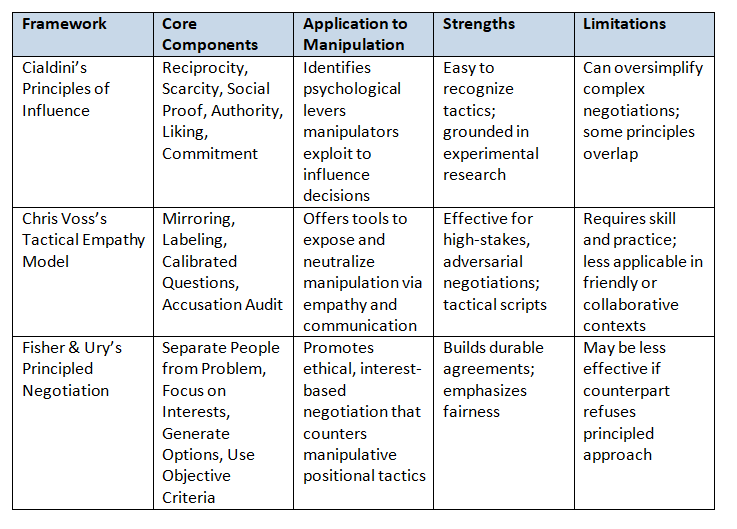
Each framework addresses manipulation from a unique angle: Cialdini explains the psychological hooks, Voss provides linguistic counters, and Fisher & Ury propose a strategic mindset shift. Experienced negotiators blend these approaches to create a robust defense.
Step-by-Step Process or Analysis
This six-step process guides negotiators through identifying, dissecting, and neutralizing manipulation tactics in real time.
Step 1: Monitor for Psychological Triggers
Watch for cues that manipulation is underway: unusually aggressive anchoring, appeals to scarcity, or pressure to conform. Use Kahneman’s anchoring and Cialdini’s scarcity as diagnostic heuristics.
Step 2: Label and Mirror to Defuse Emotional Charge
Employ Voss’s labeling (“It seems like you’re worried about losing ground on pricing”) and mirroring to show understanding and encourage dialogue. This tactic reduces defensiveness and reveals motive.
Step 3: Deploy Calibrated Questions to Shift Control
Ask open-ended, calibrated questions like “How am I supposed to accept that timeline?” These force the manipulator to reconsider their position without direct confrontation.
Step 4: Reframe Using Objective Criteria
Invoke Fisher & Ury’s principle of objective criteria by asking for standards and benchmarks. For example, “What industry data supports that pricing claim?” This neutralizes subjective manipulation.
Step 5: Call Out Manipulation Using an Accusation Audit
Preemptively acknowledge potential manipulative behavior: “It feels like you might be pushing a deadline to pressure me. Am I right?” This reduces its power by bringing it into the open.
Step 6: Establish Clear BATNA and Walk-Away Points
Maintain awareness of your Best Alternative to a Negotiated Agreement (BATNA). Confirm non-negotiable limits to avoid being coerced into disadvantageous deals.
Throughout these steps, maintain emotional regulation, stay attentive to power dynamics, and document key moments to prevent cognitive overload.
Real-World Case Studies
Case Study 1: Apple vs Samsung Patent Licensing (2012)
Context: Samsung’s legal and negotiation teams used aggressive anchoring and scarcity framing ("This offer is only valid for 48 hours") to extract higher licensing fees.
What Happened: Apple’s negotiators initially stumbled but applied calibrated questions and tactical empathy to expose inconsistencies and delay pressure tactics, forcing Samsung to revise their approach.
Lesson: Recognizing and labeling scarcity and anchoring tactics neutralizes artificial urgency and resets the negotiation clock.
Case Study 2: NFL Contract Negotiations with Star Quarterback (2018)
Context: The player’s agent deployed social proof by referencing contracts of other top quarterbacks to justify inflated demands, coupled with calibrated silence to create discomfort.
What Happened: The team’s negotiators countered by using objective criteria—salary cap data and performance analytics—and accusation audits (“It feels like you’re putting pressure by comparing other players”).
Lesson: Combining data-driven reframing with direct confrontation of manipulative silence breaks down social proof exploitation.
Case Study 3: Diplomatic Standoff over Trade Tariffs (2019)
Context: One nation used commitment/consistency tactics by emphasizing prior public commitments from the opposing side to constrain their flexibility.
What Happened: Negotiators used labeling and reframing to separate the people from the problem, allowing a shift to mutual interests rather than rigid positions.
Lesson: Principled negotiation can overcome manipulative appeals to consistency by refocusing discussions on shared goals.
Recognition and Counter-Response Guide
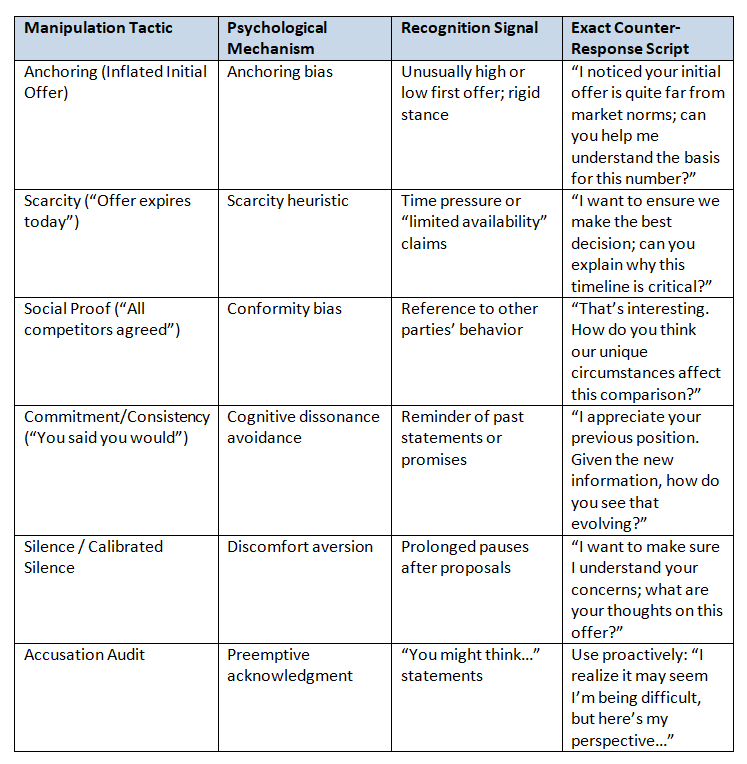
This guide equips negotiators with immediate, precise language to disarm manipulation while preserving rapport and control.
Advanced Insights
Beyond foundational tactics, elite negotiators employ nuanced techniques like meta-labeling, psychological jiu-jitsu, and integrative signaling.
Meta-labeling involves labeling the other party’s labels to expose layered manipulation. For example, if a negotiator says, “You seem hesitant,” respond with, “It seems like you’re trying to put me on the defensive by suggesting hesitation.”
Psychological jiu-jitsu leverages the opponent’s force against them by agreeing in principle but steering the conversation toward your interests.
Integrative signaling uses calibrated concessions to indicate flexibility and foster reciprocity, reducing the likelihood of manipulative exploitation.
Additionally, understanding cultural variations in manipulation perception is critical for international negotiations. For instance, what constitutes aggressive anchoring in Western contexts may be viewed as standard bargaining in East Asia, requiring adaptive responses.
Finally, advanced negotiators monitor nonverbal cues—microexpressions, gaze aversion, and voice pitch changes—to detect covert discomfort signaling manipulation attempts.
Scripts and Templates
Script 1: Neutralizing Scarcity Pressure
“You mentioned this offer is only valid until the end of the day. I want to make sure we fully explore the details before committing. Can we agree to revisit this after thorough evaluation?”
Script 2: Responding to Anchoring
“That’s an interesting starting point. Can you walk me through how you arrived at that figure? I want to understand your assumptions.”
Script 3: Addressing Social Proof
“I hear that others in the industry have accepted similar terms. Could you help me understand how their situations compare to ours?”
Script 4: Calibrated Question to Shift Control
“How am I supposed to accept that timeline given our operational constraints?”
Script 5: Accusation Audit to Defuse Tension
“You may think I’m being overly cautious or difficult here, and I understand that. My goal is to ensure we reach a sustainable agreement that works for both sides.”
Frequently Asked Questions
Q1: How can I differentiate between normal persuasion and manipulative tactics in negotiation?
Manipulation typically involves covert, psychologically exploitative tactics aiming to distort perception or pressure unfair concessions. Persuasion is transparent and respects autonomy. Watch for undue pressure, inconsistent logic, and emotional triggers.
Q2: Are all manipulation tactics unethical?
Not necessarily. Some tactics, like anchoring or framing, are natural negotiation tools. Ethical concerns arise when tactics deceive, coerce, or exploit vulnerabilities. Maintain ethical standards by focusing on transparency and respect.
Q3: What is the best mindset to resist manipulation?
Adopt a mindset of tactical empathy combined with curiosity. Seek to understand the other party’s motives while maintaining firm boundaries and a clear BATNA. This balance prevents emotional hijacking.
Q4: Can manipulation tactics differ by culture?
Yes. Cultural norms influence what is considered acceptable bargaining behavior. Research counterparts’ cultural backgrounds and adjust detection and response strategies accordingly.
Q5: How can technology affect detection of manipulation tactics?
Virtual negotiations limit nonverbal cues but provide detailed chat records and time stamps. Use these artifacts to analyze patterns and reinforce scripts. Video calls require heightened attention to tone and facial expressions.
Conclusion
Manipulation tactics in negotiation are sophisticated psychological tools that, when unrecognized, can severely disadvantage even seasoned professionals. By grounding your approach in behavioral economics, social psychology, and proven negotiation frameworks, you gain clarity and control over complex interactions. This guide has armed you with the science, frameworks, stepwise methods, real-world insights, and precise language needed to identify and neutralize manipulation decisively and ethically.
Mastery of these techniques elevates your negotiation from reactionary to strategic, enabling you to secure value, preserve relationships, and uphold integrity. Take the next step: integrate these frameworks into your preparation, practice the scripts diligently, and reflect on each negotiation with an eye for manipulation signals. Your ability to see through the smoke and mirrors will transform your outcomes and reputation as a formidable negotiator.
References
1. Kahneman, D., & Tversky, A. (1979). Prospect Theory: An Analysis of Decision under Risk. Econometrica.
2. Cialdini, R. B. (1984). Influence: The Psychology of Persuasion. Harper Business.
3. Voss, C., & Raz, T. (2016). Never Split the Difference: Negotiating As If Your Life Depended On It. HarperBusiness.
4. Fisher, R., Ury, W., & Patton, B. (2011). Getting to Yes: Negotiating Agreement Without Giving In. Penguin Books.
5. Shell, G. R. (2006). Bargaining for Advantage: Negotiation Strategies for Reasonable People. Penguin.
6. Malhotra, D., & Bazerman, M. H. (2008). Negotiation Genius: How to Overcome Obstacles and Achieve Brilliant Results at the Bargaining Table and Beyond. Bantam.