Multi-Country Negotiation Strategy: How to Manage Deals Across Multiple Jurisdictions
In 2019, a leading European automotive manufacturer was on the brink of securing a multi-billion-dollar supply chain agreement spanning China, Germany, India, and Mexico. Despite initial enthusiasm, the deal nearly collapsed due to overlooked cultural nuances and legal complexities across these jurisdictions. German engineers’ insistence on direct communication clashed with Chinese partners’ indirect, relationship-focused approach. Meanwhile, Indian bureaucratic delays and Mexican contract law intricacies created additional hurdles. The fallout? Months of lost time, eroded trust, and a rival automaker swooping in to finalize the deal.
Multi-country negotiations like this exemplify the strategic and cultural labyrinth that international business leaders face. Many professionals underestimate the layered complexity of coordinating multiple legal systems, cultural expectations, time zones, and political risk environments simultaneously. Misreading a negotiation style in one country or failing to align contract terms with diverse regulatory frameworks can unravel months of effort. The stakes include not only financial loss but damage to brand reputation and long-term partnerships.
This definitive guide will equip you with a deeply substantive, actionable blueprint to navigate multi-jurisdictional negotiations with confidence. You will master essential cultural frameworks such as Hofstede’s dimensions and Erin Meyer’s Culture Map, alongside legal essentials like CISG and ICC arbitration rules. Learn step-by-step strategies, exact scripts adapted for diverse cultures, and risk mitigation checklists. With real-world case studies from US-China trade talks to Japan’s nemawashi consensus-building, you will gain critical insights to orchestrate global deals seamlessly.
· Table of Contents
· The Strategic Foundation: Cultural and Legal Frameworks
· Key Frameworks and Models Compared
· Step-by-Step Multi-Country Negotiation Strategy
· Real-World Case Studies
· Country/Region-Specific Insights and Challenge Matrix
· Advanced Strategies for Complex Negotiations
· Scripts and Templates for International Contexts
· Frequently Asked Questions on Multi-Country Negotiations
· Conclusion and Call to Action
· References and Further Reading
The Strategic Foundation — Cultural and Legal Frameworks
Successfully managing negotiations that span multiple countries requires integrating a robust understanding of cultural dynamics with the nuances of international legal frameworks. These elements form the bedrock upon which negotiation strategies must be built.
Hofstede’s Cultural Dimensions theory remains foundational in decoding how national cultures influence negotiation behavior. Key dimensions such as Power Distance (hierarchy acceptance), Individualism vs. Collectivism (preference for self vs group), Uncertainty Avoidance (comfort with ambiguity), and Long-Term Orientation directly affect negotiation tactics and relationship management. For example, Korea’s high Power Distance and Confucian heritage demand strict respect for hierarchy during negotiations, whereas Germany’s low Power Distance encourages more egalitarian dialogue.
Erin Meyer’s Culture Map expands on these concepts through eight dimensions critical to negotiation: Communicating (low vs high context), Evaluating (direct vs indirect negative feedback), Leading (egalitarian vs hierarchical), Deciding (consensual vs top-down), Trusting (task-based vs relationship-based), Disagreeing (confrontational vs avoids confrontation), Scheduling (linear vs flexible time), and Persuading (principles-first vs applications-first). These help negotiators tailor communication styles precisely to each culture involved.
Richard Lewis’s model classifies cultures as Linear-Active (task-oriented, plan-driven), Multi-Active (emotional, people-centered), or Reactive (listening, harmony-seeking). This informs how to sequence negotiation phases, manage interruptions, or read non-verbal cues.
Edward Hall’s High vs Low Context and Monochronic vs Polychronic time concepts provide insights into indirect communication preferences and scheduling expectations. For instance, Latin American cultures tend to be high context and polychronic, valuing relationship-building and fluid timing, which contrasts sharply with the low-context, monochronic style of Scandinavia.
Negotiations crossing jurisdictions require alignment with multiple legal systems and international laws. The United Nations Convention on Contracts for the International Sale of Goods (CISG) provides a default uniform legal framework for sales contracts but is only applicable if parties choose it or are from signatory countries.
The International Chamber of Commerce’s Incoterms define standardized trade terms clarifying responsibilities for shipment, insurance, and customs duties across borders, reducing ambiguity. Choosing the right Incoterm tailored for each country’s regulations is critical.
Arbitration clauses governed by ICC rules or UNCITRAL arbitration provide enforceable dispute resolution mechanisms internationally, often preferable to local courts due to neutrality and enforceability. Due diligence should identify if any jurisdictions involved restrict arbitration or have political risk factors undermining enforceability.
Cross-border contract drafting must anticipate differences in civil vs common law traditions, language requirements, and local compliance such as data protection laws or export controls. Transfer pricing rules and foreign exchange risk management further complicate deal economics and must be incorporated into pricing strategies.
PESTLE analysis (Political, Economic, Social, Technological, Legal, Environmental) is essential to assess country risks that impact negotiations. For example, emerging markets in Africa or Southeast Asia may offer growth but present regulatory unpredictability or currency volatility. Country risk ratings by institutions such as Moody’s or Fitch provide additional risk benchmarking.
Incorporating these frameworks into negotiation planning ensures preparedness to adapt tactics, legal terms, and contingency plans aligned with each jurisdiction’s realities.
Key Frameworks and Models — Comparative Analysis
To operationalize cultural and legal insight, three primary frameworks stand out as complementary pillars for multi-country negotiation strategy: Hofstede’s Cultural Dimensions, Erin Meyer’s Culture Map, and Richard Lewis’s Cultural Types.
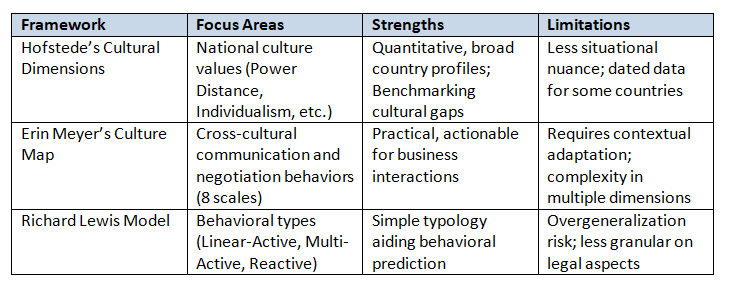
Each framework contributes unique insight: Hofstede provides macro-level cultural values; Meyer’s map offers micro-level interaction tactics; Lewis’s model simplifies negotiation style categorization. Combined, they form a powerful toolkit for diagnosing and adapting multi-jurisdictional negotiations.
Step-by-Step Strategy — Managing Multi-Country Negotiations
Step 1: Comprehensive Stakeholder and Jurisdiction Mapping
Identify all relevant parties, their cultural profiles, legal jurisdictions, and internal decision-makers. Use Hofstede’s indices and Meyer’s dimensions to create cultural “personas” for each stakeholder. Map legal differences including contract law, arbitration preferences, and regulatory requirements.
Step 2: Pre-Negotiation Alignment and Internal Coordination
Align your internal team’s understanding of cultural and legal complexities. Conduct cross-cultural training sessions. Assign country-specific experts and legal counsel. Develop a unified negotiation goal and BATNA/ZOPA analysis considering each jurisdiction’s constraints.
Step 3: Tailored Communication Planning
Design communication protocols adapted to each culture’s preferences and time zones. For example, schedule synchronous video calls with Japanese partners respecting nemawashi consensus-building; use detailed written documentation for German counterparts; allow flexibility and relational check-ins for Brazilian teams.
Step 4: Legal Framework Structuring and Contract Drafting
Integrate CISG applicability, Incoterms selections, and arbitration clauses upfront. Draft contracts with multilingual versions and clear jurisdictional compliance. Negotiate choice of law and dispute resolution mechanisms balancing neutrality and enforceability.
Step 5: Negotiation Execution with Cultural Adaptations
Apply Erin Meyer’s direct vs indirect communication insights during meetings. Use Richard Lewis’s model to pace negotiations: allow multitasking and emotional expression with Multi-Active cultures (e.g., Latin America), maintain linear agenda adherence with Linear-Active (e.g., Germany). Practice face-saving in high context cultures (e.g., Middle East).
Step 6: Post-Negotiation Follow-Up and Relationship Management
Deploy follow-up protocols respecting each culture’s preference: formal written confirmations for low-context cultures, informal relationship-building events for high-context. Monitor compliance and adjust for local political or economic risks. Use transfer pricing and FX hedging as appropriate.
Real-World Case Studies
The protracted US-China trade talks highlight the impact of cultural misunderstanding and legal complexity. US negotiators’ direct, confrontational style contrasted with Chinese emphasis on relational trust and indirect communication. Incorporating high-context strategies and allowing face-saving concessions facilitated breakthroughs. Legal frameworks such as WTO dispute mechanisms and tariffs complicated deal terms.
Post-Brexit negotiations entailed reconciling UK’s common law system with EU’s civil law and regulatory standards. The lengthy process required deep understanding of political risk, multi-jurisdictional regulatory alignment, and culturally diverse EU stakeholders. Structured phased agreements and arbitration clauses were essential to manage uncertainty.
Japanese mergers rely on nemawashi — informal consensus-building before formal negotiations. Western firms unfamiliar with this approach often misinterpret delays as indecision. Adapting by engaging multiple hierarchical levels and demonstrating patience proved key to success.
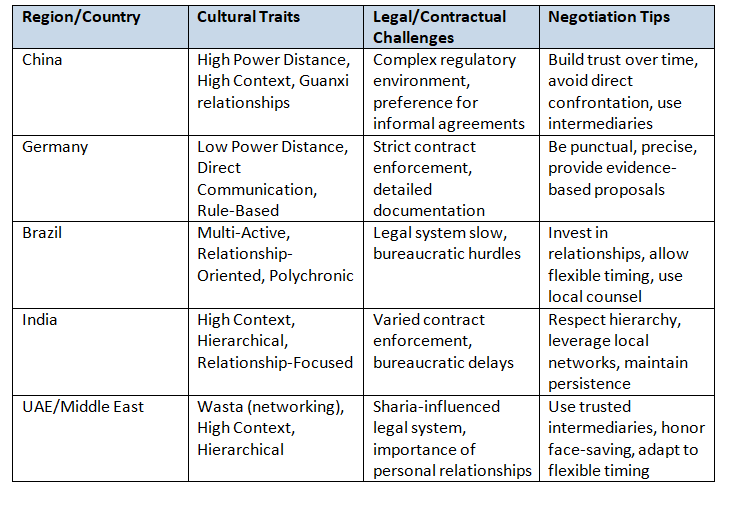
Country/Region-Specific Insights or Challenge Matrix
Advanced Strategies — Managing Complexity Like an Expert
Use professional interpreters with industry knowledge. Brief them on cultural context and technical terminology. Employ “pause and confirm” techniques to ensure shared understanding. In virtual settings, use simultaneous interpretation platforms.
Invest time in informal meetings, social rituals, and gift-giving where culturally appropriate. Avoid public criticism; use private channels for negative feedback. Recognize saving face as vital in East Asian and Middle Eastern cultures to maintain long-term collaboration.
Adapt to top-down decision-making in hierarchical cultures (e.g., Korea) by securing buy-in from senior leaders early. In consensual cultures (e.g., Japan), allocate time for behind-the-scenes consensus-building (nemawashi). Tailor your authority and communication style accordingly.
Conduct thorough due diligence on counterparties and local laws. Include clear choice of law and venue clauses. Use Escrow or Letter of Credit mechanisms to manage payment risk. Monitor country-specific political risk indices continuously.
Scripts and Templates — Word-for-Word Negotiation and Email Examples
“Thank you for taking the time to meet today. We value the opportunity to build a strong, long-term partnership. Before we discuss specifics, we would like to understand your priorities and any concerns to ensure our proposal aligns with your company’s goals.”
Subject: Clarification on Contract Clause 4.3
Dear Mr. Schmidt,
Thank you for your detailed proposal. To ensure mutual understanding, could you please provide further specifics regarding the liability limitations described in Clause 4.3? We appreciate your prompt response.
Best regards,
“I understand your concerns and appreciate your perspective. Perhaps we can explore alternative approaches that honor both our interests and respect the valued relationship between our organizations.”
“Dear Team,
To accommodate our colleagues in São Paulo and New York, we propose scheduling the next discussion on Wednesday at 10 AM EST / 11 AM BRT. Please confirm your availability or suggest alternatives.
Kind regards,
Subject: Confirmation of Terms and Next Steps
Dear Partners,
Following our productive discussions, please find attached the finalized agreement in English and Spanish. Kindly review and confirm acceptance by Friday, so we may proceed with execution.
Thank you for your collaboration.
Best regards,
Frequently Asked Questions
A1: Begin by mapping all applicable legal frameworks and identifying common grounds such as CISG applicability or ICC arbitration. Draft contracts with clear choice-of-law clauses and multilingual versions. Employ local legal experts and incorporate flexible dispute resolution mechanisms that offer neutrality and enforceability.
A2: Use cultural frameworks like Hofstede and Erin Meyer to understand preferences. Adapt communication styles—be more indirect with high-context cultures, more direct with low-context. Build relationships through informal engagements and respect hierarchical norms. Employ professional interpreters when necessary.
A3: Identify whether cultures are top-down or consensual decision-makers. For hierarchical cultures, get senior leadership buy-in early; for consensual cultures, allocate time for group consensus-building before formal meetings. Adjust your pace and expectations accordingly.
A4: Use scheduling tools to find overlapping working hours. Rotate meeting times fairly to share inconvenience. Combine synchronous video calls with asynchronous communication like emails or shared documents. Be mindful of cultural perceptions of punctuality and flexibility.
A5: Conduct thorough PESTLE analysis and monitor country risk ratings. Include contractual safeguards such as force majeure clauses. Use hedging instruments to manage currency risk. Engage local partners with deep market knowledge. Remain agile to adjust strategies as conditions evolve.
Conclusion
Navigating international negotiations is a demanding endeavor that requires mastery of intricate cultural dynamics, complex legal frameworks, and nuanced communication strategies. The ability to integrate these elements into a coherent, flexible approach determines whether global deals succeed or falter. By applying the frameworks, step-by-step tactics, and expert techniques detailed here, international business leaders can confidently orchestrate negotiations that respect cultural diversity, manage jurisdictional complexity, and build lasting partnerships.
In an era where globalization continually accelerates, developing a sophisticated multi-country negotiation strategy is not optional but essential. Start implementing the insights and scripts provided today to transform challenges into opportunities and secure your competitive advantage in the global marketplace.