Multi-Issue Negotiation Strategy: How to Create Value Across the Table

In 2018, IBM closed a landmark multi-issue deal with a global telecommunications provider, negotiating not just price but service levels, intellectual property rights, and long-term collaboration frameworks. The stakes were billions of dollars and a multi-year partnership that would define market leadership. This negotiation wasn’t just about haggling over a single number—it was a complex, multifaceted process that required a strategic approach to create value for both parties.
In today’s hyper-competitive, interconnected business environment, single-issue or price-only negotiations are increasingly obsolete. Companies face complex deals that involve multiple issues—financial, operational, legal, and relational—each with its own priorities and trade-offs. Mastering multi-issue negotiation strategy isn’t just an advantage; it is a necessity for sustainable value creation, competitive advantage, and long-term partnerships.
By the end of this comprehensive guide, senior negotiators and strategists will master the psychological foundations, frameworks, and advanced tactics of multi-issue negotiations. You will learn how to diagnose and leverage multiple interests, use proven models to map value, avoid common pitfalls, script powerful dialogues, and apply expert-level strategies to maximize joint gains across the table.
· Table of Contents
· The Strategic Foundation of Multi-Issue Negotiations
· Key Frameworks and Models for Value Creation
· Step-by-Step Multi-Issue Negotiation Process
· Real-World Case Studies: Multi-Issue Deal Successes
· Common Pitfalls and How to Avoid Them
· Advanced Tactics for Experienced Negotiators
· Scripts and Templates for Multi-Issue Negotiations
· Frequently Asked Questions on Multi-Issue Negotiations
· Conclusion: Synthesizing Insights and Next Steps
· References
The Strategic Foundation
Multi-issue negotiation strategies rest on a robust theoretical and psychological foundation that explains why integrating multiple issues leads to superior outcomes compared to single-issue bargaining.
At its core lies the concept of integrative bargaining, popularized by Fisher and Ury in their seminal book "Getting to Yes" (1981). They argued that negotiators should look beyond positional bargaining focused on fixed resources and instead seek mutual gains by addressing multiple interests. This approach contrasts sharply with distributive bargaining, which pits parties against each other for a fixed pie.
Daniel Kahneman and Amos Tversky’s research on prospect theory (1979) introduced loss aversion—the psychological tendency for people to prefer avoiding losses rather than acquiring equivalent gains. Understanding this bias helps negotiators frame offers and concessions to minimize perceived losses and maximize perceived value, especially important when multiple issues interact.
Robert Cialdini’s principles of influence (2006), such as reciprocity and commitment, provide psychological levers that negotiators can ethically use to build trust and encourage cooperative concessions across multiple negotiation dimensions.
Shell’s "Bargaining for Advantage" (2006) synthesizes these psychological insights into practical negotiation strategies, emphasizing the importance of preparation, relationship building, and adaptive tactics in complex negotiations.
Malhotra and Bazerman’s research in "Negotiation Genius" (2007) underscores the value of creativity and cognitive strategies to expand the bargaining zone by discovering hidden interests and constructing multiple equivalent simultaneous offers (MESOs).
Together, these foundational works establish why multi-issue negotiation strategies—grounded in psychology and principled negotiation—produce more durable, value-creating agreements than traditional single-issue haggling.
Key Frameworks and Models
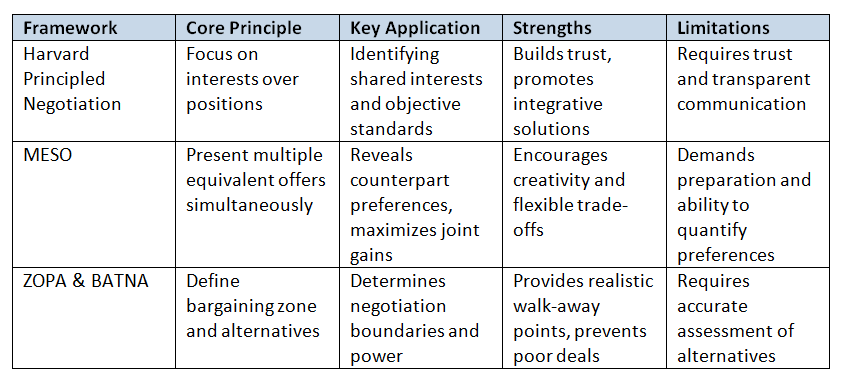
Several established frameworks serve as blueprints for planning and executing multi-issue negotiations. Below are three pivotal models.
1. Harvard Principled Negotiation Model
Focuses on interests, options, and objective criteria rather than positions. Encourages separating people from the problem and inventing options for mutual gain.
2. Multiple Equivalent Simultaneous Offers (MESO)
Proposed by Malhotra & Bazerman, MESOs involve presenting multiple offers of equal value simultaneously, revealing preferences and creating opportunities for trade-offs.
3. ZOPA and BATNA Analysis
ZOPA (Zone of Possible Agreement) defines the overlap between parties’ acceptable terms. BATNA (Best Alternative To a Negotiated Agreement) anchors negotiation power by establishing walk-away options.
Step-by-Step Process
Mastering multi-issue negotiation requires a structured yet flexible approach. Below is a detailed six-step process with actionable guidance.
Step 1: Preparation and Issue Identification
- Conduct thorough research to identify all relevant issues—price, delivery, quality, intellectual property, service levels, etc.
- Use stakeholder interviews and internal workshops to map priorities and constraints on both sides.
- Develop a BATNA for each issue and an overall BATNA to understand fallback positions.
Step 2: Interest Mapping and Prioritization
- Identify underlying interests (needs, fears, desires) behind each issue rather than stated positions.
- Rank issues by their relative importance and flexibility for both parties.
- Use tools like a Priority Matrix to visualize trade-offs.
Step 3: Value Creation Brainstorming
- Generate multiple options and combinations that could satisfy both parties’ interests.
- Employ integrative bargaining techniques: logrolling (trading off low-priority issues for high-priority gains), nonspecific compensation, and contingent contracts.
- Involve cross-functional teams to uncover creative solutions.
Step 4: Develop Multiple Equivalent Simultaneous Offers (MESOs)
- Construct at least 2-3 offers that differ in issue emphasis but are roughly equal in value to you.
- Use quantitative scoring models to ensure equivalence.
- Present offers simultaneously to elicit counterpart preferences without conceding too much.
Step 5: Negotiation and Concession Management
- Use anchoring strategically by starting with ambitious but reasonable offers.
- Track concessions carefully to maintain balance; reciprocate concessions on issues of lower priority.
- Employ active listening and calibrated questions to uncover hidden interests and barriers.
Step 6: Agreement Formalization and Follow-Up
- Ensure the agreement reflects all agreed-upon issues clearly, avoiding ambiguity.
- Use objective criteria and standards to define deliverables and measurement.
- Plan follow-up communication and conflict resolution mechanisms to sustain relationship.
This process may iterate multiple times, especially in complex multi-issue deals, but disciplined adherence ensures systematic value creation and durable outcomes.
Real-World Case Studies
Case 1: IBM and Global Telecom Multi-issue Contract (2018)
IBM negotiated a multi-year contract involving software licenses, service-level agreements, co-development rights, and pricing discounts with a major telecom provider. By applying MESOs and interest mapping, IBM structured offers that balanced immediate revenue with long-term collaboration value. The deal increased IBM’s market share and reduced service conflicts. Lesson: Multi-issue strategies enabled value beyond price, fostering innovation partnerships.
Case 2: Apple vs. Samsung Patent and Supply Negotiations (2012-2014)
Apple and Samsung engaged in simultaneous litigation and supply negotiations across patents, component pricing, and exclusivity terms. Apple used BATNA analysis to determine its fallback if Samsung refused favorable terms. Both sides employed integrative bargaining where possible, trading exclusivity for pricing concessions. Lesson: Even adversarial counterparts can create joint value by separating issues and understanding underlying interests.
Case 3: Amazon Vendor Negotiations for Product Bundling (2020)
Amazon’s procurement teams negotiated with suppliers on multiple issues: unit price, delivery schedules, marketing co-investment, and exclusivity windows. Using the Harvard Principled Negotiation framework, Amazon reframed the talks to focus on shared goals like volume growth and customer satisfaction. Amazon’s MESO offers helped uncover supplier preferences, leading to creative bundling agreements that improved margins. Lesson: Multi-issue negotiation enables complex commercial ecosystems to thrive.
Common Pitfalls and How to Avoid Them
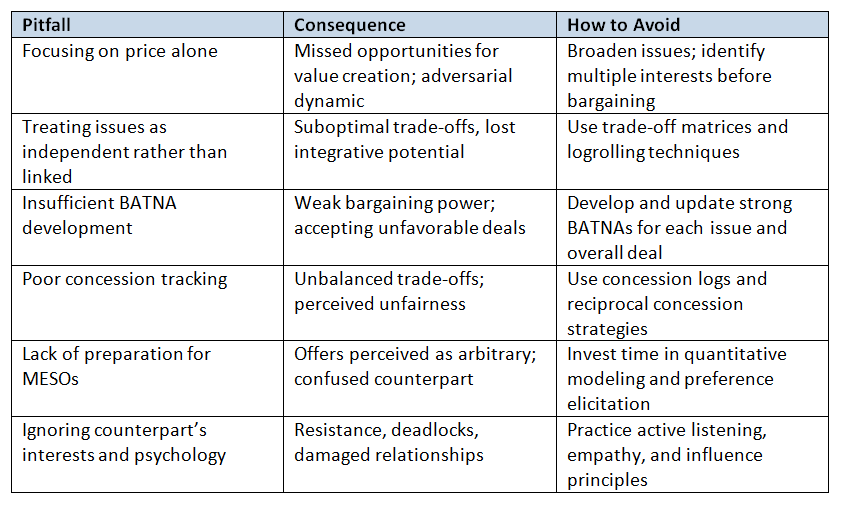
Many negotiators stumble when managing multiple issues. Below is a table summarizing common mistakes, their consequences, and practical remedies.
Advanced Tactics
Experienced negotiators can leverage sophisticated techniques to elevate multi-issue negotiations:
· Contingent Contracts: Draft agreements that condition outcomes on future events (e.g., performance metrics), reducing risk and aligning incentives.
· Issue Bundling and Unbundling: Strategically combine or separate issues mid-negotiation to create new value or simplify deadlocks.
· Using MESOs to Test Boundaries: Present MESOs designed to probe counterpart’s reservation points without signaling your own limits.
· Anchoring with Rationale: Anchor offers with objective data and rationale to enhance credibility and reduce pushback.
· Coalition Building: In multi-party negotiations, form alliances that increase collective influence on specific issues.
· Psychological Framing: Reframe losses as avoided risks and gains as opportunities, leveraging loss aversion to encourage concessions.
· Parallel Negotiations: Simultaneously negotiate related issues in multiple forums or with different stakeholders to maximize leverage.
Scripts and Templates
Below is a ready-to-use script for presenting MESOs in a multi-issue negotiation, adaptable to various contexts:
"Based on our discussions, we understand that pricing, delivery schedules, and service levels are key concerns. To find the best path forward, we've prepared three proposals for your consideration. Each offers a different balance among these issues but delivers equivalent overall value from our perspective.
Option A offers a lower price with longer delivery times but enhanced service support.
Option B provides a higher price with expedited delivery and standard service levels.
Option C balances moderate pricing with average delivery and premium service options.
Could you please share which package aligns best with your priorities? This will help us understand your preferences and tailor a final agreement."
Additionally, a concession tracking template:
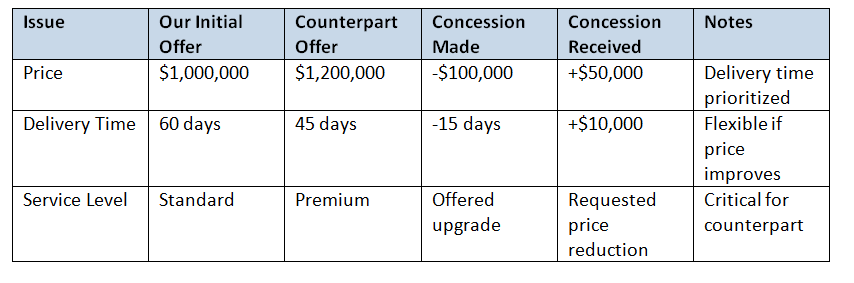
Negotiators should customize these scripts and templates to reflect industry-specific language and deal complexity.
Frequently Asked Questions
Q1: How does multi-issue negotiation differ from single-issue negotiation?
Multi-issue negotiation involves simultaneously negotiating several interrelated issues, enabling trade-offs and value creation. Single-issue typically focuses on one dimension, such as price, limiting creativity and often resulting in distributive outcomes.
Q2: What is the role of MESOs in multi-issue negotiation?
MESOs (Multiple Equivalent Simultaneous Offers) allow negotiators to present multiple packages equal in value to themselves but different in composition. This technique reveals counterpart preferences and helps find integrative solutions faster.
Q3: How can I assess the relative importance of different issues?
Use interest mapping, priority matrices, and direct questioning to rank and quantify issues from both your and the counterpart’s perspectives. Weightings can be assigned to each issue to aid in constructing balanced offers.
Q4: What if my counterpart refuses to discuss multiple issues at once?
Try to educate them on the benefits of integrative bargaining, use objective criteria to frame the discussion, and propose MESOs to demonstrate flexibility. If necessary, negotiate issues sequentially but seek to revisit bundling later.
Q5: How do BATNA and ZOPA influence multi-issue negotiation strategy?
A strong BATNA increases your leverage, allowing you to push for better terms. ZOPA defines the acceptable range across all issues where a deal is possible. Understanding both helps avoid agreements worse than your alternatives.
Conclusion
Multi-issue negotiation strategy is not merely a tactical skill but a strategic imperative in today’s complex business environment. By embracing integrative bargaining principles, leveraging psychological insights, and systematically applying frameworks like MESOs and BATNA analysis, negotiators unlock the potential to create unprecedented value across multiple dimensions.
This guide has laid out a comprehensive roadmap—from foundational theory and key models, through practical step-by-step processes, to advanced tactics and ready-made tools—that equips senior negotiators to confidently manage complexity and craft durable, mutually beneficial agreements.
The next time you face a multi-issue negotiation, approach it not as a zero-sum contest but as an opportunity to expand the pie. Begin preparing now—map interests, develop your BATNAs, and design MESOs—to transform challenging negotiations into strategic triumphs.
References
Fisher, R., Ury, W., & Patton, B. (1981). Getting to Yes: Negotiating Agreement Without Giving In. Penguin Books.
Kahneman, D., & Tversky, A. (1979). Prospect Theory: An Analysis of Decision under Risk. Econometrica, 47(2), 263-292.
Cialdini, R. B. (2006). Influence: The Psychology of Persuasion. Harper Business.
Shell, G. R. (2006). Bargaining for Advantage: Negotiation Strategies for Reasonable People. Penguin.
Malhotra, D., & Bazerman, M. H. (2007). Negotiation Genius: How to Overcome Obstacles and Achieve Brilliant Results at the Bargaining Table and Beyond. Bantam.
Lewicki, R., Saunders, D., & Barry, B. (2015). Negotiation. McGraw-Hill Education.