Multi-Stakeholder Negotiation in B2B: Strategies for Complex Enterprise Deals

In today’s complex B2B landscape, negotiations rarely involve just two parties. Instead, multiple stakeholders from different departments, levels, and even organizations come to the table, each with their own priorities, concerns, and influence. Imagine a global technology supplier negotiating a multi-million dollar contract with a multinational corporation where procurement, finance, legal, R&D, and end-user divisions all have distinct objectives. Navigating this maze is a critical skill for enterprise sales leaders and procurement professionals alike.
The stakes in multi-stakeholder negotiation have never been higher. With prolonged sales cycles, increased scrutiny on ROI, and the rise of cross-functional teams, ignoring the dynamics among multiple influencers can lead to lost deals, delayed contracts, or suboptimal agreements. Understanding how to manage these diverse interests strategically is essential to drive consensus and close deals efficiently.
This article will guide you through the nuances of multi-stakeholder negotiation in B2B. You will learn actionable frameworks like BATNA and ZOPA adapted for multi-party contexts, discover tactical approaches to stakeholder mapping and influence management, see scripts to handle conflicting priorities, and explore metrics to evaluate negotiation success. Whether you’re a seasoned sales executive, a procurement leader, or a negotiation consultant, these insights will elevate your enterprise negotiation outcomes.
· Table of Contents
· Understanding Multi-Stakeholder Negotiation in B2B
· Key Challenges of Multi-Stakeholder Negotiations
· Strategic Frameworks for Managing Multiple Parties
· Tactical Approaches and Communication Techniques
· Real-World B2B Examples and Negotiation Scripts
· Measuring Success: Metrics and KPIs in Multi-Stakeholder Deals
· Frequently Asked Questions
Understanding Multi-Stakeholder Negotiation in B2B
Multi-stakeholder negotiation refers to discussions involving more than two parties or groups, each representing different interests within a B2B transaction. Unlike traditional bilateral negotiations, these involve multiple decision-makers such as procurement officers, technical experts, finance executives, legal counsel, and end-users — all influencing the final agreement.
In enterprise sales, this complexity reflects the organizational reality: a vendor’s offer must satisfy diverse criteria including price, compliance, technical fit, scalability, and risk management. For example, a cloud services provider might need to address concerns from IT security teams, budget owners, and legal departments simultaneously.
The negotiation process in such settings is less a linear discussion and more a dynamic orchestration of multiple dialogues. Successful negotiators adopt a multi-dimensional view to understand how each stakeholder’s priorities intersect and diverge, anticipating points of conflict and alignment before formal meetings begin.
Differentiating Multi-Stakeholder from Multi-Party Negotiations
While all multi-stakeholder negotiations are multi-party, not all multi-party negotiations involve distinct stakeholders with differing objectives. For instance, a negotiation between two organizations but with multiple representatives on each side (e.g., sales and legal teams) is multi-party but may not require managing conflicting stakeholder interests internally.
Multi-stakeholder negotiation specifically requires managing internal complexity within one or both negotiating organizations. This adds layers of internal consensus-building and influence management to the external negotiation challenge.
Key Challenges of Multi-Stakeholder Negotiations
Multi-stakeholder negotiations bring unique challenges that can stall or derail B2B deals if unaddressed.
· Conflicting Objectives: Different stakeholders prioritize different outcomes — cost savings, innovation, compliance, or user experience — which can lead to competing demands.
· Communication Silos: Information asymmetry and lack of cross-functional communication within organizations can prevent a unified negotiation stance.
· Power Imbalances: Some stakeholders may wield disproportionate influence, skewing negotiations and creating resistance among less powerful parties.
· Prolonged Sales Cycles: More stakeholders mean more reviews, approvals, and potential objections, extending timelines and increasing deal fatigue.
· Hidden Agendas: Unofficial priorities or political dynamics within organizations can complicate transparency and trust.
For example, a manufacturing firm negotiating a supply contract may face pushback from procurement focused on cost, R&D insisting on technical specs, and compliance teams concerned about regulatory risk. Without reconciling these viewpoints, the negotiation risks collapse.
Strategic Frameworks for Managing Multiple Parties
Applying classic negotiation frameworks to multi-stakeholder environments requires adaptation and additional layers of analysis.
Begin by identifying all relevant stakeholders inside and outside your organization. Use tools such as a Power/Interest Grid to classify stakeholders by their level of influence and interest in the deal. This helps prioritize engagement efforts and tailor messaging.
· High Power, High Interest: Key decision-makers requiring direct involvement and customized value propositions.
· High Power, Low Interest: Gatekeepers to decision-making; engage selectively to secure support.
· Low Power, High Interest: Influencers who can champion your solution internally; keep informed and motivated.
· Low Power, Low Interest: Minimal engagement needed but monitor for changes.
BATNA and ZOPA in Multi-Stakeholder Contexts
BATNA (Best Alternative to a Negotiated Agreement) and ZOPA (Zone of Possible Agreement) are foundational negotiation concepts that become more complex with multiple stakeholders.
Each stakeholder may have different BATNAs depending on their functional priorities. For example, finance may have a BATNA focused on alternative funding options, while IT’s BATNA might be an alternative technology solution. Mapping these diverse BATNAs across stakeholders helps identify areas of flexibility and potential deal breakers.
The ZOPA expands to encapsulate the intersection of acceptable outcomes across all parties. Negotiators must find a solution that lies within the overlapping zones of acceptability, balancing trade-offs among competing demands.
Interest-Based Negotiation and the “Win-Win” Approach
Multi-stakeholder negotiations benefit from the principled negotiation approach popularized by Fisher and Ury in “Getting to Yes.” Focusing on interests rather than positions encourages collaborative problem-solving.
By understanding underlying interests — such as the end-user’s need for usability or legal’s risk mitigation priorities — negotiators can propose creative solutions that satisfy multiple stakeholders simultaneously. This reduces zero-sum conflict and builds lasting partnerships.
Tactical Approaches and Communication Techniques
Effective tactics are essential to managing complexity and driving multi-stakeholder negotiations toward closure.
Internal alignment sessions with your own stakeholders ensure a unified front. This includes clarifying goals, defining acceptable trade-offs, and preparing responses to anticipated objections.
Conduct one-on-one interviews with key external stakeholders before joint meetings. This builds rapport, uncovers hidden concerns, and helps customize proposals.
MCDA frameworks help quantify and compare competing stakeholder priorities by assigning weights and scores to different deal attributes (price, quality, delivery, support). This data-driven approach facilitates transparent trade-off discussions.
Opening with strong but reasonable anchors sets reference points that guide stakeholder expectations. Framing proposals in terms of value delivered to each stakeholder increases perceived relevance.
Recognize when stakeholders adopt competing conflict styles (competing, accommodating, avoiding, collaborating, compromising). Tailor your approach to move toward collaboration and compromise while avoiding destructive conflict.
Scenario: Procurement insists on a lower price, while R&D demands additional custom features.
Negotiator: “I understand both of your priorities are critical — cost efficiency for procurement and technical capabilities for R&D. Let’s explore how we can optimize the solution to meet your budget while phasing in key features over time, aligning with your development roadmap. Would that approach address your concerns?”
This script acknowledges both sides, proposes a creative trade-off, and invites collaborative problem-solving.
Real-World B2B Examples and Negotiation Scripts
A telecom vendor negotiated a $50 million infrastructure deal with a multinational client. The client’s stakeholders included procurement, network engineering, finance, and legal. The vendor’s negotiation team mapped stakeholders using the Power/Interest Grid and tailored messaging accordingly. They used BATNA analysis to understand alternative suppliers each stakeholder favored, identifying a narrow ZOPA.
By staging separate sessions with technical and financial teams before joint meetings, the vendor addressed hidden concerns and built trust. Anchoring the initial price at a premium justified by superior network uptime helped frame value. Ultimately, the deal closed with customized SLA terms satisfying technical and financial stakeholders.
An industrial supplier faced pushback from a client’s sustainability and compliance teams during contract renewal. The supplier used MCDA to quantify trade-offs between cost, delivery speed, and carbon footprint reduction. Presenting this data transparently enabled stakeholders to prioritize and reach consensus on a revised pricing model linked to sustainability milestones.
Opening:
“Thank you all for joining today. I appreciate the diverse perspectives represented. Our goal is to find a solution that aligns with your business objectives, balancing cost, quality, and compliance. I’d like to start by understanding the key priorities each of you has so we can address them directly.”
Conflict Resolution:
“I hear that there are differing views on [issue]. Let’s explore what underlying needs are driving these views. Perhaps we can identify options that satisfy those needs without compromising the overall deal.”
Closing:
“Based on our discussion, it seems we have agreement on [points] and some areas needing further refinement. How about we summarize these agreements and set next steps for resolving the outstanding items?”
Measuring Success: Metrics and KPIs in Multi-Stakeholder Deals
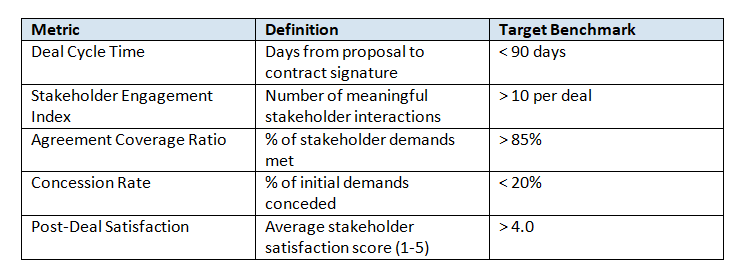
Tracking the effectiveness of multi-stakeholder negotiations requires tailored metrics beyond traditional sales KPIs.
· Deal Cycle Time: Measure the duration from initial contact to signed agreement, identifying bottlenecks caused by stakeholder reviews.
· Stakeholder Engagement Index: Quantify the number and quality of interactions with key stakeholders, using CRM data and meeting logs.
· Agreement Coverage Ratio: Percentage of stakeholder requirements fully addressed in the final contract, assessed via post-negotiation surveys or contract analysis.
· Concession Rate: Track concessions made per stakeholder group to analyze negotiation balance and power dynamics.
· Post-Deal Satisfaction Score: Collect feedback from all stakeholder groups on the negotiation process and outcome to identify areas for improvement.
Frequently Asked Questions
1. How do you identify all relevant stakeholders in a B2B negotiation?
Start by mapping the organizational structure of the client, including departments involved in decision-making, budget approval, technical evaluation, and legal compliance. Use interviews, LinkedIn research, and CRM data to uncover influencers and gatekeepers. Don’t overlook end-users who may impact adoption and success.
2. What’s the best way to handle conflicting priorities among stakeholders?
Use interest-based negotiation to uncover underlying needs rather than fixed positions. Facilitate joint discussions that focus on problem-solving and creative trade-offs. Employ data-driven tools like MCDA to make trade-offs transparent and objective.
3. How can I prepare internally before a multi-stakeholder negotiation?
Conduct alignment meetings with your team to clarify goals, roles, and fallback positions. Develop a stakeholder engagement plan and rehearse responses to anticipated objections. Ensure consistent messaging and a clear escalation path for unresolved issues.
4. When is it appropriate to use anchoring in negotiations with multiple stakeholders?
Anchoring is effective early in the negotiation to set expectations. However, it must be reasonable and backed by value justification to avoid alienating stakeholders. Tailor anchors to resonate with the most influential decision-makers.
5. How do I measure success beyond just closing the deal?
Evaluate the quality of the agreement by assessing stakeholder satisfaction, alignment with strategic goals, and the sustainability of the partnership. Use KPIs like deal cycle time, concession rates, and post-deal feedback to improve future negotiations.
Conclusion
Multi-stakeholder negotiation in B2B is a sophisticated discipline demanding strategic insight, tactical finesse, and interpersonal acumen. By thoroughly mapping stakeholders, aligning interests, and applying proven negotiation frameworks such as BATNA, ZOPA, and interest-based negotiation, professionals can navigate complex organizational dynamics and drive mutually beneficial agreements.
Investing time in preparation, employing data-driven decision tools, and fostering open communication across diverse parties will reduce negotiation friction, shorten sales cycles, and increase deal value. Mastery of these skills is essential for any B2B professional aiming to thrive in today’s multifaceted enterprise environment.
Ready to elevate your negotiation outcomes? Start by conducting a detailed stakeholder analysis on your next deal and experiment with the frameworks and scripts shared here. The difference between a stalled deal and a strategic partnership often hinges on how well you manage the multi-stakeholder landscape.
References
· Fisher, Roger, William Ury, and Bruce Patton. Getting to Yes: Negotiating Agreement Without Giving In. Penguin Books, 2011.
· Lewicki, Roy J., Bruce Barry, and David M. Saunders. Negotiation. McGraw-Hill Education, 2015.
· Shell, G. Richard. Bargaining for Advantage: Negotiation Strategies for Reasonable People. Penguin Books, 2006.
· Lax, David A., and James K. Sebenius. The Manager as Negotiator: Bargaining for Cooperation and Competitive Gain. Free Press, 1986.
· Malhotra, Deepak, and Max H. Bazerman. Negotiation Genius: How to Overcome Obstacles and Achieve Brilliant Results at the Bargaining Table and Beyond. Bantam Books, 2007.