Negotiating After a Conflict: How to Rebuild and Move Forward

In 2015, a high-profile hostage crisis in Sydney’s Lindt Café gripped the world’s attention. The standoff lasted 16 hours, with tensions escalating as the captor and negotiators battled psychological barriers on both sides. After the immediate threat ended, negotiators faced a new, equally daunting challenge: how to rebuild fractured trust and open communication channels with a traumatized hostage and a volatile captor. This scenario exemplifies the profound difficulty of negotiating after intense conflict—where emotional wounds run deep, suspicion dominates, and stakes remain sky-high. Too often, leaders, negotiators, and professionals falter here, either by rushing toward resolution without repairing trust or by allowing emotions to derail progress entirely.
Psychological research illuminates why so many post-conflict negotiations fail. Daniel Kahneman’s dual-system model shows that under pressure, negotiators default to System 1 thinking—fast, emotional, often irrational—rather than the deliberate, logical System 2 approach required for trust rebuilding. John Gottman’s work on emotional flooding reveals how high-arousal states shut down reason, while Chris Voss’s tactical empathy emphasizes the need for careful emotional attunement. Meanwhile, behavioral economics research around the ultimatum game exposes how perceived fairness and trust shape negotiation outcomes far more than pure rationality. Understanding these dynamics is critical to avoid common traps such as escalation, defensive posturing, or breakdowns in dialogue.
This comprehensive guide will equip you with the most effective psychology-based techniques and frameworks for negotiating after conflict. You will master step-by-step processes grounded in evidence-based models like Voss’s FBI negotiation method, William Ury’s “Going to the Balcony” perspective, and John Gottman’s trust repair strategies. You will learn how to detect and counteract toxic dynamics, leverage advanced emotional regulation tools, and deploy exact scripts for restoring dialogue. Real-world case studies from FBI hostage crises, corporate board disputes, and diplomatic impasses will illustrate these principles in action. By the end, you will possess a robust, actionable toolkit to rebuild relationships and move forward decisively after even the most challenging conflicts.
· Table of Contents
· The Psychology Behind This Challenge
· Key Frameworks and Models for Post-Conflict Negotiation
· Step-by-Step Process for Rebuilding and Moving Forward
· Real-World Case Studies in Post-Conflict Negotiation
· Recognizing and Countering Difficult Dynamics
· Advanced Techniques for Expert Negotiators
· Scripts and Templates for Common Scenarios
· Frequently Asked Questions
· Conclusion
· References
The Psychology Behind This Challenge
Negotiating after conflict engages some of the most primal and complex psychological mechanisms in humans. At the core lies the brain’s threat detection system, centered around the amygdala. When conflict triggers an amygdala hijack, as Daniel Goleman describes, the emotional brain overrides rational thought, flooding the body with stress hormones and impairing logical processing. This response manifests as the classic fight-flight-freeze reaction, which shuts down the higher cortical systems needed for perspective-taking and empathy, essential for negotiation.
Daniel Kahneman’s distinction between System 1 and System 2 thinking offers a powerful lens for understanding post-conflict negotiation challenges. System 1 operates automatically and quickly, driven by emotions and heuristics, while System 2 is slow, effortful, and logical. After conflict, negotiators and counterparts often remain locked in System 1, reacting defensively or aggressively rather than engaging deliberate problem-solving. The key is to create conditions that promote System 2 activation—through emotional safety, tactical empathy, and trust repair.
Chris Voss’s concept of tactical empathy, detailed in “Never Split the Difference,” emphasizes recognizing and articulating the counterpart’s emotions to de-escalate tension. This approach counters emotional flooding, a state John Gottman identifies as a barrier to repair in relationships. Gottman’s research on trust repair shows that acknowledging emotional harm, taking responsibility, and consistent trustworthy behavior over time are necessary to rebuild damaged relational capital.
Behavioral economics offers further insight through the ultimatum game, where offers perceived as unfair are often rejected even at personal cost. This reveals that fairness and trust are as critical as economic rationality. Negotiators must therefore address underlying perceptions and emotions, not just the surface terms.
Understanding these psychological and neuroscientific principles is foundational for crafting negotiation strategies that can rebuild fractured trust and enable constructive dialogue after conflict.
Key Frameworks and Models
Several established frameworks provide structured approaches to negotiating after conflict, each addressing psychological and strategic dimensions. Below is a comparison of three influential models:
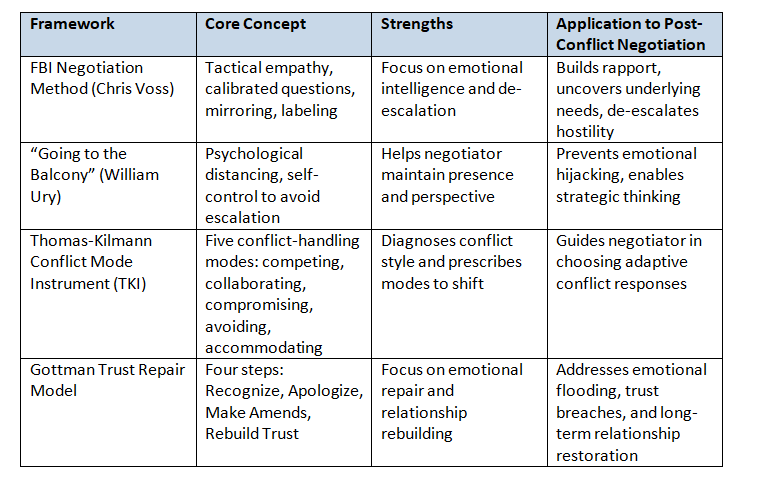
Each framework contributes unique tools: Voss’s method excels at tactical rapport-building, Ury’s approach safeguards cognitive control, TKI provides behavioral flexibility, and Gottman focuses on repairing emotional ruptures. Successful negotiators integrate these models to tailor their strategies to the relational and contextual demands of the post-conflict scenario.
Step-by-Step Process
Rebuilding and moving forward after conflict requires a deliberate, staged process. Below is a detailed six-step framework incorporating psychological techniques:
Step 1: Create Emotional Safety and Psychological Distance
Begin by recognizing the heightened emotional state on both sides. Employ Ury’s “Going to the Balcony” technique to maintain your own composure and model calm presence. Use slow breathing and mindful grounding to counter your own amygdala hijack. Communicate explicitly that the goal is to understand and rebuild, not to blame or escalate.
Psychological Technique: Emotional labeling (Voss) – acknowledge emotions without judgment (“I can see this situation has been very frustrating for you”).
Step 2: Engage Tactical Empathy to Understand Underlying Needs
Ask open-ended, calibrated questions to uncover the fears, needs, and interests beneath positional demands. Mirror language and tone to build rapport. Use labeling to validate emotions (“It sounds like trust was broken, and that’s painful”).
Psychological Technique: Mirroring and labeling (Voss)
Step 3: Acknowledge Harm and Take Responsibility
Follow Gottman’s trust repair framework by explicitly recognizing the emotional impact of the conflict. Offer sincere apologies where appropriate. Avoid defensiveness or minimization.
Psychological Technique: Apology scripting and “I” statements (“I recognize that my actions contributed to this breakdown, and I’m committed to making things right”).
Step 4: Collaborate on Rebuilding Trust and Establish New Norms
Work together to define behaviors and commitments that will rebuild trust. Use the Thomas-Kilmann model to assess preferred conflict styles and agree on collaborative modes moving forward.
Psychological Technique: Joint problem-solving and commitment framing
Step 5: Manage Emotional Flooding and Regulate Stress
Be alert for signs of emotional flooding—raised voices, rapid speech, avoidance, or shutdown—and pause the conversation if needed. Employ Amy Cuddy’s power posing and presence techniques to maintain calm authority.
Psychological Technique: Time-outs and presence exercises
Step 6: Follow-Up Consistently and Reinforce Trust
Trust repair is an ongoing process. Schedule follow-ups to assess progress, reaffirm commitments, and address emerging issues. Demonstrate reliability through consistent actions.
Psychological Technique: Consistency principle (Cialdini) and transparent communication
Real-World Case Studies
FBI Hostage Negotiation: The 1993 Waco Siege
The Waco siege involved a prolonged standoff between federal agents and the Branch Davidians. Early negotiation breakdowns were attributed to lack of tactical empathy and premature aggressive tactics. Later phases saw negotiators employ calibrated questions and labeling to better understand the group’s fears and motivations, helping to de-escalate tensions temporarily. The ultimate tragedy underscores the importance of emotional regulation and trust-building early in conflict resolution.
Corporate Boardroom Conflict: The HP-Compaq Merger Dispute (2001)
The HP-Compaq merger was fraught with internal board conflict, with factions deeply distrustful post-conflict. Applying Ury’s “Going to the Balcony” to step back from emotional reactivity, and the Thomas-Kilmann model to shift from competing to collaborating, the leadership was able to realign strategies and rebuild trust. Key was acknowledging prior harms and creating transparent communication channels, illustrating Gottman’s trust repair in a corporate context.
Diplomatic Crisis: The Camp David Accords (1978)
After decades of hostility, the U.S.-brokered Camp David Accords between Egypt and Israel hinged on negotiators’ ability to manage emotional flooding and build trust through tactical empathy. Jimmy Carter used calibrated questions and labeling to surface unspoken fears, while both sides engaged in repeated trust repair efforts over months. This case highlights the necessity of patience, presence, and structured frameworks over time.
Recognizing and Countering Difficult Dynamics
Post-conflict negotiations often face toxic dynamics that can derail progress. Understanding these psychological mechanisms and deploying exact counter-responses is critical.
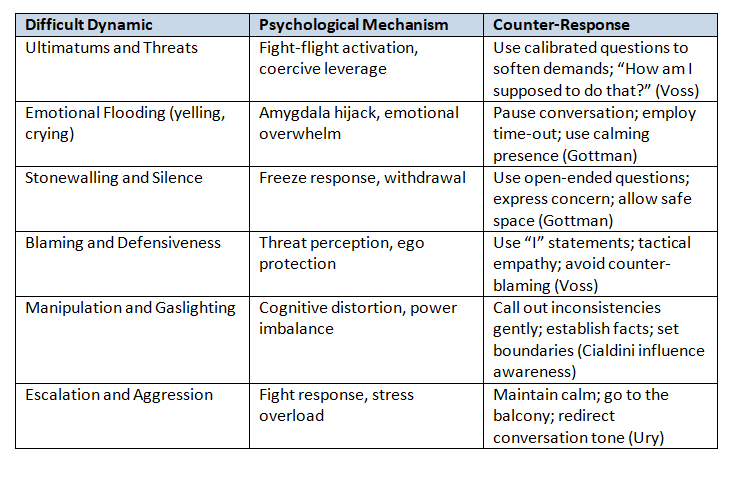
This matrix enables negotiators to proactively identify and respond to common post-conflict sabotage tactics with psychological precision.
Advanced Techniques
For expert negotiators, several advanced methods deepen the ability to rebuild trust and move forward:
· Emotional Titration: Gradually increasing emotional intensity in controlled increments to prevent flooding
· Strategic Vulnerability: Sharing controlled personal disclosures to invite reciprocity and soften defenses
· Nonverbal Synchrony: Using Paul Ekman’s microexpression analysis to detect concealed emotions and adjust approach
· Meta-Communication: Explicitly discussing the negotiation process and emotional states to increase transparency
· Reframing Ultimatums as Invitations: Transforming demands into collaborative problem-solving prompts
These techniques require high emotional intelligence and practice but can turn seemingly intractable conflicts into opportunities for deep, durable resolution.
Scripts and Templates
Below are exact scripts for common challenging scenarios in post-conflict negotiation:
“You’ve given me a clear deadline, and I want to respect that. At the same time, I need to understand the reasons behind it better. Can you help me see what’s driving this urgency?”
“I understand that what happened has caused pain and frustration. I’m truly sorry for my part in that and want to work with you to rebuild our trust.”
“I see this is very upsetting. Let’s take a moment to pause and come back when we’re both feeling a bit calmer so we can work through this together.”
“I hear your concerns, and I want to focus on solutions rather than assigning fault. What can we do now to move forward?”
“Let’s explore options together that meet both our needs. What would a successful outcome look like for you?”
Frequently Asked Questions
How do I manage my own emotions when negotiating after conflict?
Effective emotional regulation begins with awareness. Use techniques such as mindful breathing, “going to the balcony” (Ury), and power posing (Amy Cuddy) to maintain presence. Recognize triggers and pause if needed before responding to avoid amygdala hijack.
What if the other party refuses to engage in rebuilding trust?
Use tactical empathy to validate their feelings and show understanding without pressuring. Sometimes, trust repair requires time and repeated positive interactions. Maintain consistency and openness to keep the door open.
How can I tell if trust has been effectively repaired?
Signs include increased openness, willingness to share information, reduced defensiveness, and collaborative problem-solving. John Gottman’s research suggests trust is rebuilt through repeated cycles of repair and consistency.
Are apologies necessary after conflict?
Sincere apologies are crucial for acknowledging harm and starting the repair process. Use “I” statements focused on your role and commitment to change rather than defensive justifications.
What if emotions escalate during negotiation?
Recognize emotional flooding early and suggest a pause. Use calming language, avoid confrontation, and revisit the conversation when both parties are more regulated.
Conclusion
Negotiating after a conflict is one of the most psychologically complex and strategically demanding challenges any professional can face. Success hinges not just on the content of agreements but on the emotional landscape upon which those agreements are built. By understanding the neuroscience of threat responses, leveraging proven frameworks like Voss’s tactical empathy and Gottman’s trust repair, and following a structured step-by-step process, negotiators can transform fractured relationships into renewed partnerships. The ability to recognize toxic dynamics and deploy exact countermeasures further ensures that progress is not derailed by predictable pitfalls.
As you move forward, remember that rebuilding trust takes patience, presence, and consistent action. Use the scripts, techniques, and advanced methods outlined here to navigate the turbulent waters of post-conflict negotiation with confidence and skill. The stakes are high, but so too is the opportunity—to not only resolve conflict but to create stronger, more resilient relationships. Begin today by applying these insights in your most challenging negotiations and watch trust and collaboration flourish anew.
References
1. Kahneman, D. (2011). Thinking, Fast and Slow. Farrar, Straus and Giroux.
2. Voss, C., & Raz, T. (2016). Never Split the Difference: Negotiating As If Your Life Depended On It. Harper Business.
3. Ury, W. (1991). Getting Past No: Negotiating with Difficult People. Bantam Books.
4. Gottman, J. M., & Silver, N. (1999). The Seven Principles for Making Marriage Work. Crown Publishers.
5. Cialdini, R. B. (2006). Influence: The Psychology of Persuasion. Harper Business.
6. Ekman, P. (2003). Emotions Revealed: Recognizing Faces and Feelings to Improve Communication and Emotional Life. Times Books.