Negotiating Contracts Internationally: Legal, Cultural, and Strategic Considerations

International contract negotiations have repeatedly demonstrated how cultural misunderstandings and legal missteps can make or break billion-dollar deals. Consider the landmark US-China trade negotiations during the early 2010s, where subtle misinterpretations of intent and negotiation styles led to protracted talks and market uncertainty. Conversely, the successful resolution of the EU-UK Brexit withdrawal agreement showcased how deep cultural intelligence and legal precision could align to bridge seemingly irreconcilable differences. These real-world episodes underscore the vital importance of mastering the multifaceted nature of international contract negotiations.
The stakes in international negotiations are uniquely complex. Unlike domestic deals, cross-border contracts require navigating layers of cultural dimensions — from hierarchical deference to directness of communication — alongside divergent legal systems, language barriers, differing concepts of time and trust, and geopolitical risk factors. Professionals often underestimate these challenges, relying on domestic negotiation instincts that fail to account for the nuanced differences of international counterparts. This oversight can lead to damaged relationships, costly disputes, and failed agreements.
In this definitive guide, you will acquire an expert-level understanding of the cultural frameworks essential for decoding negotiation behavior, such as Hofstede’s dimensions and Erin Meyer’s Culture Map. You will learn step-by-step strategies tailored to international contexts, exact word-for-word scripts adapted for various cultural settings, and practical tools to manage legal risks and political uncertainty. By mastering these components, you will be equipped to negotiate contracts across borders with confidence, precision, and strategic foresight.
· Table of Contents
· The Foundations of International Negotiation
· Key Frameworks and Cultural Models
· Step-by-Step Strategy for International Negotiation
· Real-World Case Studies
· Country-Specific Negotiation Insights and Tactics
· Advanced Strategies for Complex International Negotiations
· Scripts and Templates for Cross-Cultural Negotiations
· Frequently Asked Questions
· Conclusion
· References
The Foundations of International Negotiation
International negotiations differ fundamentally from domestic ones due to cultural, psychological, and structural factors that profoundly influence behaviors, expectations, and outcomes. Understanding these underpinnings is critical for global business professionals.
From a cultural perspective, Geert Hofstede’s seminal research revealed systematic differences in national cultures along dimensions such as Power Distance, Individualism vs. Collectivism, Uncertainty Avoidance, Long-Term Orientation, Masculinity vs. Femininity, and Indulgence. For example, high Power Distance countries like South Korea or Saudi Arabia expect hierarchical respect and top-down decision-making, whereas low Power Distance countries such as Denmark or the Netherlands favor egalitarian dialogue.
Richard Lewis’s model classifies cultures into Linear-Active (e.g., Germany, Switzerland), Multi-Active (e.g., Brazil, Italy), and Reactive (e.g., Japan, China) types, highlighting differences in communication style and time management. Linear-Active cultures prefer structured agendas and punctuality, Multi-Active cultures prioritize relationships and emotional expression, while Reactive cultures listen carefully and avoid confrontation.
Edward Hall’s concepts of High-Context vs Low-Context communication further clarify these differences. High-Context cultures (Japan, Arab countries) rely heavily on implicit cues and shared understanding, whereas Low-Context cultures (United States, Germany) emphasize explicit verbal communication. Similarly, monochronic cultures (North America, Northern Europe) value linear scheduling, while polychronic cultures (Latin America, Middle East) embrace flexible, relational time.
Erin Meyer’s Culture Map synthesizes these insights across eight dimensions: Communicating, Evaluating, Persuading, Leading, Deciding, Trusting, Disagreeing, and Scheduling, providing a practical tool for diagnosing cultural challenges in negotiation.
Psychologically, negotiators must recognize differing attitudes toward conflict, face-saving, and risk tolerance. Structural factors include legal frameworks (common law, civil law, Islamic law), contract enforcement regimes, and political risk environments. Ignoring these foundational elements results in costly misunderstandings and failed deals.
Key Frameworks and Cultural Models
To navigate international negotiations successfully, it is essential to apply established frameworks that decode cultural behavior. Below are three critical models with a comparative overview.
| USA: 40 | Linear-Active | More egalitarian
| Germany: 35 | Linear-Active | Low tolerance for status differences
| Japan: 46 (moderate collectivism) | Reactive | Indirect communication
| Brazil: 38 (collectivist) | Multi-Active | Relationship-driven
| Sweden: 29 (low) | Linear-Active | Flexibility in process
| India: 40 (moderate) | Multi-Active | Moderate risk tolerance
| High (Japan, Saudi Arabia) | Reactive | Indirect, implicit
| Moderate (France, Brazil) | Multi-Active | Blend of styles
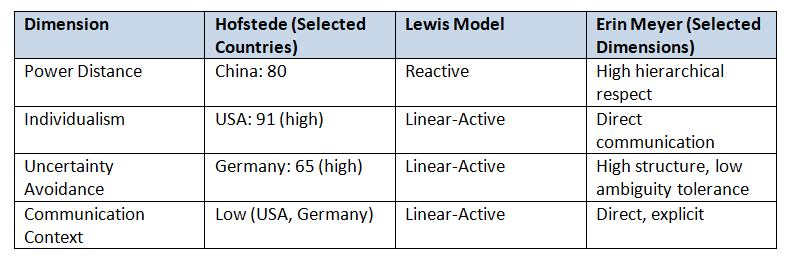
These frameworks enable negotiators to anticipate counterpart behavior and tailor their communication and strategy accordingly.
Step-by-Step Strategy for International Negotiation
Successful international contract negotiations unfold through a systematic process adapted to the complexities of cross-border interactions.
Step 1: Comprehensive Cultural and Legal Preparation
Conduct in-depth research on the counterpart’s cultural profile using Hofstede, Lewis, and Meyer’s frameworks. Analyze the applicable legal system — civil, common, or religious law — including contract enforceability and arbitration options under CISG or ICC rules. Prepare a political risk assessment, including sanctions or geopolitical tensions.
Step 2: Establishing Contact and Building Trust
Initiate contact with sensitivity to cultural protocols. In Middle Eastern or East Asian contexts, prioritize relationship-building (guanxi/wasta) before discussing terms. Use intermediaries or local agents if necessary. Employ high-context communication skills where appropriate.
Step 3: Setting the Agenda and Opening the Negotiation
Agree upon a mutually acceptable agenda respecting time orientation differences — monochronic cultures expect punctuality and clear schedules; polychronic cultures prefer flexibility. Use clear and precise language with low-context cultures, while reading between the lines with high-context counterparts.
Step 4: Exploration and Information Exchange
Encourage open dialogue but be mindful of face-saving norms. For example, Japanese negotiators avoid direct rejection; instead, look for subtle signals. Use active listening and confirm understanding through paraphrasing.
Step 5: Bargaining and Problem-Solving
Apply Fisher & Ury’s principled negotiation adapted for cultural context — focus on interests, not positions, while respecting hierarchical dynamics. In collectivist cultures, group consensus (nemawashi in Japan) is vital before closing deals. Manage BATNA and ZOPA with awareness of differing risk preferences.
Step 6: Closing and Formalizing the Contract
Ensure clarity on contract terms through precise language. Confirm acceptance in a culturally appropriate manner — a firm handshake or written confirmation. Plan for dispute resolution clauses specifying governing law and arbitration forums.
Step 7: Follow-Up and Relationship Maintenance
Post-agreement relationship management is critical. In relationship-oriented cultures, regular check-ins and social engagements build trust and smooth execution.
Real-World Case Studies
US-China Trade Negotiations (2018-2020)
Context: Trade tensions escalated with tariffs, and negotiations involved complex issues of IP protection and market access.
Cultural Dynamics: US negotiators’ linear-active, low-context style clashed with China’s multi-layered, high-context and relationship-driven approach. Miscommunication and insistence on direct confrontation delayed progress.
Outcome and Lesson: Incorporating cultural intelligence — including employing Chinese intermediaries skilled in guanxi and adopting a more indirect persuasion style — helped bridge gaps. The case illustrates the necessity of cultural adaptability alongside legal clarity.
EU-UK Brexit Withdrawal Agreement (2016-2020)
Context: Negotiations centered on trade, citizens’ rights, and border management post-Brexit.
Cultural Dynamics: UK’s individualist, low power distance culture faced the EU’s collective, rule-based approach. Time pressure and political stakes heightened uncertainty avoidance.
Outcome and Lesson: Structured use of principled negotiation, clear legal frameworks, and understanding of differing decision-making styles helped finalize the deal. Demonstrates the role of legal precision combined with cultural strategy.
Japan-US Automotive Joint Venture (2000s)
Context: Formation of a JV required alignment on operational control and cultural integration.
Cultural Dynamics: Japanese nemawashi consensus-building clashed with US direct decision-making. Initial frustration gave way to adaptation through dedicated cross-cultural training.
Outcome and Lesson: Success was achieved by respecting hierarchical decision processes and embedding relationship-building rituals. Highlights the importance of patience and cultural respect.
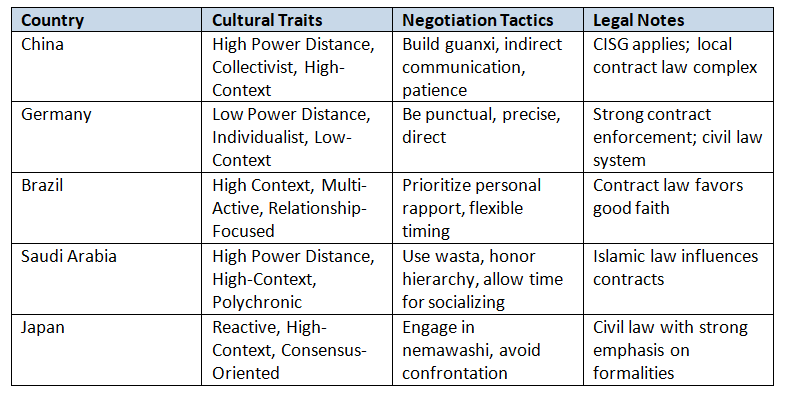
Country-Specific Negotiation Insights and Tactics
Advanced Strategies for Complex International Negotiations
Managing interpreters effectively requires pre-briefing on terminology and cultural nuances to prevent miscommunication. Building guanxi or wasta involves long-term investment in trust through social reciprocity — essential in China and the Middle East.
Navigating hierarchy means understanding who holds real decision authority; in Korea, junior team members may never speak openly, requiring engagement with senior leaders. Face-saving is paramount in many Asian cultures; avoid direct criticism and use indirect language to preserve dignity.
Time management varies: polychronic cultures may view deadlines flexibly, so build slack into schedules. Use asynchronous communication thoughtfully when dealing with significant time zone differences.
Scripts and Templates for Cross-Cultural Negotiations
Dear [Name]-san,
I hope this message finds you well. I would like to express our sincere interest in exploring a potential partnership between our companies. We highly value building a long-term relationship based on mutual respect and trust.
Would you be available for an introductory call next week at your convenience? We look forward to your guidance on how best to proceed.
Warm regards,
Good morning, everyone.
Thank you for joining us today. We have prepared a detailed agenda to ensure an efficient and productive discussion. Our objective is to reach a clear and mutually beneficial agreement based on transparent information exchange.
Please feel free to ask questions or raise concerns at any point.
Dear [Name],
I hope you are doing well. We understand that schedules can be dynamic, and we appreciate your continued interest in this negotiation.
Please let us know if there is anything we can do to assist in moving forward. We look forward to our next conversation.
Best regards,
Dear Sheikh [Name],
Thank you for the fruitful discussions and your gracious hospitality. We are honored to move forward with the agreement as outlined.
Please advise on the next steps at your convenience. We look forward to a successful and long-lasting partnership.
Kind regards,
Dear [Name],
It was a pleasure meeting with you and your team. We appreciate the opportunity to deepen our cooperation.
As discussed, we will prepare the draft contract for your review. Please do not hesitate to share any feedback or additional requirements.
Best wishes,
Frequently Asked Questions
Q1: How do I choose the appropriate governing law for an international contract?
A1: Select a neutral jurisdiction with reliable enforcement mechanisms and legal familiarity to both parties. Consider CISG applicability and arbitral institutions like ICC or UNCITRAL to reduce uncertainty.
Q2: What is the best way to manage language barriers during negotiations?
A2: Use professional interpreters familiar with legal and business terminology. Pre-brief interpreters and confirm understanding frequently. When possible, provide translated documents.
Q3: How can I handle cultural differences related to decision-making speed?
A3: Understand the counterpart’s time orientation. Patience is vital in consensus cultures (e.g., Japan), while others may expect swift decisions (e.g., USA). Adjust expectations and communicate timelines clearly.
Q4: What are key legal risks in cross-border contracts?
A4: Risks include differing contract enforceability, currency fluctuations, political instability, and divergent dispute resolution preferences. Mitigate via precise clauses and risk assessments.
Q5: How can I build trust quickly in a virtual international negotiation?
A5: Establish rapport through small talk respecting cultural norms, use video to enhance connection, confirm mutual goals, and demonstrate cultural sensitivity through language and behavior.
Conclusion
Negotiating contracts internationally demands an integrated mastery of legal frameworks, deep cultural intelligence, and strategic adaptability. By understanding the foundational cultural dimensions, applying proven negotiation models, and executing a structured yet flexible process, global professionals can transform potential cultural and legal barriers into competitive advantages. The real-world case studies illustrate that success hinges not only on legal acumen but also on empathy, patience, and respect for diverse worldviews.
We encourage you to adopt the step-by-step strategies, utilize the scripts and tables provided, and continuously refine your cultural competence to excel in international contract negotiations. Begin today by assessing your negotiation approach through the lens of these frameworks and prepare to close deals that endure.
References
· Hofstede, G. (2001). Culture’s Consequences: Comparing Values, Behaviors, Institutions and Organizations Across Nations. Sage Publications.
· Lewis, R. D. (2006). When Cultures Collide: Leading Across Cultures. Nicholas Brealey Publishing.
· Meyer, E. (2014). The Culture Map: Breaking Through the Invisible Boundaries of Global Business. PublicAffairs.
· Fisher, R., Ury, W., & Patton, B. (2011). Getting to Yes: Negotiating Agreement Without Giving In. Penguin Books.
· United Nations Commission on International Trade Law (UNCITRAL). (1980). United Nations Convention on Contracts for the International Sale of Goods (CISG).
· International Chamber of Commerce (ICC). (2021). ICC Arbitration Rules.