Negotiating Framework Agreements in B2B

In today’s rapidly evolving B2B landscape, companies increasingly rely on framework agreements to streamline procurement, reduce costs, and foster strategic partnerships. Imagine a multinational manufacturing firm negotiating a framework agreement with a global supplier to secure consistent pricing, service levels, and delivery terms across multiple regions. This scenario illustrates the critical importance of mastering the art and science of negotiating framework agreements.
Framework agreements serve as the contractual backbone for ongoing business relationships, often covering multiple transactions over extended periods. As supply chains become more complex and market volatility rises, companies must negotiate these agreements with precision to mitigate risks, capture value, and maintain agility. Failure to do so can lead to costly disputes, supply disruptions, or missed opportunities.
This comprehensive guide will equip procurement professionals, sales strategists, and contract managers with advanced frameworks, negotiation tactics, and real-world examples to excel in negotiating B2B framework agreements. You will learn how to prepare strategically, structure agreements effectively, leverage psychological negotiation principles, and measure success with relevant metrics.
· Table of Contents
· Understanding Framework Agreements: Purpose and Strategic Value
· Preparation and Research: Setting the Stage for Successful Negotiations
· Core Negotiation Frameworks Applied to B2B Agreements
· Key Clauses and Terms in Framework Agreements
· Effective Negotiation Tactics and Scripts
· Measuring Success: KPIs and Post-Negotiation Management
· Frequently Asked Questions
Understanding Framework Agreements: Purpose and Strategic Value
Framework agreements (FAs) are umbrella contracts that define terms, conditions, and pricing for future transactions between parties over a defined period. Unlike spot contracts binding one-off purchases, FAs provide flexibility and consistency, enabling quicker procurement cycles and stronger supplier relationships.
In sectors such as manufacturing, IT services, and logistics, framework agreements facilitate multi-year engagements spanning various regions, product lines, or service categories. For example, a global automotive OEM may establish a framework agreement with an electronics supplier to cover components for multiple vehicle models manufactured worldwide.
The strategic value lies in:
· Reducing negotiation frequency and transaction costs
· Locking in favorable pricing and service levels
· Aligning supplier incentives with long-term business goals
· Enhancing supply chain reliability and compliance
Unlike master service agreements (MSAs) that govern service relationships but usually require separate work orders, FAs often include pre-negotiated pricing schedules and terms that apply directly to purchase orders (POs). Understanding these distinctions helps negotiators tailor their approach and expectations accordingly.
Preparation and Research: Setting the Stage for Successful Negotiations
Thorough preparation is the cornerstone of effective negotiation. In framework agreements where stakes are high and terms impact multiple transactions, robust research and planning are even more critical.
Begin by identifying internal stakeholders—procurement, legal, finance, operations—and mapping their priorities. Common objectives might include cost reduction, improved quality, or risk mitigation.
Create a clear hierarchy of negotiables and deal breakers. For instance, a company might prioritize fixed pricing caps over payment terms flexibility.
Gather data on supplier financial health, market positioning, and alternatives. Use tools like SWOT analysis to evaluate supplier strengths and vulnerabilities.
Benchmark pricing and service levels against industry standards and competitors. For example, use databases like Gartner or Procurement Leaders reports to validate pricing assumptions.
The BATNA (Best Alternative to a Negotiated Agreement) provides your fallback if talks fail. Knowing your BATNA strengthens bargaining power.
ZOPA (Zone of Possible Agreement) defines the overlap between buyer and supplier acceptable terms. Clarifying this zone early avoids wasting time on unrealistic demands.
Document your strategy, including opening offers, concessions plan, communication protocols, and escalation paths. This ensures consistency across negotiation teams and helps manage complex multi-party engagements.
Real-world example: A European telecom operator used a cross-functional playbook during a 12-month framework negotiation with a global network equipment supplier, which helped align legal and procurement teams and shortened the cycle by 30%.
Core Negotiation Frameworks Applied to B2B Agreements
Many negotiation frameworks developed in business and psychology apply directly to framework agreements. Leveraging these models enhances both preparation and execution.
This model emphasizes:
· Separate people from the problem to maintain relationships
· Focus on interests, not positions, to create value
· Generate options for mutual gain
· Use objective criteria to evaluate options
In B2B framework agreements, understanding supplier interests (e.g., volume consistency) vs. buyer interests (cost containment) enables joint value creation.
Setting the initial offer (anchor) strategically influences the negotiation range. For example, a buyer might anchor by presenting a target price 10-15% below current rates, psychologically framing the supplier’s counteroffers.
As noted earlier, defining ZOPA and BATNA upfront helps negotiators recognize when to push or walk away.
Developed by the Program on Negotiation at Harvard, these elements include:
· Interests
· Options
· Alternatives
· Legitimacy
· Communication
· Relationship
· Commitment
Applying these systematically to each clause or negotiation point ensures comprehensive coverage.
A SaaS provider negotiating a 3-year framework with a large enterprise client used the Harvard Model by mapping client interests (scalability, uptime) and supplier interests (steady revenue, support costs). They generated options including tiered pricing and performance SLAs, leading to a win-win agreement.
Negotiation Phases and Scripts for Framework Agreements
Breaking negotiations into phases improves control and focus:
· Phase 1: Relationship Building and Information Exchange
Script: “We appreciate your partnership and want to understand your capacity to support our multi-region operations over the next three years. Can you share insights on your delivery capabilities and pricing flexibility?”
· Phase 2: Proposal and Anchoring
Script: “Based on our analysis, we believe a price point of $X per unit aligns with current market benchmarks and volume commitments.”
· Phase 3: Bargaining and Concession Management
Script: “While we recognize your concerns on pricing, we’d be willing to consider longer payment terms in exchange for maintaining the proposed pricing.”
· Phase 4: Agreement and Closure
Script: “To finalize, let’s review all agreed terms and establish clear governance mechanisms for ongoing management.”
Key Clauses and Terms in Framework Agreements
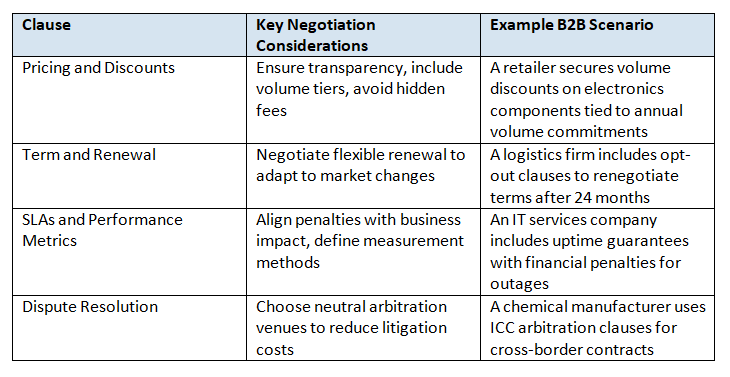
Framework agreements contain numerous clauses that require careful negotiation to balance flexibility, risk, and control.
Defines the products, services, territories, and volumes covered. Ambiguity here can lead to future disputes.
Includes pricing formulas, volume discounts, escalation clauses based on indices (e.g., CPI), and rebate mechanisms.
Specifies duration, renewal terms (automatic or negotiated), and termination rights.
Details how purchase orders are placed, approved, and confirmed under the framework.
Sets minimum service standards, penalties for non-compliance, and monitoring processes.
Protects sensitive information and clarifies ownership of developed IP.
Defines limits of liability, indemnification obligations, and insurance requirements.
Specifies mechanisms such as mediation, arbitration, or litigation jurisdiction.
Outlines procedures for modifying the agreement as business needs evolve.
Effective Negotiation Tactics and Scripts
Mastering tactics tailored to framework agreements enhances leverage and outcomes.
Use market intelligence and historical spend data to justify initial offers. Example script: “Based on our analysis of previous contracts and market rates, we propose a base price of $X with incremental discounts at volume thresholds.”
Structure concessions conditional on supplier reciprocation. Example: “If you can reduce the delivery lead time by 15%, then we can increase order volumes by 10%.”
Use silence after offers to pressure the other party into concessions. Real-world behavioral studies show negotiators tend to fill silence with beneficial information.
Reframe objections to common goals. Example: “I understand your concern about pricing, which is why we’re proposing a multi-year commitment that secures volume for you.”
Bundle issues (price, SLAs, payment terms) to trade concessions. For instance, offering longer payment terms in exchange for better pricing.
Assign team members to create controlled pressure and relief dynamics, but use sparingly to avoid relationship damage.
Supplier: “Our pricing is firm given raw material costs.”
Buyer: [Anchor] “We note market volatility but have historical spend suggesting a baseline of $X is fair. [If-Then] If you can include a price review clause linked to commodity indices, then we can agree to a longer-term commitment.”
Supplier: “Including that clause may require volume guarantees.”
Buyer: “We’re prepared to commit to minimum volumes, provided there is a cap on price escalations.”
Measuring Success: KPIs and Post-Negotiation Management
Negotiating framework agreements is just the start. Ongoing management and measurement ensure the agreement delivers intended value.
· Compliance Rate: Percentage of orders executed under framework terms
· Cost Savings Realized: Difference between negotiated pricing and market benchmarks
· Supplier Performance: SLA adherence, delivery punctuality, quality metrics
· Contract Utilization: Volume or spend against forecasted levels
· Dispute Frequency: Number and severity of contractual disputes
Create joint steering committees with supplier representatives to review performance quarterly. Use scorecards to communicate results and identify improvement areas.
Monitor market changes and operational feedback to trigger renegotiation clauses proactively. For example, if raw material prices drop significantly, revisit pricing to share benefits.
Leverage contract lifecycle management (CLM) systems to automate monitoring, alerts, and reporting, ensuring transparency and accountability.
A global energy company implemented monthly KPI dashboards post-framework agreement with a drilling contractor, leading to a 12% improvement in on-time delivery and a 7% cost reduction in year one.
Frequently Asked Questions
A framework agreement establishes general terms and pricing for a series of future transactions but often lacks detailed scopes of work. An MSA focuses on the overall relationship and terms for services but typically requires separate statements of work (SOWs) for each engagement. Framework agreements are more transactional, while MSAs are relationship-centric.
Include clauses for periodic price reviews tied to objective indices, volume adjustment mechanisms, and termination or renegotiation rights. Structured change management provisions help accommodate evolving business needs without renegotiating the entire contract.
SLAs define expected service levels, measurement criteria, and penalties for non-compliance. They are crucial for managing supplier performance across multiple transactions and maintaining accountability, especially in service-based frameworks.
Coordinate cross-functional teams from all involved regions/entities to align requirements and compliance. Negotiate centralized terms with local adaptations where necessary. Employ scalable governance models to manage complexity and ensure consistency.
· Overly rigid terms that limit flexibility
· Insufficient clarity on scope leading to disputes
· Ignoring supplier financial health and market conditions
· Poor stakeholder alignment and communication
· Neglecting post-contract management and KPIs
Conclusion
Framework agreements in B2B negotiation is a sophisticated discipline that demands strategic preparation, mastery of negotiation frameworks, and precise attention to contractual details. These agreements underpin critical supplier relationships and influence cost structures, operational efficiency, and risk exposure across the enterprise. By applying proven negotiation techniques such as BATNA analysis, anchoring, and multi-issue bargaining, professionals can create agreements that balance flexibility with control and foster long-term partnerships.
Equally important is the post-negotiation phase—effective governance, KPI monitoring, and continuous improvement ensure that the negotiated value is realized and sustained. Organizations that invest in these capabilities gain a competitive advantage through optimized procurement cycles and stronger supplier collaboration.
To elevate your negotiation results, start by conducting rigorous preparation, engage stakeholders early, and implement structured negotiation playbooks tailored to your industry context. Harness the frameworks and tactics outlined in this guide to transform your framework agreement negotiations into strategic wins.
Take the next step: review your current framework agreements, identify gaps, and apply these insights to your upcoming negotiations for measurable impact.