Negotiating in Asia vs Europe: Key Differences and How to Adapt Your Strategy

In 2017, a major European automotive supplier lost a $50 million contract with a leading Japanese manufacturer, not because of pricing or product quality, but due to a profound cultural misunderstanding. The European team, eager to close the deal quickly, pushed for a contract signing during initial meetings, ignoring Japan’s deep-rooted consensus-building processes such as nemawashi and ringi. The Japanese side, feeling rushed and disrespected, withdrew quietly, illustrating how invisible cultural scripts can silently sabotage even the most promising deals. This incident underscores a critical truth in cross-cultural negotiation: success hinges not just on what you negotiate, but how you negotiate.
Cross-cultural negotiation is fundamentally different from domestic deals because it involves navigating unseen layers of cultural expectations, communication norms, and decision-making protocols. Negotiators often fall into the trap of assuming that their way of conducting business is universal, leading to misinterpreted signals, eroded trust, and missed opportunities. For example, while German negotiators value directness and Sachlichkeit (businesslike objectivity), their Asian counterparts, such as South Koreans and Chinese, often emphasize harmony, hierarchy, and saving face. Misreading these cues can cost relationships and millions of dollars.
This comprehensive guide will equip you with the cultural intelligence and practical tools necessary to bridge these gaps. You will master renowned cultural frameworks like Hofstede’s six dimensions, Erin Meyer’s Culture Map, Richard Lewis’s communication styles, and Edward Hall’s context theory. We will unpack country-specific insights—from China’s guanxi and mianzi to Scandinavia’s egalitarianism—and provide actionable, step-by-step strategies, exact word-for-word negotiation scripts, and expert-level techniques to ensure your next negotiation succeeds, regardless of geography.
· Table of Contents
· The Science of Cultural Differences in Negotiation
· Key Cultural Frameworks with Country Comparisons
· Step-by-Step Cultural Preparation Strategy
· Real-World Case Studies from Asia and Europe
· Country/Region-Specific Insights Table
· Advanced Cross-Cultural Negotiation Strategies
· Scripts and Templates for Different Cultures
· Frequently Asked Questions
· Conclusion and Call to Action
· References
The Science of Cultural Differences in Negotiation
Understanding the profound cultural underpinnings that shape negotiation behavior calls for a deep dive into several foundational theories and empirical research. Each framework offers unique lenses to decode the subtle but powerful influences of culture on communication, decision-making, and relationship-building.
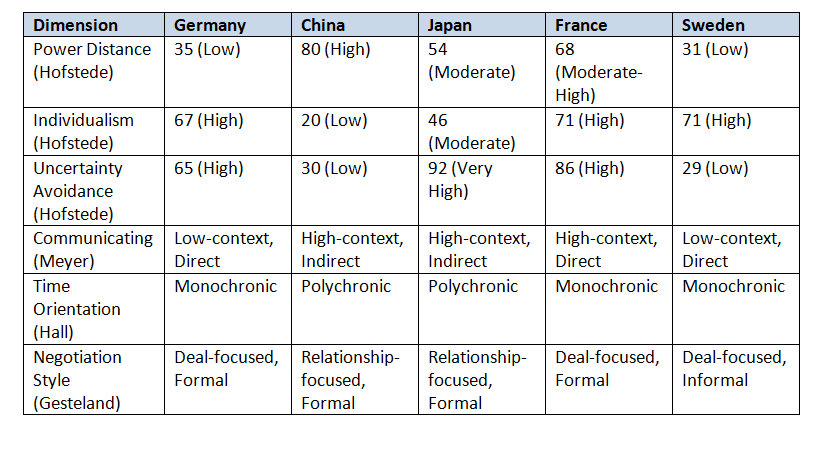
Geert Hofstede’s Six Cultural Dimensions remain the cornerstone of cross-cultural studies, quantifying national cultures along power distance, individualism vs collectivism, masculinity vs femininity, uncertainty avoidance, long-term orientation, and indulgence. For example, Germany scores low on power distance (35), favoring egalitarianism, but high on uncertainty avoidance (65), reflecting a preference for clear rules. China scores a high 80 on power distance, signifying hierarchical acceptance, and 87 on long-term orientation, emphasizing perseverance and planning. These scores explain why German negotiators appreciate direct, structured meetings, while Chinese counterparts expect deference to authority and patience for consensus.
Erin Meyer’s Culture Map builds on Hofstede by categorizing cultures across eight dimensions that directly impact negotiation style: communicating (low-context vs high-context), evaluating (direct vs indirect negative feedback), persuading (principles-first vs applications-first), leading (egalitarian vs hierarchical), deciding (consensual vs top-down), trusting (task-based vs relationship-based), disagreeing (confrontational vs avoids confrontation), and scheduling (linear-time vs flexible-time). For instance, Scandinavians, scoring low-context and egalitarian, prefer straightforward, fact-based discussions, whereas Japanese negotiators, high-context and hierarchical, rely heavily on nonverbal cues and seniority.
Richard Lewis’s model divides cultures into Linear-Active (German, Swiss), Multi-Active (Spanish, Italian, Latin American), and Reactive (Japanese, Chinese, Korean). Linear-Active negotiators are task-oriented and sequential, Multi-Active are emotional and flexible, while Reactive cultures listen carefully and prioritize harmony. This explains why South Korean negotiators practice nunchi—reading the room silently—before responding.
Edward Hall’s research on high-context vs low-context communication further clarifies these cultural divides. Asian cultures like Japan, China, and Korea are high-context, relying heavily on implicit messages, nonverbal cues, and the shared context. European countries vary, with Germany, the UK, and Scandinavia being low-context, favoring explicit, direct communication. Hall’s monochronic versus polychronic time perception also plays a role: Europeans tend to be monochronic, valuing punctuality and schedules, while many Asian cultures prefer polychronic approaches, accommodating interruptions and relational time.
Richard Gesteland’s dimensions—deal-focused vs relationship-focused, formal vs informal, rigid-time vs fluid-time, expressive vs reserved—add further nuance. Europeans such as Germans and Swiss are deal-focused, formal, and rigid-time oriented, while many Asian cultures value relationships and fluid time, with greater emotional restraint.
David Livermore’s Cultural Intelligence (CQ) framework—CQ Drive, CQ Knowledge, CQ Strategy, CQ Action—provides a practical roadmap for negotiators to develop cultural empathy and adapt their behavior effectively. CQ Strategy, for example, encourages pre-negotiation reflection on cultural assumptions, while CQ Action guides behavioral adjustments during negotiations.
Finally, Trompenaars & Hampden-Turner’s seven dimensions—universalism vs particularism, individualism vs communitarianism, neutral vs emotional, specific vs diffuse, achievement vs ascription—reveal why European cultures lean toward universalism and achievement (e.g., Germany, UK), while Asian cultures often emphasize particularism, communal harmony, and ascription based on status (e.g., China, India). Understanding these contrasts prevents missteps such as ignoring hierarchical protocols or misusing informal communication.
Key Cultural Frameworks
In practice, several frameworks serve as indispensable tools to prepare for and execute cross-cultural negotiations. Here we compare three widely used models—Hofstede’s Dimensions, Erin Meyer’s Culture Map, and Richard Lewis’s communication types—highlighting how they complement each other for nuanced cultural insight.
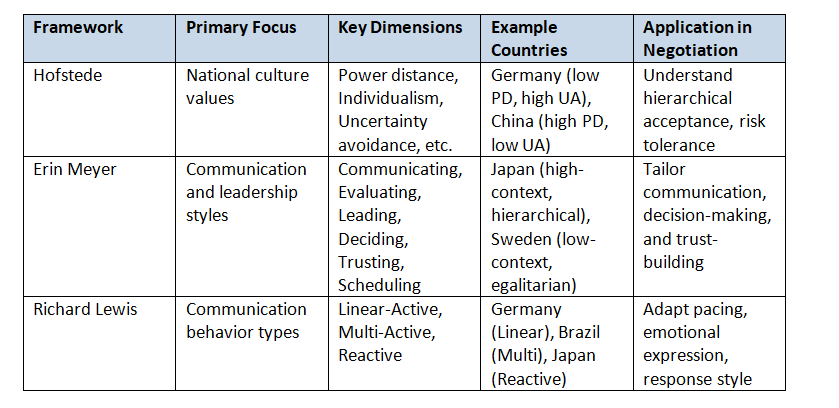
By integrating these frameworks, negotiators gain a multidimensional understanding—for example, knowing a Japanese counterpart is high-context (Meyer), reactive (Lewis), and scores high on uncertainty avoidance (Hofstede) prepares you to approach them with patience, indirect communication, and clear risk mitigation.
Step-by-Step Cultural Preparation Strategy
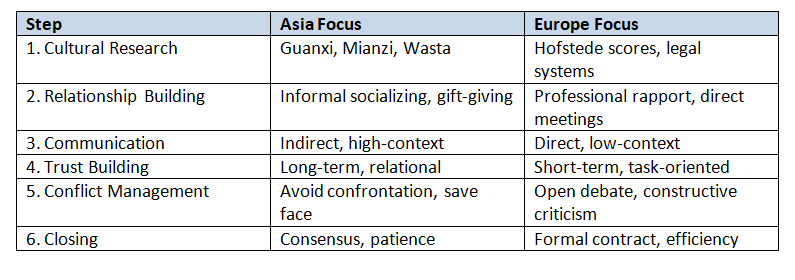
Adapting your negotiation strategy for Asia versus Europe demands a systematic, research-driven approach. Below are six critical steps to culturally prepare for successful outcomes.
1. Conduct Deep Cultural Research
Use Hofstede, Meyer, Lewis, and Hall frameworks to profile your counterpart’s national culture. Supplement this with country-specific business customs, etiquette, and current socio-political context. For example, researching China’s guanxi (relationship networks) and mianzi (face) dynamics is crucial for trust-building.
2. Understand Relationship-Building Norms
In Asia, prioritize establishing personal relationships before discussing business. Learn about practices like nemawashi (informal consensus building) in Japan or wasta (influence networks) in the Middle East. In Europe, relationships may be more transactional but still require respect and professionalism.
3. Adapt Your Communication Style
Adjust according to Meyer’s communicating and evaluating dimensions. For instance, use indirect language and avoid blunt criticism in Japan or China, but adopt direct, fact-based communication in Germany or Scandinavia. Be mindful of high-context signals like silence or nonverbal cues in Asia.
4. Build and Maintain Trust
Trust is relationship-based in Asia and task-based in many European countries. Invest time in social interactions and honors protocols in Asia, such as exchanging business cards with both hands in Japan. In Europe, demonstrate competence and reliability through punctuality and transparency.
5. Manage Face-Saving and Conflict Resolution
Recognize the importance of face in Asian cultures. Avoid public criticism or forcing confrontations. Use indirect methods to address disagreements. In contrast, European cultures like France and Germany may welcome intellectual debate and direct feedback.
6. Tailor Closing and Follow-Up
In Asia, closing may occur only after multiple informal approvals (ringi system in Japan). Be patient and avoid pressuring for quick decisions. In Europe, you can often proceed with a clear contract after formal meetings. Follow up promptly and professionally in all contexts.
Real-World Case Studies
Examining concrete examples brings cultural frameworks to life.
Case Study 1: Daimler-Benz and Mitsubishi Motors (Germany-Japan)
In the late 1990s, the German-Japanese partnership struggled due to conflicting negotiation styles. Daimler’s direct, task-focused approach clashed with Mitsubishi’s emphasis on consensus and subtle communication. Misunderstandings around authority and decision-making delayed integration. The lesson: understanding hierarchical decision processes and indirect communication in Japan is essential for cooperation.
Case Study 2: Nokia’s Entry into China
Nokia’s Finnish team initially faced challenges in China due to underestimating guanxi networks and the importance of mianzi. After investing in local relationship-building and adapting their communication style to be less confrontational and more deferential, Nokia successfully expanded market share. This underscores the value of CQ Drive and CQ Knowledge in cross-cultural adaptation.
Case Study 3: French-British Negotiations in the EU
The “Brexit” negotiations highlighted differing cultural attitudes toward persuasion and evaluation. The French negotiators’ preference for intellectual argumentation and indirect criticism contrasted with the British preference for pragmatic, direct dialogue. Recognizing these differences could have facilitated more productive dialogue.
Country/Region-Specific Insights
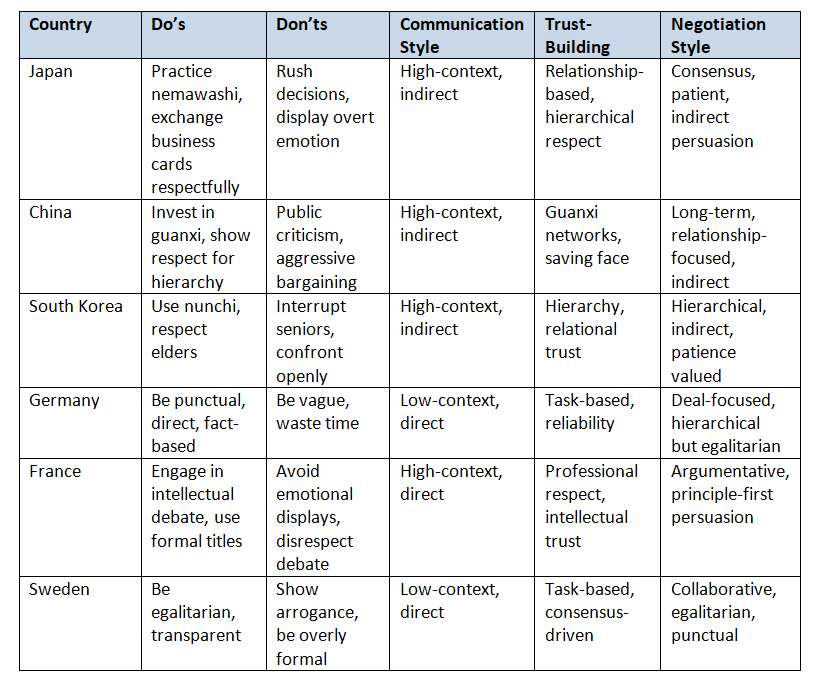
Below is a detailed table synthesizing cultural do’s and don’ts, communication style, trust-building approaches, and negotiation styles for key Asian and European countries.
Advanced Strategies
To excel at cross-cultural negotiation between Asia and Europe, consider these expert techniques:
Managing Interpreters: Choose interpreters skilled not only in language but cultural nuance. Brief them on negotiation goals and cultural sensitivities. For example, in Japan, interpreters should understand honorifics and formality levels.
Building Guanxi/Wasta/Relationships: In China and Middle East contexts, invest time in social rituals such as dinners, gift-giving, and informal meetings. Remember wasta in the Middle East often influences access and decisions.
Navigating Hierarchy and Face: Always identify decision-makers and show appropriate deference. Avoid public criticism to prevent loss of face; instead, use private, indirect feedback.
Adapting Persuasion Styles: Use principle-first logic with French negotiators but applications-first with Germans. In Asia, emphasize harmony and group benefits rather than individual gain.
Reading Non-Verbal Signals: Silence can indicate disagreement in Europe but respect in Japan. Watch proxemics and gestures carefully—crossed arms may be defensive in Germany but neutral in Asia.
Scripts and Templates
Here are exact word-for-word scripts conveying the same core message tailored to four cultural contexts:
Message: Request a meeting to discuss a potential partnership.
German (Direct, Formal):
“Dear Mr. Schmidt, I hope this message finds you well. I would like to schedule a meeting next week to discuss our potential partnership. Please let me know your availability. Best regards.”
Japanese (Indirect, Polite):
“Dear Mr. Tanaka, I trust you are doing well. If it is convenient for you, may I humbly request the honor of meeting at your earliest convenience to explore how we might collaborate beneficially. I look forward to your kind reply. Sincerely.”
Brazilian (Warm, Relationship-Oriented):
“Olá Senhor Silva, I hope all is well with you and your family. I would love to find a time next week for us to sit down and talk about how we can work together. Please let me know what works for you. Abraços.”
American (Transactional, Direct):
“Hi John, I’d like to set up a meeting next week to discuss a potential partnership opportunity. Are you available? Looking forward to hearing from you.”
Frequently Asked Questions
Q1: How important is hierarchy in Asian vs European negotiations?
Hierarchy plays a much larger role in Asia, especially in countries like China, Japan, and South Korea, where decision-making is top-down and seniority commands respect. In Europe, countries like Germany and Sweden are more egalitarian, though some Mediterranean countries maintain hierarchical respect.
Q2: What communication mistakes should I avoid when negotiating in Asia?
Avoid being overly direct or confrontational, as this can cause loss of face. Do not rush decisions or interrupt senior members. Pay attention to nonverbal cues and silence, often used to convey disagreement or contemplation.
Q3: How do Europeans typically handle conflict in negotiations compared to Asians?
Europeans, especially French and Germans, often engage in direct debate and intellectual argumentation. Asians tend to avoid open conflict, favoring harmony and indirect disagreement to preserve relationships.
Q4: How can I build trust effectively in Asian vs European contexts?
In Asia, invest in long-term relationships through social interactions, gift-giving, and showing respect for hierarchy. In Europe, demonstrate competence, punctuality, and transparency to build task-based trust.
Q5: Are negotiation timelines different between Asia and Europe?
Yes. Asian negotiations often require patience due to consensus-building and multiple approvals, while European negotiations tend to be more time-efficient, focused on closing deals within scheduled meetings.
Conclusion
Navigating the intricate cultural landscapes of Asia and Europe requires more than knowledge of language or business practices; it demands cultural intelligence, empathy, and strategic adaptation. By integrating seminal frameworks—from Hofstede’s dimensions to Meyer’s Culture Map—with real-world country-specific insights, you are empowered to anticipate and bridge cultural gaps that otherwise silently erode trust and opportunity. The stakes are high: millions of dollars and long-term partnerships depend on your ability to read invisible scripts, respect hierarchy, and communicate effectively.
Armed with step-by-step preparation strategies, advanced techniques, and precise negotiation scripts tailored to diverse cultural contexts, you can transform potential misunderstandings into breakthroughs. Whether negotiating in Tokyo, Berlin, Shanghai, or Paris, your cultural fluency will be your greatest competitive advantage. Start applying these insights today to elevate your global negotiation success.
References
1. Hofstede, G. (2011). "Dimensionalizing Cultures: The Hofstede Model in Context." Online Readings in Psychology and Culture.
2. Meyer, E. (2014). "The Culture Map: Breaking Through the Invisible Boundaries of Global Business." PublicAffairs.
3. Lewis, R. D. (2006). "When Cultures Collide: Leading Across Cultures." Nicholas Brealey Publishing.
4. Hall, E. T. (1976). "Beyond Culture." Anchor Books.
5. Gesteland, R. R. (2012). "Cross-Cultural Business Behavior." Copenhagen Business School Press.
6. Livermore, D. (2015). "Leading with Cultural Intelligence: The Real Secret to Success." AMACOM.