Negotiating in Emerging Markets: Strategies for High-Growth, High-Risk Environments

Emerging markets present both tantalizing opportunities and formidable risks for international negotiators. Consider the 2018 US-China trade negotiations, where the stakes were monumental: billions in tariffs threatened to derail global supply chains, and misunderstandings rooted in cultural communication styles exacerbated tensions. Similarly, a European multinational’s failed deal in Nigeria in 2016, resulting from underestimated local political risk and ambiguous contract terms, led to multi-million-dollar losses and reputational damage. These high-profile missteps illustrate the razor-thin margin for error when negotiating in fast-evolving, high-stakes environments.
The strategic and cultural stakes in emerging market negotiations are layered and complex. Beyond the volatility of political and economic environments, negotiators must navigate distinct cultural dimensions—for instance, India’s high-context communication and hierarchical social norms versus Brazil’s emphasis on relationship-building and trust. Most professionals err by applying Western negotiation templates without adapting to these nuanced realities, leading to breakdowns in trust, misaligned expectations, and ultimately failed deals. A sophisticated approach requires mastery of cross-cultural frameworks, legal considerations unique to emerging markets, and tailored risk mitigation strategies.
This comprehensive guide equips you to master the art and science of negotiating in emerging markets. You will gain deep insights into foundational cultural and strategic models including Hofstede’s dimensions, Erin Meyer’s Culture Map, Richard Lewis’s typology, and Edward Hall’s time and context concepts. We will dissect step-by-step strategies with actionable tactics and language scripts, present real-world case studies from Asia, Africa, and Latin America, and provide a tactical challenge matrix by region. Advanced techniques such as managing interpreters, preserving face across cultures, and navigating complex legal environments will prepare you to mitigate risk and close deals confidently in these dynamic markets.
· Table of Contents
· The Strategic Foundation: Cultural and Legal Frameworks
· Key Frameworks and Models: Comparative Analysis
· Step-by-Step Strategy for Negotiating in Emerging Markets
· Real-World Case Studies: Lessons from Global Deals
· Country/Region-Specific Insights and Challenge Matrix
· Advanced Strategies: Relationship Building and Risk Management
· Scripts and Templates for International Negotiations
· Frequently Asked Questions on Emerging Market Negotiations
· Conclusion and Call to Action
· References
The Strategic Foundation — Cultural and Legal Frameworks
Negotiating in emerging markets requires a solid foundation of cultural intelligence combined with legal and political awareness. The complexity arises from overlapping layers: cultural values shape communication and decision-making styles; political and economic volatility amplify risk; and legal systems often differ dramatically from Western standards, affecting contract enforceability and dispute resolution.
Hofstede’s cultural dimensions remain essential for diagnosing cultural differences that influence negotiation behavior. For example, emerging markets like India and Brazil score high on Power Distance, indicating acceptance of hierarchical authority, which affects decision-making speed and protocol. Similarly, uncertainty avoidance varies widely—Mexico tends to have higher uncertainty avoidance, demanding more detailed contracts, while China shows lower scores, relying more on relational trust.
Erin Meyer’s Culture Map expands on this by breaking down negotiation-relevant behaviors into eight dimensions, such as communication style (low-context vs. high-context), feedback (direct vs. indirect), and scheduling (linear vs. flexible time). These dimensions help anticipate potential pitfalls such as misunderstandings in indirect communication or frustration over flexible deadlines.
Richard Lewis’s model classifies cultures as Linear-Active (e.g., Germany, USA), Multi-Active (e.g., Latin America, Southern Europe), and Reactive (e.g., Japan, China). Emerging markets often lean towards Multi-Active or Reactive, emphasizing relationships, harmony, and flexible agendas, which affects negotiation pacing and tactics.
Edward Hall’s high- and low-context communication theories further elucidate why implicit messages and nonverbal cues are critical in many emerging markets. High-context cultures—common in Asia and the Middle East—rely heavily on context and relationships, making trust-building essential before substantive negotiations can occur. Additionally, monochronic versus polychronic time perceptions influence scheduling expectations and the flow of negotiations.
On the legal front, familiarity with international contract frameworks such as the United Nations Convention on Contracts for the International Sale of Goods (CISG), ICC arbitration rules, and UNCITRAL model law is crucial. Emerging markets may have underdeveloped contract enforcement mechanisms, increasing reliance on arbitration and informal dispute resolution. Understanding local contract law nuances and political risk frameworks like PESTLE analysis or country risk ratings helps anticipate regulatory changes, expropriation risks, or currency controls.
· Key Considerations in Emerging Market Negotiations
· Cultural dimensions affecting hierarchy, communication, and time
· Legal frameworks: CISG, ICC rules, UNCITRAL, local law variations
· Political risk and economic volatility analysis (PESTLE)
· Currency and transfer pricing risks
· Relationship-building and trust as negotiation currency
Key Frameworks and Models — Comparative Analysis
This section compares three foundational frameworks: Hofstede’s Cultural Dimensions, Erin Meyer’s Culture Map, and Richard Lewis’s Model, focusing on their applicability to emerging market negotiation challenges. Each framework offers unique lenses to decode complex cultural signals that influence negotiation processes, styles, and outcomes.
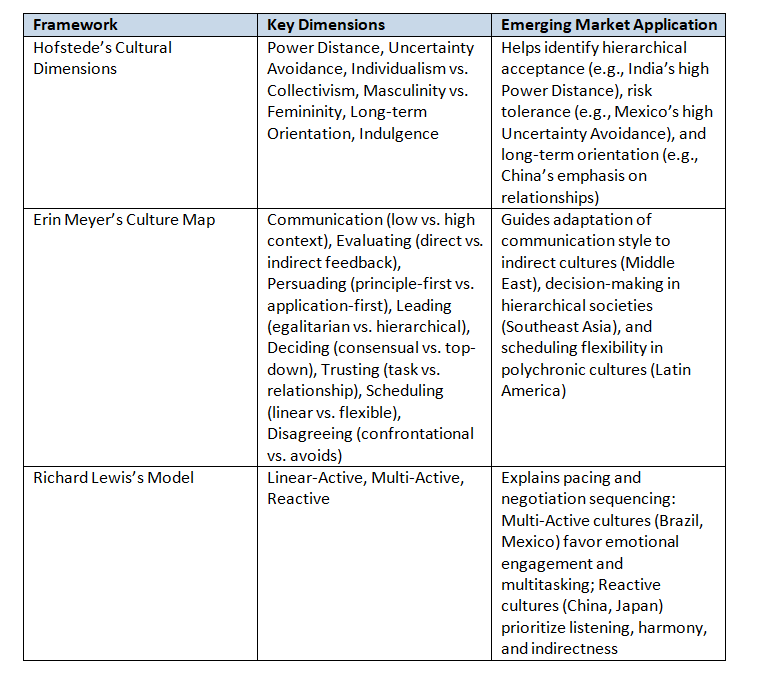
Understanding these frameworks together equips negotiators to tailor their approach—balancing directness with diplomacy, timing with patience, and legal rigor with relational flexibility—in emerging market contexts where misreading cues can derail deals.
Step-by-Step Strategy — Detailed Tactics for Emerging Market Negotiations
Step 1: Conduct Comprehensive Cultural and Political Due Diligence
Before entering negotiations, analyze the target country’s cultural profile using Hofstede, Meyer, and Lewis models. Complement this with a PESTLE analysis to assess political, economic, social, technological, legal, and environmental risks. Review local regulatory frameworks and currency controls. Utilize local experts or consultants for nuanced insights.
Step 2: Build Relationships and Trust Before Formal Negotiations
Emerging markets emphasize relationship-building—often more than contract terms—in early stages. Invest time in face-to-face meetings, dinners, or social events. Engage in “nemawashi” (Japan) or “wasta” (Middle East) informal networking to gain endorsements.
Step 3: Adapt Communication Style to Cultural Context
In high-context cultures (e.g., China, UAE), rely on nonverbal cues and implicit messaging. Avoid blunt or confrontational language. In contrast, in more direct cultures (e.g., South Africa), clear, transparent communication is preferred.
Step 4: Structure Negotiations with Flexibility and Patience
Expect extended timelines in polychronic cultures; avoid rigid agendas. Recognize hierarchical decision-making that may require multiple approval layers.
Step 5: Leverage International Legal Frameworks and Local Counsel
Draft contracts compliant with CISG or ICC arbitration where possible, but adapt to local legal environments. Engage trusted local legal advisors to identify enforceability risks and regulatory hurdles.
Step 6: Implement Risk Mitigation and Exit Strategies
Define BATNA (Best Alternative to a Negotiated Agreement) clearly, and identify ZOPA (Zone of Possible Agreement) boundaries considering currency fluctuations and political risks. Use transfer pricing and FX hedging where applicable.
These six steps form a holistic framework to handle the complexities of emerging market negotiations, balancing cultural sensitivity with legal rigor and strategic risk management.
Real-World Case Studies — Lessons from Global Deals
Case Study 1: US-China Phase One Trade Deal (2019)
The US-China negotiations highlighted the challenge of reconciling fundamentally different negotiation cultures—US linear-active directness clashing with China’s reactive, high-context style. Initial tariffs escalations increased urgency but also mistrust. Success emerged from phased agreements focusing on concrete deliverables, extensive backchannel communications, and leveraging trusted intermediaries to preserve face.
Case Study 2: Volkswagen’s Entry into India (2007-2012)
Volkswagen’s early struggles in India stemmed from underestimating India’s hierarchical decision-making and regulatory complexity. Failure to engage local stakeholders and navigate bureaucratic processes delayed operations. Later, adopting local partnerships and investing in relationship-building accelerated approvals.
Case Study 3: South African Mining Joint Venture (2015)
A European mining firm’s joint venture in South Africa succeeded by integrating community stakeholder consultations, adapting to multi-active cultural styles, and using ICC arbitration clauses to mitigate legal risks. Transparent communication and honoring local customs built trust with both government and community.
Country/Region-Specific Insights or Challenge Matrix
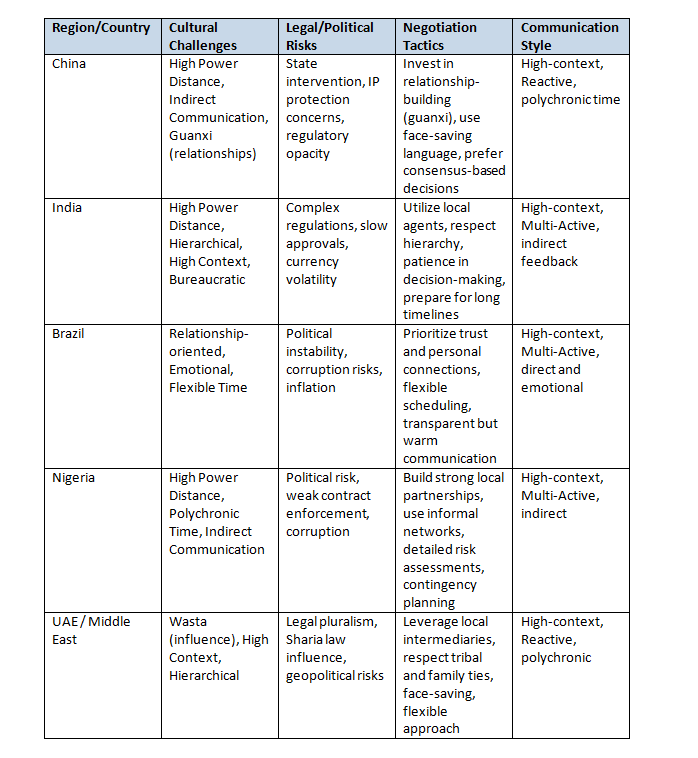
Use this matrix as a quick-reference guide to tailor your negotiation approach and risk management by region.
Advanced Strategies — Relationship Building and Risk Management
Managing Interpreters and Cultural Mediators
In multilingual environments, professional interpreters are critical. Use briefings to align on tone and terminology; avoid jargon. Maintain eye contact with your counterpart, not the interpreter, to preserve rapport.
Mastering Face-Saving and Hierarchy Navigation
In many emerging markets, saving face is paramount. Avoid public criticism; use indirect language and private feedback. Acknowledge titles and honorifics, and allow senior leaders to speak first. Use nemawashi (Japan) or wasta (Middle East) informal consensus-building before formal meetings.
Legal Risk Mitigation in Volatile Environments
Anticipate delays with clauses for force majeure, currency controls, and political risk insurance. Structure payment terms to mitigate FX risk (e.g., use letters of credit). Reserve dispute resolution in neutral venues under ICC arbitration or UNCITRAL rules.
Leveraging Relationship-Building as a Strategic Asset
Beyond transactional exchanges, cultivate long-term relationships by showing cultural curiosity, honoring local customs, and engaging in corporate social responsibility initiatives. This builds goodwill that can be invaluable during crises or renegotiations.
Scripts and Templates — Word-for-Word Examples for International Contexts
Script 1: Initial Meeting Request Email for High-Context Culture (e.g., China)
Dear Mr. Wang,
I hope this message finds you well. It would be an honor to meet with you to explore possible areas of mutual interest between our companies. I believe that through open dialogue and collaboration, we can build a long-lasting and beneficial partnership.
Please let me know your availability at your convenience.
With respect,
---
Script 2: Soft Proposal Language for Hierarchical, Indirect Culture (e.g., India)
“Perhaps we might consider exploring options that could enhance the value for all parties involved. I would be grateful to hear your thoughts on this.”
---
Script 3: Follow-Up Email After a Delayed Meeting (e.g., Brazil)
Dear Ms. Silva,
I trust you are well. I wanted to express my understanding regarding our postponed meeting and reiterate my enthusiasm to continue our discussions at a time that suits you best.
Warm regards,
---
Script 4: Contract Clause Suggestion for Political Risk Mitigation
“In the event of unforeseen governmental actions or regulatory changes adversely affecting contract performance, both parties agree to engage in good faith discussions to renegotiate terms in a timely manner.”
---
Script 5: Dispute Resolution Clause Adapted for Emerging Market
“All disputes arising from this agreement shall first seek amicable settlement through mediation in [neutral city]. Failing which, the dispute shall be resolved by arbitration under ICC Rules, with the language of arbitration being English.”
Frequently Asked Questions
Q1: How can I build trust quickly in emerging market negotiations?
Building trust requires investing time in relationship-building activities beyond formal meetings. Demonstrate respect for local customs, listen actively, and engage in social rituals. Avoid rushing to contract details before trust is established.
Q2: What role do cultural intermediaries play in negotiations?
Cultural intermediaries or local advisors help decode nuanced communication, facilitate introductions, and assist with informal consensus-building (e.g., wasta, nemawashi). They can prevent misunderstandings and accelerate negotiation progress.
Q3: How do I manage currency and political risks in emerging markets?
Use hedging tools for FX risk, include force majeure and political risk clauses in contracts, and consider purchasing political risk insurance. Maintain flexible payment terms and monitor country risk ratings continuously.
Q4: When should I insist on international arbitration versus local dispute resolution?
Insist on international arbitration when local courts are unreliable or biased. However, balance this with the need to maintain local goodwill by exploring mediation or local arbitration initially. Tailor dispute clauses to the specific country context.
Q5: How do I adapt my communication style for high-context cultures?
Avoid direct confrontation, use indirect and polite language, pay attention to non-verbal cues, and confirm understanding subtly. Build rapport before discussing contentious issues, and use silence strategically.
Conclusion
Negotiating in emerging markets demands a sophisticated blend of cultural intelligence, strategic patience, and rigorous risk management. By internalizing foundational models such as Hofstede’s dimensions and Meyer’s Culture Map, and applying a structured, step-by-step approach, negotiators can transform challenges into opportunities. Embracing local relationship-building practices, adapting communication styles, and preemptively addressing legal and political risks position global executives to close deals that are not only profitable but sustainable.
The stakes are high, but the rewards in these dynamic, high-growth environments are substantial for those prepared to navigate the complexities with nuance and discipline. Begin integrating these frameworks and scripts into your negotiation playbook today to accelerate success in emerging markets.
For tailored consulting or training on emerging market negotiation strategies, contact our expert team to unlock your global potential.
References
Brett, J. M. (2014). Negotiating Globally: How to Negotiate Deals, Resolve Disputes, and Make Decisions Across Cultural Boundaries. Jossey-Bass.
Erin Meyer. (2014). The Culture Map: Breaking Through the Invisible Boundaries of Global Business. PublicAffairs.
Hofstede, G., Hofstede, G.J., & Minkov, M. (2010). Cultures and Organizations: Software of the Mind. McGraw Hill.
Lewis, R. D. (2006). When Cultures Collide: Leading Across Cultures. Nicholas Brealey Publishing.
Meyer, E., & Harrower, M. (2018). The Culture Map in Practice: Negotiation and Leadership in Complex Cultures. Harvard Business Review Press.
United Nations Commission on International Trade Law (UNCITRAL). (2020). UNCITRAL Model Law on International Commercial Arbitration.
World Bank. (2023). Doing Business Reports: Country Risk Profiles and Political Risk Assessments.