Negotiating in the Middle East: Culture, Relationships, and Deal-Making Strategies

Negotiations between Western executives and Middle Eastern business leaders have repeatedly illustrated how cultural misunderstandings can derail multimillion-dollar deals. One notable example was a European energy company’s attempt to secure a joint venture with a Gulf sovereign investment fund. Despite a lucrative proposal, the negotiations collapsed abruptly when the Western side pushed for rapid contract finalization without investing time in building personal relationships. The Gulf partners perceived this as impatience and disrespect, interpreting it as a threat to their honor and trust. Months of effort and millions in potential investments evaporated because the Western team failed to understand the invisible cultural scripts guiding Middle Eastern deal-making—scripts that emphasize relationship-building, patience, and honor above transactional expedience.
Cross-cultural negotiation is fundamentally different from domestic deal-making precisely because of these invisible layers of meaning, assumptions, and expectations that negotiators often fail to recognize. What seems like a simple business meeting is actually a complex dance involving trust cultivation (wasta), face-saving (mianzi), and nuanced communication styles that are deeply embedded in culture. Misreading indirect communication, underestimating the role of hierarchy, or ignoring the primacy of personal connections can lead to misinterpretation, erosion of trust, and ultimately failed deals. The challenge is not just language but decoding these cultural signals that are often tacit and intuitive to insiders.
In this comprehensive guide, you will master the definitive frameworks and country-specific insights crucial for negotiating successfully in the Middle East. Drawing on the seminal research of Geert Hofstede, Erin Meyer, Richard Lewis, Edward Hall, Richard Gesteland, David Livermore, and Trompenaars & Hampden-Turner, we will dissect their cultural dimensions with precise scores for key Middle Eastern countries. You will gain actionable step-by-step preparation strategies, expert-level techniques for relationship-building and persuasion, and exact word-for-word scripts tailored to different negotiation contexts. This pillar page will equip executives, diplomats, and global business leaders with the cultural intelligence needed to build trust, navigate hierarchy, and close deals with confidence in the region.
· Table of Contents
· The Science of Cultural Differences in Negotiation
· Key Cultural Frameworks: Hofstede, Meyer, Lewis Comparison
· Step-by-Step Cultural Preparation Strategy
· Real-World Case Studies
· Country/Region-Specific Insights: Do’s and Don’ts Table
· Advanced Cross-Cultural Negotiation Strategies
· Scripts and Templates for Different Cultural Contexts
· Frequently Asked Questions
· Conclusion and Call to Action
· References
The Science of Cultural Differences in Negotiation
Understanding negotiation in the Middle East requires a deep dive into the science of cultural dimensions as researched by leading scholars. Each framework offers unique lenses through which to interpret behavior, communication, trust, and decision-making.
Geert Hofstede’s 6 Dimensions provide foundational insight. Countries in the Middle East, such as Saudi Arabia, UAE, and Egypt, score very high on Power Distance (Saudi Arabia 95, UAE 90, Egypt 70), signifying strong hierarchical structures where authority and respect for rank are critical. They also exhibit high Collectivism (low Individualism scores: Saudi Arabia 25, UAE 25) and strong Uncertainty Avoidance (Saudi Arabia 80, Egypt 70), revealing a preference for group cohesion, loyalty, and structured processes. Masculinity scores are moderate to high (Saudi Arabia 60), reflecting competitive and achievement-oriented business cultures. Long-Term Orientation varies; Saudi Arabia scores 36, indicating more normative, tradition-respecting values. Indulgence is low (Saudi Arabia 25), pointing to restraint in social behaviors.
Erin Meyer’s Culture Map reveals Middle Eastern cultures as high-context communicators, with indirect and nuanced messaging. On the Trusting scale, Middle Eastern countries emphasize relationship-based trust over task-based trust, consistent with Trompenaars’ communitarian orientation. On the Disagreeing scale, they tend to avoid public confrontation, favoring harmony and indirect disagreement. Leadership tends to be hierarchical and centralized, with decision-making often top-down but requiring consensus through consultation with senior family or tribal members. Scheduling is often polychronic, with fluid timelines and flexibility, contrasting sharply with monochronic Western counterparts.
Richard Lewis categorizes Middle Easterners primarily as Reactive communicators—listening carefully, reacting harmoniously, and maintaining face. This contrasts with Linear-Active Westerners who prefer direct sequential communication. Edward Hall’s high-context communication theory is essential here; Middle Easterners rely heavily on contextual cues, body language, and relationship history rather than explicit verbal content. They also tend towards polychronic time, valuing relationships over strict adherence to schedules.
Richard Gesteland’s dimensions show the Middle East as strongly relationship-focused, formal in business attire and protocol, fluid in time perception, and expressive in communication style, balancing warmth and restraint depending on context. David Livermore’s Cultural Intelligence model underscores the importance of CQ Drive (motivation to learn), CQ Knowledge (understanding cultural norms), CQ Strategy (planning for cultural differences), and CQ Action (adapting behavior), all critical to successful Middle Eastern negotiations.
Trompenaars & Hampden-Turner highlight particularism over universalism in the Middle East: rules and agreements are often adapted depending on relationships and circumstances. The region exhibits communitarian values (group over individual), emotional expressiveness, diffuse relationships (personal and professional spheres overlap), and ascription (status based on age, family, or position).
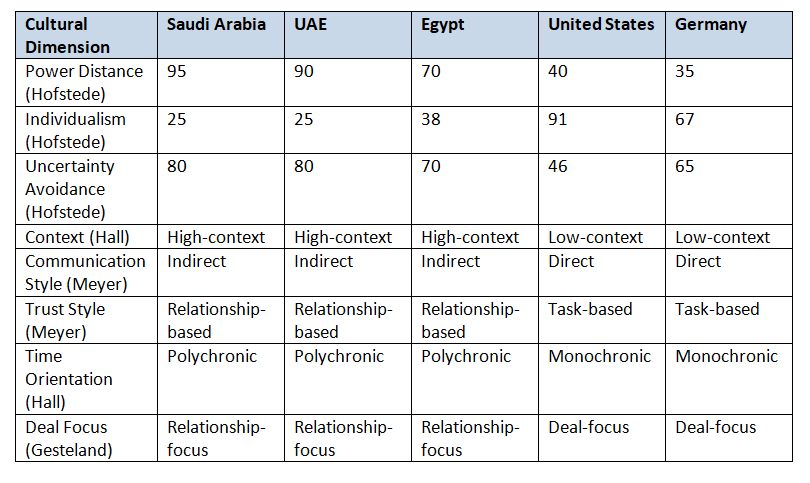
This deep cultural profile explains why Western decision-focused, direct, and time-sensitive negotiation styles often clash with Middle Eastern approaches that prioritize relationship-building, indirect communication, and flexible timing.
Key Cultural Frameworks
This section compares three core cultural frameworks—Hofstede’s Dimensions, Erin Meyer’s Culture Map, and Richard Lewis’s Model—highlighting their relevance to Middle Eastern negotiation.
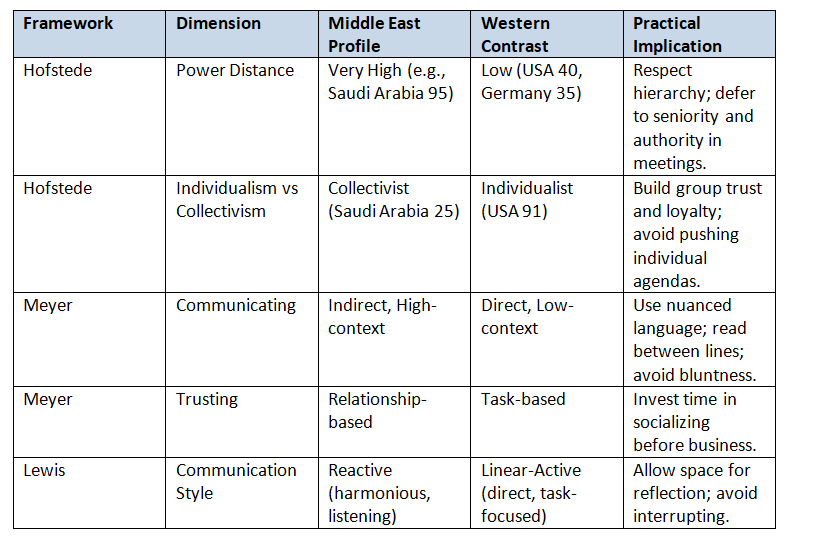
Understanding these frameworks helps negotiators anticipate and adapt to divergent expectations, communication patterns, and decision-making styles.
Step-by-Step Cultural Preparation Strategy
Step 1: Conduct In-Depth Cultural Research
Before any interaction, study the target country’s scores on Hofstede’s dimensions, communication styles per Meyer and Lewis, and local customs. For example, familiarize yourself with Saudi Arabia’s emphasis on hierarchy and the UAE’s multicultural business environment. Use authoritative sources, including governmental trade guides and regional business consultants.
Step 2: Build Relationships through Wasta and Trust Networks
Middle Eastern deals hinge on wasta—personal connections and influence networks. Identify and engage trusted intermediaries, attend social gatherings, and invest time in informal conversations. Demonstrate sincerity and patience; rushed approaches signal disrespect.
Step 3: Adapt Communication Style to High-Context Norms
Use indirect language, polite euphemisms, and nonverbal cues. Avoid confrontational or overly explicit statements. For instance, instead of saying “No,” say “We will consider this carefully.” Observe body language and show attentiveness.
Step 4: Incorporate Face-Saving and Honor
Be mindful of mianzi (face). Public criticism or disagreement undermines trust. Praise generously and use deferential titles. When disagreements arise, address them privately and diplomatically.
Step 5: Navigate Hierarchy and Consensus Building
Expect decisions to involve senior leaders or family elders. Use nemawashi-like consultation processes, allowing stakeholders to voice opinions before formal meetings. Avoid pressuring for immediate answers; patience is key.
Step 6: Manage Time Flexibly and Respect Polychronic Scheduling
Plan for meetings to start late or extend beyond planned durations. Keep agendas flexible, allowing for extended small talk and hospitality rituals such as coffee or tea ceremonies. Avoid showing frustration over delays.
Step 7: Close Deals with Formality and Written Confirmation
Once trust and consensus are achieved, document agreements formally, respecting local legal frameworks. Recognize that verbal commitments carry weight but require follow-up in writing for clarity.
Real-World Case Studies
Case Study 1: The Saudi-European Energy Joint Venture
A European energy firm underestimated Saudi Arabia’s high Power Distance and collectivist culture. They skipped informal dinners crucial for trust-building and pushed for rapid contract signing. The result was a breakdown in negotiations. When they later adopted a patient approach, engaging tribal leaders and respecting hierarchy, the deal was revived.
Case Study 2: UAE Tech Partnership Navigating Multicultural Teams
A US tech company entering Dubai initially clashed with Emirati partners over direct communication style and tight deadlines. Training in Erin Meyer’s Culture Map enabled their team to shift to indirect communication, building relationship-based trust and adapting to polychronic time, leading to smooth collaboration.
Case Study 3: Egyptian Manufacturing Deal and Face-Saving
An Asian supplier offended Egyptian executives by bluntly pointing out flaws in product samples during a meeting. The Egyptians withdrew quietly. A consultant introduced private feedback channels and respectful language, restoring trust and resulting in a successful contract.
Country/Region-Specific Insights
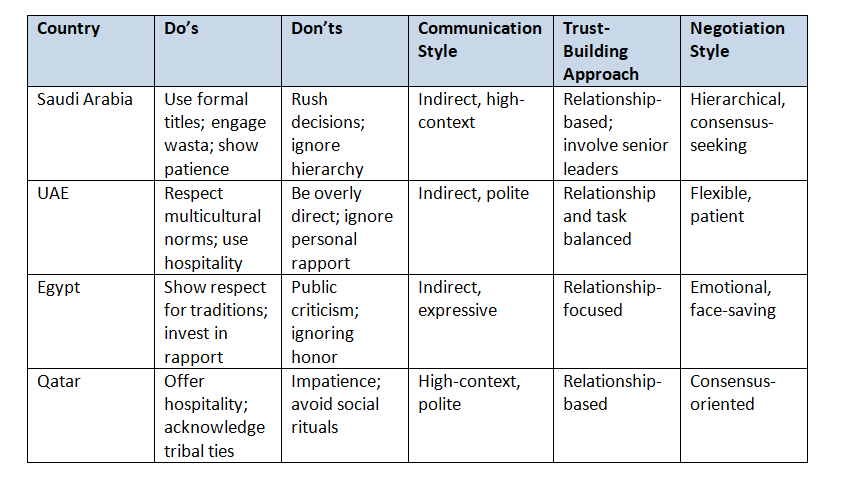
These nuanced country profiles help tailor approaches for maximum impact.
Advanced Strategies
Managing interpreters effectively is critical—choose culturally aware interpreters who understand negotiation dynamics and can convey subtlety. Build guanxi-like wasta networks by leveraging introductions from trusted mutual contacts. Navigate hierarchy by engaging decision-makers early and respecting their authority publicly while consulting influencers privately. Adapt persuasion styles by combining logical arguments with appeals to honor and family reputation. Read non-verbal signals such as prolonged eye contact, gestures, and proxemics, which carry meaning in Middle Eastern cultures.
Scripts and Templates
Script 1: Initial Meeting Request - Saudi Arabia
“Dear Mr. Al-Faisal, I hope this message finds you well. I would be honored to arrange a meeting at your convenience to discuss potential collaboration opportunities. I value the chance to build a strong relationship based on mutual trust and respect. Please let me know a suitable time. With highest regards, [Your Name]”
Script 2: Same Message - Germany
“Dear Mr. Müller, I would like to schedule a meeting to discuss potential cooperation. Please advise on your available times. Best regards, [Your Name]”
Script 3: Same Message - Brazil
“Olá Sr. Silva, Espero que esteja bem. Gostaria muito de conversar sobre oportunidades de parceria. Fico à disposição para agendar um encontro no melhor horário para você. Um abraço, [Seu Nome]”
Script 4: Same Message - United States
“Hi John, I’m reaching out to set up a meeting to explore potential partnership opportunities. Let me know when you’re available. Best, [Your Name]”
Script 5: Polite Refusal - Egyptian Business Partner
“Thank you very much for your kind proposal. We will need some time to carefully consider all aspects before moving forward. We appreciate your understanding and look forward to continued dialogue.”
Frequently Asked Questions
Q1: How important is relationship-building in Middle Eastern negotiations compared to Western contexts?
Relationship-building is paramount in the Middle East, often preceding any substantive business discussion. Unlike Western task-based trust, Middle Eastern cultures rely on personal connections, reputation, and extended social interaction before formal deals proceed.
Q2: What role does hierarchy play in Middle Eastern business meetings?
Hierarchy is deeply embedded, with respect for seniority and authority critical. Decisions often come from top leaders or family heads, so it is vital to recognize rank and address the appropriate individuals with deference.
Q3: How can Western negotiators adapt to high-context communication?
Westerners should listen actively for implicit meaning, avoid blunt language, and be comfortable with ambiguity. Using indirect expressions and allowing time for relationship cues increases understanding and rapport.
Q4: What is wasta and how does it affect deal-making?
Wasta refers to social networks and influence used to facilitate business and social favors. Leveraging wasta through trusted intermediaries can open doors and smooth negotiations, but must be approached ethically.
Q5: How does time orientation impact scheduling and deadlines?
Middle Eastern cultures tend to be polychronic, focusing on relationships over rigid schedules. Flexibility, patience, and accommodating social rituals in timing are crucial for successful interactions.
Conclusion
Negotiating in the Middle East is a sophisticated exercise in cultural intelligence that transcends typical business acumen. The region’s unique combination of high power distance, collectivism, high-context communication, and relationship-centered trust demands that negotiators invest time in understanding invisible cultural scripts such as wasta, mianzi, and polychronic time. Successful deal-making is less about pushing contracts and more about building enduring relationships that honor hierarchy, respect face, and embrace patience. By mastering the cultural frameworks of Hofstede, Meyer, Lewis, Hall, Gesteland, Livermore, and Trompenaars, and applying the step-by-step preparation strategies and scripts outlined here, global executives can navigate this complex terrain with confidence and grace.
As international business continues to expand into the Middle East, your ability to decode cultural signals, adapt communication styles, and foster trust will not only safeguard deals but create lasting partnerships. Begin your journey today by integrating these insights into your negotiation playbook and experience the transformational power of true cultural intelligence in the Middle East.
References
· Hofstede, G. (2001). Culture's Consequences: Comparing Values, Behaviors, Institutions and Organizations Across Nations.
· Meyer, E. (2014). The Culture Map: Breaking Through the Invisible Boundaries of Global Business.
· Lewis, R. D. (2006). When Cultures Collide: Leading Across Cultures.
· Hall, E. T. (1976). Beyond Culture.
· Gesteland, R. R. (2012). Cross-Cultural Business Behavior: Marketing, Negotiating and Managing Across Cultures.
· Livermore, D. (2015). Leading with Cultural Intelligence.
· Trompenaars, F., & Hampden-Turner, C. (2012). Riding the Waves of Culture: Understanding Diversity in Global Business.