Negotiating Long-Term Supplier Contracts: A Complete Guide for Buyers and Sellers

Imagine a global electronics supplier losing a flagship contract with a Fortune 500 manufacturer after months of tense negotiation stalemates. The buyer, armed with extensive should-cost models and alternative sourcing options, squeezed margins ruthlessly, while the supplier failed to articulate value beyond price. The result? A lost contract, damaged reputation, and missed revenue streams. On the other side, the buyer faced supply risks and costly onboarding of a new supplier, disrupting production schedules.
This scenario underscores the high stakes inherent in negotiating long-term supplier contracts. These agreements often span multiple years, involve millions in spend, and shape the competitive advantage of both parties. Yet, many suppliers and buyers stumble due to asymmetries of information, misreading power dynamics, and neglecting total cost of ownership (TCO) considerations. Buyers may focus solely on price without strategic category management, while suppliers fail to leverage relationship capital or deploy effective BATNA strategies.
In this comprehensive guide, procurement managers, category leaders, CPOs, sales directors, and account managers will master actionable negotiation frameworks including the Kraljic Matrix, BATNA/ZOPA analysis, and should-cost modeling. You will gain step-by-step tactics tailored for both buyers and sellers, real-world case studies from industry titans like Toyota and Amazon, detailed counter-tactic response scripts, and advanced strategies for multi-year deal structuring and value-based positioning. Prepare to transform your approach to long-term supplier contract negotiations into a strategic advantage.
· Table of Contents
· The Strategic Landscape: How Procurement Really Works
· Key Frameworks and Models
· Step-by-Step Strategy for Buyers and Sellers
· Real-World Case Studies
· Tactics and Counter-Tactics Matrix
· Advanced Procurement Negotiation Strategies
· Scripts and Templates for Negotiation Scenarios
· Frequently Asked Questions
· Conclusion
· References
The Strategic Landscape: How Procurement Really Works
Understanding the strategic environment of procurement is essential before engaging in contract negotiations. Procurement is not merely a transactional function focused on price reduction; rather, it is a complex discipline involving supplier segmentation, category management, and alignment with broader business objectives.
Professional buyers operate under multiple incentives and KPIs: cost savings, supplier risk mitigation, innovation enablement, and ensuring supply continuity. These factors influence negotiation postures and tactics. For instance, leveraging the Kraljic Matrix allows buyers to segment suppliers into four quadrants—Strategic, Leverage, Bottleneck, and Non-Critical—each demanding a tailored approach.
Total Cost of Ownership (TCO) analysis extends beyond unit price to include logistics, quality, warranty, and service costs, enabling a holistic view of supplier value. Should-cost modeling empowers buyers to estimate a fair production cost baseline, anchoring negotiation targets and exposing inflated supplier pricing.
Supplier segmentation through category management ensures that procurement efforts and negotiation intensity correspond to the spend impact and supply risk. For example, strategic suppliers require partnership-oriented negotiation focused on long-term value and innovation, whereas leverage suppliers may be driven by competitive bidding and price pressure.
Understanding buyer psychology is critical. Behavioral economics, particularly Kahneman’s loss aversion theory, shows buyers fear potential supply disruption (loss) more than they value potential savings (gain). This often results in risk-averse behavior during negotiations, which suppliers can strategically address.
In summary, successful negotiation on long-term contracts requires a deep understanding of procurement’s strategic landscape: aligning negotiation objectives with supplier segmentation, employing TCO and should-cost insights, and anticipating buyer behavioral drivers.
Key Frameworks and Models
Procurement negotiations are underpinned by several foundational frameworks that guide decision making and strategy formulation. Three essential models include the Kraljic Matrix for supplier segmentation, TCO vs Price analysis for cost assessment, and BATNA (Best Alternative to a Negotiated Agreement)/ZOPA (Zone of Possible Agreement) for negotiation leverage.
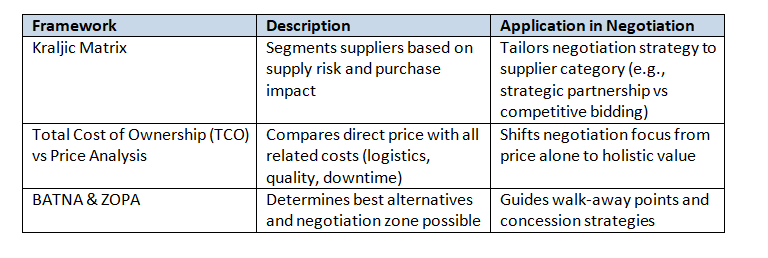
The Kraljic Matrix divides suppliers into:
- Strategic: High impact and high supply risk – partnership and collaboration focused
- Leverage: High impact but low supply risk – competitive bidding and volume consolidation
- Bottleneck: Low impact but high supply risk – risk mitigation and contingency planning
- Non-Critical: Low impact and low supply risk – process efficiency and transactional management
TCO frameworks prevent price fixation by incorporating hidden costs such as quality failures, inventory holding, and after-sales service. For example, Boeing’s supplier disputes often centered on failure to account for quality cost impacts versus initial price savings.
BATNA and ZOPA are negotiation concepts borrowed from game theory. BATNA represents the best alternative if negotiations fail, while ZOPA is the overlap zone where both parties can find agreement. Understanding these helps buyers and sellers set realistic targets and avoid costly deadlocks.
Step-by-Step Strategy
This section breaks down the negotiation process into six detailed steps, presenting tactics and exact communication scripts from both buyer and seller perspectives.
Step 1: Preparation and Research
Buyer: Conduct comprehensive category analysis using Kraljic segmentation and TCO modeling. Identify your BATNA by assessing alternative suppliers and internal substitution options.
Seller: Analyze buyer’s procurement triggers, review historical pricing and contract terms, and prepare should-cost arguments highlighting your unique value proposition.
Step 2: Initial Engagement and Relationship Building
Buyer script: “We value your partnership and seek to align on a contract that ensures mutual growth and stability over the next three years.”
Seller script: “Thank you for the opportunity. Our goal is to deliver not only competitive pricing but also innovation and reliability that supports your business objectives.”
Step 3: Proposal Exchange and Anchoring
Buyer: Present initial RFP with clear requirements including quality, delivery, and service KPIs. Anchor price expectations based on should-cost data.
Seller: Provide a detailed proposal emphasizing total value, including quality improvements and risk mitigation, not just price.
Step 4: Negotiation and Concession Management
Buyer tactic: Use objective criteria to justify pricing requests, e.g., “Our should-cost model indicates that a 5% price reduction is feasible considering raw material trends.”
Seller tactic: Counter with value-based arguments, “While price is important, our enhanced service reduces downtime costs by 10%, which offsets the slight premium.”
Step 5: Closing and Contract Finalization
Buyer script: “We appreciate your flexibility. Let’s document agreed terms including performance metrics and penalties to ensure accountability.”
Seller script: “We accept these terms and look forward to a collaborative partnership that drives continuous improvement.”
Step 6: Post-Contract Relationship Management
Buyer: Monitor supplier performance against agreed KPIs and provide feedback. Maintain open communication channels to preempt risks.
Seller: Proactively report innovations and cost-saving opportunities to reinforce partnership value and justify contract renewals.
Real-World Case Studies
Toyota’s Supplier Partnership Model
Toyota revolutionized procurement by developing long-term partnerships with suppliers through the Toyota Production System (TPS). Its approach emphasizes transparency, shared risk, and continuous improvement. Toyota’s suppliers are integrated into early design phases, reducing supply risk and enabling cost efficiencies over contract lifecycles. The strategic lesson: collaboration and information sharing enhance negotiation outcomes beyond price battles.
Amazon’s Vendor Negotiations
Amazon exerts immense buyer power due to volume and market dominance. It employs aggressive squeeze tactics including strict performance monitoring, penalty clauses, and frequent renegotiation to drive down costs. Suppliers often accept thin margins for access to Amazon’s platform. This case highlights the importance of supplier BATNA and diversification to maintain leverage.
Boeing’s Supply Chain Disputes
Boeing’s 787 Dreamliner program suffered supply chain disruptions due to overly aggressive sourcing and contract terms that underestimated complexity. Overreliance on unintegrated suppliers led to delays and cost overruns. The lesson: procurement must balance cost with supply risk and invest in supplier capability development.
Tactics and Counter-Tactics
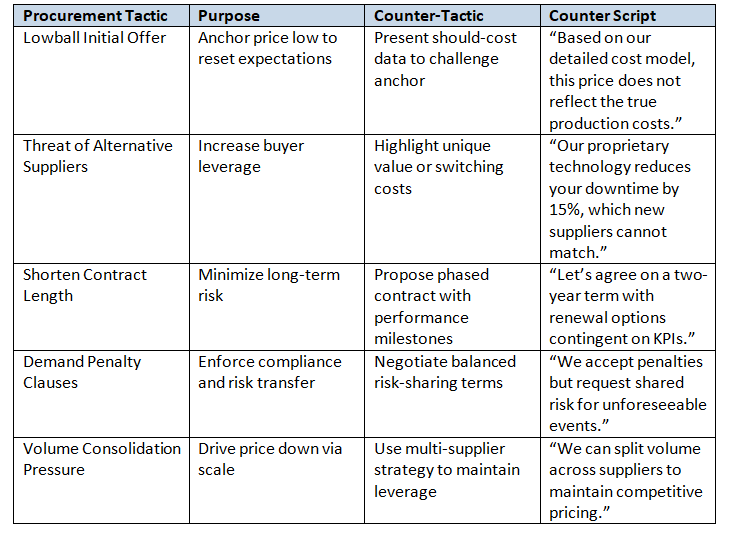
Advanced Strategies
Relationship Leverage: Develop cross-functional connections within the buyer’s organization to build influence beyond procurement. Engaging engineering or quality teams can support supplier value positioning.
Multi-Year Deal Structuring: Use tiered pricing tied to volume growth or innovation milestones to align incentives and manage risk over contract duration.
Value-Based Positioning: Shift negotiation dialogue from price to business outcomes, such as reducing time-to-market, improving product quality, or enabling sustainability goals.
Lean Procurement: Implement continuous improvement loops in contracts, encouraging suppliers to eliminate waste and improve efficiency collaboratively.
Economic Price Adjustment Clauses: Incorporate inflation or commodity price indexation to share market volatility risks fairly.
Scripts and Templates
Script 1: Buyer Initial Contract Proposal Email
“Dear [Supplier Name],
We appreciate our ongoing collaboration and are keen to formalize a long-term agreement that supports mutual growth. Attached is our RFP detailing volume forecasts, quality expectations, and delivery schedules. Our target pricing range is informed by thorough market and should-cost analysis.
We look forward to your detailed proposal by [date] and to a constructive negotiation process.
Best regards,
Script 2: Seller Proposal Cover Letter
“Dear [Buyer Name],
Thank you for sharing your RFP. Enclosed is our proposal offering competitive pricing coupled with enhanced service levels and quality guarantees. Our value-engineered solutions aim to reduce your total cost of ownership and support your strategic objectives.
Please let us know a convenient time for follow-up discussions.
Best regards,
Script 3: Buyer Negotiation Concession Request
“After reviewing your proposal, we believe a price adjustment of 4% is justified considering current raw material trends and our internal cost models. We are committed to this partnership and open to discussing how we can jointly realize efficiency gains.”
Script 4: Seller Counter-Concession Email
“We appreciate your feedback. To accommodate your pricing expectations, we propose a 3% reduction paired with a commitment to introduce a process improvement initiative that will further reduce your operational costs.”
Script 5: Contract Closure Confirmation
“Dear [Supplier Name],
Thank you for your collaboration throughout the negotiation process. We confirm acceptance of the terms outlined in the attached contract, including volume commitments, pricing schedules, and performance metrics.
We look forward to a successful partnership.
Best regards,
Frequently Asked Questions
Q1: How can buyers accurately calculate the total cost of ownership in long-term contracts?
A1: Buyers should include purchase price, logistics, quality defects, inventory carrying costs, service levels, and end-of-life disposal costs. Using should-cost modeling and cross-functional inputs from finance, operations, and quality teams enhances accuracy.
Q2: What is the best way for suppliers to improve negotiation leverage against powerful buyers like Amazon or Walmart?
A2: Suppliers should diversify their customer base, demonstrate unique value propositions (e.g., proprietary technology, superior quality), and build strategic relationships beyond procurement teams to create demand pull.
Q3: How do BATNA and ZOPA influence contract negotiation outcomes?
A3: BATNA defines the fallback if negotiations fail, providing a walk-away threshold. ZOPA is the range within which both parties can agree. Knowing both prevents unrealistic demands and fosters efficient deal closure.
Q4: What role does behavioral economics play in procurement negotiations?
A4: Concepts like loss aversion explain why buyers may resist change due to fear of supply disruption. Recognizing these biases helps suppliers frame proposals to reduce perceived risk and increase acceptance.
Q5: How can multi-year contracts be structured to balance flexibility with commitment?
A5: Including renewal options, performance-based pricing tiers, and economic adjustment clauses allows contracts to adapt to market changes while providing stability for both parties.
Conclusion
Negotiating long-term supplier contracts is a strategic endeavor that requires a deep appreciation of procurement’s complexities, buyer psychology, and structured frameworks like the Kraljic Matrix and BATNA analysis. Both buyers and sellers benefit when negotiations transcend price battles and focus on total cost of ownership, value creation, and partnership development.
By adopting the step-by-step strategies, deploying robust negotiation scripts, and learning from real-world exemplars such as Toyota’s collaborative supplier model or Amazon’s leverage tactics, procurement professionals can transform contract negotiations into a source of sustained competitive advantage. Begin applying these insights today to build resilient, profitable, and mutually beneficial supplier relationships.
References
1. Kraljic, P. (1983). Purchasing Must Become Supply Management. Harvard Business Review.
2. Kahneman, D. (2011). Thinking, Fast and Slow. Farrar, Straus and Giroux.
3. Porter, M. E. (1980). Competitive Strategy: Techniques for Analyzing Industries and Competitors. Free Press.
4. Williamson, O. E. (1985). The Economic Institutions of Capitalism. Free Press.
5. Monczka, R. M., Handfield, R. B., Giunipero, L. C., & Patterson, J. L. (2015). Purchasing and Supply Chain Management. Cengage Learning.
6. Harland, C., Zheng, J., Johnsen, T., & Lamming, R. (1999). An Operational Model for Managing Supplier Relationships. European Journal of Purchasing & Supply Management.